Indemnification in a clinical trial agreement is the promise by one party to carry the other's losses when a third party — almost always a trial participant or their family — brings a claim arising out of the trial. In a sponsor's template it runs one way: the sponsor indemnifies the institution, the investigator and their staff against claims for bodily injury caused by the investigational product or by conduct of the trial in accordance with the protocol, and it stops short of anything the institution itself did wrong. The hard part is not writing that sentence. It is that the sentence has five recognisable places where a site will push, and a contracting team that has not decided its answer in advance sends all five to a lawyer. Botminds' Clinical Trial Agreement Negotiation places each of the five against the sponsor's own position ladder and escalates only what has no approved answer, with the walk-away line quoted and a recommendation attached.
The worked examples are fictional sample data: the sponsor Northwind Bio, the site Marlowe University Hospital and its negotiator Rachel Kim, the contracts manager Priya Raman and the legal counsel Omar Haddad, on round two of a Phase 3 agreement. The regulations and the harmonised guideline are real and linked where they appear.
One 19-change round, and how much of it was really a legal question
19
tracked changes in the site’s round 2 redline, across 22 pages
17
settled at a position the contracting team had already approved
2
had no approved position and went to the named legal owner
Both
of the two were edits to the indemnity clause
What does indemnification mean in a clinical trial agreement?
Indemnification means that if someone outside the agreement sues, one of the two parties pays — the loss, the settlement, and usually the cost of defending it. It is not the same as liability. Liability is what a court would decide between a claimant and a defendant. Indemnity is a private reallocation of that outcome between the sponsor and the institution, agreed in advance, which is why its wording can be argued over for weeks by people who will probably never see a claim.
It is also not the same as subject injury compensation, although the two clauses sit together and sites edit them together. Subject injury is a promise to a participant about their medical care and their losses, usually without anyone having to prove fault. Indemnity is a promise between two organisations about who ends up out of pocket. Who pays for a trial injury, and what the consent form must say covers that other clause; a site can be fully covered on injury and still refuse to sign the indemnity.
Three features make the indemnity in a site agreement different from a commercial one. The claimant is a person who was harmed while helping to develop a medicine, which makes a hard liability cap politically difficult for both sides. The institution is often a public body or a charity whose insurer will not stand behind an open-ended obligation. And the sponsor retains the regulatory responsibility whatever the contract says: ICH E6(R3) lets the sponsor transfer, and the investigator delegate, the work itself, but each keeps overall responsibility for what was handed on (ICH E6(R3), principle 10.1). An indemnity moves money. It does not move answerability.
The sponsor's standard indemnity, and what it already covers
Before reading a redline it is worth being clear about what the unedited clause already gives the site, because much of what a site asks for is in the template already and the ask is a sign that the site's counsel has not read it against their own checklist. A typical sponsor indemnity covers third-party claims for bodily injury or death arising from the administration of the investigational product; from a procedure required by the protocol that the participant would not otherwise have undergone; and from the sponsor's own negligence. It names the institution, the investigator and the institution's employees as covered persons. It carries a duty to defend, or at least to pay defence costs, and it survives termination of the agreement.
What it excludes is equally standard: claims arising from the institution's own negligence or wilful misconduct, and claims arising from a material departure from the protocol or from the sponsor's written instructions. Those two exclusions are the whole argument. Everything below is a site trying to narrow one of them.
The indemnity ladder Clinical Trial Agreement Negotiation reads, written before the first redline
| Position | The wording the sponsor will hold | When it is used |
|---|---|---|
| Preferred | Sponsor indemnifies the institution, the investigator and their staff for third-party bodily-injury claims arising from the investigational product or from protocol-required procedures, excluding the institution’s negligence or wilful misconduct and excluding material protocol deviations. | The template. Opens every negotiation. |
| Fallback 1 | The protocol-deviation exclusion is kept, but does not apply to a deviation made to protect a participant’s safety. | Where the site argues its clinicians must be free to act in an emergency. A reasonable ask, and cheap to concede. |
| Fallback 2 | Mutual indemnity: each party indemnifies the other for claims arising from its own negligence or wilful misconduct, with the sponsor’s product indemnity unchanged. | Where the institution’s policy requires reciprocity. Concedes symmetry, not substance. |
| Walk-away | The sponsor never indemnifies the institution for the institution’s own negligence or misconduct, and never accepts uncapped consequential damages. | The line. A redline that crosses it is a decision for the legal owner, not a negotiation. |
Move one: deleting the protocol-deviation carve-out
The first move is a straight deletion. The site strikes the words that exclude claims arising from a material protocol deviation, so that the sponsor's indemnity holds even where the site departed from the protocol that the indemnity was written around. Sites rarely argue this as a risk transfer. They argue it as clinical freedom: a physician who protects a participant in the moment should not discover afterwards that the act voided the site's cover.
That argument is right about the case it describes and wrong about the clause it edits. A deletion covers an emergency deviation, and it also covers a site that enrolled an ineligible participant, missed a required safety assessment or dosed outside the window. The answer that satisfies the real concern without the rest is to keep the exclusion and carve out the emergency: the exclusion does not apply to a deviation made to protect the safety of a participant. In the sample agreement that is Fallback 1, and it is also the exact wording the same institution signed with the same sponsor in a 2024 study — which is why the counter drafted for this round is not a compromise but a quotation.
Move two: 'solely' and 'gross' — two words that move the whole risk
The second move is the one worth reading every agreement for, because it is two words long and both look editorial. The site inserts "solely" into the trigger, so the sponsor indemnifies only claims caused solely by the investigational product; and "gross" into the exclusion, so the sponsor's carve-out shrinks to the institution's gross negligence and wilful misconduct.
Together they invert the clause. Almost no claim arising from a trial has a single cause — a participant harmed by a drug reaction that a site then managed badly has two — so "solely" removes the indemnity from exactly the cases where it would ever be called on. And "gross" leaves the sponsor paying for the institution's ordinary negligence, which is the common kind. The sponsor is now insuring the site's clinical practice. In the sample round these two insertions arrive in one change to §9.2, and that single change is the reason the agreement reaches a lawyer at all.
The counter is not a counter-draft so much as a restatement: the trigger is claims "arising from" or "attributable to" the product or a protocol-required procedure, and the exclusion is the institution's negligence, full stop. A sponsor that has written that as a walk-away position does not need a meeting to answer it.
Should a sponsor accept mutual indemnification?
Usually yes, and it costs less than it sounds. Mutual indemnification means each party indemnifies the other for claims arising from its own negligence or wilful misconduct. Institutions ask for it because their own policies require reciprocity in contracts, and because a one-way indemnity reads to a research administrator as a statement about who is trusted.
What a sponsor gives up by agreeing is small. A one-way clause that already excludes the institution's negligence has, in substance, allocated that risk to the institution; a mutual clause says the same thing in the active voice and adds a defence obligation running the other way. What a sponsor must not do is let mutuality become symmetry of the product indemnity. The sponsor's cover for harm caused by its own investigational product is not a favour to be matched; it is the price of asking a site to administer an unlicensed medicine. In the sample playbook mutual indemnity, each party for its own negligence, sits at Fallback 2 with the product indemnity explicitly unchanged.
The five moves a site makes on indemnity, and the answer written down in advance
What the site asks for, and why: Strike the exclusion for claims arising from a material protocol deviation. Argued as clinical freedom in an emergency.
The sponsor’s approved answer: Keep the exclusion; carve out deviations made to protect a participant’s safety. Fallback 1 — and in the sample round, wording this institution already signed.
What the site asks for, and why: Indemnify only harm caused solely by the product; exclude only the institution’s gross negligence.
The sponsor’s approved answer: Refuse both. This is the walk-away: it would leave the sponsor paying for the institution’s ordinary negligence. Decided by the legal owner, not by a counter-draft.
What the site asks for, and why: Each party indemnifies the other for its own negligence and wilful misconduct. Often an institutional policy requirement.
The sponsor’s approved answer: Accept at Fallback 2, with the product indemnity unchanged. Symmetry of fault, not symmetry of product risk.
What the site asks for, and why: A money cap on the sponsor’s obligation, or an exclusion of indirect and consequential loss on both sides.
The sponsor’s approved answer: A mutual exclusion of consequential loss is answerable; an uncapped consequential exposure is not, and a cap on the bodily-injury indemnity is a legal decision every time.
What the site asks for, and why: Additional-insured status on the sponsor’s policy, rather than a certificate of insurance.
The sponsor’s approved answer: Accept the limit asked for — in the sample round $10M per occurrence — and offer a certificate of insurance instead. Fallback 1; the cover is the same, the administration is not.
Move four: caps, consequential damages and the walk-away line
The fourth move asks for a number. Sometimes it is a mutual exclusion of indirect, special and consequential damages, which most sponsors can live with and which protects both sides from a claim for lost profits or lost research funding. Sometimes it is a cap — the sponsor's total liability limited to the value of the budget, or to a stated sum.
The two should never be answered together. A consequential-damages exclusion removes a category of loss that nobody intended to cover. A cap removes part of a bodily-injury obligation, and the part it removes is the tail: the catastrophic single claim that is the only reason the clause exists. A cap set at the value of a site budget is, on a serious injury, no indemnity at all. The sample playbook's walk-away covers both ends of this — never uncapped consequential damages, and never the institution's own negligence — which leaves a mutual exclusion of consequential loss as the answerable middle and sends a proposed money cap on the injury indemnity to the legal owner each time.
Move five: certificate of insurance or additional insured
The last move is administrative and the easiest to concede in the wrong direction. A site asks to be named as an additional insured on the sponsor's clinical trial policy. It sounds equivalent to a certificate of insurance and it is not. A certificate evidences cover; additional-insured status makes the institution a party to the sponsor's policy, which brings the sponsor's insurer into the site's own notification and claims-handling arrangements, can affect the sponsor's aggregate across hundreds of sites, and usually needs the insurer's agreement rather than the contracting team's.
The practical answer is to agree the limit and refuse the mechanism. In the sample round the site asked for $10M per occurrence and additional-insured status; the drafted counter accepts the limit and offers a certificate of insurance naming the study. An institution will often accept that, because what its risk office usually needs is evidence that the cover exists at the level stated.
Where a country publishes a model agreement the whole question disappears, because the indemnity and the insurance schedule are part of text the parties may not alter — which is why the UK model agreement and four other countries have to be handled by a rule applied before any clause is classified, and not by this ladder at all (UK Health Research Authority).
What no agreement can contract around
However the two organisations allocate risk between themselves, neither can pass the result to the participant through the consent form. United States regulation is explicit.
No informed consent, whether oral or written, may include any exculpatory language through which the subject or the representative is made to waive or appear to waive any of the subject's legal rights, or releases or appears to release the investigator, the sponsor, the institution, or its agents from liability for negligence.
21 CFR 50.20, general requirements for informed consent
That rule governs the consent form rather than the contract, and the distinction matters when a site's counsel invokes it against an indemnity clause, which happens. The right reading is narrower and more useful: the parties may agree between themselves who bears a loss, and they may not write the participant's rights away in the document the participant signs. A sponsor that concedes an indemnity position on the strength of a misquoted rule has given something away for nothing; a sponsor that lets contract wording leak into a consent form has created a finding for an inspector.
The second thing no clause moves is responsibility for the trial itself. ICH E6(R3) puts the roles and responsibilities of the parties in the agreement and expects the document to define them clearly — but defining who performs an activity is not the same as deciding who answers for it, and no allocation of indemnity changes which party the regulator will ask.
How an indemnity redline is answered in a single round
In the sample study, round two of the Marlowe agreement contains two §9 edits. Section 9.1 deletes the protocol-deviation carve-out. Section 9.2 adds "solely" and "gross". Neither sits on an approved position, so both leave the contracts manager's hands and reach the named legal owner — with the clause, the site's own text and margin comment, the playbook's walk-away line quoted, and a recommendation.
The two indemnity edits as Clinical Trial Agreement Negotiation routes them
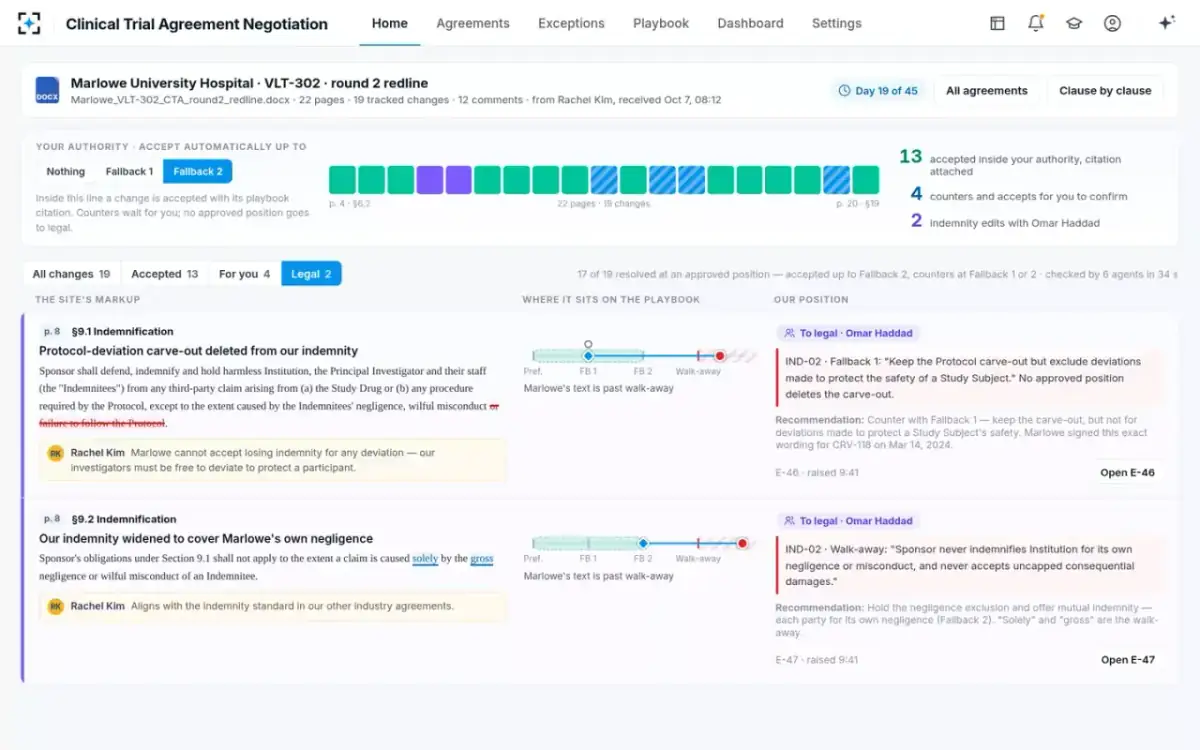
What the legal owner receives is the difference that makes a four-day turnaround possible. Not a 22-page Word file with an instruction to review it, but one clause at a time: the site's ask, the position the sponsor holds, the precedent if there is one, and three decisions to pick from — approve the recommendation, hold the sponsor's position, or approve the site's text. Each decision is kept with the name of the person who made it and the date and time.
What reaches a lawyer, before and after the clause families are written down
Round 2 as it used to arrive in the legal queue
- Changes that needed a legal decision · 11%
- Changes already answerable from an approved position · 89%
Round 2 as it arrives once the ladder exists
- Changes that needed a legal decision · 100%
One indemnity clause across three rounds, and who held the pen at each stage
- Template out2 d
- Site’s first deletion14 d
- Sponsor counters at Fallback 13 d
- Site counsel reviews9 d
- Accepted as the 2024 wording2 d
- Template out2 d
- Site’s insertion14 d
- Legal owner decides4 d
- Position held, mutual indemnity offered3 d
- With the site’s risk office7 d
What belongs in a lawyer's queue, and what does not
The test is not how serious the clause family sounds. It is whether the organisation has already decided its answer. A publication review window is trivial and a sponsor still has to decide whether 45 days is acceptable — once. An indemnity trigger is grave and, once the walk-away is written, most edits to it are answerable without a lawyer because they fall inside or outside a line already drawn.
Three things therefore belong in a legal queue: a change with no approved position at any rung; a change past the walk-away; and a clause the site has refused twice, where the question has stopped being about wording and become a decision about whether to keep this site. Everything else is a position the contracting team owns, and sending it to a lawyer is not caution — it is a week.
A legal owner’s queue: the clause, the ask, the walk-away and a decision
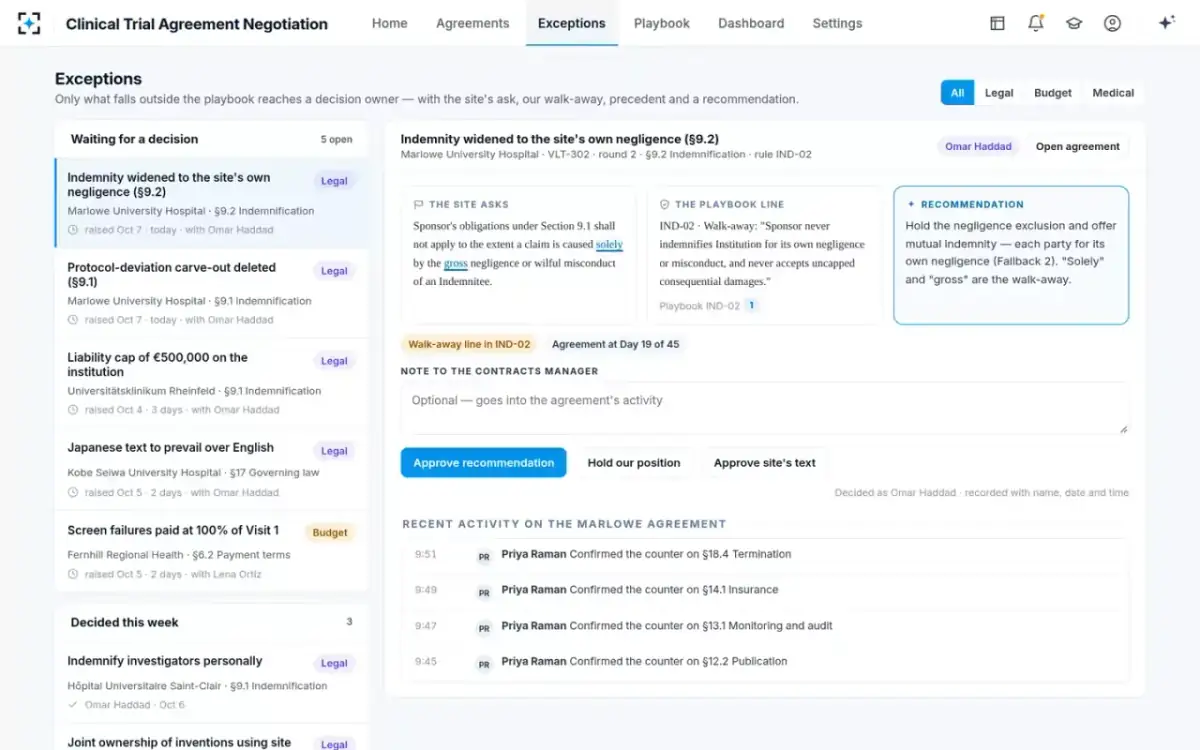
Written down this way, the indemnity clause stops being the reason an agreement is late. In the sample round it accounted for 2 changes of 19 and 4 days of a 45-day target, and the other 17 changes never queued behind it. For the wider shape of the document those 17 changes come from, the ten clause families of a clinical trial agreement sets out who owns each. To see an indemnity edit routed with its walk-away quoted, start from Clinical Trial Agreement Negotiation.
Questions people ask
Who indemnifies whom in a clinical trial agreement?
In the ordinary case the sponsor indemnifies the institution, the investigator and their staff against third-party claims for bodily injury arising from the investigational product or from a protocol-required procedure. The indemnity stops at the institution's own negligence and wilful misconduct, and usually at material protocol deviations. Where the clause is made mutual, the institution gives the sponsor the same promise for claims arising from the institution's own fault.
Can a site make the sponsor cover the site's own negligence?
It can ask, and the ask is usually disguised rather than stated: inserting "gross" before "negligence" in the sponsor's exclusion leaves the sponsor paying for the institution's ordinary negligence, which is the common kind. Most sponsors treat this as a walk-away position rather than a fallback, because it converts a product indemnity into insurance for another organisation's clinical practice.
What is a liability cap in a clinical trial agreement?
A ceiling on what one party can owe the other, often proposed at the value of the site budget or a stated sum. A mutual exclusion of indirect and consequential loss is a different thing and much easier to agree. A cap on a bodily-injury indemnity removes the catastrophic single claim the clause exists for, so it is worth treating as a decision for a lawyer every time rather than a number to be split.
Does the sponsor indemnify the investigator personally?
Usually yes, where the investigator is acting within the protocol and within their employment. The covered-persons list in most templates names the institution, the investigator and the institution's employees and agents. Investigators ask because they often sign the agreement in their own name as an acknowledging party, which creates a personal obligation to conduct the trial in accordance with the protocol.
What insurance does a sponsor have to carry for a trial?
The level is set by the law of the country, the ethics committee or the agreement rather than by one global rule, and in the European Union and the United Kingdom insurance arrangements are reviewed as part of the trial authorisation. ICH E6(R3) section 3.14.1 says that where the applicable rules require it, the sponsor should insure or indemnify the investigator and institution against claims arising from the trial, except claims arising from malpractice or negligence. A limit of several million per occurrence is a common institutional ask.
Is indemnification the same as subject injury compensation?
No. Subject injury is a promise about a participant's treatment and losses, often payable without proving that anyone was at fault, and it has to match what the participant was told in the consent form. Indemnity is a promise between the sponsor and the institution about who bears a third-party claim. A site can be satisfied on one and still refuse the other, and in practice it often is.