The clinical study report signature page is appendix 16.1.5 of the report, and ICH E3 asks for very few signatures on it. A clinical study report (CSR) is the document that tells regulators what a trial found. Where regulators require them, the principal or coordinating investigators sign in appendix 16.1.5; where they do not, the sponsor's responsible medical officer signs there instead, and the report must name its authors, "including the responsible biostatistician(s)". The rest of the approval is set by the sponsor, and the work belongs to five people: the lead medical writer, the biostatistics lead, the statistical programmer, the medical monitor and the clinical lead. Botminds' Clinical Study Report Authoring keeps all five, and changes what their weeks hold.
The hard part is the handoffs between them. One person writes the words, others own the numbers, and a table re-run after database lock can quietly invalidate a sentence someone has already signed. The solution is AI software for CSR writing built around that problem: agents draft the report from the locked tables, listings and figures (TLFs), link every number to its source cell, and trace each re-run to the sentences it changes. It moves their weeks away from transcribing and re-checking, toward the judgment their signatures stand for.
One signature page, many rounds of review
16.1.5
the appendix where ICH E3 places the report’s signature
2.6cycles
mean review rounds per report, ranging from 1 to 5
25.7days
mean working days from first draft to final report
Who signs a clinical study report under ICH E3?
ICH E3 asks for one signature, by the investigator or the sponsor's medical officer, and named authors; the sponsor adds its own approvals for each part of the report. ICH E6(R3), adopted in January 2025, adds that where a coordinating investigator is involved, "consideration should be given to them being a signatory". Everything else is internal approval, and it follows who owns the content.
The medical writer drafts the text. In EMWA's description of the work, "the text part, written by the medical writer, comprises Sections 1–13 and Section 15"; Section 14 holds the statistical output and the narratives. So the person who writes most of the words owns almost none of the numbers in them. That split, words with one person and numbers with another, is where a report's friction starts.
In an electronic system, each of these approvals is a signature with a stated purpose. 21 CFR Part 11 requires a signed electronic document to show the signer's name, the date and time, and "the meaning (such as review, approval, responsibility, or authorship)". A biostatistician approving Section 11 is attesting to something different from a clinical lead approving the whole report, and the map below shows who attests to what.
Who signs which part of the report
What is appendix 16.1.5, and what does the signature page say?
Appendix 16.1.5 is the CSR's signature page: one sheet, modelled on the sample form in Annex II of ICH E3, on which an investigator or the sponsor's responsible medical officer confirms that the report is accurate. The form carries the study title, the study authors, a single sentence of attestation, the signer's name, affiliation and signature, and a date. The sentence is the whole of what the signer attests: "I have read this report and confirm that to the best of my knowledge it accurately describes the conduct and results of the study."
Read closely, that sentence attests accuracy, not authorship. The signer need not have written a word, and the people who did need not sign. Raquel Billiones, writing on authorship in EMWA's journal in 2016, puts it plainly: "the authors and the signatories of a CSR are not necessarily the same people", and "the minimum requirement is for the sponsor's responsible medical officer to sign off on the document."
What the ICH E3 signature page carries, and who supplies each line
| Line on the form | What it records | Usually supplied by |
|---|---|---|
| Study title | The study the attestation covers | Medical writer, from the protocol |
| Study author(s) | Who is credited with the report; E3 elsewhere asks that the responsible biostatistician be named | Sponsor policy; often the writer and biostatistician |
| Attestation | "I have read this report and confirm that to the best of my knowledge it accurately describes the conduct and results of the study" | Fixed text from Annex II |
| Investigator or sponsor's responsible medical officer | The person attesting, depending on the regulator's requirement | The coordinating investigator for multicentre EU studies; otherwise the sponsor's medical officer |
| Affiliation, signature, date | Who the signer is and when they signed | The signer |
Does the coordinating investigator have to sign the CSR in the EU?
Yes, for reports in a European marketing authorisation application: EU law has long required an investigator's signature, and for multicentre studies that of the coordinating investigator. The EMA's note for guidance on coordinating investigator signature, in operation since April 2002, restates the rule: "Each Clinical Study Report submitted as part of a Marketing Authorisation Application, or any variation, extension, specific obligation or follow-up measure to one, should be signed by the investigator or in the case of multicentre studies the co-ordinating investigator."
The note's one piece of guidance is about timing: "The co-ordinating investigator or the process of designating the signatory co-ordinating investigator should be defined in the protocol agreed for the study." That is practical advice for the schedule as much as for compliance. The coordinating investigator is usually outside the sponsor, signs on paper or in another organisation's system, which often makes it the hardest signature to schedule; naming that person in the protocol means the signing date can be booked before lock rather than chased after it.
Where no regulator asks for an investigator's signature, E3 falls back to the sponsor's responsible medical officer, typically the clinical lead or a senior physician in clinical development. A global report destined for several regions often carries both, so one page serves every submission.
Why CSR timelines slip: the handoffs between owners
CSR timelines slip in the handoffs, because a number changed after lock has to travel back through every person who passed it on. A value in Section 11 has passed through three pairs of hands before a reviewer reads it: the programmer who produced the table, the biostatistician who released it, and the writer who copied it into a sentence. Nobody on that chain holds a list of the sentences that quote the cell.
EMWA's conference data put the cost bluntly: "Draft data changes in the final TFLs will mandate changes in the CSR." Each review round repeats the problem, because every reviewer re-checks numbers they did not produce. The chain below is the same re-run handled by the solution, with the mechanical steps done by agents and every decision left with a person.
A re-run in Clinical Study Report Authoring, from programming QC to a new signature
A person decides
Statistical programmerIndependent QC finds a derivation error; the affected outputs are re-run and delivered.
Agent
Output readerReads the new delivery into cells, each with its row, column, population and program run.
Never: rounds or reformats a value
Agent
Number verifierCompares the delivery with the last, cell by cell, and flags every sentence that quotes a changed cell.
Never: lets a mismatched section be approved
A person decides
Lead medical writerReviews each old and new value, and updates the flagged sentences in one step.
A person decides
Biostatistics leadSigns again only the sections whose numbers changed.
The lead medical writer: from copying numbers to editing a cited draft
With agents, the medical writer stops copying numbers into prose and starts editing a draft in which every number is already cited. Drafting a results section by hand is transcription first and writing second, and it is where errors start: as a QC specialist writing in EMWA's journal puts it, "it is extremely easy to add incorrect data to tables when working with source tables that are over a hundred pages long".
Take a sample study, VLT-302, as it runs through the solution: a fictional Phase 3 psoriasis trial with 642 participants. The results writer drafts eight results sections quoting 79 numbers, and every one of them is a link to the cell it came from. When the writer clicks 62.4%, Table 14.2.1.1 opens beside the text at row "PASI 75 responders", column "Veltrimab 150 mg (N=428)", with the dataset, program and run time underneath.
Clinical Study Report Authoring, the writer's view: a number and its cell
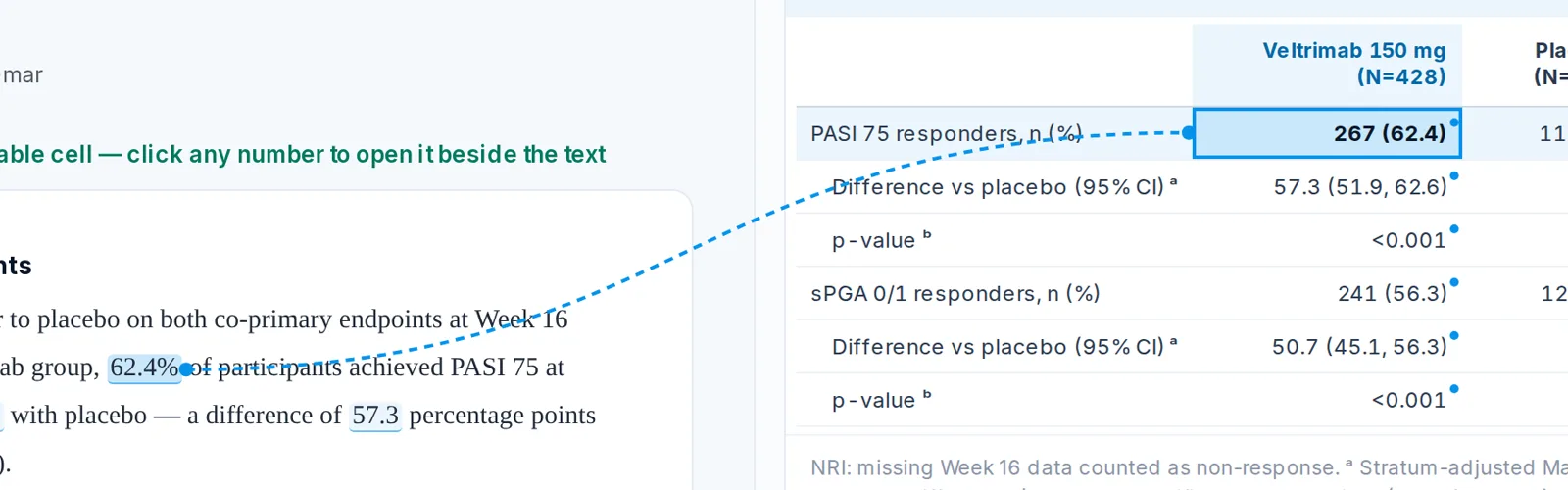
The dashed line runs from the number in the sentence to the exact row and column it was quoted from.
In the solution's full build, the model never types a number at all. It places a reference to a cell, the system renders the value from the delivered output, and a bare numeral the model writes is refused. That changes what the writer reads for. The question is no longer whether 62.4 is right; it is whether the sentence says what the table supports.
That is where AI drafts still go wrong. In Pfizer's blinded test of AI-drafted pharmacokinetic report sections, experts scored the drafts at about 90% of the manually written reports. Besides formatting slips, the errors were "semantic miscalibrations" and "contextual inaccuracies", such as calling a 9% decrease in Cmax "moderate" instead of "small". Catching that is a writer's skill, and the cited draft leaves time for it.
By our estimate, review becomes half of what is left
By hand · 16.5 weeks
- Copying, drafting, narratives and checking, 14.5 wk · 88%
- Review rounds, 2 wk · 12%
With the solution · 2.8 weeks
- Copying, drafting, narratives and checking, 1.4 wk · 50%
- Review rounds, 1.4 wk · 50%
The biostatistics lead: "which sentences did my re-run break?"
The biostatistics lead now gets a list of exactly which sentences a re-run changed, and signs again only the sections they sit in. E3 names the responsible biostatistician as an author, and in the solution's default sign-off the efficacy sections are approved by biostatistics. That makes every re-run a personal problem: the statistician knows exactly which cells moved and has no way to see which sentences quote them, short of re-reading the report.
In the sample study, independent programming QC finds that the PASI 75 response flag was set on a rounded improvement. Re-derived on the unrounded value, as the statistical analysis plan specifies, one participant at 74.6% improvement becomes a non-responder. Four outputs are re-run. The solution compares them with the previous delivery: 8 of 38 cells changed, quoted by 8 numbers in 5 sentences across Sections 11.4.1, 11.4.3 and 13. The 17 other numbers drawn from those outputs still match, and nobody has to re-read them.
Section 11.4.3, Subgroup analyses, had been signed at 09:40. Two of its six numbers changed, so the update withdraws that signature and the report drops from 5 to 4 of 11 sections approved. The biostatistics lead signs 11.4.3 again and nothing else. The full account of that re-cut follows it minute by minute.
The statistician's view: one signature withdrawn, nothing else reopened
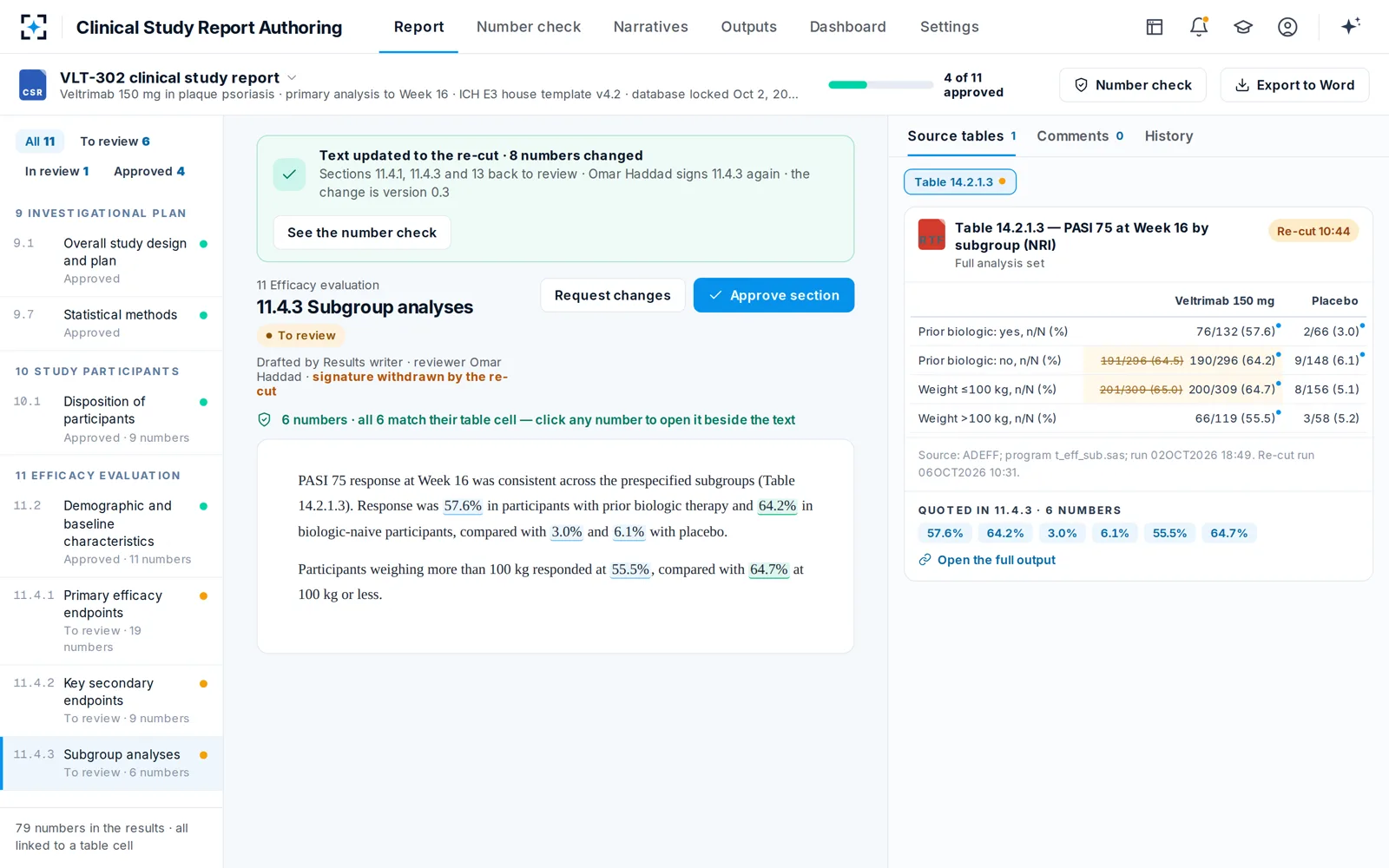
Two struck cells in the subgroup table are the whole reason this section went back to its signer.
The statistical programmer: QC that the text finally follows
The programmer's QC now reaches the text: each re-run output is compared cell by cell with the last delivery, and the sentences quoting a changed cell are flagged. A Phase III trial typically needs 200 to 500 tables, listings and figures, each double-programmed at 1.6 to 2.0 times the primary effort, according to a 2026 review that has not yet been peer reviewed. All of that checking ends at the edge of the output. When independent QC finds an error after lock, the finding travels as an email, and whether the report follows depends on someone remembering where the value was used.
With every delivery kept and compared cell by cell with the last, the programmer's correction becomes its own notice: the re-run output is the message. In the sample study, biostatistics delivers 412 outputs at lock (186 tables, 142 listings and 84 figures), read into 9,840 addressable cells. Only 15 of those outputs are quoted in the report and narratives, and the outputs screen shows which sections quote each one. A re-issue three days after lock, correcting two adverse-event end dates in a listing, re-checks three narratives and changes no text, and the screen says so.
The programmer still signs nothing in the report. What changes is that QC is no longer finished when the output is right; it is finished when every sentence quoting it is right too, and the system knows which those are.
The medical monitor: the listing row behind every statement
The medical monitor reads patient narratives in which every statement cites its listing row, so attesting means checking sources rather than re-deriving them. E3 section 12.3.2 asks for a narrative for "each death, each other serious adverse event" and other significant events of special interest, covering the clinical course, timing against dosing, laboratory results, countermeasures, outcome and the investigator's and sponsor's opinion on causality. Depending on the phase of the trial, a single CSR can need as many as 1,000 narratives, each one to four pages long. The safety physician who attests them has to trust every date and dose in each one.
In the sample study, the narrative writer drafts 53 narratives: 38 serious adverse events including one death, 9 discontinuations for adverse events and 6 events of special interest. Every statement cites its listing row by number, and the E3 12.3.2 elements are ticked off beside the text. Two details are missing at source, a hospital discharge date and a CT pulmonary angiogram report, so the agent raises a query instead of guessing, and those narratives cannot be approved until it is answered.
The medical monitor's view: listings on the left, cited narrative on the right
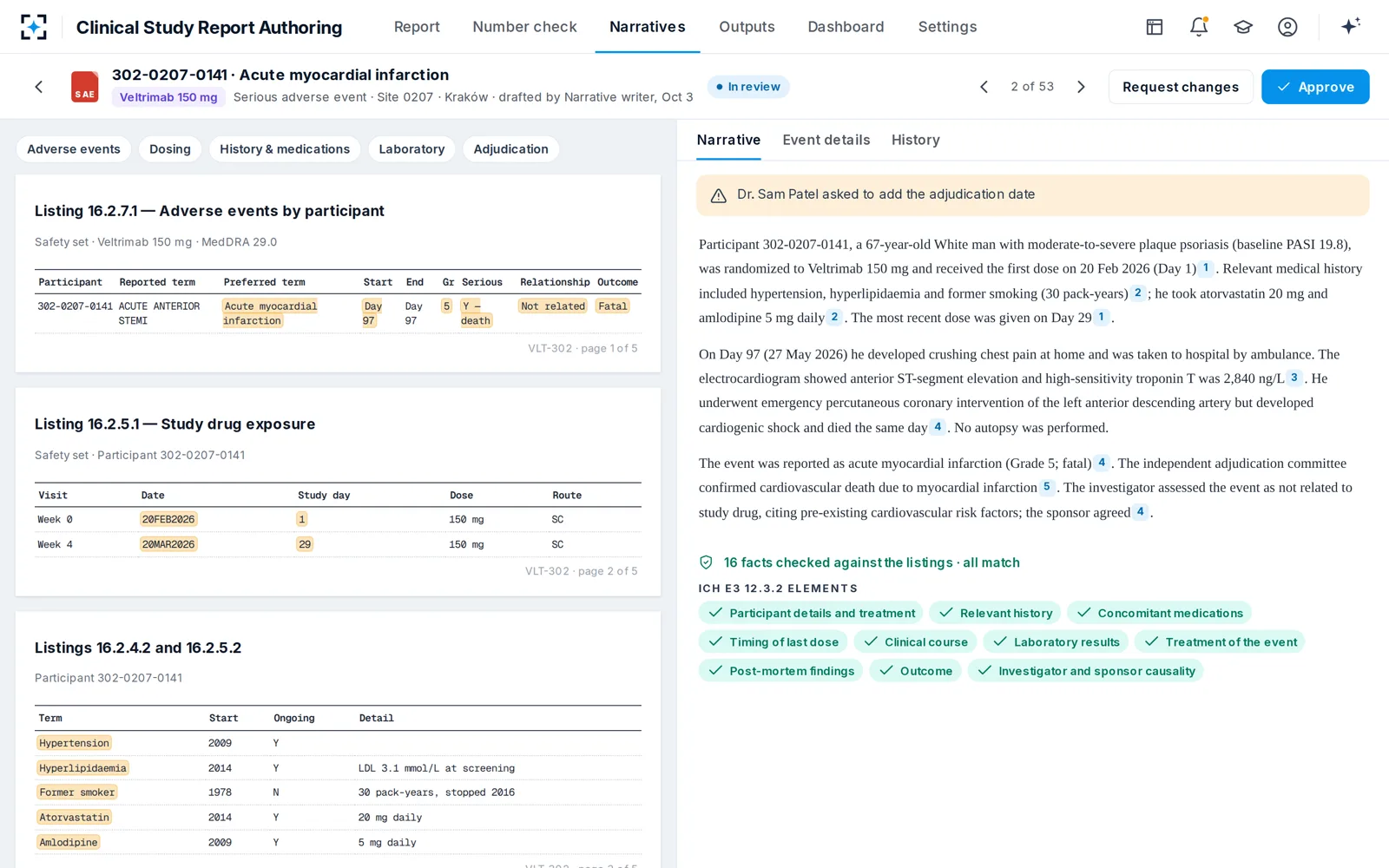
Each numbered chip opens the listing rows it cites, so a reviewer checks the source, not the prose.
E3 says what a narrative must contain, not who attests it, and the solution lets the sponsor assign narratives to medical writing or to the medical monitor. The page on cited narratives goes element by element.
The clinical lead: what changed since I last read it
The clinical lead gets one screen listing every number that changed since the last version, and whether its owner has signed again. The final signatory spends the least time inside the report and carries the most accountability for it. By the time the report reaches the clinical lead, it has been through review rounds the lead did not attend and re-runs the lead did not request. The question is the same at every round: what moved since the last version I read, and has its owner signed it again?
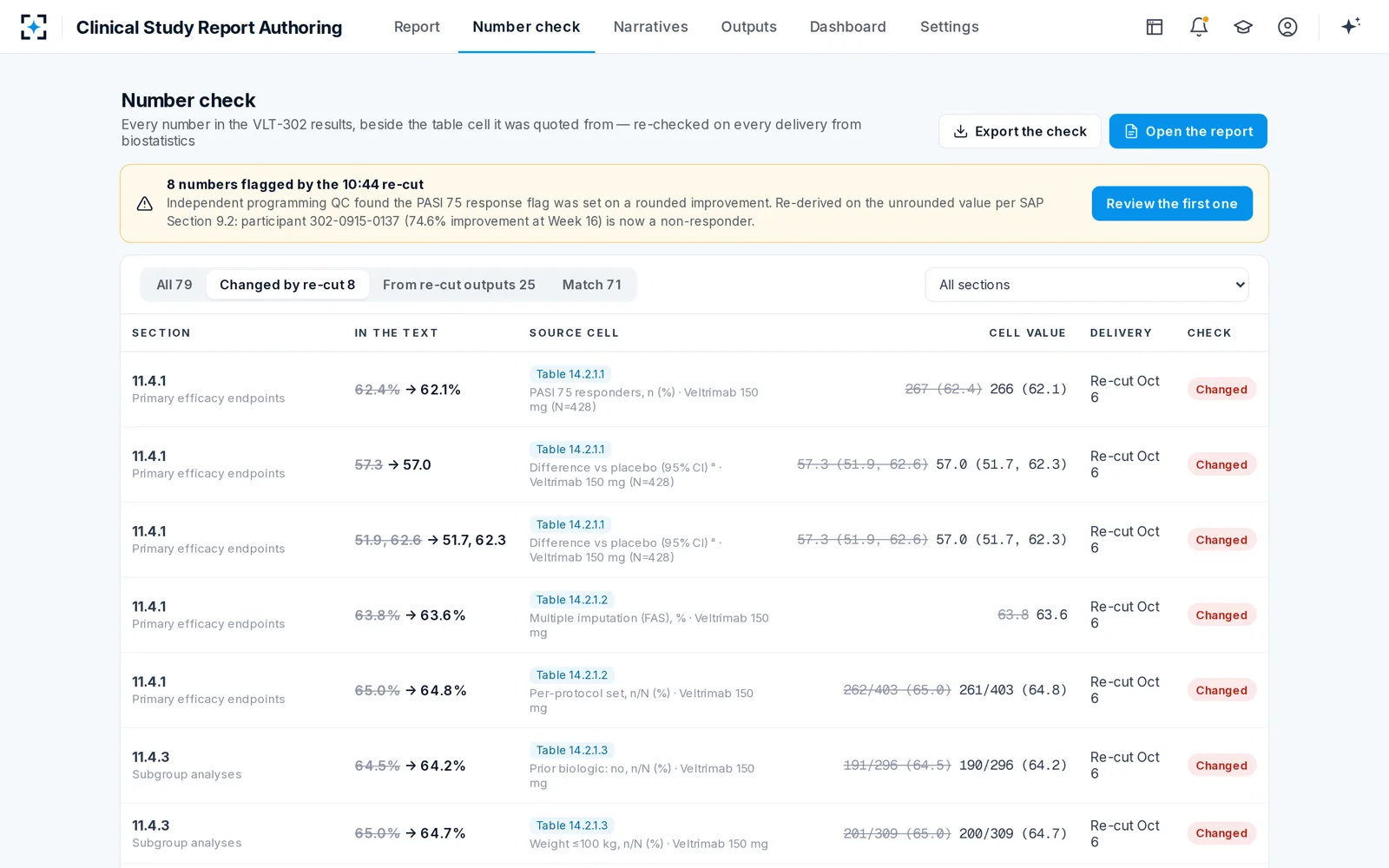
The number check answers it on one screen: every number, the sentence it sits in, its source cell, the delivery it came from and whether it still matches. In the sample study, filtering to "Changed by re-cut" leaves eight rows, each showing the struck old value, the new one and the section it reached.
The clinical lead's view: every number the re-run changed
Can a clinical study report be signed electronically?
Yes, if the system meets 21 CFR Part 11 for an FDA submission, or the equivalent EU expectations for computerised systems. Part 11 defines an electronic signature as the "legally binding equivalent of the individual's handwritten signature" and sets four requirements a CSR signature has to meet:
- Unique to one person. Each electronic signature "shall be unique to one individual and shall not be reused by, or reassigned to, anyone else" (11.100), and the organisation must verify the person's identity before issuing it.
- Its meaning shown. The signed record must display the signer's printed name, the date and time, and the meaning of the signature, "such as review, approval, responsibility, or authorship" (11.50). An efficacy approval and a final sign-off are different meanings.
- Bound to the record. Signatures must be linked to their records so they "cannot be excised, copied, or otherwise transferred" (11.70). In practice, a signature is good for one version, and an edit to that version leaves it signing something that no longer exists.
- Two components to sign. A signature not based on biometrics needs at least two distinct identification components, such as an identification code and a password (11.200).
The third rule is the one that matters most for a report whose numbers move. A section signed at 09:40 and edited at 10:52 is no longer the record the signer approved, whatever the wording of the edit, which is why the solution withdraws a signature as soon as a re-cut changes the text it covers.
Every approval in the solution is an electronic signature that states its meaning and is kept with name, date and time in the audit trail. In the full build, signing requires re-authentication, each signature is bound to the exact version signed and is marked superseded by any later edit, and the author of a report can never be its safety, final or QC signatory. What the regulations require of an AI-drafted report covers those controls in detail.
Can AI write a clinical study report? What stays human
AI can draft and check a CSR, but people must still decide and sign. The agents draft, check and propose; they never approve, sign or change signed text. Everything a signature attests to stays with the person who gives it. The five agents are each defined as much by what they may not do as by what they do.
Who does each task in Clinical Study Report Authoring
By hand, today: The writer copies each value from the tables and a QC reviewer re-checks it.
With agents: Agents link every number to its source cell and refuse one without a cell. The writer judges what the sentence claims.
By hand, today: The statistician emails the change; the writer searches the report for the old values.
With agents: Agents compare deliveries and flag each sentence quoting a changed cell. The writer accepts each update; the owner signs again.
By hand, today: Writers assemble each narrative from listings and eCRF pages, then the safety physician checks it.
With agents: Agents draft with every statement cited and query any missing detail. The physician reviews the course and causality, and attests.
By hand, today: A reviewer checks headings and cross-references by eye.
With agents: An agent confirms the required E3 headings and that every cross-reference resolves. People decide what the report argues.
By hand, today: Signatures on a document whose numbers may have moved since they were checked.
With agents: Only people sign. Approval is held while any number mismatches, and a changed section returns to its signer.
AI/ML applications used for drafting, compiling, editing, translating, tailoring, or reviewing medicinal product information documents should be used under close human supervision.
EMA, reflection paper on AI in the medicinal product lifecycle (2024)
Will AI replace medical writers? The skills that matter more now
The most detailed public account so far points to redeployment rather than replacement. Novo Nordisk centralised its CSR authoring in a team of four writers who automate all the company's CSRs, freeing 37 others "to permanently prioritize other business needs", by its own account in a 2026 peer-reviewed review.
The harder question is training. In AMWA's 2021 survey of regulatory writers, 54.5% had more than ten years of experience and only 6.1% had fewer than two. A junior who learns the craft by transcribing and checking tables is learning on exactly the work agents now take, so teams will need to teach the judgment directly:
- Reading a table as an argument. Knowing when a difference is small, when a subgroup claim is earned, and when "consistent across subgroups" stops being true after a re-run.
- Working from the SAP and the estimand. The writer who knows how an endpoint was derived is the one who spots a sentence that describes the wrong population.
- Adjudicating review. Settling conflicting comments with a stated reason, rather than accepting every edit in turn.
- Writing for the public copy. The EU Clinical Trials Regulation requires a lay summary of results and the posting of the full report, so plain language and redaction judgment become core skills.
Questions people ask
Does the statistical programmer sign the clinical study report?
ICH E3 does not ask for it. The guideline requires the authors to be named, including the responsible biostatistician, and a signature in appendix 16.1.5; programming quality is assured through independent QC and double programming of the outputs rather than a signature on the text.
Should the medical writer sign the CSR?
No regulation requires it, and the CORE Reference, the EMWA and AMWA user manual for E3, does not suggest the writer as a co-signatory "because it is not mandated by existing regulatory guidelines", as Billiones reports. Some sponsors ask the writer to sign an internal authorship page; separating authorship from approval is the safer design, and in the solution's full build the author cannot be the safety, final or QC signatory.
Who signs a CSR that a CRO wrote?
The sponsor still does. Billiones describes authorship being attributed to sponsor personnel by default, with the CRO or consultant listed in appendix 16.1.4 as responsible for writing; the 16.1.5 attestation comes from the sponsor's responsible medical officer or the investigator, never from the vendor.
Is the signature page made public when the CSR is published?
Under EMA Policy 0070 the agency publishes the study reports with three appendices: the protocol, the sample case report form and the statistical methods documentation. Billiones notes that sections 16.1.4 and 16.1.5, with the names of signers and contributors, were not among the parts posted publicly.
Who should own the patient narratives?
E3 specifies what a narrative must contain, not who attests it, so the sponsor's procedures decide; many give it to the safety physician or medical monitor. Whoever it is should be able to see the listing row behind every statement before signing.