An AI medical writing platform should be chosen the way it will be used: on one of your own studies, scored against a report your team already signed. A clinical study report is the ICH E3 document a sponsor writes after database lock, turning hundreds of locked tables, listings and figures (TLFs) into results text and patient narratives. It is slow because every number has to match its table, and every re-run of an output can break sentences already reviewed. Botminds' Clinical Study Report Authoring is AI software for CSR writing: agents draft the results and narratives with every number linked to the table cell it came from, and people review and sign. A medical writing team can be ready to use it on its next lock in about six weeks, if the first study it runs is not a live one. Replay a study you have already submitted, then compare the draft, number by number, with the report your team signed. That report is your answer key. Six weeks is the plan's target, not a promise; the last section lists what stretches it.
Implementing Clinical Study Report Authoring: six weeks from a finished study to the next lock
How to choose an AI medical writing platform: what to look for, and how to test it
Look for what the platform knows about its sources and what it refuses to do, then test each claim on your own completed study. A first draft is no longer the hard part: in a peer-reviewed test on seven pharmacokinetic reports from one company, AI-drafted sections scored about 90% of expert quality in about 18 minutes. What separates platforms is what happens after the first draft, when outputs are re-run, reviewers disagree and people sign. The table pairs each criterion with the replay test that proves it and the document to ask for.
Choosing an AI medical writing platform: criteria, tests and evidence
| What to look for | Why it matters for a CSR | Test it in the replay | Ask the vendor for |
|---|---|---|---|
| Every number traced to a cell | QC becomes a comparison instead of a re-derivation | Click 20 numbers; each should open its output, row, column and population | How a value reaches the page, and whether the model can type one |
| Re-runs traced to sentences | Late re-runs are routine, and signed sections must not change silently | Load a second delivery; compare the flagged sentences with your team's edits at the time | Recall and precision on seeded changes, with denominators |
| Honest gaps in narratives | A guessed date in a death narrative is an inspection finding | Delete a source fact; the draft should raise a query | The rule for missing facts, in writing |
| Your template, not theirs | E3 is "not a set of rigid requirements or a template" | Draft into your current house template and style guide | How a template change is configured, and by whom |
| Signatures and audit trail | Part 11 meaning, linking and re-authentication; changes that do not obscure history | Edit a signed section; the signature should be withdrawn | Validation package, audit-trail export, separation-of-duties rules |
| Blinding as a system rule | An agent reading unblinded data early is a breach | Try to open unblinded outputs before the lock date | Where the rule lives and who can change it |
| A usable export | Reviewers and partners still work in Word | Export a section; links should survive as comments | Export formats and what they keep |
One criterion is missing on purpose: a vendor's percentage time saving. Published figures run from 25% to 90% and stop the clock at different points, so they cannot rank platforms. The comparison of methods behind the platforms is in clinical study report automation, compared on one re-cut, and the questions to put to any AI tool are on AI for clinical study reports.
How do you pilot AI on a clinical study report? Use one you have already submitted
Because a completed study comes with an answer key, the report you signed, and a live one does not. A live pilot tests two things at once: whether the tool drafts correctly, and whether this study's outputs arrive on time. When the timeline slips you cannot tell which one failed. And without an answer key, the only way to know whether the draft is right is to do the full QC you hoped to save, under deadline.
Nor does "faster than usual" mean much on a live study. Across eight EMWA workshops, writers reported a mean of 16.9 working days from final tables to a first draft, with a range of 5 to 45, and the author concluded there are no industry-standard durations at all. A single live study, compared with a team's memory of "usual", sits somewhere inside that spread.
A replay removes both problems. Same outputs, same SAP, same template, and a signed report to compare against: a paired comparison on your own material. It also answers the question published evidence cannot. A peer-reviewed test, Pfizer's blinded scoring of AI-drafted pharmacokinetic CSR sections, rested on seven reports across two study types from one company, and its authors say so. Your QA group will want evidence from your studies, your outputs and your house style. The replay produces it.
What do you need to implement Clinical Study Report Authoring?
Eight things from one completed study and your house rules: the locked TLFs as delivered, the SAP, your CSR template and style guide, the participant listings and SAE pages, the submitted report, the sign-off owners and your recent timelines. Almost everything the replay needs is already in your archive. The work in week one is finding the right version of each item, especially the deliveries. If the study had a re-issue or a re-cut after lock, keep every delivery separately and in order. That history is the most valuable thing you can give the replay.
Eight things the replay needs, most of them already archived
- Every locked output, as delivered
Tables, listings and figures in RTF or text-based PDF, one delivery per folder: the lock delivery, then each re-issue or re-cut, dated.
- The statistical analysis plan
Endpoint names, populations and methods. The results text has to follow it word for word.
- Your CSR template
The ICH E3-based house template the report was written in: the headings and order the agents write into.
- Your style guide
Tense, rounding, abbreviation rules. Settle rounding first: "as in the table" and "whole numbers in the summary" give different drafts.
- Participant listings and SAE pages
Adverse events, dosing, history, labs and eCRF pages for every death, serious event, discontinuation and event of special interest.
- The submitted report
The signed version you sent. It is the answer key. Keep its review rounds and comments if you can; they price the effort you are trying to cut.
- Who signs what
Named owners for efficacy, safety, narratives and the final report. Decide narratives explicitly; organisations differ.
- Your last few timelines
Lock to first draft and first draft to final for your recent reports. Without them, week 4 has nothing to compare against.
Choose the study with some care. A recent Phase 2 or 3 study is best, written in your current template, with a real narrative load, and ideally one that had a re-cut after lock. Pick one your writers remember well enough to judge the draft quickly, but not one so unusual that its result would not carry over to the next study.
Week 1: the decisions only your team can make
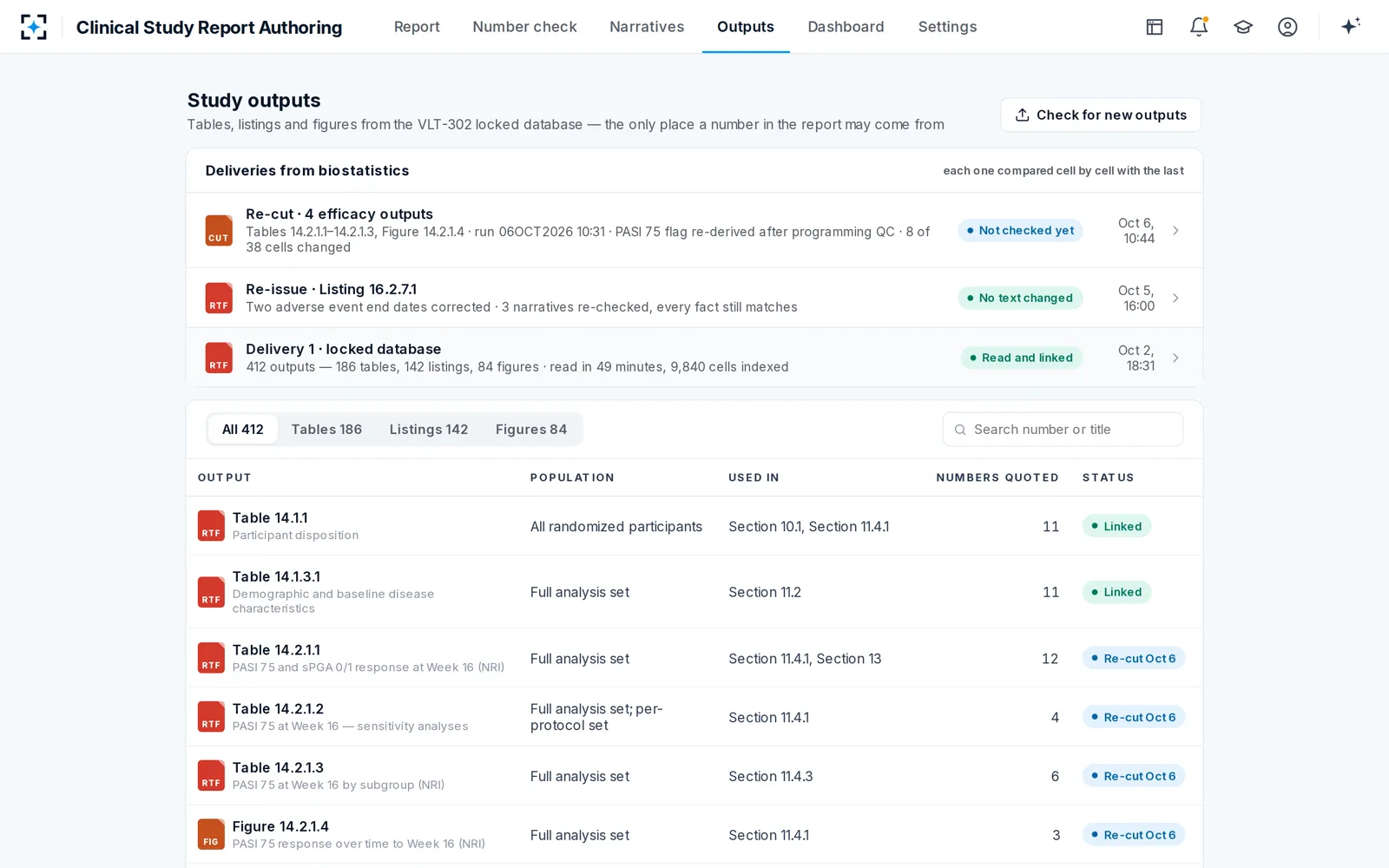
Week 1 is for decisions, not data: template, rounding, style and who signs what. The technical intake is short. The outputs are read into cells, each keeping its row, column, population and program run, and the deliveries are listed in the order they arrived. What takes the week is the decisions: which template, how percentages are rounded when quoted, which style guide, and who signs each part of the report. Those decisions become settings, and every later draft is checked against them.
Intake: every delivery listed and kept, and every output traced to the sections that quote it
Settle the sign-off owners in this week, not later. They decide who reviews in weeks 2 and 3 and who has to attend the week 4 scoring. Two questions often need an answer. Who signs the narratives: medical writing, or the safety physician? And may the lead writer also be the final signatory? Your SOPs may already answer both. If not, week one is cheaper than week five for the argument.
Configuration is a short list of decisions, each kept as a setting
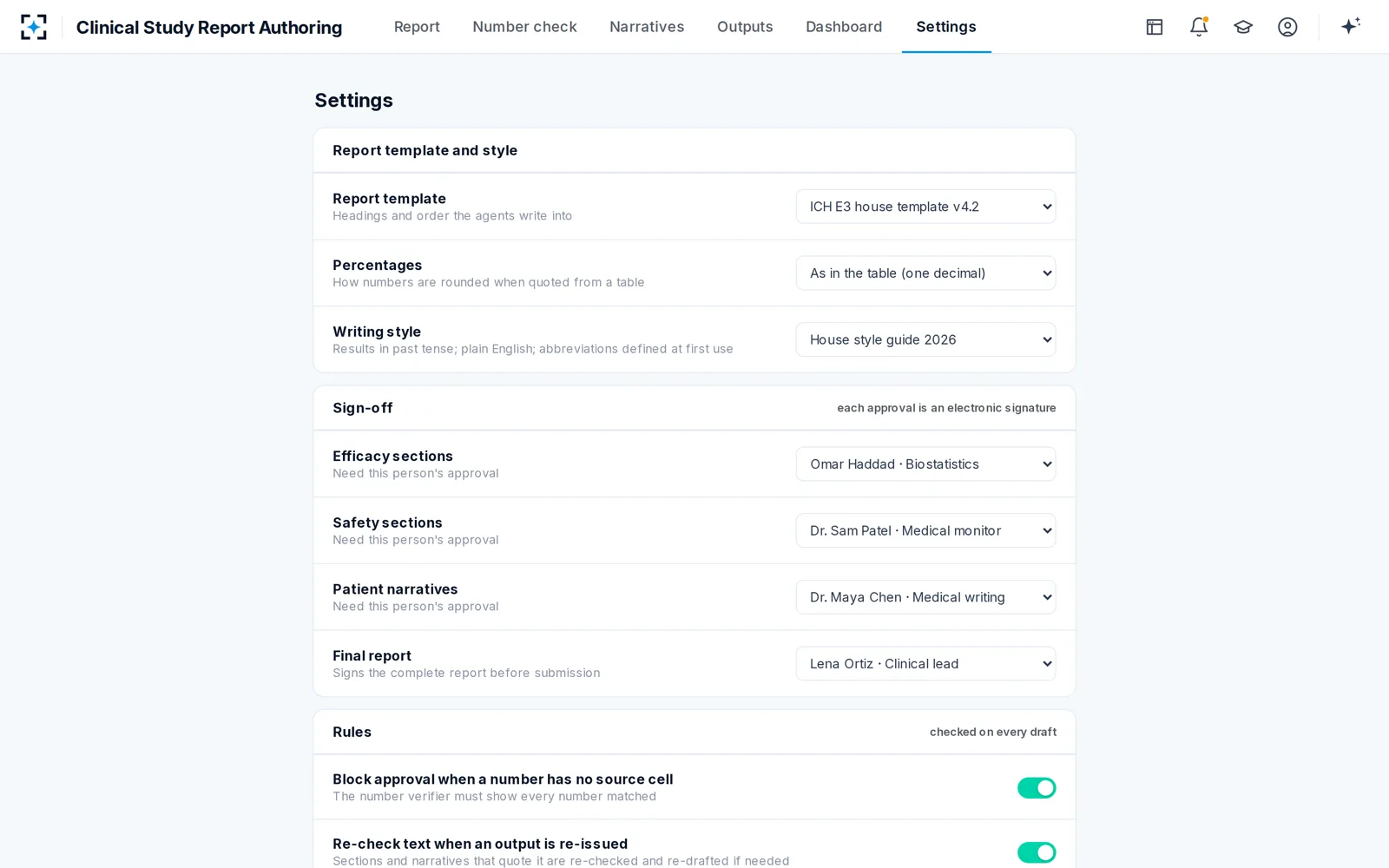
Settle the rounding rule before the replay: it decides whether a percentage in the draft can match the one in your signed report.
Weeks 2–3: replay the study the way it actually happened
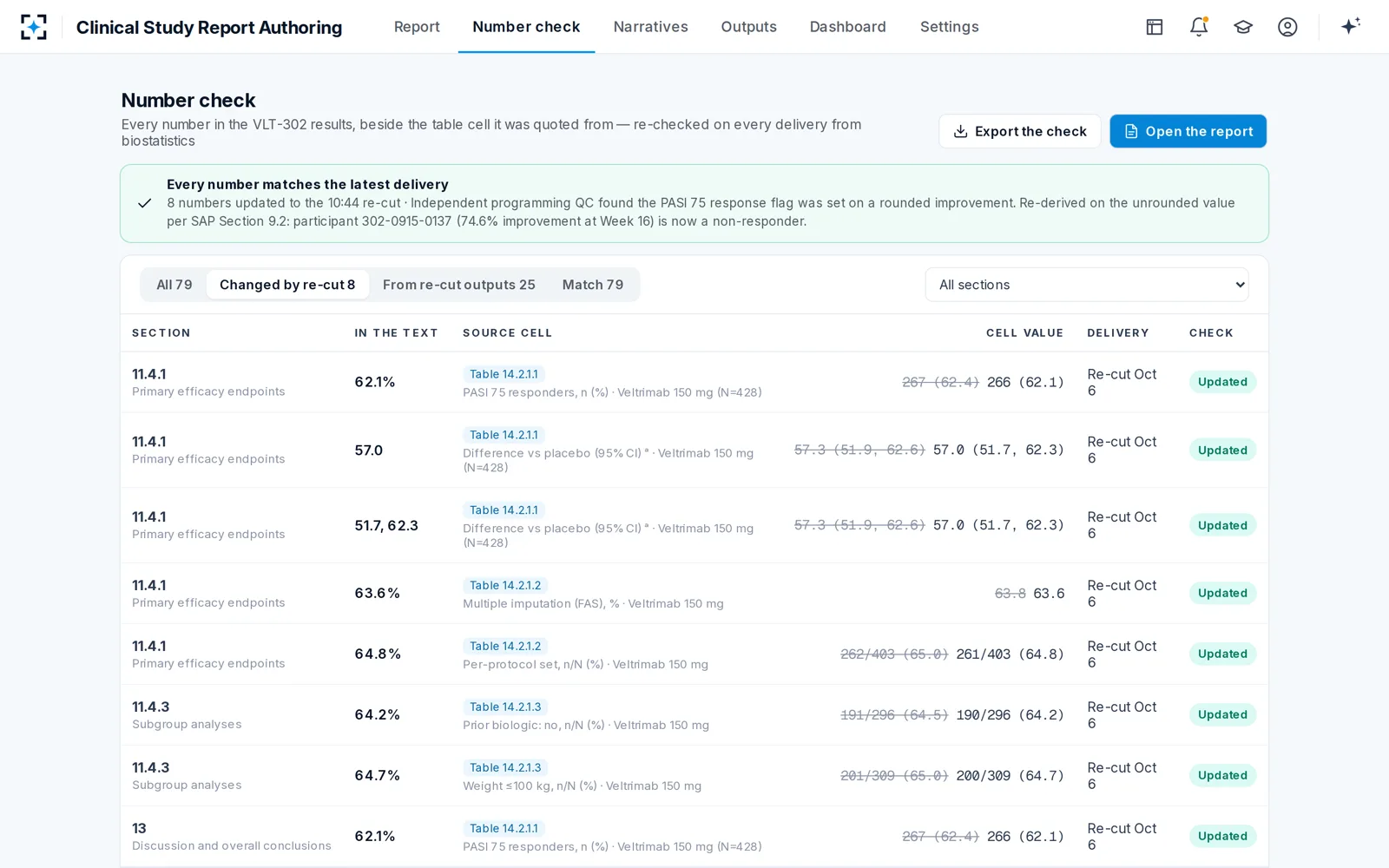
Replay every delivery in the order biostatistics sent it, not just the final one. Load the deliveries in their real order, not just the final one. The lock delivery goes in first and the agents draft from it. Then each later delivery goes in on its own, and the solution compares it with the last, cell by cell, and lists every sentence that quotes a changed value. A study whose final report already reflects a re-cut gives you a free test: the list of flagged sentences should match the edits your writers made by hand at the time.
The replay, agent by agent, with your writers at the end
Agent
Output readerReads the lock delivery into cells, each with its row, column, population and program run.
Never: rounds or reformats a value
Agent
Results writerDrafts disposition, baseline, efficacy, safety and conclusions in your template, following the SAP.
Never: writes a number it cannot link to a cell
Agent
Narrative writerDrafts each narrative from the listings, every detail cited to its listing row.
Never: guesses a missing detail
Agent
Number verifierTakes each later delivery in turn and flags every sentence quoting a cell that changed.
Never: lets a mismatched section be approved
A person decides
Your writers and reviewersReview the draft as they would a colleague's, logging their time and every change they make.
The machine part takes minutes. Your reviewers' part takes the two weeks: they read the draft as they would a colleague's and log their time and every change. If the study had no re-cut, ask programming to re-run two or three efficacy tables with a deliberate, documented change, such as one participant reclassified, and replay that as a third delivery. You then know exactly what should be flagged.
Week 4: how to score an AI-drafted CSR against the report you signed
Scoring is where a replay earns its keep, and it should be done number by number rather than by impression. For each number in the draft, find its counterpart in the submitted report and its source cell. Each one either matches, differs, is missing from the draft, or appears only in the draft. When the two reports disagree, trace both to the cell before you score. A difference is not automatically the draft's error. Sometimes the signed report carries a value that was changed by hand after a late re-run. The definitions, and how to count a stale number, are set out in how to measure the accuracy of an AI-drafted CSR.
- Numbers: share that match their cell and the submitted report; any number in the draft with no source cell (the target is none).
- Narratives: each cited detail checked against its listing row, and the ICH E3 12.3.2 elements present in each narrative.
- Re-cuts: the flagged sentences compared with the edits your team actually made, or with the change you seeded.
- Prose: a senior writer scores sections blind against the originals. Pfizer's team did this and scored the AI-drafted sections at about 90% of the manually written ones.
- Effort: reviewer hours to bring the draft to the standard of the signed report, set against your recent timelines. The economics page shows how to set that baseline.
The scoring material already exists: every number beside the cell it came from
Before the replay, the evidence a vendor can show you is evidence on someone else's data. Ours is below, and it comes from our own tests on synthetic study data. The replay exists to replace each of these with a number measured on your study.
What Clinical Study Report Authoring does on synthetic study data, before your replay
100%
of table cells read correctly
n = 10,571 cells, synthetic
1.00
recall and precision in finding text hit by a re-cut
600 seeded cell changes, synthetic
20/20
seeded wrong numbers caught, and 10/10 unlinked numbers
synthetic
119s
to draft 28 sections, all 199 numbers linked
synthetic
Week 4 ends with the second decision. If the scorecard holds up, continue. If it shows a pattern, such as one table family read badly or a style rule misapplied, fix it and replay those sections before week 5. Do not carry a known defect into validation.
Weeks 5–6: how to validate AI authoring software, update SOPs and choose the next lock
Validate it as a computerised system under the quality system you already run. Validation follows the rules your quality system already applies. ICH E6(R3) asks that computerised systems used in trials be "fit for purpose (e.g., through risk-based validation, if appropriate)". FDA's 2025 draft guidance on AI explicitly leaves out models used for "drafting/writing a regulatory submission", so the question is your own QA framework's, not a new regulatory category. EMA puts the expectation plainly:
"Quality review mechanisms need to be in place to ensure that all model-generated text is both factually and syntactically correct before submission for regulatory review."
EMA, Reflection paper on the use of AI in the medicinal product lifecycle (2024)
The replay is most of that mechanism's evidence. Each scoring result maps to a requirement and a test. What QA adds in week 5 is the controls around the text. Do signatures show the printed name, date and time, and meaning that 21 CFR Part 11 §11.50 requires? Is every change in the audit trail with who, what and when? Is approval held while a number is flagged? In the live solution, signing requires the password again, each signature is bound to the exact version signed and is superseded by any later edit, and the author cannot sign as safety, final or QC signatory. The agents draft and propose; they never approve or sign. What each rule requires, clause by clause, is on the regulatory page.
The SOP change is specific, and it needs care. Medical writing QC, as a QC specialist describes it in EMWA's journal, checks the document "against source data": the data in tables, and whether each analytical statement is supported by them. The work instruction should say what the system now checks on every draft (each number against its cell, each narrative detail against its listing row) and what the human QC still owns: interpretation, consistency of the argument, and anything the system cannot link. Whether that changes the scope of human QC is QA's call, made on the replay's numbers.
Week 6 turns to the next real lock. Pick the study, agree with biostatistics that every delivery goes in, re-runs included, and no table is touched up by hand, and get the front of the report ready before the final outputs land. EMWA's companion guide makes the same recommendation, and the reason is the same: "draft data changes in the final TFLs will mandate changes in the CSR." What can be prepared before lock, and by whom, is laid out step by step in the lock-to-signed-report timeline.
Who does what: a RACI for the go-live
Medical writing leads, biostatistics and programming supply and review, QA validates and IT hosts. Five functions carry the plan. The safety physician and the clinical lead come in where their sections are reviewed and scored in weeks 2 to 4. Their signing duties are described on the page on the five people who sign a CSR.
One function answers for each task
| Week | Task | Medical writing | Biostatistics | Programming | QA | IT |
|---|---|---|---|---|---|---|
| 1 | Gather outputs, SAP, listings and the submitted report | A | R | R | I | C |
| 1 | Access, hosting and security review | I | I | · | C | A·R |
| 1 | Template, style, rounding and signers | A·R | C | · | C | · |
| 2–3 | Replay each delivery in the order it happened | A | R | R | I | C |
| 2–3 | Review the draft and the narratives | A·R | R | · | I | · |
| 4 | Score the draft against the signed report | A·R | R | C | C | · |
| 5 | Validation plan, tests and evidence | C | C | · | A·R | R |
| 5 | SOP and work-instruction changes | R | C | C | A | · |
| 6 | Training, next study, delivery agreement | A·R | R | C | I | I |
What changes for the writers
The replay is also the training. Writers learn the tool on a study whose answers they already know, so they can tell a fluent but wrong sentence from a right one, which is the skill that matters. A writer's attention moves from copying and re-checking numbers to the argument, the narratives' clinical sense, and the review rounds. That is not a small change, and the sponsors furthest along treat it as one. Novo Nordisk reorganised the work itself, centralising CSR authoring in a team of four writers who automate all of the company's reports. You do not need that reorganisation to adopt a finished product, but you do need a named owner on the writing team and protected review time in weeks 2 to 4.
Is your TLF delivery ready for AI? What slows a team down
The delays worth planning for sit in the outputs and the organisation more than in the software. The lean-authoring review in Therapeutic Innovation & Regulatory Science puts it bluntly: "AI is only as good as the content it is trained on." For a CSR, the content is the TLF package. Check your completed study's delivery against these rows in week 1. Each left-hand row you recognise is a few days added, or a fix to agree with programming before the next lock.
TLF readiness: what slows the reading, and what an agent-ready delivery looks like
Slows the replay: Scanned or image-only PDFs; one merged file with no bookmarks.
Agent-ready: RTF or text-based PDF, one output per file or a bookmarked bundle.
Slows the replay: The same endpoint titled differently by different programs.
Agent-ready: One title pattern: output number, title, population.
Slows the replay: Named only in a footnote or the program name.
Agent-ready: Population and N in every column header.
Slows the replay: No program name or run date on the output.
Agent-ready: Program, analysis dataset and run date and time in every footer.
Slows the replay: A re-run overwrites the earlier file.
Agent-ready: Each delivery kept and dated; a re-cut says which outputs changed and why.
Slows the replay: Output numbers reused for different content between deliveries.
Agent-ready: Stable output numbers across every delivery.
Slows the replay: Delivered as images only.
Agent-ready: Each figure with its data table, so a quoted value has a cell.
Slows the replay: Values touched up in the file after the program ran.
Agent-ready: Every value exactly as the program printed it.
Slows the replay: Ad hoc extracts per participant, prepared by hand.
Agent-ready: Standard listings with the participant ID on every row, plus SAE pages.
Outside the outputs, four things are worth heading off in week 1:
- The deliveries cannot be reconstructed. If only the final outputs survive, the replay loses its re-cut test. Seed one instead (weeks 2–3).
- QA's validation approach is first discussed in week 5. Agree in week 1 what evidence QA will accept, so that the scoring produces it.
- The security and hosting review starts late. IT's review usually has its own queue; start it on day one.
- The template is still moving. If the house template is being revised, replay in the current one and say so, or the scorecard measures the template change rather than the drafting.
A team that clears those comes out of week 6 with something a pilot rarely gives: its own measured evidence, on its own study, before a live report depends on it. To see the replay start, bring the outputs of one of your completed studies to Clinical Study Report Authoring.
Questions people ask
Does the platform have to be validated before the pilot?
Not before the replay, because a completed study feeds no submission. Validation belongs before first live use, which is why it sits in week 5: ICH E6(R3) asks for computerised systems that are fit for purpose through "risk-based validation", and the replay's scorecard is the evidence that validation rests on.
Can we replay a study a CRO wrote for us?
Yes, if you hold the delivered outputs, the SAP and the signed report. The template should be the one you will use next, which may not be the CRO's. If the two differ, configure yours and score content, not layout.
Do we have to pause the current process during the six weeks?
No. The replay runs on a finished study, so live reports carry on as before. The real cost is reviewer time in weeks 2 to 4, which is why it belongs in the plan from the start.
Who should own the platform after go-live?
A named lead on the medical writing team, with QA owning its validated state. The most detailed published case, Novo Nordisk, centralised CSR authoring in a team of four writers who automate all of the company's reports; a smaller team can start with one owner who keeps the template, rules and sign-off settings current.
What if the scorecard is not good enough?
That is what the week 4 decision is for. A replay that fails tells you exactly where, by section and by table, at no risk to a submission. Fix the cause, replay those sections, and score again before validation.