AI in regulatory medical writing is allowed, and governed by the same rules as the writing it replaces: no regulator forbids an AI-drafted first draft, and every one of them holds the sponsor's people accountable for the result. A clinical study report (CSR) is the ICH E3 document that tells regulators what a trial found, written from hundreds of locked tables, listings and figures (TLFs) in the weeks after database lock. Every number has to match its source, and a re-run table can silently break sentences already reviewed. Botminds' Clinical Study Report Authoring drafts the results sections and patient narratives from the locked TLFs, links every number to the table cell it came from, and leaves review and signature to named people. So can you submit a CSR whose first draft was written by AI? Yes. None of the texts that govern a CSR forbids it. They ask whether the report is complete and accurate, whether every result traces to the locked analysis, who wrote and approved it, and whether the electronic records behind it can be trusted.
An AI-drafted report has to clear exactly the bar a hand-written one does, and it has to show its working more explicitly, because a reviewer cannot assume a person typed each number. The useful question for regulatory affairs and QA is therefore not "is it allowed" but "which obligation does each control answer, and what do we keep to prove it". This page quotes the four texts that decide it and ends with the evidence pack to keep for an IND, NDA, BLA or marketing authorisation application. It is a reading of public texts, not legal advice.
Four texts decide it; only two were written with AI in mind
1995
ICH E3, the structure of a CSR: current Step 4 version, with a 2012 Q&A
Judges the report
§11.50
21 CFR Part 11: what an electronic signature must show
Judges the records and signatures
2024
EMA reflection paper on AI: 'close human supervision' of drafted text
Judges the oversight
2025
FDA draft guidance on AI for regulatory decisions: drafting is out of scope, conditionally
Judges the model, when in scope
Does ICH E3 allow an AI-written clinical study report?
Yes: ICH E3 judges the content of the report, not how it was typed, and it names people, not systems, as authors and signatories. ICH E3 is still the 1995 guideline ("Current Step 4 version dated 30 November 1995"), and its aim is unchanged: "a single core clinical study report acceptable to all regulatory authorities of the ICH regions." Its demands are about content. The report is "integrated" and "should not be derived by simply joining a separate clinical and statistical report"; the synopsis "should include numerical data to illustrate results, not just text or p-values"; each death and serious adverse event gets a narrative with the elements section 12.3.2 lists.
The 2012 Q&A matters more for an automated workflow than people expect. It says plainly that "ICH E3 is a Guideline, not a set of rigid requirements or a template, and flexibility is inherent in its use." A tool that forces every study into one rigid heading tree is not more compliant; it risks the "redundant and suboptimal information" the Q&A warns about. The house template should be the sponsor's choice, and adapting it should be cheap.
Two E3 provisions bear directly on AI. The report must list "the author(s) of the report, including the responsible biostatistician(s)", and appendix 16.1.5 carries the signature of the principal or coordinating investigator or, where that is not required, "the sponsor's responsible medical officer". ICH E6(R3), adopted in January 2025, ties marketing-application reports back to E3 and adds that a coordinating investigator should be considered as a signatory. Authors and signatories are people. Nothing in either text makes room for a system in those slots.
Does the FDA's AI guidance cover drafting a CSR?
Not as a rule. The FDA's January 2025 draft guidance names "drafting/writing a regulatory submission" as outside its scope, provided the use does not affect patient safety, drug quality or the reliability of study results.
In January 2025 the FDA published the draft guidance Considerations for the Use of Artificial Intelligence to Support Regulatory Decision-Making for Drug and Biological Products (docket FDA-2024-D-4689), marked "Draft — Not for Implementation". Its scope is AI "where the specific use of the AI model is to produce information or data to support regulatory decision-making regarding safety, effectiveness, or quality for drugs." Then comes the sentence most summaries shorten:
"This guidance does not address the use of AI models (1) in drug discovery or (2) when used for operational efficiencies (e.g., internal workflows, resource allocation, drafting/writing a regulatory submission) that do not impact patient safety, drug quality, or the reliability of results from a nonclinical or clinical study."
FDA draft guidance, January 2025, section II (Scope)
Drafting a submission is named as an example of operational efficiency, but the exclusion carries a qualifier: uses "that do not impact patient safety, drug quality, or the reliability of results". The next sentence in the guidance is the practical instruction: "We encourage sponsors to engage with FDA early if they are uncertain about whether or not their use of AI is within the scope of this guidance."
So the design of the drafting tool decides where it sits. A model that writes prose around numbers it cannot alter is squarely an efficiency. A model that may type, round or restate a number has a path to changing what the report says the study found. A model that judges causality or derives a statistic the analysis never produced is generating information a regulatory decision rests on, and that is the guidance's subject.
Where AI for CSR writing sits against the FDA's scope sentence
This is why the solution is built so that the model never types a number. The model places a reference to a delivered table cell and the system renders the value from that cell; a bare numeral the model writes is refused, and a deterministic check, not the model, matches every number to its source. The narrative writer raises a query when a fact is missing at source rather than writing one. Those two rules are what keep the use in the top band, and they are worth writing into the context of use if you document one.
How to apply the FDA's seven-step credibility framework to AI medical writing
Treat the seven steps as the skeleton of a short credibility rationale: out of scope does not mean undocumented. Many QA teams will want one on file regardless. The framework sizes effort by model risk, which it defines as "a combination of two factors: (a) model influence ... and (b) decision consequence". For a drafting tool, the controls around the model drive influence down: no number without a cell, no section without a person's approval.
The FDA's seven steps, read for a CSR drafting tool
The step, in the FDA's words: Define the question of interest that will be addressed by the AI model
What it means for AI drafting: How do the locked outputs read as report prose? The scientific question is answered by the statistical analysis, not the model.
The step, in the FDA's words: Define the COU for the AI model
What it means for AI drafting: Drafts text for human review from the locked delivery. Every number is rendered from a delivered cell. A named person accepts each change and signs each section.
The step, in the FDA's words: Assess the AI model risk
What it means for AI drafting: Decision consequence is high: a wrong efficacy figure misinforms the review. Influence is low when no number reaches the page unmatched and every section is approved by a named person.
The step, in the FDA's words: Develop a plan to establish the credibility of AI model output within the COU
What it means for AI drafting: Seeded-error tests with acceptance criteria written first: wrong numbers, unlinked numbers, number-words, missing narrative elements, a re-cut.
The step, in the FDA's words: Execute the plan
What it means for AI drafting: Run it on a completed study of your own, where the signed report is the answer key.
The step, in the FDA's words: Document the results of the credibility assessment plan and discuss deviations from the plan
What it means for AI drafting: A credibility assessment report; the guidance allows it to be "held and made available to FDA on request (e.g., during an inspection)".
The step, in the FDA's words: Determine the adequacy of the AI model for the COU
What it means for AI drafting: If it falls short, the guidance lists the options: add evidence, raise rigor, add controls, change approach, or revise the use.
Step 4 is where most teams under-invest. A plan that only reads sample output proves little; seeded errors prove that the checks fail when they should. How to measure the accuracy of an AI-drafted CSR sets out a number-level test design, and the six-week go-live plan runs it on one of your own completed studies.
What does the EMA expect from AI-generated regulatory text?
Close human supervision, and quality review that makes all model-generated text factually and syntactically correct before submission, with responsibility left on the sponsor. The EMA has addressed AI drafting more directly than the FDA: its reflection paper on AI in the medicinal product lifecycle, adopted by the CHMP on 9 September 2024, says of product-information documents: "AI/ML applications used for drafting, compiling, editing, translating, tailoring, or reviewing medicinal product information documents should be used under close human supervision. Given that generative language models are prone to include plausible but erroneous or incomplete output, quality review mechanisms need to be in place to ensure that all model-generated text is both factually and syntactically correct before submission for regulatory review."
The passage is written about product information, but its logic transfers to a CSR without strain, and the paper's general principle leaves no gap: "it is the responsibility of the clinical trial sponsor, marketing authorisation applicant/holder or manufacturer to ensure that all algorithms, models, datasets, and data processing pipelines used are fit for purpose". Responsibility does not move to the vendor.
In January 2026 the EMA and FDA published ten joint principles of good AI practice in drug development. Four read like a checklist for a drafting tool: "Human-centric by design"; a "Risk-based approach" with "proportionate validation, risk mitigation, and oversight"; a "Clear context of use"; and "Data governance and documentation", under which "Data source provenance, processing steps, and analytical decisions are documented in a detailed, traceable, and verifiable manner, in line with GxP requirements." For a CSR, that means one thing in practice: each number can be followed back to the output, row and column it came from.
Does the EU AI Act apply to AI in regulatory medical writing?
Lightly. Drafting a clinical study report is not among the high-risk uses the EU AI Act (Regulation 2024/1689) lists in its Annex III, so the heavy obligations for high-risk systems do not attach to the drafting tool itself. The duties that can reach a sponsor sit in Article 50, on transparency, which applies from 2 August 2026.
The relevant clause is about published text. A deployer of an AI system that generates text "published with the purpose of informing the public on matters of public interest" must disclose that it was artificially generated, unless the content "has undergone a process of human review or editorial control" and a person holds editorial responsibility for publishing it. A CSR filed with an agency is not published to inform the public. Its public copies are closer: the redacted report posted under the Clinical Trials Regulation and Policy 0070, and above all the lay summary written for patients. For those, the exemption is the workflow this page already recommends: a named person reviews, edits and approves before anything is published.
Where each rule bites in an AI-assisted CSR workflow
| Rule | What it governs | What it asks of AI drafting | Status |
|---|---|---|---|
| ICH E3 | Content and structure of the report | Nothing specific to AI; authors and signatories are people | Guideline, 1995, with a 2012 Q&A |
| FDA draft guidance on AI | AI producing information for regulatory decisions | Drafting is out of scope if it cannot affect the reliability of results | Draft, January 2025 |
| EMA reflection paper | AI across the medicinal product lifecycle | Close human supervision and quality review of all generated text | Adopted by the CHMP, September 2024 |
| EMA–FDA joint principles | Good AI practice in drug development | Human-centric design, risk-based oversight, traceable documentation | Published January 2026 |
| 21 CFR Part 11 | Electronic records and signatures | Audit trail, signature meaning and linking, validated system | In force |
| EU AI Act, Article 50 | Transparency of AI-generated content | Disclosure for public-facing text, unless a person reviews it and holds editorial responsibility | Applies from 2 August 2026 |
What Part 11 requires of an electronic signature on a CSR
A Part 11 signature shows the signer's printed name, the date and time, and the meaning of the signature, and it stays linked to the record it signs. A CSR maintained and signed electronically is an electronic record, and Part 11's scope covers records created, modified and maintained under the agency's requirements and those submitted to it. Its signature rules are short and exact. Section 11.50 requires every signed record to show "(1) The printed name of the signer; (2) The date and time when the signature was executed; and (3) The meaning (such as review, approval, responsibility, or authorship) associated with the signature." Section 11.70 requires signatures to be linked to their records so they "cannot be excised, copied, or otherwise transferred". Section 11.100 says each signature "shall be unique to one individual".
A signature carries a name, a meaning, a date and a time
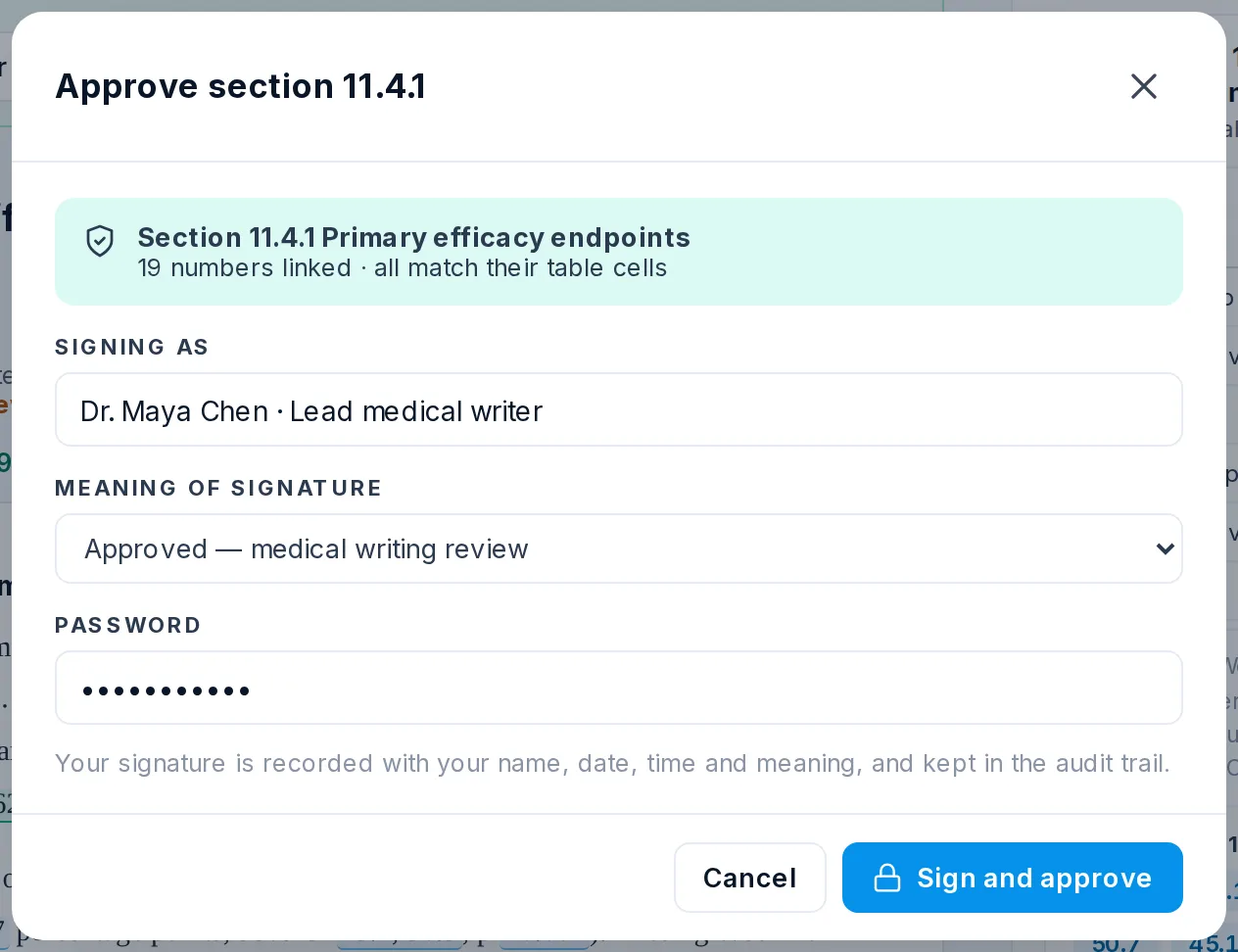
Meaning is a required field, not a comment: 11.50(a)(3) asks for it, and it is what separates 'I reviewed the medical writing' from 'I approve the efficacy results'.
Two of Part 11's less-quoted controls matter most once agents join the workflow. Section 11.10(f) calls for "operational system checks to enforce permitted sequencing of steps and events"; a section that cannot be approved while a number is unmatched, and a package that cannot leave without the approval signature, are sequencing checks. Section 11.10(j) requires "written policies that hold individuals accountable and responsible for actions initiated under their electronic signatures". An agent has no signature and cannot be held accountable, so every agent action has to end in a person's.
Part 11 compliance is a property of a validated system operated under your procedures, not a label a product carries. The vendor can supply controls and validation evidence; the sponsor still validates for its intended use, as 11.10(a) requires.
What must the audit trail of an AI-drafted report show?
What changed, who or what changed it, when, and why, without obscuring what was there before. Section 11.10(e) asks for "secure, computer-generated, time-stamped audit trails" that record entries and actions, and adds: "Record changes shall not obscure previously recorded information." ICH E6(R3) goes further for higher-criticality data: changes documented "including, where appropriate, the reason for the change", and systems that "record and maintain workflow actions in addition to direct data entry". The EMA's 2023 guideline on computerised systems in clinical trials spells out ALCOA++, where "Attributable" means attributable "to the person and/or system generating the data".
That last phrase is the one an AI workflow must satisfy. Each sentence should carry two attributions: the agent that drafted it and the person who accepted it. Every delivery of outputs should be kept, so the trail can show which data the text was written from. Take a sample study, VLT-302, with fictional people. After database lock, independent programming QC re-derives a response flag and four outputs are re-run. The solution compares the new delivery with the last cell by cell, finds 8 numbers in 5 sentences that quote changed cells, and holds approval and export until the writer accepts the update.
Every replacement is listed before anyone accepts it
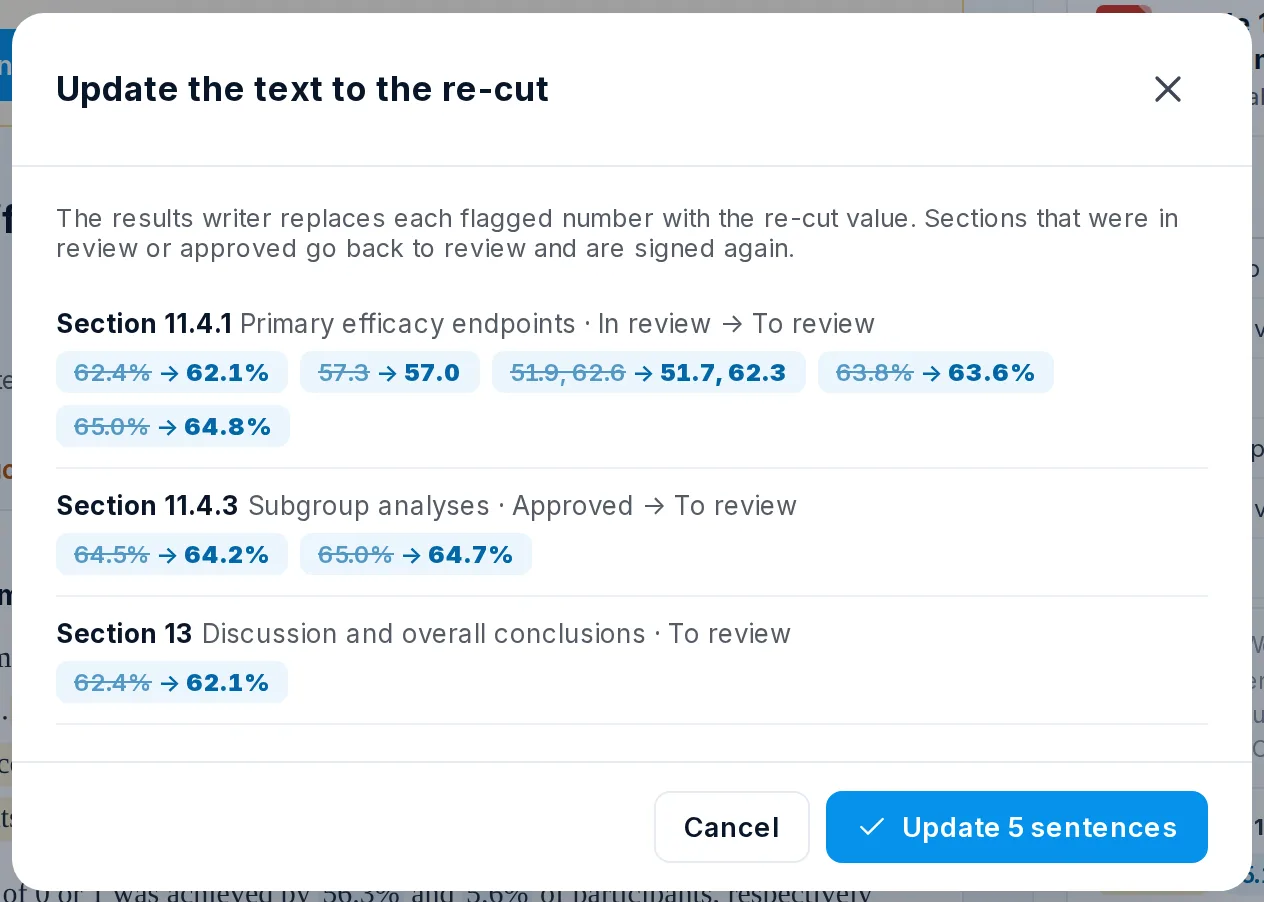
Section 11.4.3 had already been signed by the biostatistics lead. A signed section whose numbers change cannot keep its signature, or the signature no longer refers to the text it sits on, which is the excision 11.70 exists to prevent. So the update withdraws it, the change becomes version 0.3, and the section goes back to its signer. The full sequence is in the 10:44 re-cut case study.
A changed section loses its signature, visibly
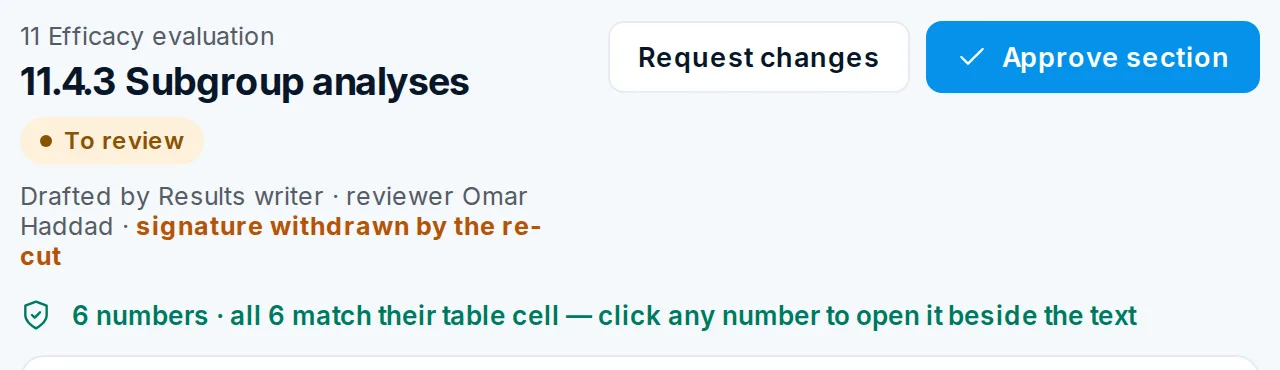
Each change makes a new version and earlier versions are kept, with deliveries, agent steps, comments and signatures recorded with who, what and when. The full build adds the old and new value and a reason on every change, and a tamper-evident audit chain, so "who changed 62.4% and why" is answered from the history rather than from memory.
How blinding and patient privacy apply to AI drafting
Both are access rules the system must enforce: no agent reads unblinded outputs before lock, and no public copy carries a participant's identity. Unblinded results must not reach anyone, human or agent, before database lock. A drafting agent that can read unblinded outputs early is a blinding breach whether or not a person ever looks at what it wrote. In the full build, the rule that unblinded outputs are readable only after lock is fixed in the system's read permissions, applying to every agent and every person, rather than left as a setting someone could switch off. Ask any vendor where that rule lives and who can change it.
Privacy runs the other way: the CSR leaves the building. E3 asks for a "Patient identifier" in each narrative, and the narrative writer uses participant identifiers only, never names. Under the EU Clinical Trials Regulation the applicant submits the CSR to the EU database "within 30 days after the day the marketing authorisation has been granted", and under EMA Policy 0070 "Clinical reports must be anonymised to prevent patients and professionals who participated in clinical trials from being identified". The solution proposes redactions of personal and confidential information for both copies and checks that the two agree. A proposed redaction is still only a proposal; the decision to redact belongs to a person.
Who is the author of an AI-drafted CSR?
A person: whoever accepted the text and put a name to it. The AI is a system you validate, not an author. E3 lists authors among the people who contributed to the study and asks for the responsible biostatistician by name. Part 11 offers "authorship" as one of the meanings a signature can carry. The EMA puts responsibility on the sponsor. The system is documented the way any GxP system is, by its validation and its audit trail.
In Clinical Study Report Authoring, agents propose and check; people accept and sign
Agent
Drafting agentWrites the section from the locked delivery, placing references to cells instead of numbers.
Never: types a number or fills a missing fact
Agent
Number checkMatches every number to its cell: value, rounding, population, column. Holds approval on any mismatch.
Never: lets an unmatched number through
A person decides
Medical writer acceptsReads, edits and accepts the text. Acceptance is attributed to a named person.
A person decides
Section owner signsBiostatistics signs efficacy, the medical monitor signs safety, each with a stated meaning.
A person decides
Clinical lead signsSigns the complete report before submission. The author cannot hold this signature.
The five people who sign a clinical study report looks at how each signatory's week changes.
The evidence pack to keep for an inspection
Keep, for each obligation, the control that meets it and the record that proves it. An inspector does not ask whether AI was used; they ask to see how a number got into the report, who approved it, and what happened when it changed. Each obligation above should map to a control in the system and to a record you can produce on the day.
Each obligation, its control in Clinical Study Report Authoring, and the record you produce
What the text requires: A complete, integrated report; synopsis with numerical results; 12.3.2 narrative elements.
Control in the authoring system, and the evidence kept: House template with heading and cross-reference checks; narrative element checklist. Keep the template version and the check results per draft.
What the text requires: Out of scope only if the use does not impact the reliability of results.
Control in the authoring system, and the evidence kept: A model that cannot place a bare number; queries instead of invented facts. Keep a written context of use and, optionally, a credibility assessment report.
What the text requires: Close human supervision; quality review so that all generated text is factually correct.
Control in the authoring system, and the evidence kept: Every change accepted and every section approved by a named person; every number matched to its cell. Keep the number-check report for each version.
What the text requires: Name, date and time, and meaning on each signature, linked to the record, unique to one person.
Control in the authoring system, and the evidence kept: Re-authenticated signatures bound to the signed version, withdrawn when it changes. Keep the signature manifest.
What the text requires: Time-stamped audit trail; changes do not obscure earlier entries; reasons recorded.
Control in the authoring system, and the evidence kept: Version history with old and new values and reasons; every delivery kept. Keep the audit export and the delivery comparisons.
What the text requires: Systems validated and fit for purpose, proportionate to risk.
Control in the authoring system, and the evidence kept: Seeded-error tests run on one of your completed studies. Keep the validation plan, results and deviations.
What the text requires: No access to unblinded results before database lock.
Control in the authoring system, and the evidence kept: Read permissions that open unblinded outputs only after lock, for agents and people alike. Keep the access log.
What the text requires: Anonymised public copies of the CSR.
Control in the authoring system, and the evidence kept: Proposed redactions for a person to decide; a consistency check between copies. Keep the redaction log and approvals.
None of this is new regulation. It is the existing GxP record-keeping discipline applied to a new kind of contributor, which is also why a well-built drafting system can make an inspection easier rather than harder: the trace from sentence to cell to delivery to signature exists by construction, instead of being reconstructed from email.
Questions people ask
Do we have to tell the FDA that AI drafted the CSR?
None of the passages quoted on this page sets a rule for labelling AI-drafted text, so settle it in your SOPs. If the use could touch the reliability of results, take up the early engagement the FDA invites, and write the context of use down now, while the answer is obvious.
Is the FDA's AI guidance final?
No. The January 2025 document is a draft marked "Not for implementation" that "Contains Nonbinding Recommendations". The FDA's guidance page lists it under docket FDA-2024-D-4689 and accepts comments on any guidance at any time.
Does Part 11 apply to a Word draft that is later signed on paper?
Part 11 covers records kept in electronic form under FDA requirements and those submitted electronically, so the system where the controlled versions and signatures live is the one that has to meet it. A Word export is a working copy. In the sample study, the export keeps each number's link to its cell as a comment, so the trace survives outside the system.
Do medical writing SOPs need to change for AI drafting?
Yes, in four places. ICH E6(R3) expects computerised systems to be fit for purpose "through risk-based validation", so the SOP should state the tool's context of use, who may accept AI-drafted text, what QC covers that it did not before (unlinked numbers, inferred claims, stale values), and which records are kept for an inspection.
Does an AI-drafted narrative need different QC from a hand-written one?
It needs the same check, and published practice already says so: a narrative generated with an automation tool "needs validation of data against the data sources", and medical review "is a must" whatever produced it. It also needs one the hand-written process never had to prove: that the model added nothing. Citing each fact to its listing row makes that check a comparison rather than a re-research, and a fact the listings lack should arrive as a query, not as text.