A CSR QC checklist is the list a quality-control reviewer works through before a clinical study report is signed: every number against its source, every statement against the data, and the document against itself. A clinical study report (CSR) is the ICH E3 document that turns a trial's locked tables, listings and figures (TLFs) into the report FDA and EMA review. Writing it means quoting hundreds of values correctly, and keeping them correct when biostatistics re-runs outputs after database lock. Botminds' Clinical Study Report Authoring uses AI agents to draft the results sections and patient narratives with every number linked to the table cell it came from, so that accuracy can be checked rather than assumed. Whatever tool drafts your report, the way to evaluate it is the same: stop asking whether "the AI is accurate" and count.
For every number, check that it points to a source cell, equals that cell under your rounding rule, comes from the population, row and column the sentence claims, and is still current after the latest re-delivery. For every patient narrative, check that each statement cites a listing row that supports it and that the ICH E3 12.3.2 elements are present. Each check yields a ratio with a numerator you can audit. A model's quality score cannot give you that.
What the published evidence measures, and what it leaves open
~90%
reporting quality of AI-drafted PK sections, relative to expert-written CSRs, in a blinded review
Pfizer, 7 reports, 2 study types
87%
of 32 regulatory reviewers say poor document quality impedes their assessment; none disagreed
AMWA survey, 2021
0
published studies of numeric error rates in CSRs that our research could find
so the baseline has to come from your own studies
What should a CSR QC checklist include?
Two halves: a check against source data and a check for consistency, which is how a QC specialist describes the job in EMWA's journal, "comparing data in tables and checking that analytical statements are supported by the data presented" on one side, and "spelling, grammar, punctuation, formatting, style, and cross-references" on the other. For an AI-drafted report the source half grows, because a model can produce a fluent sentence that no table supports. The checklist below covers a full report; the items marked for AI drafts are the ones a hand-written report rarely needed.
A QC checklist for a clinical study report, with the items AI drafts add
- Every number matches its source cell
Value, row, column and analysis population, under the report's rounding rule. A value from the per-protocol table in a full-analysis-set sentence is a match on digits and a failure on meaning.
- Every number comes from the latest delivery
Check the delivery date of each source output against the last re-issue or re-cut. For AI drafts: list numbers that quote re-run outputs and re-check each one.
- No number without a source
For AI drafts: numerals and number-words ("one death", "nearly a third") must point at a cell or carry a written justification.
- Every analytical statement is supported
"Consistent across subgroups", "small", "clinically meaningful": each claim must follow from the data and the analysis plan. For AI drafts: look for context the model inferred, such as a criterion called "pre-specified" that the protocol never specified.
- Synopsis, body, conclusions and in-text tables agree
The same result is quoted the same way in Section 2, Sections 10–12, Section 13 and every in-text table.
- Endpoints and methods match the protocol and analysis plan
Every protocol endpoint is reported or its absence explained; population names and methods follow the analysis plan.
- Patient narratives are complete and cited
ICH E3 12.3.2 elements present for each death, serious and significant event; each fact traceable to a listing row; missing facts raised, not filled.
- Required headings and cross-references resolve
ICH E3 headings of the chosen template present; every "Table x" and "Section y" points to an object that exists.
- Style, terms and abbreviations
House style followed, abbreviations defined at first use, terms consistent with the protocol and the analysis plan.
- Appendices and signature page in place
Section 16.1 items present, including the 16.1.5 signature page, and every listing the text cites included in 16.2.
The first four items are where AI drafts differ. A hand-typed report fails on random slips, which a proof-reader can catch by reading. A generative draft fails systematically: the wrong population, a stale cell, a confident word the data does not support. Those have to be counted, and the rest of this page shows how.
How do you QC a clinical study report? Order, timing and who checks
QC usually runs once the report is near-final, by someone who did not write it, against an agreed scope and with enough time. The EMWA author is blunt about the last point: "It is not realistic for a consistency and data check to be performed in one day on a 100 page clinical study report!" She also asks writers to proofread before QC and to state "what they want the QC specialist to check" and how findings should be handled, because a QC reviewer who has to guess the scope checks the wrong things.
The schedule follows. In the EMWA scheduling survey, quality assurance on the final integrated report took a mean of 6.6 working days, with a range of one to thirty (Hamilton, 2014). The risk in that number is not its length but its position: it sits at the end, after the last review round, so any re-run output that lands during QC restarts the source half of the checklist. Software has helped with the consistency half for years, but the same author warns that proofreading software "will not identify issues with analytical statements or incorrect data". The source half has stayed manual, and that is the half an AI draft makes larger.
Independence is the last rule. The person who wrote a section should not be the one who QCs it, and with AI drafts the same applies to software: the agent that drafts must not be the one that checks. In Clinical Study Report Authoring the writers and the checkers are separate agents, and in the fuller build a human QC reviewer signs the QC record and cannot QC a report she wrote.
Why don't AI quality scores and hallucination studies answer the CSR question?
Because they grade a whole document by expert opinion, while a CSR fails on a single wrong value. The most careful public test of AI-drafted CSR text so far comes from Pfizer. Clinical pharmacologists, blinded to authorship, graded pharmacokinetic results sections drafted from tables, listings and figures. The AI drafts reached accuracy scores of 4.36 and 4.50 out of 5 against 4.73 and 4.86 for expert-written reports, a ratio of 92–93% (Samuelsson et al., 2026). It is a good study. It still cannot tell a QA lead whether section 11.4.1 of next month's report contains a wrong number.
A quality score of 92% is an average opinion over a whole document. A CSR fails on single values: one percentage from the wrong population is enough for a regulator to question the rest. Regulators say so themselves: in an AMWA survey of 32 agency reviewers, 77% agreed that poor document quality will delay approval, and participants warned that it can "bias reviewers against subsequent submission documents from the same sponsor" (Cooper et al., 2021).
The Pfizer authors also listed what went wrong. Most issues were formatting. The one that matters most for a validation lead is the fourth category: "contextual inaccuracies, where the model inferred context not explicitly stated in the source data", such as calling a bioequivalence criterion "pre-specified" when the protocol did not pre-specify it. That is the generative failure EMA warns about when it says language models "are prone to include plausible but erroneous or incomplete output" (EMA reflection paper, 2024).
The design question is whether the model is allowed to produce a numeral at all. If it writes numbers freely, you are measuring a hallucination rate and need a large sample to bound it. If every number must be a reference to a delivered cell, and the value is rendered from that cell, a fabricated number becomes impossible by construction. What remains to measure is narrower: whether the right cell was chosen, and whether it is still current. The rest of this page measures exactly that.
Five ways a number in a CSR goes wrong, and only one of them is a typo
A number can be wrong in value, in rounding, in population, in row or column, or by going stale after a re-cut. Only the first is a typo that a proof-reader reliably sees. Medical writing QC has always checked numbers against outputs. What changes with automated drafting is that the errors are no longer random slips; they are systematic, and each kind needs its own check. Here is one cell from a sample study and five sentences that quote it wrongly. Every wrong number is plausible, and three of them are real cells in the same set of outputs.
One cell, five plausible wrong sentences
The first four are about choosing the cell. Rounding errors depend on a house rule set by the SAP or the style guide ("as in the table, one decimal" versus "whole numbers in the summary"), so the check must apply the rule rather than compare strings. Population and row-or-column errors are the dangerous pair: the number exists, it is correctly typed, and it answers a different question. A check that matches values against "any cell in the table" will pass both.
The fifth is different in kind. A stale number was right when it was written. It becomes wrong when statistical programming re-runs an output after QC, which Hamilton's EMWA data shows is routine: "Draft data changes in the final TFLs will mandate changes in the CSR" (Hamilton, 2014). No reading of the text can find it, because nothing in the text changed. The 10:44 re-cut case study follows one such re-run through every sentence it touches.
How accurate is AI medical writing? Ten measures that answer it for a CSR
Ten ratios cover it: four for numbers, four for patient narratives and two for the assembled report. A measure is useful to QA only if its numerator and denominator are defined tightly enough that a second person, given the same draft and outputs, gets the same answer. Split them by what they protect: the numbers, the narratives, and the document as a whole.
The measures that answer 'is this draft right?'
- Number match rate
Numbers equal to their linked cell under the rounding rule ÷ numbers checked. Value, population, row and column must all agree.
- Unsourced-number rate
Numerals and number-words ("one death", "nearly a third") with no linked cell and no written justification ÷ all numbers. Target: zero.
- Stale-number rate
Numbers whose cell changed in a later delivery while the text did not ÷ numbers quoting re-delivered outputs. Target: zero at sign-off.
- Re-cut recall and precision
Sentences flagged after a re-delivery against the sentences that truly quote a changed cell. Recall below 1 is a miss; low precision wastes reviewers.
- Narrative citation coverage
Statements in a narrative that cite a listing row ÷ all statements. An uncited age or date is unverifiable, even if it is right.
- Narrative detail accuracy
Cited statements the listing row actually supports ÷ cited statements. Checks the citation, not just its presence.
- ICH E3 12.3.2 completeness
Required narrative elements present, or marked not applicable with a reason ÷ required elements, per narrative.
- Gap-honesty rate
Details missing at source that were raised as open questions ÷ all details missing at source. The complement is the guess rate, and it must be zero.
- Cross-reference resolution
"Table x" and "Section y" references that resolve to the right object ÷ all references.
- First-time-right sections
Sections approved without a number or claim changed in review ÷ sections drafted. The measure reviewers feel.
Two of these deserve a note. The unsourced-number rate has to include number-words. A draft that links every numeral but writes "one death occurred" or "a 67-year-old man" has quietly reintroduced unchecked numbers, and the check that ignores them will report a perfect score. The gap-honesty rate matters most for narratives. ICH E3 asks each narrative for the clinical course, "relevant laboratory measurements", "post mortem findings" and the causality opinions (ICH E3, 12.3.2). When a listing lacks one of them, a generative model is under pressure to fill the slot. The measure that matters is how often it declined to. Patient narratives, cited takes the element checklist further.
A narrative scored on citations and elements, not on prose
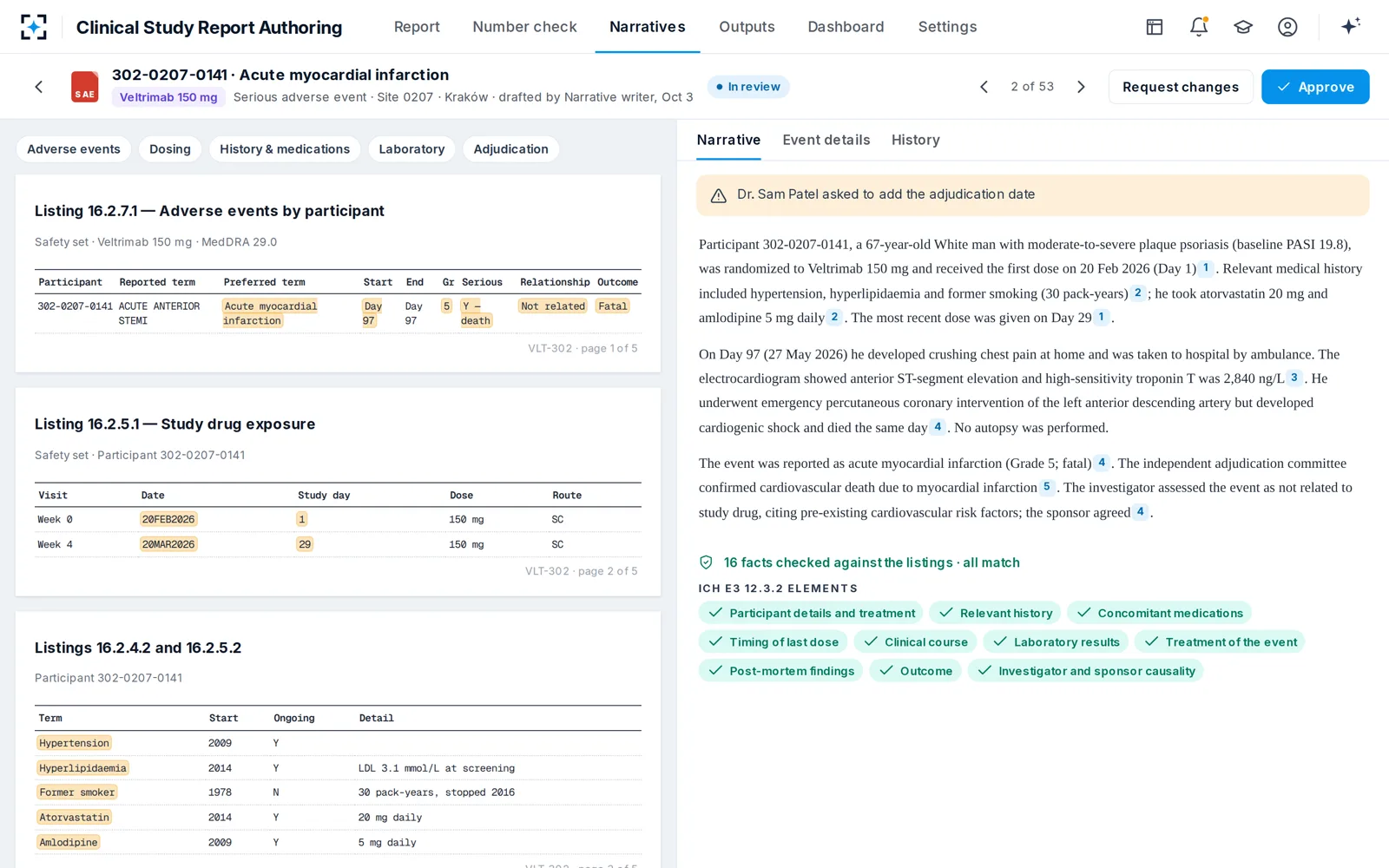
Look at the numbers in the prose: day 97, 30 pack-years, 20 mg, 2,840 ng/L. Each must trace to a highlighted listing value, which is why citation coverage and detail accuracy are counted per statement, not per paragraph.
How to build a test set: replay your own completed studies
The best test set for AI CSR writing is two or three of your own completed studies, replayed delivery by delivery. There is no public benchmark for CSR accuracy, and the research behind this series found no published study of numeric error rates in CSRs at all. That is less of a problem than it sounds. Every sponsor and CRO already holds the perfect test set: completed studies with locked outputs, every re-delivery, and a signed report.
A retrospective replay works like this. Choose two or three completed studies, ideally of different designs, and at least one where programming QC re-ran outputs after lock. Freeze the outputs exactly as each delivery left biostatistics. Let the agents draft from the lock delivery alone, then feed them the later deliveries in their original order. The signed CSR is a useful comparison, but it is not the answer key: the cell is. Where the agent's draft and the signed report disagree, adjudicate against the outputs, and expect a few cases where the signed report is the one that was wrong.
Add deliberate errors. A checker that has only seen correct drafts has not been tested. Seed the draft with known wrong values, swapped columns, per-protocol numbers in full-analysis-set sentences, unlinked number-words and narratives with a deleted listing row, and count how many the checks catch. The point is the one the statistical programming field is now making about itself: a 2026 scoping review found that just 2.3% of 527 validation papers contained effectiveness data (Yan et al., medRxiv preprint). Measure the checker, not only the writer.
A replay that scores the draft and the checks at the same time
A person decides
Pick and freezeTwo or three completed studies; every delivery kept exactly as issued, in order.
Agent
Draft from lockResults sections and narratives drafted from the lock delivery only.
Never: sees the signed CSR
Agent
Check every numberEach number compared with its cell: value, rounding, population, row and column.
Agent
Replay the re-cutsLater deliveries fed in order; changed cells and the sentences quoting them flagged.
A person decides
Seed, adjudicate, signKnown errors planted; disagreements settled against the outputs by two reviewers; QA signs the scorecard.
How to run the evaluation so the result survives an audit
Keep the numeric comparison deterministic. An LLM asked "does this sentence match this table?" is a second model with its own error rate, and you would then need to evaluate the evaluator. Normalise formats first ("267 (62.4)" in the table, "62.4%" in the text) and compare under the stated rounding rule. Reserve judgement for what cannot be computed: whether "consistent across subgroups" is a fair reading of a forest plot, or whether an event is described with the right clinical emphasis.
Count at the level of the number, and report the denominators. "100% match" over 79 numbers and over 7,900 numbers are different claims. Keep every disagreement, with the cell, the sentence and the adjudication, because the list of misses is the most useful output of the whole exercise: it tells you which error type your process is weakest on. Then re-run the replay whenever the model, the prompts, the house template or the rounding rules change. The joint EMA–FDA principles ask for exactly this: performance assessments that evaluate "the complete system including human-AI interactions", and "scheduled monitoring and periodic re-evaluation" over the system's life (EMA and FDA, January 2026).
A worked scorecard: Clinical Study Report Authoring on a sample study
On a sample study, the scorecard shows a draft that was fully linked at lock, went stale in eight places when four outputs were re-run, and was held until all eight were fixed. Take that study, VLT-302, as it runs through Clinical Study Report Authoring. It is a fictional Phase 3 psoriasis trial: Veltrimab 150 mg against placebo, 642 participants, 412 outputs at lock. The results writer drafts 79 numbers across eight results sections, each linked to its cell. On the morning of review, programming QC finds that the PASI 75 response flag was set on a rounded improvement, re-derives it, and re-runs four outputs.
The VLT-302 sample study, scored after the re-cut
79of 79
numerals in the results linked to a source cell before review
8
numbers in 5 sentences quoted a cell the re-cut changed, all flagged before sign-off
17of 25
other numbers from the re-run outputs re-checked and still matching
2
narrative details missing at source, raised as questions instead of written in
Read the scorecard as a QA lead would. Before the re-cut, the number match rate was 79 of 79. After it, 71 numbers still matched and 8 were stale, a stale-number rate of 8 out of the 25 numbers that quote re-run outputs. The solution's number verifier compared the new delivery with the last, cell by cell, found 8 changed cells out of 38, and traced them to five sentences in sections 11.4.1, 11.4.3 and 13. Approval and export were held until the writer updated the text, and one already-signed section lost its signature and went back to the biostatistician. After the update the stale-number rate was zero, which is the only value that should be allowed to reach a signature.
The number check, filtered to what the re-cut changed
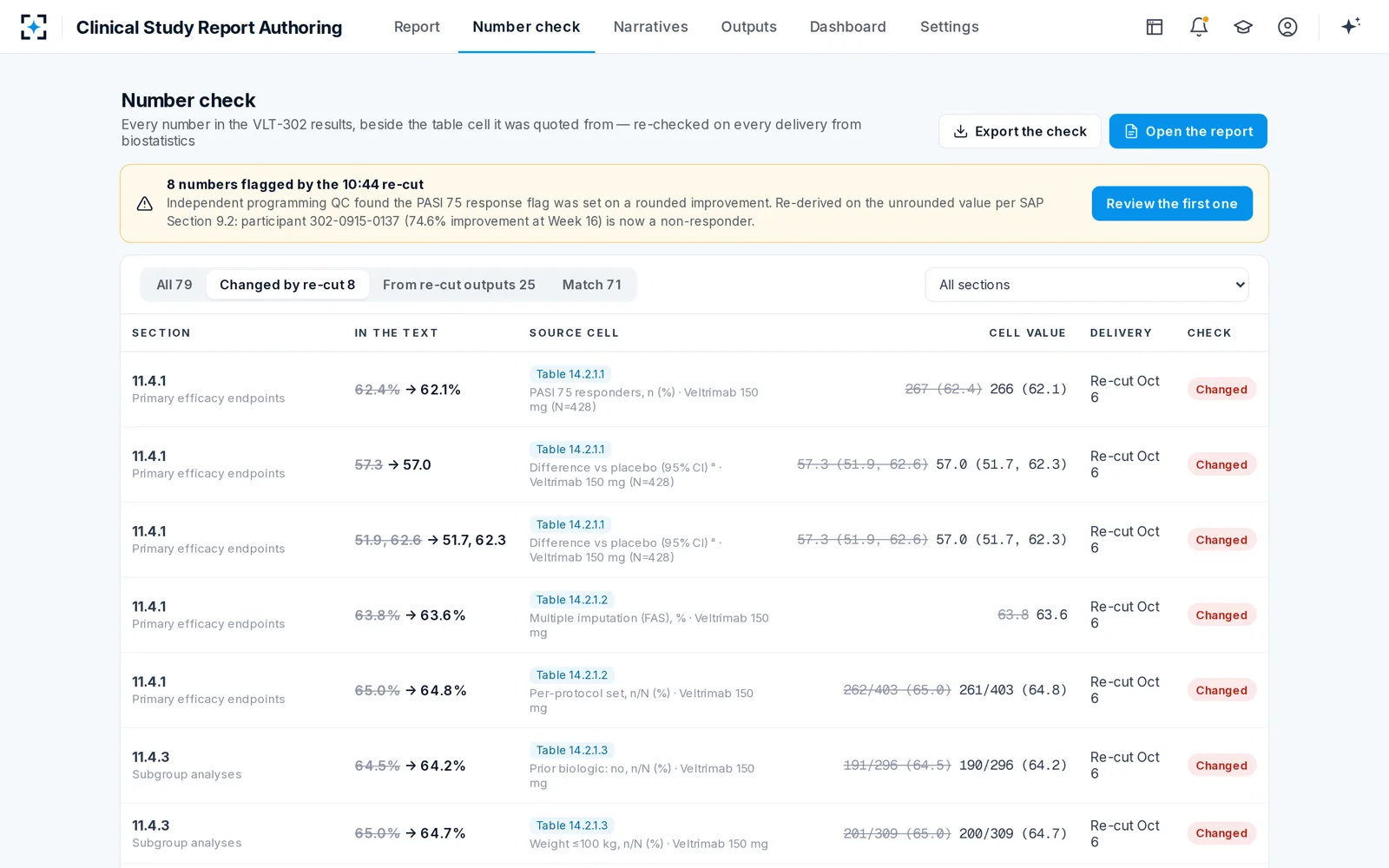
Every row carries its denominator's evidence: the sentence, the cell it came from, and which delivery that cell belongs to.
The same scorecard has limits that should be stated alongside it. It covers the results sections the sample study drafts, not the synopsis or in-text summary tables. And number-words in its safety section ("One death occurred", "a 67-year-old") are not linked or checked there, so its unsourced-number rate is complete only for numerals; the fuller build of the solution requires them to be linked or justified. A scorecard that names its own gaps is worth more to QA than one that does not.
The checks themselves were also measured. In our own tests on synthetic study data, they caught 20 of 20 seeded wrong numbers and 10 of 10 seeded unlinked ones, and flagged 600 seeded cell changes with recall and precision of 1.00. These are tests of the checks on fictional fixtures, not results from a customer study, and they are what the replay on your own studies is for.
Seeded errors caught by Clinical Study Report Authoring's checks, in our own synthetic tests
20of 20
wrong numbers planted in drafted sections
10of 10
unlinked numbers planted
600of 600
cell changes planted in re-deliveries; recall and precision 1.00
What 100% should mean, and what it must not be allowed to mean
A 100% number match rate means each number equals its cell, from the right population and column, in the latest delivery. It does not mean the analysis is right. In the sample study, the error that started everything was in the derivation of a response flag; programming QC found it, not the text check. It does not mean the interpretation is right either: a sentence can quote 62.1% accurately and still overstate what it shows. And it says nothing about selection, whether the report quotes the numbers a reviewer needs.
It also does not mean zero errors in the next study. Zero observed errors in n checks puts the upper bound of a 95% confidence interval at roughly 3/n (the "rule of three"). Zero mismatches in 79 numbers is consistent with a true error rate of up to about 3.8%; zero in 10,000 bounds it near 0.03%. That is why the denominator matters more than the percentage, and why the replay should cover thousands of numbers before anyone quotes a rate.
A 100% match rate without its denominator is a slogan. With 79 numbers behind it, it still allows an error rate of nearly 4%.
Thresholds: what holds a section, and what only gets reported
Separate two kinds of threshold. Evaluation thresholds decide whether you trust the system enough to use it on a live study; release holds decide whether a particular section may be signed today. The first can be a rate. The second should be absolute.
- Hold the section while any number has no source cell, mismatches its cell, or quotes a cell a later delivery changed. A rate of 99% here still means a wrong number in a signed report.
- Hold the narrative while a required 12.3.2 element is missing or a detail is missing at source, until a person resolves it or writes down why it does not apply.
- Withdraw a signature when a signed section's numbers change, so the signer sees the new values rather than inheriting them.
- Report, do not hold, on first-time-right sections, re-cut precision and review effort. These are trend measures for the head of medical writing.
- Set the evaluation bar before the replay, including the minimum denominator per error type, so the result cannot be argued into a pass afterwards.
These holds belong in the system, not in a checklist a busy writer can skip, and they should stop a person, not an agent: the agents may flag and propose, but releasing a held section is a signed human decision.
Reporting accuracy to QA and to regulators
We found no regulator guidance written specifically for AI-drafted CSRs. FDA's 2025 draft guidance on AI explicitly does not address AI used for "drafting/writing a regulatory submission" when it does not affect patient safety, drug quality or the reliability of study results (FDA, January 2025). EMA expects "close human supervision" and "quality review mechanisms" that ensure all model-generated text is "factually and syntactically correct before submission" (EMA, 2024). Either way the accountability sits in the sponsor's existing quality system, and the evidence you need is the evidence QC already produces, made complete.
A QC specialist writing in EMWA's journal defines medical writing QC as checking documents "against source data", comparing the data in tables and checking "that analytical statements are supported by the data presented" (Jones, 2018). A number-level scorecard turns that definition into something an auditor can sample: each number with its cell, delivery and check result; each change with the old value, the new value, who accepted it and when. It is the "traceable" in ALCOA++, which EMA's computerised-systems guideline applies to all data generated in a trial (EMA, 2023). Hamilton's EMWA data put QA on the final integrated report at a mean of 6.6 working days (Hamilton, 2014). A scorecard that is complete before QA begins does not remove that step; it changes it from re-deriving every number to sampling a trail.
What to hand QA, then: the replay protocol and its seeded-error results; the evaluation thresholds and the date they were set; and, for each live report, the number check at the moment of each signature. What a regulator may ask for is the same trail, study by study. What regulators require maps those controls to ICH E3, Part 11 and EMA's expectations, and the six-week plan builds the replay on one of your own completed studies in its first weeks. The design that makes all of this countable is set out on the Clinical Study Report Authoring page.
Questions people ask
Can the AI put a number in the report that is not in the tables?
In Clinical Study Report Authoring, no: the model places a reference to a cell and the value is rendered from the delivered output, so a numeral with no cell is refused and the section cannot be approved. The residual risks are choosing the wrong cell and the cell going stale, which is what the number match and stale-number rates measure.
Should we use an LLM to grade AI-drafted CSRs?
For style, tone and whether a claim is fair, an LLM can help reviewers triage. For numbers, no: the comparison is exact and should be done by code you can validate, with a human adjudicating every disagreement.
How many studies does a replay need?
Enough numbers to make the denominator meaningful for each error type, which usually means two or three completed studies of different designs, at least one with a post-lock re-run. Seeded errors top up the rare types.
What is a 100% QC check in medical writing?
It means every number and statement in the document is checked against its source, not a sample of them. Whether it covers the whole report or only its data is set in each sponsor's QC procedure, and it is why QC time scales with the number of quoted values. For AI drafts, the rule of three above shows why the denominator of a "100%" matters as much as the rate.
Can QC software replace the human QC reviewer?
Not for judgement. Consistency tools and a deterministic number check can remove most of the mechanical work, but whether a statement is supported by the data, or an endpoint is described with the right emphasis, still needs a person who understands the study. What software can do is make the reviewer's sample a trail rather than a re-derivation.