Clinical study report automation is software that takes over parts of writing a clinical study report: drafting, checking, reusing approved text and following changes. A clinical study report (CSR) is the ICH E3 document that tells regulators what a trial found. Medical writers build it from hundreds of tables, listings and figures (TLFs) after database lock, and biostatistics, safety and clinical leads sign it. It is hard because every number must match its source table, and the tables keep changing: programming QC re-runs outputs after the text is drafted, sometimes after a section is signed. Four generations of CSR authoring have tackled this: copy-paste in Word, structured content authoring (SCA), templated natural-language generation (NLG), and AI agents. Botminds' Clinical Study Report Authoring belongs to the fourth: agents draft the report from the locked tables, link every number to its cell, and trace each re-cut to the sentences and signatures it reaches.
The four are layers rather than rivals: SCA reuses approved text, templates fill fixed shapes, and agents draft, check and follow change. The comparison that matters is what each one does when programming QC re-runs a table the report already quotes.
The best published evidence for each step forward
16.9days
By hand: working days from final tables to a first draft, then 25.7 more to final
EMWA practitioner survey, 2008–2013
35hours
Novo Nordisk: authoring effort per CSR from lock to approval, with a lean template and a pre-approved text library
Company figure, in a peer-reviewed article
~90%
Pfizer: blinded experts scored AI-drafted PK sections against expert-written ones
Peer reviewed; seven reports
What is clinical study report automation, and which parts of a CSR can it take?
It is any method that removes a person from a mechanical step between the locked outputs and the signed report, and the steps differ enough that no single method covers them all. Reusing approved methods text is a library problem; writing efficacy results is a drafting problem; checking 79 numbers against their cells is a comparison problem; following a re-run table into a signed section is a change problem. A buyer who asks "can it automate the CSR?" gets a yes from every vendor. The better question is which of these steps each method takes, and which it leaves.
Which parts of a clinical study report each kind of automation can take
| Part of the report | What the work is | Method that fits | What stays with people |
|---|---|---|---|
| Design, methods, populations | Restating the protocol and analysis plan | Structured content reuse; drafting from a structured protocol | Approving the wording once |
| Disposition and baseline | Standard results with a predictable shape | Templated text or agents drafting from the tables | Reading for anything unusual |
| Efficacy and safety results | New sentences about this study's numbers, with emphasis and caveats | Agents drafting from cells, with every number linked | The interpretation and every claim |
| Patient narratives | Fixed ICH E3 elements, repeated hundreds of times | Templated generation or cited drafts from the listings | Clinical review and attestation |
| Number QC | Each value against its source cell | Deterministic comparison, once numbers are linked | Adjudicating disagreements |
| A re-run after lock | Finding every sentence a changed cell reaches | Delivery-to-delivery comparison through the links | Accepting each update; re-signing |
| Discussion and conclusions | The argument of the report | Agents can draft and flag claims a re-cut undermines | Writing and signing the argument |
Read down the third column and the generations sort themselves. Structured content takes the first row. Templated generation takes the second and fourth. Agents with source links can take the middle rows, and the two checking rows only work if the numbers were linked when they were written. The rest of this page tests each generation on the row that hurts most, a table re-run after someone has signed.
Generation 1: copy-paste from RTF tables into Word, checked by people
Generation 1 is the hand-built report, and it is still common: biostatistics delivers the TLFs as RTF or PDF, and the writer types the numbers into a Word template. A typical Phase 3 trial produces 200–500 such outputs, each double-programmed, according to a 2026 review of statistical programming (a preprint). Across 78 industry CSRs, Doshi and Jefferson measured the attached tables alone at a median of 337 pages.
The method's defect is not speed but memory. Once a percentage is typed into a sentence it no longer knows which row, column, population and program run it came from. Every check after that is a person reopening the table: medical-writing QC means checking the document "against source data", then for consistency and format. In the EMWA timing survey, writers needed a mean of 16.9 working days from final tables to a first draft, then 25.7 to final, over 2.6 review cycles. The spread is wide: 3 to 120 days for the second step. The same survey's advice is blunt.
"Draft data changes in the final TFLs will mandate changes in the CSR."
Hamilton, Medical Writing (EMWA), 2014
That sentence describes the problem every later generation is measured against. Hand-built reports cope with change by avoiding it: writers wait for final tables, and a late re-run means a person re-reading every page that might quote it. The calendar from lock to signed report is shaped largely by this waiting.
Generation 2: what is structured content authoring in pharma, and where does it stop?
Structured content authoring makes approved text reusable across documents; it does not make the numbers in a CSR traceable. It attacks a different waste: the same paragraph written several times across a programme. The EMWA overview by authors from Parexel, Lilly, Pfizer and Roche puts the principle as "create once, use often". Content is broken into components, labelled with metadata and managed centrally, so a study design paragraph written for the protocol is reused, not retyped, in the CSR. The same authors name what it cures: "information drift", the slow divergence of the same fact across separately written documents.
SCA pays off where text really is shared: study design, endpoint definitions, methods that restate the protocol and the statistical analysis plan, standard safety wording. It also pushes teams toward agreed templates. TransCelerate released a common CSR template in 2018, and the ICH M11 structured protocol was adopted in November 2025, which gives SCA a machine-readable source upstream.
Templates alone do not make reports lean. Writing leaders from eight sponsors report that Lilly moved from a 14-section to an 8-section report in 2020, yet "reports over 10,000 pages continued". ICH itself warns, in its 2012 E3 Q&A, that E3 "is a Guideline, not a set of rigid requirements or a template".
The limit is structural. A component is approved text. The results sections are not reused text; they are new sentences about this study's numbers. In a typical SCA set-up, "64% of participants responded at Week 16" is a sentence inside a study-specific component, and the number in it is as unlinked as it was in Word. When the table is re-run, the library has nothing to propagate.
Generation 3: templated NLG and programmed text
Templated generation writes exact numbers into sentences someone wrote in advance, which makes it fast for patient narratives and rigid almost everywhere else. Its oldest form is programmed text: a SAS or R macro that emits "x of N (y%) participants" straight from the analysis dataset. Its commercial form is natural-language generation (NLG), in which rules choose among pre-written sentence patterns and fill their slots. The output is exact by construction, because the value goes from dataset to sentence with no one retyping it.
It found its best use in patient narratives. ICH E3 12.3.2 fixes the elements of a narrative, so a narrative has a predictable shape, and a single CSR can need 1,000 or more of them. Two medical writers describe the programmed approach as "currently widely adopted": a template whose placeholders are filled from the clinical database, "producing consistent and accurate outputs", so the writer no longer checks each value by hand. Manual intervention by writers, they add, "is, however, still required". (How a cited narrative is built today is the subject of a separate piece.)
Templates are bounded by what their authors foresaw. They render the sentence they were given; they do not judge whether a 9% decrease is "small" or "moderate", or whether "consistent across subgroups" still holds after a re-run. A template that covers efficacy prose must be built per endpoint and per design. That is why narratives, with their fixed list of elements, suit it best. Practitioners already see the next step: the same writers note that an AI tool can "self-generate a full narrative output" from listings and safety forms, while judging the programmed approach still better suited, for now, to standardised narratives. The generations are already merging at the edges.
On a re-cut, templated text has one move: render again. The new values arrive, but the writer's edits since the first render must be protected or merged by hand, and nothing in the output says which values moved, or that one of the re-rendered paragraphs sits in a section someone signed an hour earlier.
Generation 4: AI agents for CSR writing, and how Clinical Study Report Authoring uses them
AI agents draft the results sections and narratives from the locked tables and keep a link from every number to its cell, so the report can be checked and updated instead of re-read. An agent here means a language model given a narrow job, a defined set of sources and rules it cannot break, working alongside other agents and handing its work to a person. For a CSR that means: read the locked delivery into addressable cells, draft the results sections and narratives in the house template, check every number against its cell, and, when a new delivery arrives, work out what it changed in the text.
The first published results are strong on speed. In a blinded test at Pfizer, experts scored AI-drafted pharmacokinetic sections at about 90% of the quality of expert-written ones, produced in a mean of 18.2 minutes. The Pfizer authors add the condition for adoption: "traceability of generated text to source data, immutable logs, and documented human review".
That condition is the design centre of Clinical Study Report Authoring. Take a sample study, VLT-302, a Phase 3 psoriasis trial with fictional participants, as it runs through the solution. Its 412 outputs are read into cells, each keeping its row, column, population and program run. Every number in the draft is a link to one of those cells: click it, and the table opens beside the text at that cell.
Clinical Study Report Authoring: a number that remembers its cell
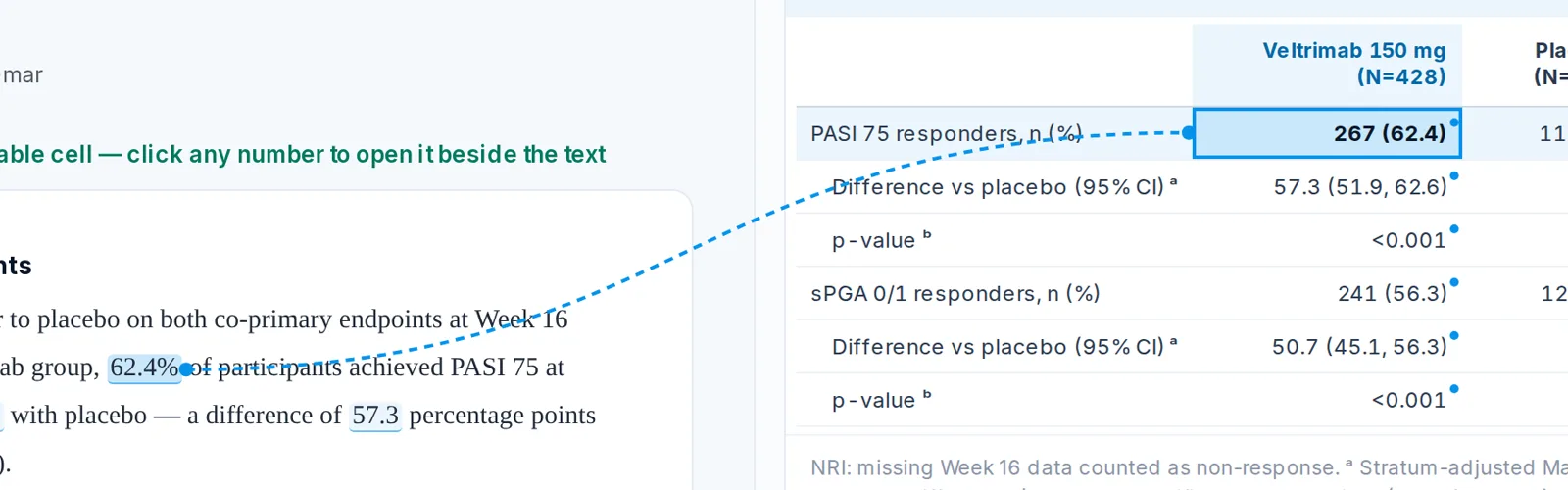
The link is the unit of trust: the number in the sentence and the value in the delivered cell are compared, not assumed.
In the full build the model never types a number at all. It places a reference to a cell, the system renders the value exactly as delivered, and a bare numeral the model writes is refused. The agents draft, check and propose; people approve and sign. How the jobs divide between the agents, and what each is forbidden to do, is set out in a piece on the agents themselves.
Can ChatGPT write a clinical study report?
A general chat assistant can write fluent CSR prose, but not a reviewable report: it keeps no link from a sentence to the table cell it rests on, so every number still has to be checked by hand. Many writers already use a general assistant. In a small 2023 EMWA survey, 52% of 76 medical writers used an AI writer occasionally and 17% regularly. For rewording, summarising a protocol or tightening a discussion paragraph, a chat window is a fine tool.
It is the wrong tool for the results sections, and not mainly because it might invent a number. The Pfizer study catalogues the subtler failures that survive a fluent read: "moderate" used for a 9% decrease in Cmax where convention says "small", and a criterion called "pre-specified" when it came from earlier reports, not the protocol. A chat transcript cannot show which cell a sentence rests on, so every such slip is found only by a person re-reading against the tables, which is generation 1's QC with a faster typist.
Regulators have drawn the line in the same place. The FDA's 2025 draft guidance on AI explicitly leaves "drafting/writing a regulatory submission" out of its scope, so accountability stays with the sponsor's existing quality system. The EMA expects generated text to be used "under close human supervision", with review mechanisms that make sure "all model-generated text is both factually and syntactically correct before submission". Neither asks for a particular tool; both ask what evidence the review rests on. What the rules require of an AI-drafted report is covered on its own.
What happens to each generation when a TLF is re-run after database lock?
Only the fourth generation can say which sentences a re-run table changed and withdraw the signatures it reaches; the other three leave a person to find out. First drafts flatter every generation. The informative test comes later. In VLT-302, independent programming QC finds that the PASI 75 response flag was set on a rounded improvement. Re-derived on the unrounded value, one participant becomes a non-responder, and four outputs are re-run on the morning of 6 October, four days after lock. Across those four outputs, 8 of 38 cells change. The report quotes 25 numbers from them, and one of the affected sections, 11.4.3 Subgroup analyses, was signed by the biostatistics lead at 09:40.
One re-cut, four generations: what each knows about the 25 affected numbers
In the solution, the check runs in five visible steps: read the re-run outputs, compare them cell by cell with the previous delivery, find every sentence that quotes a changed cell, re-check the other numbers from those outputs, and flag the result for the writer. It finds 8 numbers in 5 sentences across sections 11.4.1, 11.4.3 and 13; the other 17 still match. Each flagged sentence shows the old value struck through beside the new one, and approval and export are held until a person updates the text.
In Clinical Study Report Authoring, the re-cut reaches a signed section
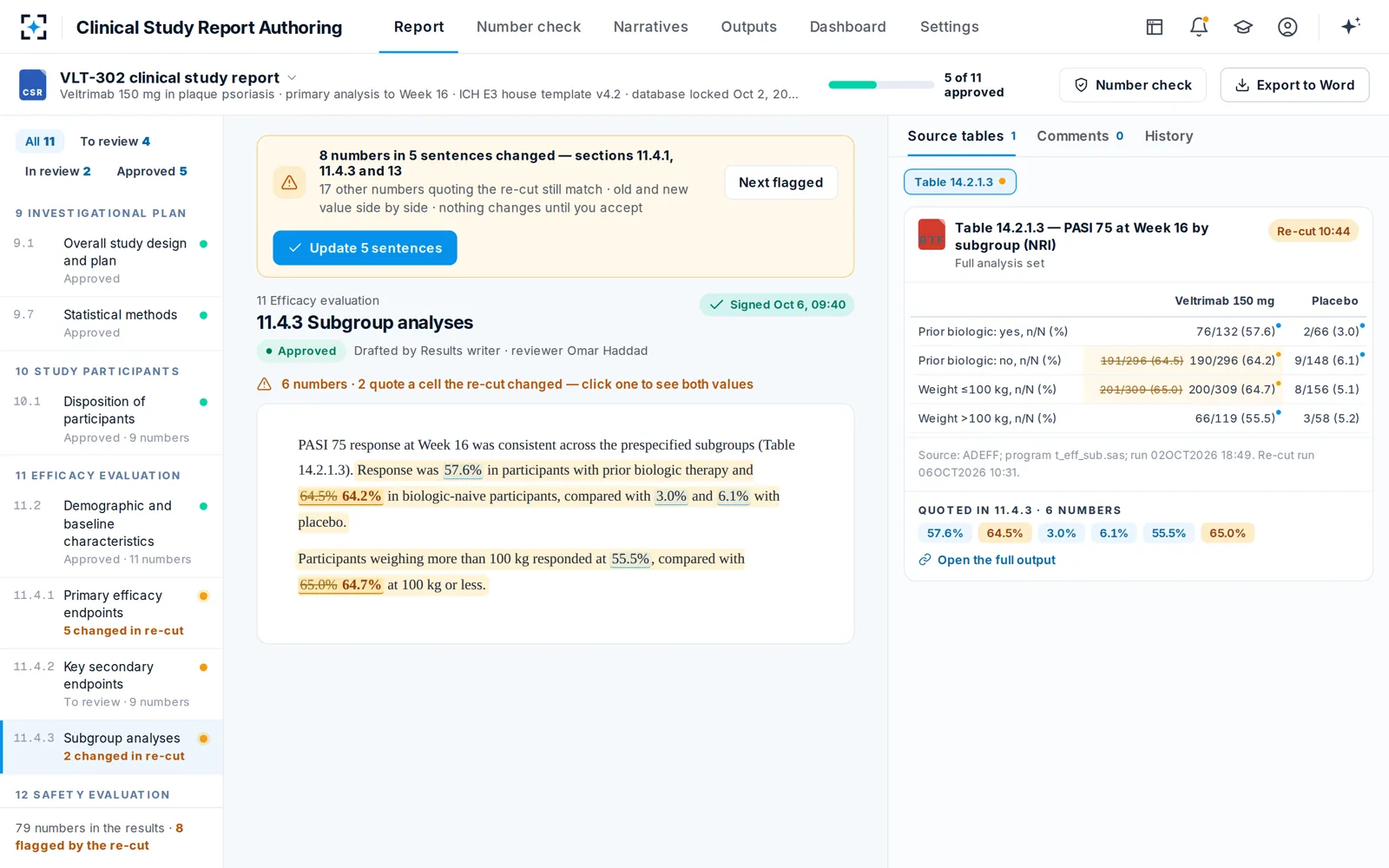
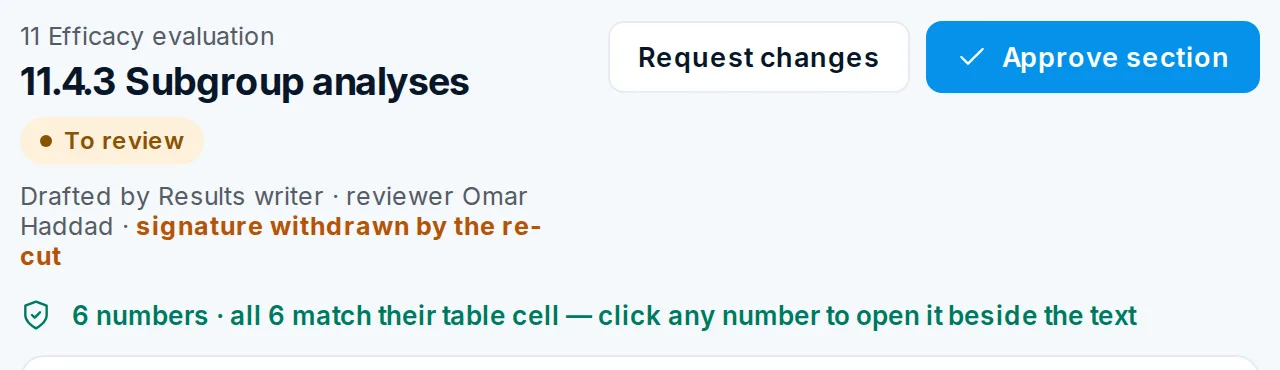
The last step is the one the earlier generations have no concept of. Updating the text changes a section that carries a signature, so the solution withdraws that signature and sends the section back to its signer, who signs the new version again. A signed section never changes silently. That matters beyond tidiness: 21 CFR Part 11 requires that an electronic signature be "linked to their respective electronic records", and a signature that silently survives a change to the signed text is linked to text that no longer exists. The minute-by-minute version of this morning is in the 10:44 re-cut case study.
After the update, the signature does not survive the change
How to choose CSR authoring software: five tests
Test behaviour, not category: five checks on one of your own completed studies show which generation a tool really belongs to. Category labels blur quickly; vendors in every generation now say "AI". These five tests can be run in a day on a completed study of your own, and each gives a yes or no.
Five tests that separate the generations
- Sources: click a number
Does it open the exact cell, with row, column, population and program run? A table reference is not a cell.
- Re-cut: re-run one table
Which sentences are flagged, in which sections, with old and new values? How many are you told still match?
- Narratives: remove one fact
Delete a discharge date from the listings. Does the draft guess, leave a gap, or raise a query?
- Signatures: edit a signed section
Does the signature survive the edit? It should not. Who is asked to sign again?
- Template: break a cross-reference
Rename a table or drop a required E3 heading. Is it reported before review, or found by a reviewer?
Run the re-cut test with seeded changes so the answer is a count, not an impression. In our own tests on synthetic study data, the solution found all 600 seeded cell changes with no false flags, and caught 20 of 20 deliberately wrong numbers. A tool that cannot be measured this way cannot be trusted this way; how to measure an AI-drafted report sets out the method.
If you already run structured content: what agents add
Structured content and templates: Reused from a managed library: design, definitions, methods.
Agents on top: The same library, used as the drafting source for those sections.
Structured content and templates: Written per study by a writer, or rendered from a fixed template.
Agents on top: Drafted per study from the locked tables, in the house template.
Structured content and templates: Typed, or filled from a dataset; no link once it is in the text.
Agents on top: A link to its cell, checked for value, rounding, population and column.
Structured content and templates: Re-check by hand, or re-render and merge edits.
Agents on top: Changed cells traced to the sentences that quote them; the rest confirmed.
Structured content and templates: No link between a signature and the numbers under it.
Agents on top: Held while flagged; a changed section loses its signature and is signed again.
Should you build or buy CSR automation? Combine the generations first
Most teams should combine them: approved text from structured content, the house template, and agents for drafting, checking and following change. The useful question is not which generation to buy but which layer does which job. The programme reporting the largest published gain already stacks them. Novo Nordisk's CSR automation couples "a pre-defined and pre-approved text library" with the protocol and the study's actual findings, which is SCA's library feeding an automated layer. Writing leaders from eight sponsors put the dependency in one line: "AI is only as good as the content it is trained on."
One workflow, three layers: where each generation earns its place
Agent
Read and draftLocked TLFs into cells; approved text for design and methods; results and narratives from the cells.
Never: writes a number without its cell
Agent
Check every numberValue, rounding, population and column, against the linked cell.
Never: lets a mismatched section be approved
A person decides
Writer and reviewers decideEdit the argument, accept or reject proposals, sign their sections.
Agent
Follow each new deliveryCompare cell by cell; flag the sentences a change reaches.
Never: changes signed text
A person decides
Signers sign againOnly the sections whose numbers actually moved.
Building it yourself is possible, and the published case shows what it takes. Novo Nordisk first rewrote its template, then built its own tool on a text library "developed by analyzing historical CSRs"; its writing leaders report about 35 hours of authoring effort per CSR from lock to approval, with four writers automating all of the company's CSRs and 37 freed for other work. Those figures are the company's own, and the template work came first: the same authors warn that "automation applied to an inefficient operation will only amplify the inefficiency".
Speed alone no longer distinguishes a CSR tool: a credible first draft in minutes is now a peer-reviewed result. What a build has to get right, and what a buyer should test for, is the control model: the link from each number to its cell, the re-cut trace, and signatures that cannot outlive the text they approved. The economics of each route deserve their own arithmetic.
Questions people ask
Is structured content authoring the same as AI writing?
No. Structured content authoring manages and reuses text that people wrote and approved; AI generates new text. The two combine well: the approved library becomes the source the AI drafts design and methods sections from.
Do we need structured content in place before adopting agents?
No, but it helps. Agents can draft results directly from the tables, which is where SCA contributes least. An approved library makes the design and methods sections consistent, so drafting starts from text your reviewers have already accepted.
Which parts of the report should stay with people?
The interpretation: the discussion and overall conclusions, the clinical judgement in narratives, and every approval. Agents can draft those sections and flag when a re-cut undermines a claim, but the argument and the signature belong to the people named in the report.
Does CSR automation shorten review rounds?
Less than anything else. In our own estimate on the sample study, copying, drafting, narratives and checking fall from 14.5 weeks of writing effort to 1.4, while review rounds fall only from 2 weeks to 1.4, because review is where people read, argue and decide. The EMWA survey's mean of 2.6 review cycles per report is the part of the calendar automation leaves most intact.
How long does a fair comparison take?
The five tests above can be run in a day on a completed study. A proper pilot that starts from one of your own studies is covered in the six-week plan.