How long does it take to write a clinical study report? About 74 working days from database lock to a final report for a moderately complex Phase 3 study, in the only public stage-by-stage benchmark, with a range wide enough that a team's own history predicts better. A clinical study report (CSR) is the ICH E3 document that tells regulators what a trial found, written after database lock from the tables, listings and figures (TLFs) that statistical programming produces. It is hard less because of the writing than because the text quotes values from hundreds of outputs, and every one has to keep matching its source through re-runs, review rounds and signatures. That benchmark, workshop data EMWA collected between 2008 and 2013, gives drafting just over three of those weeks. Botminds' Clinical Study Report Authoring exists for the rest: its agents link every number in the draft to its table cell, draft the results and patient narratives, and trace each re-cut to the sentences it changes, while people decide and sign.
After lock, the report passes through seven stages: outputs delivered, numbers moved into text, results drafted, patient narratives, quality control, review rounds and signatures.
The benchmark: three weeks of drafting inside fifteen weeks of elapsed time
16.9
working days, final tables to first draft
mean; range 5–45
25.7
working days, first draft to final report
mean; range 3–120
2.6
review cycles per report
mean; range 1–5
≈74
working days, lock to final report
our sum of the stage means
Those weeks are not spent writing. Look at what each stage actually involves and three kinds of work come out: copying (moving a value from a table into a sentence), checking (proving that the value in the sentence is still the value in the table) and judgment (deciding what the results mean and whether to sign). Only the third needs a medical writer, a statistician or a physician. The first two take most of the calendar, and they are what agents should take over.
What happens after database lock?
Database lock freezes the clinical data and starts the reporting clock, but the writer has nothing final to write from for about five working weeks, while statistical programming produces and checks the TLFs. Getting to lock already takes time: a Tufts CSDD survey of 257 companies, published in Therapeutic Innovation & Regulatory Science, put the average from last patient last visit to lock at 36.3 days. Lock then starts a second clock, the one that ends when the report is signed.
The first leg of that clock belongs to statistical programming. In the EMWA data, draft tables, listings and figures arrived a mean 13.9 working days after lock, and final ones another 10.6 days later. A 2026 scoping review (a preprint) counts 200 to 500 outputs in a typical Phase 3 trial, each independently double-programmed.
So the writer's first real input is a delivery of several hundred files. Everything after that is a relay between five or six people, and every hand-off adds time.
What lock hands the writer: hundreds of outputs, not a story
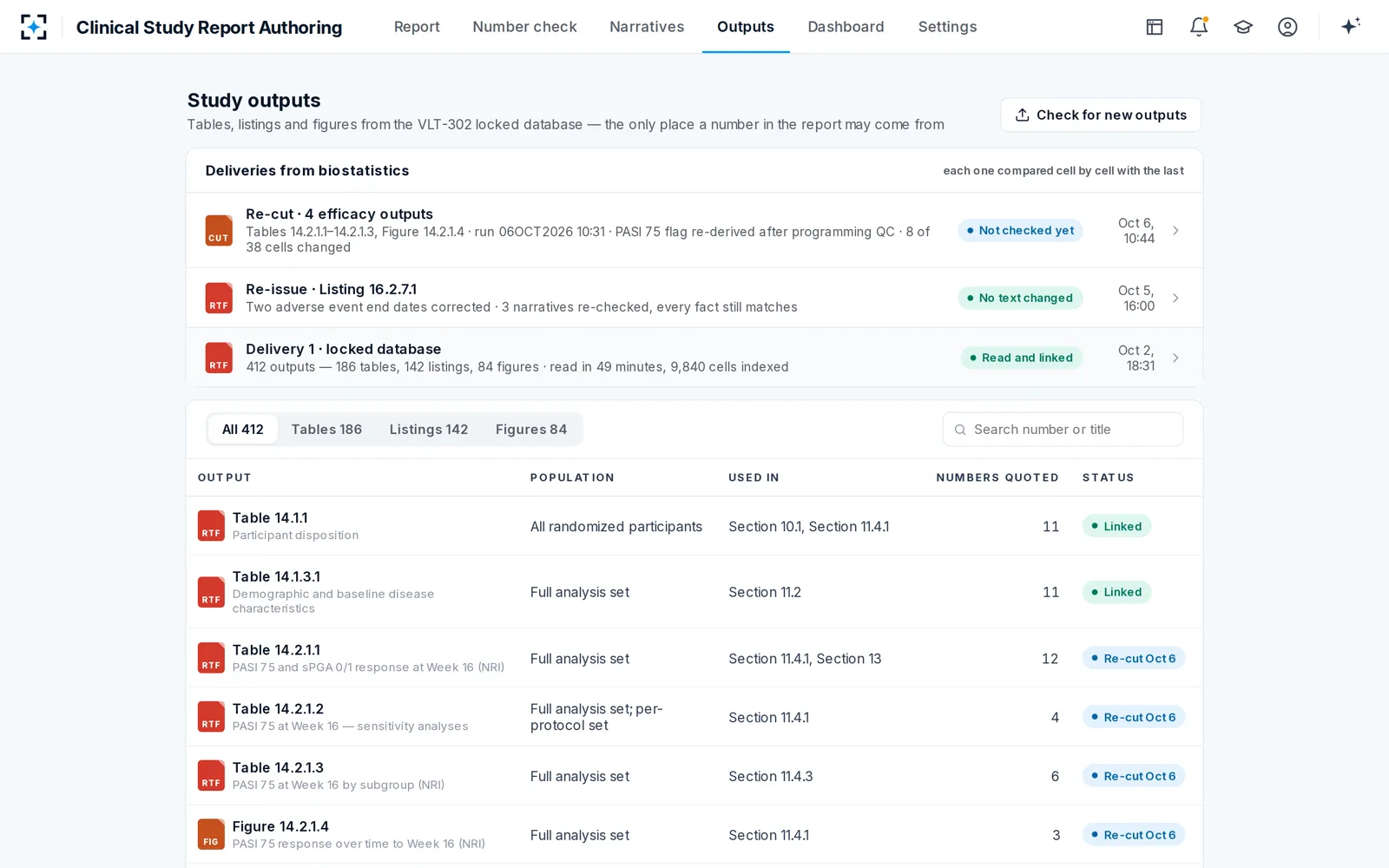
The useful question about a delivery is not how many outputs it holds but which sentences depend on each one. That is the link this screen keeps.
What are the steps in writing a clinical study report, and who owns each?
The medical writer takes part in all seven stages, which is why the writer's calendar sets the report's calendar. Each stage has an owner who does the work and others who review it, answer questions about it or sign it. The statistician is in four rows, and the statistical programmer appears twice more after delivery, because quality control and review are when outputs get re-run.
Who holds each stage, and where the re-cut sends the work back
- Writer medical writer
- Stats biostatistician
- Safety safety physician or medical monitor
- Lead clinical lead, the sponsor's responsible medical officer
- QC independent quality-control reviewer
- Prog. statistical programmer
1. Outputs delivered
Programming produces the tables, listings and figures from the analysis datasets; the biostatistician reviews them against the statistical analysis plan. The writer waits, or drafts from draft outputs, which the EMWA author warns against: "Draft data changes in the final TFLs will mandate changes in the CSR."
2. Numbers moved into text
The writer finds each value an in-text table or sentence needs, in the right output, row, column and population, and types it in. A single primary efficacy section can quote a dozen or more numbers from several outputs. This is copying, and it is where transcription errors are born.
3. Results drafted
Disposition, baseline, efficacy, safety and conclusions are written around those numbers, with the statistician answering method questions and the clinical lead shaping the key messages. This stage holds most of the genuine judgment in the report.
4. Patient narratives
ICH E3 asks for narratives of each death, each other serious adverse event and other significant events of special interest. Depending on the phase of the trial, a single report can need as many as 1,000, each one to four pages long: assembly from listings and the safety database, then medical review by the safety physician. The narratives page takes this stage apart in detail.
5. Quality control
An independent reviewer checks every number against its source. In EMWA's journal, a QC specialist describes the job as checking the document "against source data", comparing the data in tables and confirming that each analytical statement is supported by them, then for consistency and format. It is pure checking, repeated whenever an output changes.
6. Review rounds
The draft circulates to statistics, safety, clinical and regulatory reviewers, comments are reconciled and the text revised, an average of 2.6 times per report in the EMWA data. Each round can surface a question that sends programming back to re-run an output.
7. Signatures
The owners sign their parts and the responsible medical officer signs the report. A signature is only as good as the version it was given on, so any later change to a signed section has to send it back to its signer. The five people who sign each see these weeks differently.
How long does it take to write a clinical study report, stage by stage?
About 74 working days from lock to final for a moderately complex Phase 3 study, if you add up the EMWA survey means, though the spread is so wide that no single number holds. The EMWA table is still the only public, stage-by-stage benchmark, and its own author is blunt about its limits.
"There are no industry standard durations for analysis and reporting tasks."
Hamilton, Medical Writing, 2014
The spread proves it. Drafting ranged from 5 to 45 working days; first draft to final ranged from 3 to 120, with a standard deviation (21.1 days) almost as large as the mean. A team's last report is a better predictor of its next one than any industry average.
The newer figures are small or company-reported, and measure different things. In a blinded test at Pfizer, published in Clinical and Translational Science in 2026, AI-drafted pharmacokinetic results scored about 90% of the quality of expert-written CSRs with clinical pharmacologists as judges. Medical writing leaders from eight large sponsors, writing in Therapeutic Innovation & Regulatory Science in 2026, report an average of 5.25 weeks from availability of data to approval for registrational reports at companies using lean authoring, and about 35 hours of authoring effort per report at Novo Nordisk.
Two lessons follow. The first draft is no longer the hard part: a model can now produce a credible one, and lean templates have shrunk what it must contain. And none of these figures says much about the stretch after the first draft, which in the EMWA data was the longest and least predictable stage of all.
Where the weeks go: waiting, copying and re-checking
A third of the calendar is waiting for outputs, the longest stage is review rounds, and the first draft takes under a quarter.
Where the 74 working days go
- Draft TLFs13.9 d
- Final TLFs10.6 d
- First draft16.9 d
- Review rounds25.7 d
- QA6.6 d
Read the bar with the three kinds of work in mind. The first third is waiting for programming. The blue segment, the only one that looks like writing, is itself mostly copying numbers and checking them. The amber segment, the longest, is reviewers reading, the writer reconciling comments, and the same numbers being checked again each time an output moves.
- Copying: moving values from outputs into sentences and in-text tables; assembling narratives from listings.
- Checking: QC of every number, re-checking after each re-issue or re-cut, confirming cross-references and consistency between synopsis, body and conclusions.
- Judgment: interpreting results, choosing what the report argues, medical review of narratives, resolving reviewer conflicts, signing.
None of the public benchmarks splits the weeks this way, so treat any precise share with suspicion, including ours below. The direction is consistent, though. Writing in EMWA's journal about narratives, two medical writers recall that writers "used to spend a huge amount of time simply copying and pasting data from multiple sources", and that every hand-entered value then needed a full QC check.
Why re-cuts and review rounds stretch the CSR timeline
The draft-to-final stage varies so much because it is a loop, not a line. A reviewer queries a result; programming QC finds a derivation issue; an output is re-run. Every sentence that quotes the re-run output now has to be found and re-checked, including sections that were already approved, and the signatures on those sections are no longer good.
Done by hand, that search has no shortcut. The writer goes through the report looking for every number taken from the changed outputs, compares each with the new delivery, corrects the ones that moved and tells the signers which sections changed. In practice the safest course is often to re-run QC across every section that quotes the outputs. Each re-cut can cost days, and with an average of 2.6 review rounds there is room for more than one.
A re-cut, traced to the sentences it touches
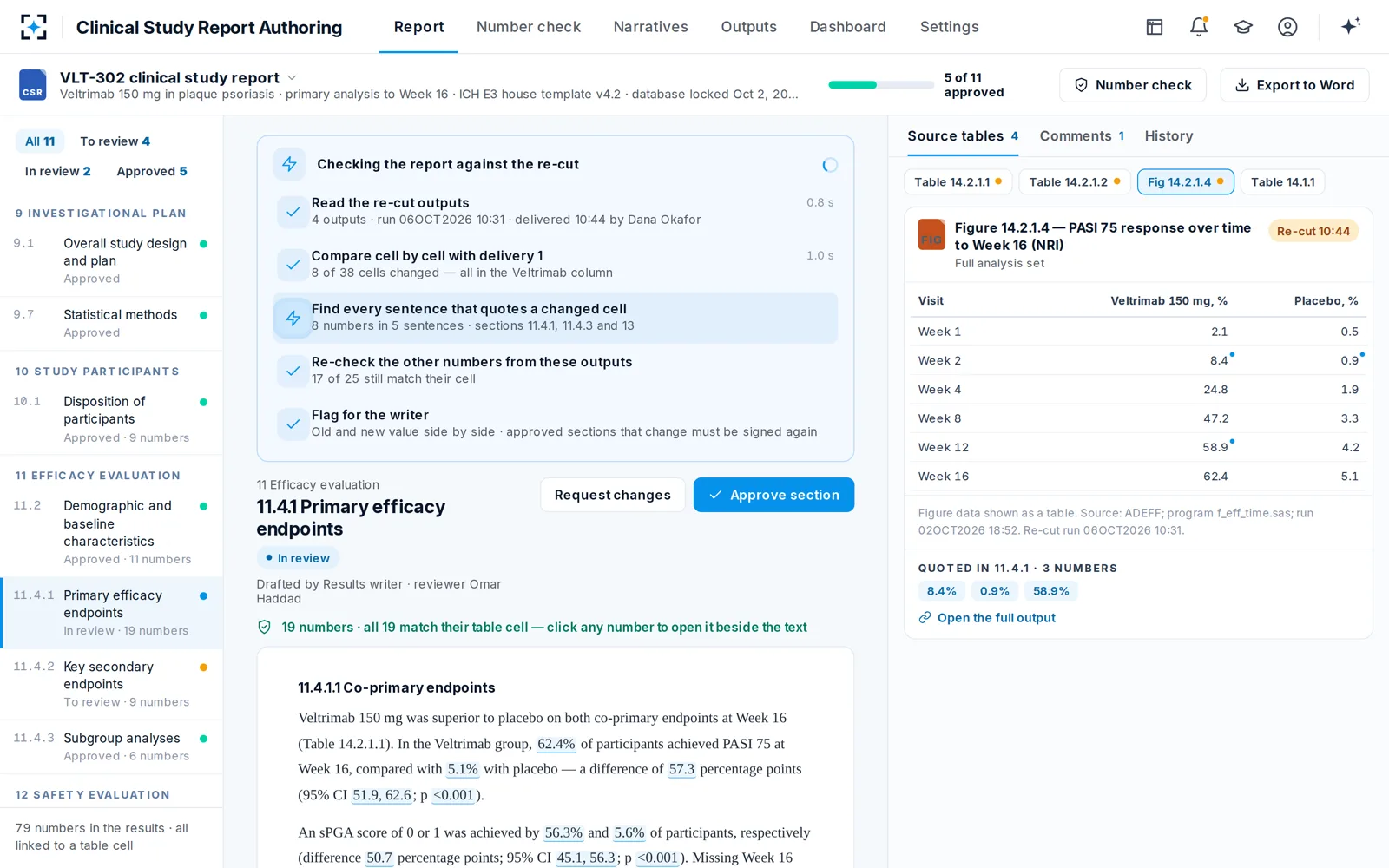
One of those sections, the subgroup analyses, had already been signed that morning. The signature is withdrawn and the section goes back to its signer.
The re-cut case study follows that one morning minute by minute. The point for the timeline is simpler: if finding the affected sentences takes seconds instead of days, the loop stops dominating the tail. In our own tests on synthetic study data, the list of affected sentences was ready 6.4 to 10 seconds after a re-cut was uploaded, and all 600 cell changes seeded into the test deliveries were found with no false alarms. Those are test results on fabricated studies, not a customer measurement.
What makes a clinical study report take longer to write?
Complexity, counted in outputs, endpoints and serious events more than in participants. The EMWA author lists what a scheduler should weigh: the number of subjects, the study phase, the indication, the number of secondary efficacy variables, the number of unique TLFs and the complexity of the analysis. The survey means on this page describe the middle case, a Phase 3 study of 200 to 400 participants; a "high" complexity report runs longer on every stage.
Page counts show what that means on paper. Across 78 industry reports that Doshi and Jefferson assembled for BMJ Open, the median synopsis ran 5 pages, the efficacy evaluation 13.5 and the safety evaluation 17, while the attached tables ran 337 pages and the individual efficacy listings 447. The text a writer drafts is a thin layer over hundreds of pages it must agree with, and each of those pages can move.
Five things that lengthen a clinical study report, and why
| Driver | Why it adds time | Scale in the published record |
|---|---|---|
| Unique outputs | Each table, listing or figure is a source the text may quote, and one more thing QC re-checks when it changes | 200–500 in a typical Phase 3 trial, each double-programmed (2026 preprint review) |
| Secondary endpoints | Each adds results text, in-text tables and synopsis lines that must agree with each other | Named by EMWA as a complexity driver |
| Deaths and serious adverse events | ICH E3 12.3.2 asks for a narrative for each one, reviewed by a physician | Up to about 1,000 narratives in a single report |
| Review rounds | Each round is a full read, a comment log and a revision, and can trigger a re-run | Mean 2.6 rounds, range 1–5 |
| Template length | Sections kept by habit are drafted, reviewed and checked like any other | One company moved from 14 to 8 sections and still produced reports over 10,000 pages |
The last row is the one a writing team controls. ICH's own 2012 questions and answers on E3 warn that reading the guideline "as a rigid template can result in presentation of redundant and suboptimal information". The lean-authoring review reports documents about 50% shorter at Merck under lean authoring, and an average of 5.25 weeks from data to approval for registrational reports at the companies it describes. Writing less is the oldest way to write faster, and it compounds with every review round.
How to plan a CSR timeline backwards from the final-report date
Start from the date the final report is due and subtract each stage, because that date rarely moves. In the EMWA author's words, the sponsor "will predetermine the date of the final CSR", taking into account the one-year deadline for public results, and while a slip upstream might seem to justify a later final date, "this cannot be assumed, and rarely happens." Worked backwards with the survey means, the schedule for a moderately complex Phase 3 report looks like this.
A CSR schedule worked backwards from the final-report date
| Stage | Mean working days | Must start by | Have ready before it starts |
|---|---|---|---|
| QA on the final report | 6.6 | 7 days before final | Every comment closed, every signer booked |
| First draft to final (review rounds) | 25.7 | 32 days before final | Reviewer list, comment rules and a date for each round |
| Final TLFs to first draft | 16.9 | 49 days before final | Shell, methods sections, in-text table shells, narrative templates |
| Draft TLFs to final TLFs | 10.6 | 60 days before final | Programming QC plan; the writer reviews draft outputs for layout only |
| Database lock to draft TLFs | 13.9 | 74 days before final | Table shells agreed with the analysis plan |
| Last data in-house to lock | 6.6 | 80 days before final | Data review and query closure plan |
Two things follow from the table. First, planning on the mean is planning to be late half the time. The review stage has a standard deviation of 21.1 days around its 25.7-day mean, so a cautious planner who allows one standard deviation books about 47 working days for review alone, and that buffer is larger than the whole drafting stage.
Second, when the final date is fixed and outputs arrive a week late, that week comes out of drafting or review, never out of programming. The only stages a team can shorten without cutting a reviewer's reading time are the copying and checking inside them, and that is the work the next section takes apart.
Can you start writing the CSR before database lock?
Yes. The shell, the methods sections, the in-text table shells and the narrative templates can all be written before lock; only the results need final outputs. The EMWA author recommends that the "front end", including "unpopulated in-text summary results tables, and appendices", be completed before the final outputs are received. In practice that means:
- The shell: the house template with every ICH E3 heading, the synopsis frame and the in-text table shells, built from the protocol and the statistical analysis plan.
- Methods sections: study design, populations, endpoints and statistical methods restate the protocol and the plan and need no unblinded data.
- Mock outputs: if the table shells in the analysis plan fix every row, column and population, each sentence can be written against a known cell before that cell has a value.
- Narrative templates: the ICH E3 elements for each narrative type, agreed with the safety physician, so assembly can start the day the listings land.
The last two are what make a fast post-lock draft possible at all, for people or for agents: the work after lock becomes filling known cells rather than reading several hundred new files.
The same timeline with Clinical Study Report Authoring
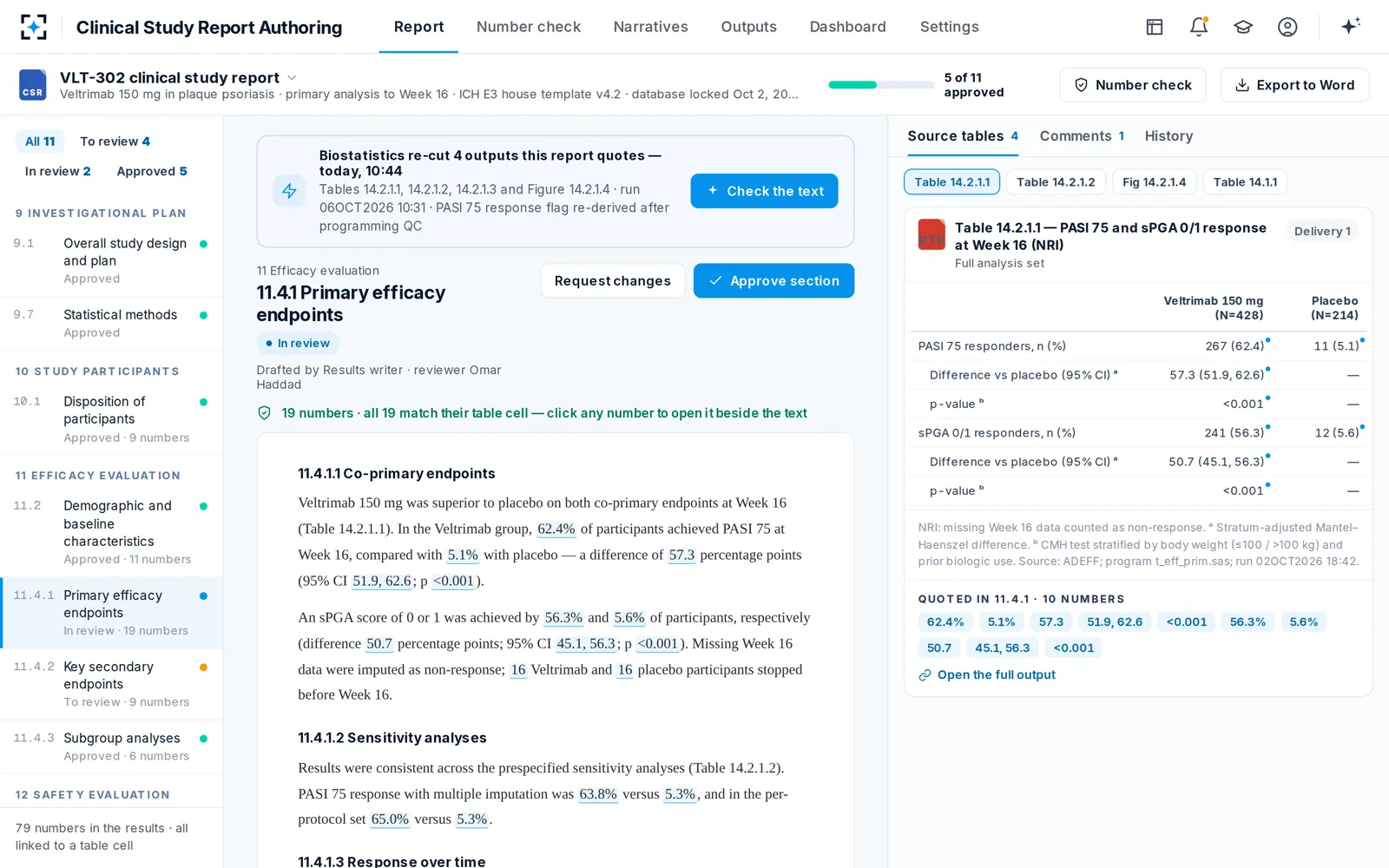
With agents, copying and checking shrink from weeks to days, and a re-cut becomes a list of sentences to approve; review rounds and signatures stay with people. Take a sample study, VLT-302, as it runs through the solution. The database locks at 18:31 on 2 October and the delivery of 412 outputs is read into 9,840 addressable cells within the hour, each keeping its row, column, population and program run. Narratives for 53 participants are drafted the next day, two of them held because a detail is missing from the source. The results sections are drafted by the morning of 6 October, with every number linked to its cell. At 10:44 that morning the re-cut arrives, and the five-step check above runs against it.
How Clinical Study Report Authoring divides the work: agents copy and check, people judge and sign
Agent
Output readerReads every delivered table, listing and figure into cells that keep their row, column, population and program run.
Never: rounds or reformats a value
Agent
Results writerDrafts the results sections in the house template, following the analysis plan.
Never: writes a number it cannot link to a source cell
Agent
Narrative writerDrafts each narrative from the listings, citing every statement to its listing row.
Never: guesses a missing detail
Agent
Number verifierChecks every number against its cell and compares each new delivery cell by cell, flagging sentences that quote a change.
Never: lets a section with a mismatch be approved
A person decides
Writer and signersThe writer decides the wording and accepts each re-cut update. Biostatistics signs efficacy, the medical monitor safety, the clinical lead the report.
The design target is a first full draft five days after lock. As the benchmarks show, that alone is no longer unusual. The difference is in stages 5 and 6: quality control becomes a standing property of the draft, because every number already points at its cell, and a re-cut becomes a list of sentences to approve rather than a re-read of the report.
Every number in the draft points at its cell
Our estimate: copying and checking nearly vanish; review rounds shrink least
What the economics page does with these weeks is a separate question. For the timeline, the shape matters more than the totals: once copying and checking are gone, the remaining time is reviewers and signers doing the work only they can do.
Questions to ask about your own last report
Before trusting any benchmark, including the ones on this page, reconstruct your own last report. The answers show where your weeks went.
Six questions for your last CSR
- How many working days from lock to final outputs?
If it is close to the 24.5 in the EMWA data, a third of your timeline is spent before writing starts.
- How many deliveries did the writer receive after the first?
Count re-issues and re-cuts. Each one restarted checking for every number it touched.
- Which approved sections were reopened, and why?
A reopened section points to a re-cut, or a review comment that arrived after sign-off.
- How long did the full QC take, and how many times was it run?
A repeated full QC is the clearest sign that changes could not be traced.
- How many review rounds, and how many comments in each?
Compare with the mean of 2.6. Count the comments about numbers rather than meaning.
- Who was waiting on whom, and for how many days?
Hand-offs, not tasks, usually explain the difference between a 50-day and a 100-day report.
Questions people ask
How many review cycles does a clinical study report go through?
A mean of 2.6 in the EMWA scheduling data, with a range of one to five. Each cycle is a full read by statistics, safety, clinical and regulatory reviewers, a comment log and a revision, and the draft-to-final stage that holds them was the longest and least predictable in the survey.
How long does database lock take after the last patient visit?
A Tufts CSDD survey of 257 companies put the average at 36.3 days from last patient last visit to lock, shorter at CROs (27.7) than at sponsors (38.7). The EMWA writers reported a mean of 6.6 working days from the last subject's data arriving in-house to lock, which measures a narrower step.
Is there a regulatory deadline for the final clinical study report?
No guideline sets one for the report itself; the deadlines attach to public results. In the EU a results summary and a lay summary are due within a year of the end of the trial, and the full report must be posted within 30 days of a marketing authorisation decision. In the US, results for applicable trials are due no later than one year after primary completion, so most sponsors set the final-report date inside that year.
Can the writer start from draft outputs to save time?
Many do, but the EMWA guidance calls reporting from draft outputs "not efficient" and "not recommended", because changes in the final outputs force changes in the text. Writing against the output shells is the safer head start, as long as every quoted number can later be traced to its final cell.
How long is a clinical study report?
Far longer than the part anyone writes. In the 78 industry reports Doshi and Jefferson studied, the median report ran 644 pages, one ran 15,440 and the mean was 1,854; the synopsis alone had a median of 5 pages. ICH E3 asks for a synopsis "usually limited to 3 pages", though the EMWA author notes that about 10 pages is acceptable for a complex study.