Can AI write a clinical study report? It can draft one, results and patient narratives included, provided every number it uses is traced to its source table and people keep the approvals. A clinical study report (CSR) is the ICH E3 document that turns a trial's locked tables, listings and figures (TLFs) into the results, safety narratives and conclusions a sponsor submits to the FDA, EMA and other regulators. It is hard because every one of its numbers must match a table exactly, and the tables keep changing after database lock. Botminds' Clinical Study Report Authoring is agentic AI software built for that work: it drafts the report from the TLFs, links every number to its table cell, and leaves approval and signatures with people.
In CSR writing, "agentic" should mean one thing: the work is split between narrow AI agents the way a well-run writing team splits it, and every agent has written limits. Clinical Study Report Authoring has five. An output reader turns the locked outputs into addressable cells. A results writer and a narrative writer draft from those cells. A number verifier and a template checker examine the draft, and neither of them ever writes it. People approve and sign; no agent can.
The five agents of Clinical Study Report Authoring: one reads, two write, two check, a person signs
Agent
Output readerReads every table, listing and figure in the locked delivery into cells addressed by output, row, column, population and program run. Spots re-issues and re-cuts.
Agent
Results writerDrafts the ICH E3 results sections in the house template, using the SAP’s endpoint names, populations and methods. Each number points to a cell.
Agent
Narrative writerDrafts narratives for deaths, serious adverse events, discontinuations and events of special interest, citing each statement to its listing row.
Agent
Number verifierChecks every number against its cell, and compares each new delivery with the last, cell by cell, flagging the sentences that quote a change.
Agent
Template checkerConfirms the required ICH E3 headings are present, that every “Table x” and “Section y” reference resolves, and that house style holds.
A person decides
The section’s named signerReads the draft with its sources beside it, accepts or rejects what the agents propose, and signs with an electronic signature.
Why not use one AI model to write a CSR?
Because a single model asked to "write the CSR" reads, interprets, drafts and judges its own work in one pass, and nothing in that pass can fail visibly. Split the job, and each handoff becomes a place where a check can fail.
One of the few blinded, peer-reviewed tests of AI-drafted CSR text comes from Pfizer. Blinded clinical pharmacologists scored AI-drafted pharmacokinetic results at about 90% of the quality of expert-written reports, across seven reports from one organisation. The useful part is the error list. Besides formatting, reviewers found terminology drift, "moderate" used for a 9% fall in Cmax where a pharmacologist would write "small", and "contextual inaccuracies, where the model inferred context not explicitly stated in the source data": calling a bioequivalence criterion "pre-specified" because earlier reports had used it, though neither the protocol nor the SAP specified it.
None of those errors is a wrong digit. Each is a sentence that sounds right and is not supported by the source, the kind of error that survives a read-through of a long document. The study's authors draw the same conclusion: traceability of generated text to source data, immutable logs and documented human review "remain critical for adoption". Their own system was already a chain of model calls rather than a single prompt.
Given that generative language models are prone to include plausible but erroneous or incomplete output, quality review mechanisms need to be in place to ensure that all model-generated text is both factually and syntactically correct before submission for regulatory review.
EMA, Reflection paper on the use of AI in the medicinal product lifecycle (2024)
Dividing the work answers that demand structurally. When one agent may only read, one may only write from what was read, and another may only check what was written, an unsupported sentence has to get past an agent whose single job is to find it. It is the maker–checker principle that regulated industries already apply to people, applied to software.
The same job, shaped two ways
One model, one prompt: Typed by the model from whatever it read in the outputs.
Five agents, separated duties: A reference to an addressed cell; the value shown is the cell’s, exactly as delivered.
One model, one prompt: The same model, or a reviewer reading the whole document.
Five agents, separated duties: A separate verifier, whose numeric comparison is ordinary deterministic code.
One model, one prompt: A plausible guess is the path of least resistance.
Five agents, separated duties: A query is raised and the narrative cannot be approved until it is answered.
One model, one prompt: Inferred from habit or earlier reports.
Five agents, separated duties: Out of bounds for the writer; a checker reports it and does not reword it.
One model, one prompt: Regenerate, then re-read everything to see what moved.
Five agents, separated duties: Compare the deliveries cell by cell and flag only the sentences that quote a changed cell.
One model, one prompt: No notion of who signed what.
Five agents, separated duties: No agent may change it; a change withdraws the signature and returns the section to its signer.
How the output reader extracts data from RTF and PDF tables
The output reader reads every table, listing and figure from RTF or PDF into cells and gives each cell an address, so later agents quote addresses rather than copy digits. Everything downstream depends on this dull job being done perfectly. A typical Phase 3 trial produces 200 to 500 tables, listings and figures, according to a 2026 review of statistical programming automation (a preprint, not yet peer reviewed). Each cell's address names the output it sits in, its row, its column, the analysis population and the program run that produced it. A figure is stored as its underlying data table, so a number quoted from a curve still points at a row, not at an image.
Take a sample study, VLT-302, as it runs through the solution: a fictional Phase 3 trial of Veltrimab 150 mg against placebo in plaque psoriasis, 642 participants randomised 2:1. At database lock biostatistics delivers 412 outputs (186 tables, 142 listings and 84 figures), and the output reader indexes them as 9,840 cells in 49 minutes.
Every delivery is kept, and every output knows which sections quote it
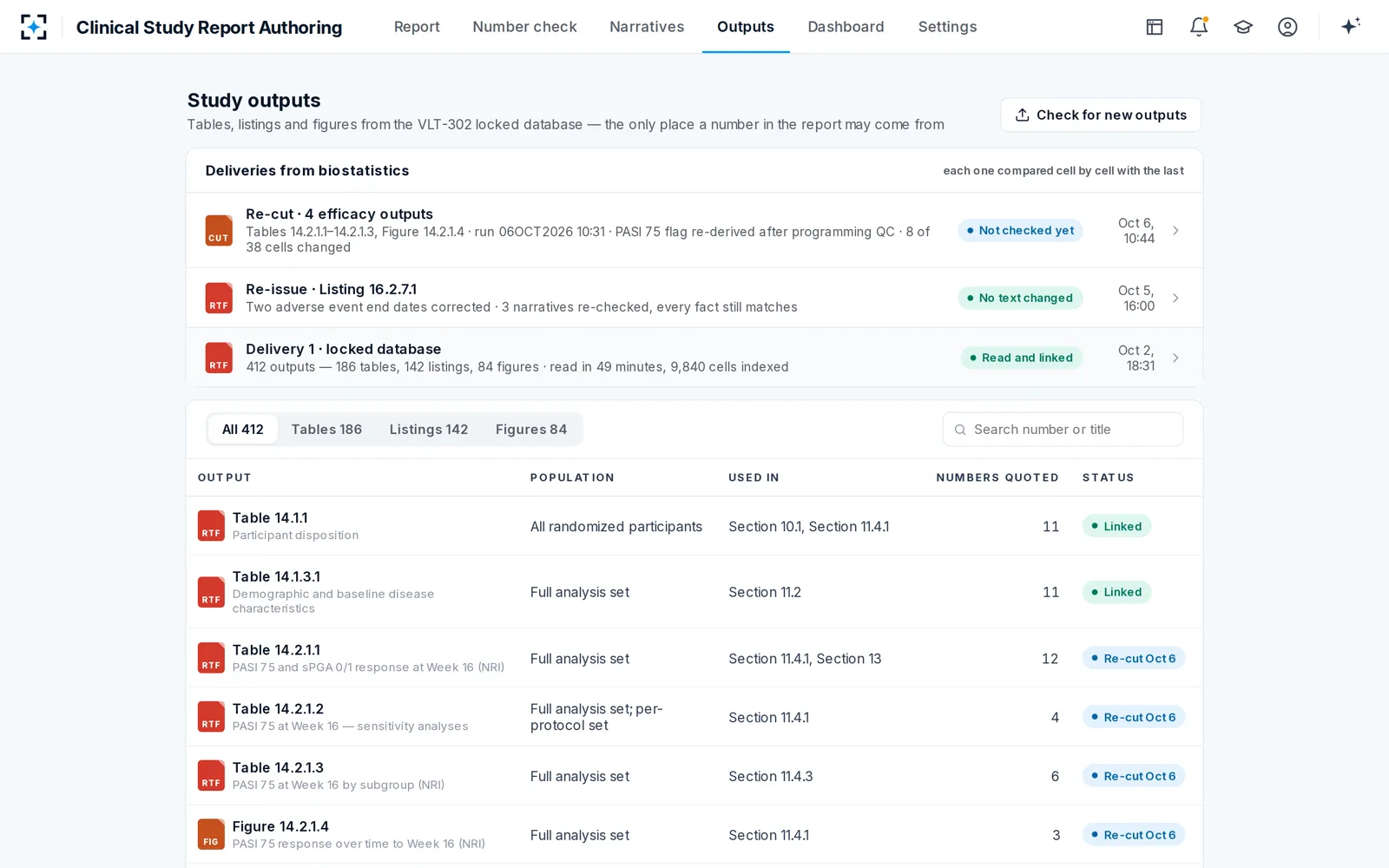
Read the 'Used in' column: the reader does not just store outputs, it knows which sections depend on each one. That is what makes a re-cut traceable later.
Its limits are as important as its speed. It never rounds or reformats a value: "267 (62.4)" is stored as those characters, not as a float. It reads only outputs from a locked delivery. And because every delivery is kept rather than overwritten, a re-issue or re-cut is a new version to compare against the last, not a silent replacement. In our own tests on synthetic study data, cell reading was exact on all 10,571 cells measured.
How do you stop AI from hallucinating numbers in a CSR? Never let it type one
The results writer drafts the ICH E3 results sections (disposition, baseline characteristics, efficacy, safety and conclusions) in the sponsor's house template, taking endpoint names, populations and methods from the SAP. ICH E3 asks for an integrated report that is not simply a clinical and a statistical report joined together, so this is real drafting: choosing what to report, in what order, with what emphasis.
What it cannot do is type a number. When the draft needs the PASI 75 response rate, the agent places a reference to the cell, and the value on the page is rendered from the delivered cell. A bare numeral written by the model is refused. Spelled-out numbers are held to the same rule: "one death" or "nearly one third" must be linked to a source or justified in writing. The writer also makes no claim the tables do not support, which closes the "pre-specified" class of error at the point of writing.
Every number in the text is a pointer to one cell
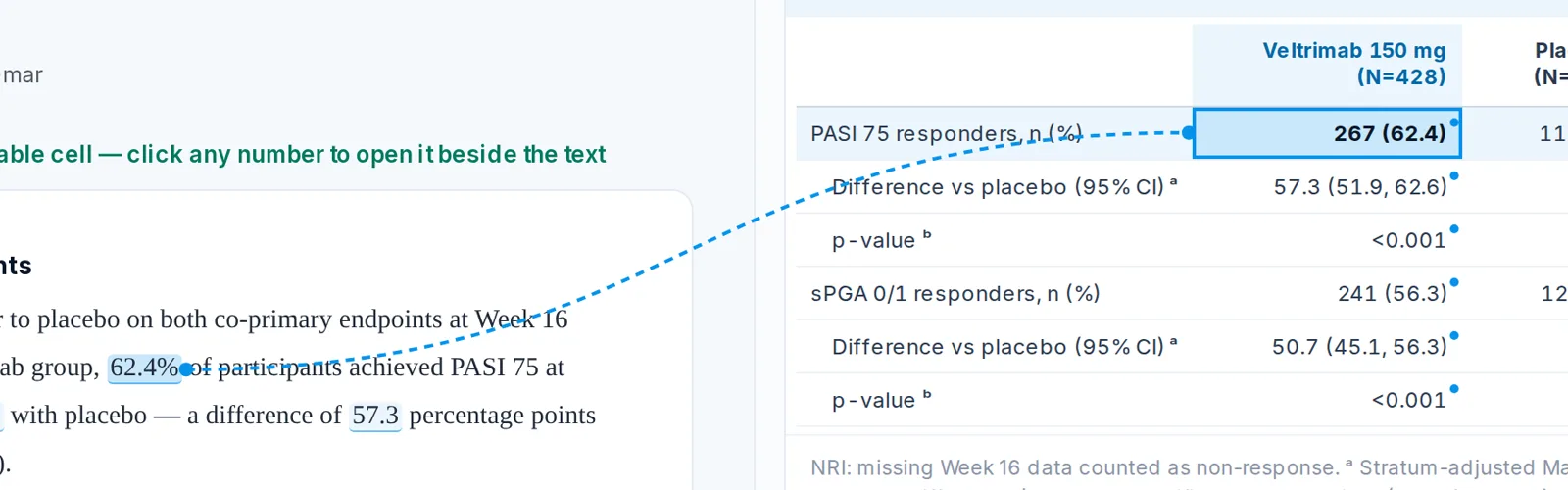
The address carries five things: output, row, column, population and program run. Any one of them wrong is a different number, even when the digits happen to agree.
The results writer has a second duty that only appears later. When a re-cut changes a cell, or a reviewer requests changes, it proposes new wording; the change lands only when a person accepts it.
What happens when a patient narrative is missing a detail?
The narrative writer raises a query instead of guessing, and the narrative cannot be approved until the gap is closed. Its job is the narratives ICH E3 section 12.3.2 requires: one for each death, each other serious adverse event and each event of special interest, with the event's nature and intensity, its clinical course and timing relative to dosing, relevant laboratory values, whether the drug was stopped, countermeasures, post-mortem findings and causality.
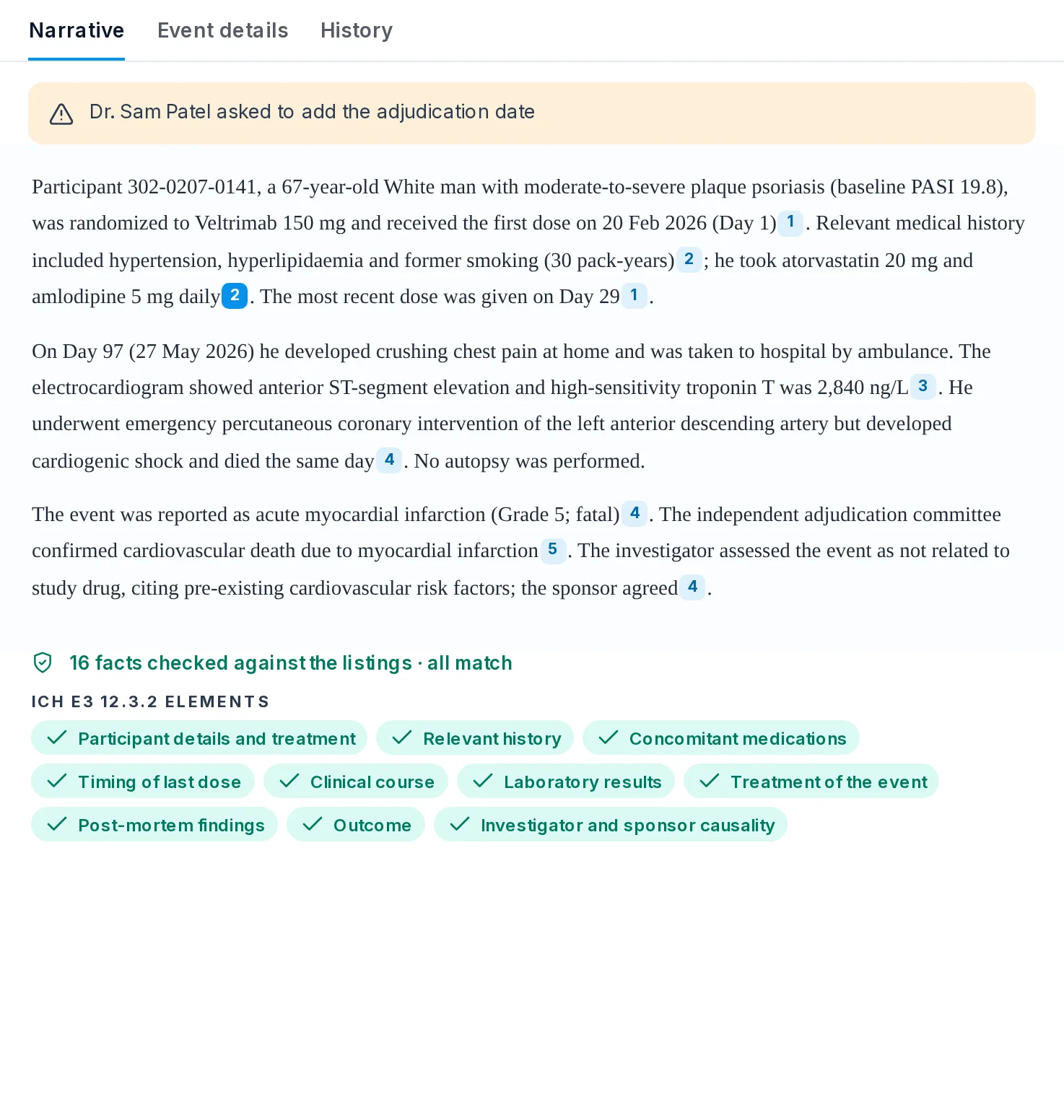
The agent drafts these from the participant listings and SAE case-report pages, cites each statement, by number, to the listing row it came from, and uses participant identifiers only, never names. In the sample study the agent drafts 53 narratives (38 serious adverse events including one death, 9 discontinuations and 6 events of special interest), and two of them are missing something at source: a hospital discharge date for an acute cholecystitis, and a CT pulmonary angiogram report for a pulmonary embolism. Rather than write a plausible date, it raises a query. The page on cited patient narratives walks through one in full.
Each statement in a narrative names the listing row behind it
Why the checkers in Clinical Study Report Authoring never draft
The number verifier and the template checker are the reason the writers can be trusted, and they earn that by never writing. A checker that can repair what it finds stops being a check: its fixes need checking too, and the audit trail can no longer say who wrote what.
The number verifier
The verifier takes every number in every section and narrative and compares it with its linked cell. The comparison itself is deterministic code, not a model judgement; the model's part is limited to number-words and derived figures that need interpretation. A section cannot be approved while any of its numbers fails. Medical writing QC checks a document "against source data", comparing the data in tables and the statements made about them; the verifier makes that check continuous rather than a phase at the end.
What the number verifier compares, for every number
- Value
The figure in the sentence is the figure in the cell, exactly as delivered.
- Rounding
Any rounding follows the house rule set for the report (by default, as in the table), never drift.
- Population
The sentence describes the analysis set the table was run on: full analysis set and per-protocol are different numbers.
- Column
The arm named in the sentence is the arm of the cell. A placebo value attributed to the active arm is the classic transposition.
- Delivery
The cell comes from the latest delivery. A newer re-cut turns yesterday’s match into today’s flag.
- No source at all
A numeral with no cell, or a number-word such as “one death”, is flagged until it is linked or justified in writing.
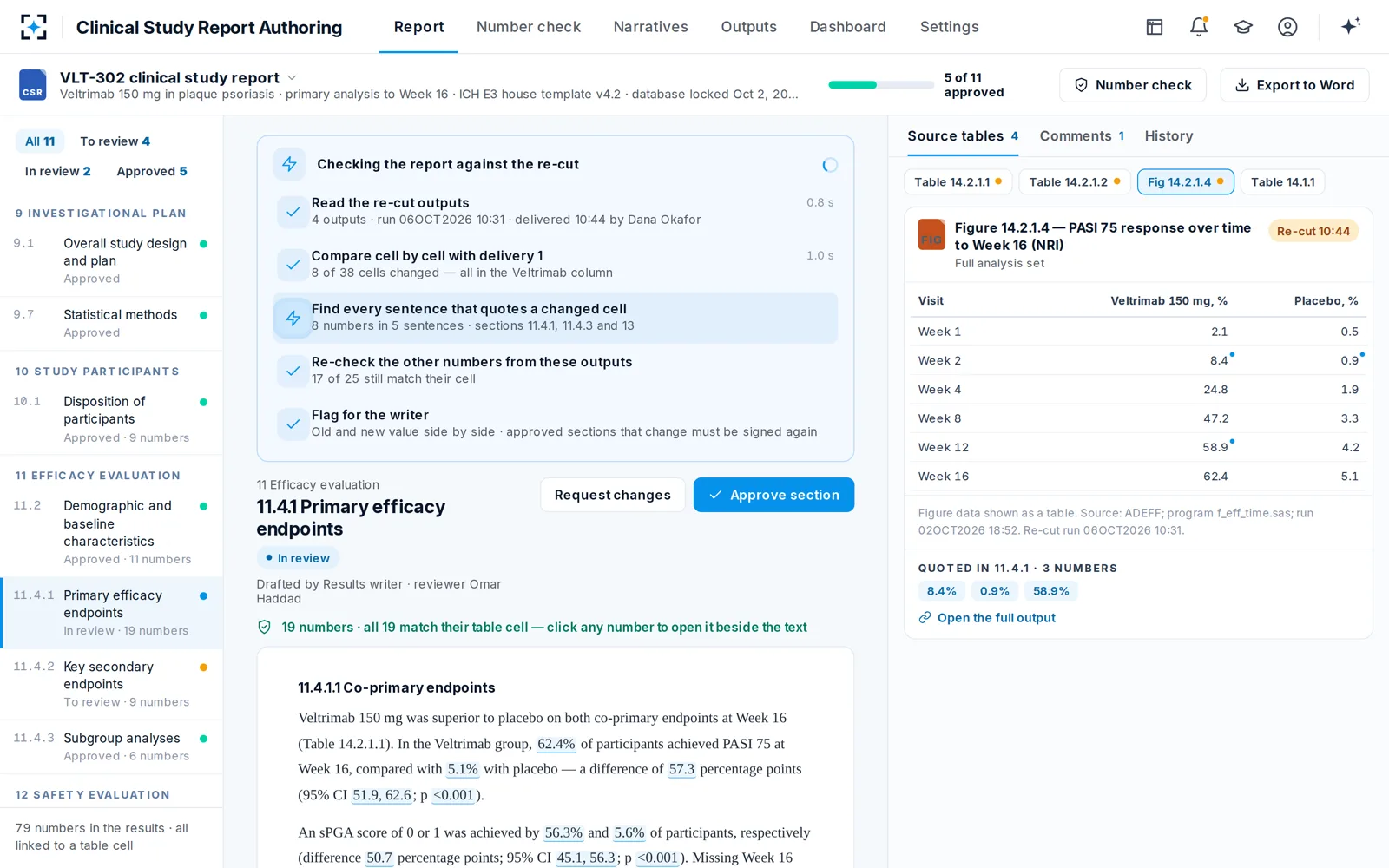
The verifier runs again on every re-issue and re-cut, and that is where the division of labour pays most. Late changes are routine: an EMWA benchmark of CSR timelines notes that "draft data changes in the final TFLs will mandate changes in the CSR". In the sample study, independent programming QC finds that a PASI 75 response flag was set on a rounded improvement. One participant at 74.6% becomes a non-responder, and four outputs are re-run. The verifier compares the new delivery with the old: 8 of the 38 cells in those outputs changed. It finds 8 numbers in 5 sentences that quote them, across Sections 11.4.1, 11.4.3 and 13, confirms the other 17 numbers drawn from those outputs still match, and holds approval and export. It changes no text.
The verifier's re-cut check, step by step
In our own tests on synthetic study data, the verifier caught all 20 deliberately wrong numbers and all 10 deliberately unlinked ones planted in a draft, and the re-cut comparison found all 600 seeded cell changes with no false alarms. How to run that kind of test on your own reports is the subject of measuring the accuracy of an AI-drafted CSR.
The template checker
The template checker confirms that every heading the chosen ICH E3 template requires is present, that every "Table x" and "Section y" cross-reference resolves to something that exists, and that the house style holds: past tense, abbreviations defined at first use, the sponsor's conventions. It reports and nothing more. In particular it never rewrites text a person has signed, even to fix a broken reference; the finding goes to the section's owner. In the solution's fuller scope this role widens into a consistency check that reads the synopsis, body, Section 13, in-text tables and narratives against one another.
What are the guardrails on AI agents writing a regulatory document?
Each agent has its own limits, and three bind all five: none may read unblinded outputs before database lock, approve or sign a section, or change text a person has signed. Those three mark the line between drafting and accountability. Most descriptions of AI agents list what they can do; for a document that goes to regulators, the useful list is the other one.
Each agent's own limits, and the three all five share
Read down a column and you have an agent's job description in the negative. Read across the bottom band and you have the reason a regulated team can let software draft at all. The blinding rule is designed to hold for every person as well as every agent. And because no agent may change signed text, a re-cut that reaches a signed section cannot be absorbed quietly: the update withdraws that signature and sends the section back to its signer.
These limits are not prompt instructions that a model may or may not follow. Unlinked numerals are refused rather than discouraged, approval is held by the application rather than by a reminder, and a signature is tied to the version it signed.
Who approves an AI-drafted CSR? Named people, never agents
Agents find changes and propose wording; the lead medical writer accepts it, and each section's named owner signs. The clearest way to see the division is to follow one change from arrival to signature. In the sample study, the re-cut reaches a section already signed: 11.4.3 Subgroup analyses, approved by the biostatistics lead at 09:40, has 2 of its 6 numbers changed. Here is who does what next.
On a re-cut, agents find and propose; people accept and sign
Agent
Output readerReads the re-cut delivery: four outputs re-run at 10:31, kept beside the lock delivery.
Agent
Number verifierFinds 8 changed numbers in 5 sentences, shows old and new values side by side, and holds approval and export.
A person decides
Lead medical writerReviews each flagged sentence and chooses to update the five sentences, seeing every section whose status will change.
Agent
Results writerReplaces each flagged number with the re-cut value. The report becomes a new version; the earlier one is kept.
A person decides
Biostatistics leadSees “signature withdrawn by the re-cut” on 11.4.3 and signs the changed section again.
A person decides
Clinical leadSigns the final report, with every number beside its cell and every change the re-cut made.
Every approval is an electronic signature that carries the signer's name, the date and time, and its meaning, such as "Approved — medical writing review". Ownership is assigned per report: by default, biostatistics signs the efficacy sections, the medical monitor the safety sections and the clinical lead the final report. In the solution's full scope a signature also requires the signer to re-authenticate, is bound to the exact version signed and is marked superseded by any later edit, and the report's author can never be its safety, final or QC signatory. The page on the people who sign a CSR follows each of those roles through a report.
That allocation is also what regulators are asking for. FDA's 2025 draft guidance on AI places "drafting/writing a regulatory submission" outside its scope, which leaves accountability with the sponsor's existing quality system; EMA expects close human supervision of any AI-drafted text. What that means for submission is set out in what the rules require of an AI-drafted CSR.
What AI tools are used for regulatory writing, and how do they differ?
Five kinds of tool are sold or built for CSR work, and they differ less in the model they use than in what they know about the source. A buyer comparing them should ask each the same question: when this sentence says 62.4%, how does the tool know, and how will it know tomorrow if the table changes?
Five kinds of AI tool for CSR writing, by what they know about the source
| Kind of tool | What it does well | What it does not know |
|---|---|---|
| General chat assistant | Fluent prose from pasted tables; fast first drafts of a paragraph | Where any number came from; nothing survives a re-run; no record of who approved what |
| Drafting assistant inside the word processor | Section drafts in the house template, close to how writers already work | Usually the link from a sentence back to a specific cell; re-cuts mean re-reading |
| Templated text generation | Deterministic sentences programmed from datasets, identical every run | Interpretation; anything the template author did not foresee; edits are lost on regeneration |
| Structured content platform | Reusable, approved text blocks shared across protocol, report and summaries | The results themselves, which change every study; AI drafting is an add-on |
| Agentic system with source tracing | Drafting and checking split between agents, every number a pointer to a cell, re-cuts traced to sentences | Clinical judgement and approval, which stay with people by design |
The table also shows where the risk sits. The first two kinds are fast to adopt and leave the hardest problem, keeping text and tables in agreement through re-runs and review rounds, exactly where it was. The comparison of all the approaches on one re-cut is on clinical study report automation compared.
What to ask before you buy AI for clinical study reports
Ask for evidence on your own completed study, not a demonstration on the vendor's, and ask what the tool refuses to do. A system that drafts beautifully but cannot show where a number came from will cost its savings back in QC. These eight questions separate the kinds above in a single meeting.
Eight questions for any AI CSR tool
- Show me the source of this number.
The answer should be an output, row, column, population and program run, opened beside the sentence, not a file name.
- Can the model type a number?
If it can, every number needs a human check. If values are rendered from cells, the check becomes a comparison code can do.
- What happens when a table is re-run?
Ask to see a second delivery compared with the first, and the list of sentences it changed, including in signed sections.
- What does it do with a missing fact?
A narrative should say a date is missing and stop, not supply a likely one.
- Who can approve, and what does a signature bind to?
Named people only, with Part 11 meaning, re-authentication and a signature tied to the exact version.
- How is blinding enforced?
Unblinded outputs before lock should be unreadable by any agent or person, as a rule of the system, not a setting.
- Will you replay one of our completed studies?
Score the draft against the report you signed, number by number; see the six-week plan for how.
- What does it cost per report, and what does it export?
Model cost per report should be cents to dollars; the Word file should keep the links as comments for reviewers.
A good answer to the seventh question is worth more than any published time saving, because claims in this market range from 25% to 90% and measure different things. How to run that replay, and what to score, is in choosing an AI medical writing platform.
Questions people ask
Does an agentic CSR replace medical writing QC?
No. The verifier removes the mechanical part of QC, matching numbers to tables, and does it on every delivery rather than once. In the solution's full scope an independent human QC reviewer still works a checklist and a findings log and signs off the QC, and the writer cannot QC her own report.
What does AI drafting cost per clinical study report?
The model usage is small next to the people. In our own tests on synthetic study data, drafting a report the size of the sample study cost about $0.07 in model usage and its 53 narratives about $0.55; the cost that matters is the writer, statistician and physician time the draft does or does not save.
How long does an AI draft take?
Minutes, not weeks. In Pfizer's blinded study each report's AI-drafted pharmacokinetic sections took an average of 18.2 minutes to generate, and in our own tests on synthetic data the solution drafted 28 sections in 119 seconds with all 199 numbers linked. The calendar after that is review and signatures.
Can AI start the CSR before database lock?
The parts that need no unblinded results, yes: the shell, the methods sections that restate the protocol and analysis plan, and narrative templates. ICH's M11 structured protocol, adopted in November 2025, makes the protocol itself machine-readable, which is the natural upstream source for those sections. The results wait for lock, and in the solution unblinded outputs are unreadable before it.
Are the five agents the whole solution?
They are the drafting and checking core. Later stages have their own narrowly scoped agents: one consolidates reviewer comments and surfaces conflicting ones, another proposes redactions and a lay summary for public disclosure. Each follows the same rule: it proposes, and a person decides.