Patient narratives in a clinical study report are short, chronological clinical accounts of one participant's adverse event each, and ICH E3 section 12.3.2 requires one in the clinical study report (CSR) for each death, each other serious adverse event (SAE) and each other significant adverse event of special interest. Writing one means pulling the participant's adverse-event, dosing, history, medication, laboratory and causality data from several listings, then telling the event against study day and dose. The prose is the easy part. The hard part is that every date, dose and lab value must match the listings exactly, across hundreds of narratives, and keep matching when a listing is re-issued. Botminds' Clinical Study Report Authoring exists for that work: AI agents draft each narrative with every fact cited to its listing row, check every value, and turn a missing fact into a query, while the medical monitor and the named signers judge and sign.
The narrative load a single CSR can carry
1,000
or more patient narratives one CSR can need, depending on the phase of the trial
4pages
for a long narrative, one for a short: length follows the events and the data available
6–10
narratives can sit in the body of the report; more go to section 14.3.3
14
items ICH E3 asks each narrative to cover
Narratives are therefore a different job from the results sections. A results writer interprets a few hundred tables once. A narrative writer repeats one small, exacting act hundreds of times, and in each repetition a single wrong study day or dose is a finding.
What does ICH E3 12.3.2 require in a patient narrative?
ICH E3 12.3.2 requires eight clinical elements and six identifying details in each narrative, described "in general" rather than as a fixed template. The guideline's own words are short. There should be "brief narratives describing each death, each other serious adverse event, and those of the other significant adverse events that are judged to be of special interest because of clinical importance." Each should cover, "in general", the nature and intensity of the event; the clinical course leading up to it, timed against study drug administration; relevant laboratory measurements; whether the drug was stopped, and when; countermeasures; post-mortem findings; and the investigator's and, if appropriate, the sponsor's opinion on causality.
It then adds six identifying details: patient identifier; age, sex and general clinical condition; the disease being treated and its duration; relevant concomitant or previous illnesses; relevant concomitant or previous medication with dosage; and the test drug, dose and length of exposure. Narratives can sit in the body of the report or in section 14.3.3, "depending on their number".
Two words in that text matter more than they look. "In general" makes the list a standard rather than a form, consistent with the 2012 E3 Q&A that calls E3 "a Guideline, not a set of rigid requirements or a template". And "relevant" leaves to the writer and the safety physician which history, which medications and which labs belong in the story. That judgement is the clinical part of the job, and no automation should take it silently.
Which adverse events need a patient narrative?
Deaths, all other serious adverse events and other significant adverse events of special interest need a narrative; events clearly unrelated to the drug may be omitted or described very briefly. E3 sets those three mandatory categories and one licence to shorten. The rest is a sponsor decision, and the place to make it is a narrative plan agreed before database lock, not a debate in the first review round.
Which events need a narrative under E3
- Every death
Mandatory. The only narratives that must address post-mortem findings, and usually the ones read first.
- Every other serious adverse event
Mandatory. Seriousness comes from the SAE form, so reconcile the clinical and safety databases before counting.
- Other significant events of special interest
Mandatory for events "judged to be of special interest because of clinical importance". Name them in the plan, from the protocol or safety plan.
- Events leading to withdrawal or dose reduction
E3 12.3.3 groups these with the other significant events. Whether each gets a full narrative is a sponsor choice; write it down.
- Events clearly unrelated to the drug
E3 says they "may be omitted or described very briefly". "Clearly" is a medical call, so record who made it.
Take a sample study, VLT-302, as it runs through Clinical Study Report Authoring: a fictional Phase 3 psoriasis trial with 642 participants and no real people in it. Its narrative plan produces 53 narratives: 38 serious adverse events including one death, nine discontinuations because of an adverse event, and six events of special interest. Every example below comes from that sample study.
Where does the data for a patient narrative come from?
The data for one narrative comes from at least five places: the adverse-event, exposure, medical-history, concomitant-medication and laboratory listings, plus the SAE form and, for deaths, the adjudication report. A narrative looks like a paragraph but behaves like a join. The fourteen items rarely sit in one place: the event is in the adverse-event listing, the dose in the exposure listing, the history in another, the troponin in the laboratory listing, and the cause of death may sit only in an adjudication committee's report or the SAE form's free text. Writing a narrative by hand is mostly the work of opening those sources side by side and keeping study days, calendar dates and doses aligned between them.
Where each E3 element usually comes from
- Identifier, age, sex
Demographics listing (16.2.4); the identifier must match across every source.
- Disease and its duration
Baseline disease characteristics; often omitted when the same for every participant, as E3 allows.
- Relevant history
Medical history listing; "relevant" is the writer’s and physician’s call.
- Relevant medications, with dose
Prior and concomitant medication listing; check dose and start date, not just the name.
- Study drug, dose, exposure
Exposure listing (16.2.5): first dose, last dose before onset, dose changes.
- Nature and intensity
Adverse-event listing (16.2.7): reported and coded term, grade, seriousness criterion.
- Clinical course and timing
Onset and end study day against last dose; the SAE form’s description supplies the story.
- Relevant laboratory values
Laboratory listing (16.2.8), plus local hospital results that may exist only on the SAE form.
- Drug stopped, and when
Action taken in the adverse-event listing, confirmed against the exposure dates.
- Countermeasures
Concomitant medications and procedures started for the event; SAE form treatment fields.
- Post-mortem findings
Death page, autopsy report or adjudication; "no autopsy was performed" is itself a stated fact.
- Investigator and sponsor causality
Relationship field in the listing; the sponsor’s view from the safety database.
Two traps recur. The clinical database and the safety database describe the same event at different moments, so a narrative drafted from one can disagree with the other on a date or an outcome; reconciling them is part of writing, not a separate chore. And the safety side rarely arrives as clean listings: CIOMS and MedWatch forms from the safety database are supplementary sources that, even when the rest of a narrative is programmed, "still need to be inserted manually". A best-practice paper in Perspectives in Clinical Research asks that every data point in the template be "mapped against the patient profile", with missing or discrepant data raised "on an immediate basis".
How to write a patient safety narrative, step by step
Agree the template and the list first, then write in batches against the listings, reconcile with the safety database, and send each batch for medical review. Ledade and colleagues, describing practice in Perspectives in Clinical Research, put the template first because "it avoids subjectivity", and ask that sample narratives be agreed before later batches are written. The steps below follow that order.
Writing a CSR patient narrative, from plan to signature
| Step | What the writer does | Where it usually goes wrong |
|---|---|---|
| 1. Fix the list | Agree which events get a narrative (the E3 categories plus the sponsor's own) and freeze the list against the reconciled databases | Counting SAEs from the clinical database alone, then finding more in the safety database |
| 2. Fix the template | One order of elements and one house style for every narrative type, agreed with the safety physician | Each writer inventing an order, so reviewers cannot scan across narratives |
| 3. Write a sample | Draft two or three narratives of each type and have them reviewed before the batch | Writing two hundred narratives to a template the physician then changes |
| 4. Assemble each one | Pull the elements from the listings and SAE forms, align study days with doses, write the course in order | A study day that disagrees with the exposure listing by one, from a date converted twice |
| 5. Check against source | Map every data point to its listing row and raise each gap or discrepancy at once | Filling a missing date with the plausible one |
| 6. Medical review and sign-off | Safety physician reviews relevance, course and causality wording; the named signer approves | Review spent re-checking dates instead of judging the account |
The order of the account matters as much as its content. A narrative that follows the E3 elements in a fixed sequence lets a reviewer find the dose or the causality statement in the same place every time. Built from the sample study's death narrative, the skeleton reads:
- Who: participant 302-0207-0141, with age, sex and the disease under treatment, then the relevant history (hypertension, hyperlipidaemia, smoking) and medications with dose (atorvastatin, amlodipine).
- Exposure: study drug and dose, first dose, and the last dose before onset, in study days.
- The event: acute myocardial infarction on Day 97, its intensity and the seriousness criterion.
- Course and countermeasures: what happened, in order, with the relevant laboratory values, such as troponin at 2,840 ng/L, and the treatment given.
- Action and outcome: what was done with the study drug and when, and the outcome; for a death, the post-mortem findings, here that no autopsy was performed.
- Causality: the investigator's assessment, then the sponsor's where appropriate, and for a death the adjudication committee's classification, here cardiovascular and not related to study drug.
Each line of that skeleton maps to one or two sources in the checklist above. That is what makes a narrative checkable: a reviewer who knows the order knows where to look, and a reviewer with a citation on every fact does not have to look at all.
Can AI write patient narratives? Three generations compared
Yes, but only a draft that cites every fact can be reviewed faster than it can be rewritten. Narrative automation has come in three generations. The first is the programmed narrative: a template whose blanks are filled from the analysis datasets by SAS or a natural-language-generation engine. It is consistent and fast, and because the values are inserted by program, two medical writers note in EMWA's journal, "the QC check of each item of data by the MW is not necessary"; they still judge it the best fit today for standardised, repetitive documents such as narratives. Its weakness is the reading experience, a string of field-shaped sentences that a writer then rewrites into a clinical account, and the rewrite is where hand errors return.
The second generation is the generative draft: a language model given the participant's data and asked to write. The prose is good. The risk is the one regulators name. Pfizer's blinded evaluation of AI-drafted pharmacokinetic CSR sections found "contextual inaccuracies, where the model inferred context not explicitly stated in the source data". In a narrative, inferred context is a plausible discharge date, a convenient onset time, or a causality phrase the investigator never wrote.
The third generation is the cited draft: generated prose in which every fact carries a marker pointing to the listing row it came from, a separate check compares each cited value with that row, and a fact with no source is reported as missing instead of written. The test that separates the second and third generations is simple: can a reviewer verify the draft faster than they could have written it? Without citations, the answer is no, because verifying means re-opening every listing anyway. The longer comparison across report authoring is on the four generations of CSR authoring.
What each generation does where it matters to a safety reviewer
How does a medical monitor review a cited narrative?
The medical monitor reviews a cited narrative by clicking each citation to see the listing rows behind it, then spends the saved time on clinical judgement. In the sample study, the death narrative for participant 302-0207-0141 (acute myocardial infarction on Day 97) opens beside its sources: the adverse-event listing, the exposure listing, history and medications, the laboratory listing and the adjudication committee's report. Each fact in the text carries a numbered marker. Clicking one highlights the rows it rests on, so the reviewer reads the claim and its evidence in the same glance.
Clinical Study Report Authoring: one click from a sentence to its listing rows
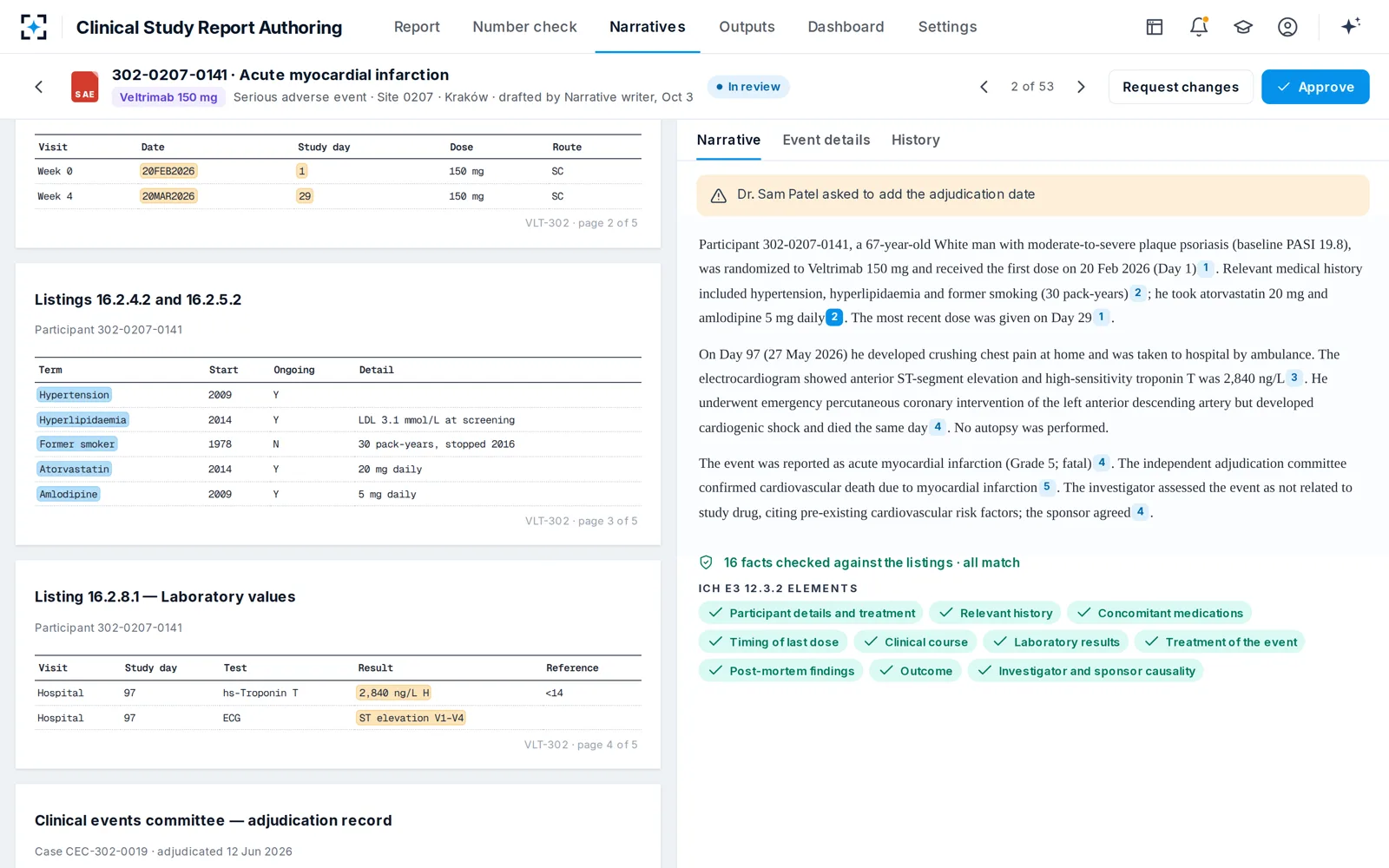
Read what carries no marker as closely as what does. Here, 'taken to hospital by ambulance' and 'No autopsy was performed' have none; a reviewer should know where each comes from before signing.
That changes what review is for. Checking that 2,840 ng/L is the troponin on Day 97 becomes a click, so the medical monitor's attention goes to what only a physician can judge: whether the history chosen is the relevant history, whether the course reads in the right order, whether the causality sentence says what the investigator said and no more. The perspective of the people who sign is the subject of the five people who sign a clinical study report.
How Clinical Study Report Authoring divides narrative work: agents check, people sign
Agent
Narrative writerDrafts each narrative from the listings and SAE pages, with a numbered citation on every fact.
Never: guesses a missing fact, or uses a name instead of a participant identifier
Agent
Number verifierCompares every cited date, dose and value with its listing row, and re-checks on every re-issue.
Never: lets a narrative be approved while a value disagrees with its row
A person decides
Medical monitorOpens the citations, judges relevance, clinical course and causality wording, and requests changes.
A person decides
Named signerApproves with an electronic signature carrying name, date, time and meaning. Your SOP names who that is.
How the narrative agent is built, and what it is forbidden to do, is covered in inside the five agents.
What should a narrative do when a fact is missing?
It should say the fact is missing and raise a query, never fill the gap with a plausible value. The single most valuable behaviour in a narrative draft is refusing to write what the data does not say. In the sample study, participant 302-0207-0119 was hospitalised for acute cholecystitis, and the discharge date is absent from the source. The draft states what it can, reports "10 facts checked against the listings · 9 match · 1 missing in source", raises a query, and the narrative cannot be approved until the gap is answered.
Generative language models are prone to include plausible but erroneous or incomplete output.
EMA, Reflection paper on the use of AI in the medicinal product lifecycle (2024)
The timing of that question matters. After lock, filling a gap may mean changing locked data, so it is far cheaper to find gaps while the database is still open. Practice already leans that way: when a study needs more than about 150 to 200 narratives, writing "usually starts along with cleaning of database", and the pre-lock drafts are updated once the data are final. A cited draft run on a pre-lock snapshot turns every unsourced fact into a list of questions for data management while they can still be answered cheaply.
In our own tests on synthetic study data, the narrative facts matched their listing rows with a measured accuracy of 1.00 across 1,019 facts, and all 844 required 12.3.2 elements were present. Those are results on synthetic test data, not a customer study. How to run that kind of measurement on your own data is on measuring the accuracy of an AI-drafted CSR.
What happens to narratives when a listing is re-issued?
A cited narrative re-checks only the facts that cite the changed rows, instead of regenerating or re-reviewing the whole text. Listings change after narratives are drafted. An end date is corrected, a coded term is re-mapped, a late lab value arrives. A programmed narrative regenerates and loses the writer's edits. An uncited draft has to be re-read in full, because nothing says which sentence used the changed field.
A cited narrative knows exactly which rows it depends on. In the sample study, the adverse-event listing is re-issued two days after the narratives are drafted, with two end dates corrected. The solution re-checks the three narratives that cite those rows; every fact still matches, so no text changes. Had a cited value moved, only that sentence would be flagged, with the old value beside the new one, and approval would wait for a person to accept the change. The same mechanism handles re-cut tables in the results sections, traced sentence by sentence in the 10:44 re-cut case study.
How do you protect participant privacy in patient narratives?
Use the study's participant identifier, never a name or initials, and keep only clinically relevant detail, because narratives are the most personal pages of a CSR and the report may later be published. E3 asks for a patient identifier, age, sex and a clinical history, and a single narrative can combine those with a site city and calendar dates. That is fine in a regulatory submission and a problem the moment the report is published. EMA's clinical data publication policy publishes the study reports themselves, with redactions shown as a box labelled "PPD", and Health Canada's public release guidance sets an anonymisation target of a cell size of 11 patients.
Three habits make the later redaction smaller, which is the explicit aim of the CORE Reference: refer to participants only by study identifier, never by name or initials; prefer study days to calendar dates where your style guide allows; and leave out detail that is not clinically relevant, such as how the participant reached hospital. The narrative writer in the solution uses participant identifiers only. The disclosure obligations themselves are covered in what the rules require of an AI-drafted CSR.
Questions people ask
What is the difference between a patient narrative and a patient profile?
A patient profile is a programmed display of everything recorded for one participant, domain by domain, delivered as PDF, Excel or RTF; a narrative is the prose account E3 asks for, written from it. Ledade and colleagues treat the profile as the primary source and ask that every data point in the narrative template be mapped against it.
Does a narrative need the sponsor's opinion on causality?
E3 asks for the investigator's opinion on causality and the sponsor's opinion "if appropriate", so the investigator's view is always reported and the sponsor's is added where it differs or matters. Where an adjudication committee has classified the event, as for the sample study's death, its classification belongs in the narrative too, attributed to it.
How long should a narrative be?
E3 says "brief", yet a narrative with several events and a long history runs to several pages in practice. Length should follow the event: a fatal event with adjudication earns a fuller account than an uncomplicated, recovered hospitalisation. Padding the clinical course with every available lab value makes review slower, not safer.
Is a CSR patient narrative the same as an SAE narrative?
No. The SAE narrative on an expedited safety report is written when the event is reported, often from incomplete information. The CSR narrative is written after database lock from cleaned listings, for the 12.3.2 elements, and may differ where follow-up information arrived later.
Should narratives go in the body or in section 14.3.3?
E3 leaves it to their number. A handful can sit in section 12.3.2 itself; a large trial's several hundred belong in 14.3.3, with the body discussing patterns across them as section 12.3.3 asks.