TLFs, the tables, listings and figures that statistical programming produces from a trial's analysis datasets, are the source of every number in a clinical study report (CSR). When TLFs are re-run after the report has been drafted, every number the text quoted from them may now be wrong, and nothing in the document says which. The new outputs are correct the moment they arrive. The report is not, and it stays wrong until someone finds each sentence that quoted a changed cell, corrects it, and sends any section that was already signed back to its signer. The fix is the easy part. The search is the work.
That search is why Botminds built Clinical Study Report Authoring, software in which agents draft the ICH E3 results sections and patient narratives from the locked TLFs, with every number linked to the table cell it came from. When statistical programming re-runs an output, the link is what lets the report find its own stale numbers.
This page follows one re-cut from start to finish. Take a sample study, VLT-302, as it runs through the solution: a fictional Phase 3 trial of Veltrimab 150 mg against placebo in moderate-to-severe plaque psoriasis, randomised 2:1, N=642, with PASI 75 and sPGA 0/1 at Week 16 as co-primary endpoints. The people and numbers are invented. The mechanics are the ones every reporting team lives with.
One derivation fix, followed all the way to the text
4
outputs re-run by statistical programming
three tables and one figure
8of 38
cells in those outputs changed value
8numbers
in 5 sentences across 3 sections now disagreed with their table
1section
already signed by its reviewer had to be signed again
What are TLFs in clinical trials, and how does a CSR use them?
TLFs are the programmed outputs of a trial's statistical analysis: tables of summary results by treatment arm, listings of participant-level data, and figures. Statistical programmers produce them from the analysis datasets according to the shells in the statistical analysis plan, the biostatistician releases them, and the medical writer quotes them. Some writers and programmers say TFLs; the outputs are the same.
ICH E3 gives them two homes in the report. Section 14 holds the "tables, figures and graphs referred to but not included in the text": demographic data (14.1), efficacy data (14.2) and safety data (14.3), including the displays of adverse events, the listings of deaths and serious events, and the narratives. Appendix 16.2 holds the participant data listings, from discontinued patients (16.2.1) to adverse event listings for each patient (16.2.7). The text in Sections 10 to 13 and the synopsis, which E3 says "should include numerical data to illustrate results, not just text or p-values", quotes from both.
Where TLFs sit in an ICH E3 clinical study report, and what quotes them
| Output | ICH E3 home | What it holds | Quoted in |
|---|---|---|---|
| Summary tables | 14.1, 14.2, 14.3.1 | Demographics, efficacy results, adverse event displays by arm | Sections 10–12, in-text tables, synopsis, Section 13 |
| Figures | 14.2 and 14.3 | Response over time, forest plots of subgroups, survival curves | Efficacy text, often as a value read from the figure's data |
| Safety listings | 14.3.2, 14.3.4 | Deaths, other serious and significant adverse events, abnormal laboratory values | Section 12 and the patient narratives |
| Participant data listings | 16.2.1–16.2.8 | Discontinuations, deviations, exclusions, demographics, efficacy, adverse events and laboratory data per participant | Narratives, disposition text, deviation summaries |
That is the scale the writer works against. A Phase 3 trial produces several hundred outputs, and the text quotes a small fraction of them, but which fraction is known only to whoever wrote each sentence. In the sample study below, 15 of 412 delivered outputs are quoted anywhere in the report or narratives. The other 397 can change without touching a word, and the 15 cannot change without touching several.
What happened at 10:44: a response flag set on a rounded value
A one-participant derivation fix re-ran four efficacy outputs on the morning the report was converging. The database locked on 2 October at 18:31. By the morning of 6 October the results sections were drafted, five of the report's eleven sections were approved, and the subgroup section had been signed at 09:40. At 10:44 statistical programming delivered a re-cut.
Independent programming QC had found that the PASI 75 response flag was derived from a rounded percentage improvement. Participant 302-0915-0137 improved by 74.6% at Week 16. Rounded to 75, that crossed the threshold and counted as a response. The statistical analysis plan (section 9.2) says to derive the flag on the unrounded value, so the participant became a non-responder. Tables 14.2.1.1 to 14.2.1.3 and Figure 14.2.1.4 were re-run at 10:31 and delivered at 10:44.
It is a textbook defect: a threshold applied after rounding. And the arithmetic is small. The responder count in the Veltrimab arm fell from 267 to 266 of 428, so 62.4% became 62.1%. The efficacy conclusion does not move. But the report now says 62.4% while its own Section 14 table says 62.1%, and that kind of disagreement is exactly what reviewers catch in a cross-check. And the cost reaches beyond one table. In an AMWA survey of regulatory reviewers, participants said poor document quality not only slows their assessment but "has the potential to bias reviewers against subsequent submission documents from the same sponsor".
One participant belongs to many populations
The fix touched one participant, yet it reached far beyond the primary table. That participant was in the full analysis set, the per-protocol set, the biologic-naive subgroup and the 100 kg-or-lighter subgroup, and in the multiple-imputation sensitivity analysis. Every numerator that counted them fell by one. The reach of a derivation fix is the list of populations and subgroups the affected participants belong to. It is not the table someone thinks of as "the one that was fixed".
What is a TLF re-cut, and why does it happen?
A re-cut is a re-run of statistical outputs after they were delivered, usually because independent QC found a programming or derivation error. It is not a failure of statistical programming. It is the control working. A typical Phase III trial needs 200 to 500 tables, listings and figures, each validated by independent double programming that costs 1.6 to 2.0 times the primary programming effort (a preprint, citing a secondary source). The point of the second programmer is to disagree with the first. When the disagreement surfaces after a delivery, outputs are re-run.
EMWA's timeline survey found that moving from draft to final tables took a mean of 10.6 working days for a moderately complex Phase III study, and warned against writing from drafts at all:
"Draft data changes in the final TFLs will mandate changes in the CSR."
Hamilton, Medical Writing (EMWA), 2014
The advice is sound, but "final" is a status that QC can take away. In the sample study, outputs changed twice after lock in four days. On 5 October, Listing 16.2.7.1 was re-issued with two adverse-event end dates corrected; three patient narratives quoted it, and all three still matched. On 6 October came the re-cut. The first changed no text. The second changed eight numbers. A team cannot tell those two apart without looking, and looking is the cost.
How are TLFs validated? Double programming, and what it misses
Mostly by double programming: a second programmer writes independent code from the same specification, and the two sets of outputs are compared until they agree. The 2026 scoping review of statistical programming found the practice nearly universal and its evidence base thin: "just 2.3% of 527 validation papers contained effectiveness data, and zero RCTs comparing validation approaches exist", so double programming "rests on Very Low quality evidence." It is a preprint, not yet peer reviewed, but the finding is a sober one: the industry's most expensive check has not been measured against cheaper ones.
Two limits matter for the report. First, double programming checks code against a specification; if both programmers read the specification the same wrong way, they agree on the wrong number. The defect in the case below, a threshold applied after rounding, is the kind that survives until someone reads the analysis plan's wording against the derivation, and it surfaced only after delivery. Second, every check ends at the edge of the output. Nothing in output validation looks at the sentence that quotes a cell, so a re-run that fixes an output leaves the report's copy of the old value exactly where it was.
That is the gap a writer's QC fills, by checking every quoted number "against source data", and the gap a re-cut reopens. The checks before the output and the checks after it are both thorough; the join between them is held by nobody.
Why a re-run table is hard to trace in a CSR
A re-run table is hard to trace because the report does not know where its numbers came from. EMWA's survey describes the division of labour plainly: the medical writer writes Sections 1 to 13 and Section 15; Section 14 is the statistical output. When outputs are re-run, Section 14 updates itself. Sections 1 to 13 do not. In a word-processor draft, "62.4%" is five characters. Nothing joins it to a table, a row, a column or a program run.
So after a re-cut, two people each hold half the map. The programmer can compare outputs and say which cells changed. The writer knows which sentences she wrote. Nobody holds the join between them, and every way of rebuilding it by hand fails somewhere:
- Re-check every number from the affected outputs. Medical writing QC checks the document "against source data", table by table. Repeating it on every number that quotes a re-run output is safe, slow, and arrives just as review is converging.
- Search the document for the old values. In this report "65.0%" appears twice with different meanings: once for the per-protocol set, once for the 100 kg-or-lighter subgroup. They change to different values, 64.8% and 64.7%. "62.4" sits in the efficacy section, in the conclusions and in the data behind a figure. One table cell holding a difference and its confidence interval prints as three numbers. A find-and-replace gets at least one of these wrong.
- Trust memory. The writer remembers that section 11.4.1 quotes Table 14.2.1.1. She may not remember that the conclusions in Section 13 restate the same figure, and that sentence is among the most read in the report.
How Clinical Study Report Authoring finds every sentence a re-cut changed
It compares the two TLF deliveries cell by cell, then follows each changed cell to the sentences that quote it. That works because the join is explicit from the start. When the agents draft a section, each number is written as a link to the exact cell it came from: table, row, column, population and program run. The text knows its sources, so a re-cut becomes a lookup rather than a search.
When the 10:44 delivery arrived, a banner on the section said biostatistics had re-cut four outputs this report quotes. The writer, Dr. Maya Chen, clicked "Check the text", and five steps ran in view:
- Read the re-cut outputs.
- Compare them cell by cell with the previous delivery: 8 of 38 cells changed, all in the Veltrimab column.
- Find every sentence that quotes a changed cell: 8 numbers in 5 sentences, in sections 11.4.1, 11.4.3 and 13.
- Re-check every other number quoted from these outputs: 17 of 25 still match.
- Flag the 8 for the writer, old and new values side by side.
Clinical Study Report Authoring checks the text against the re-cut in five steps
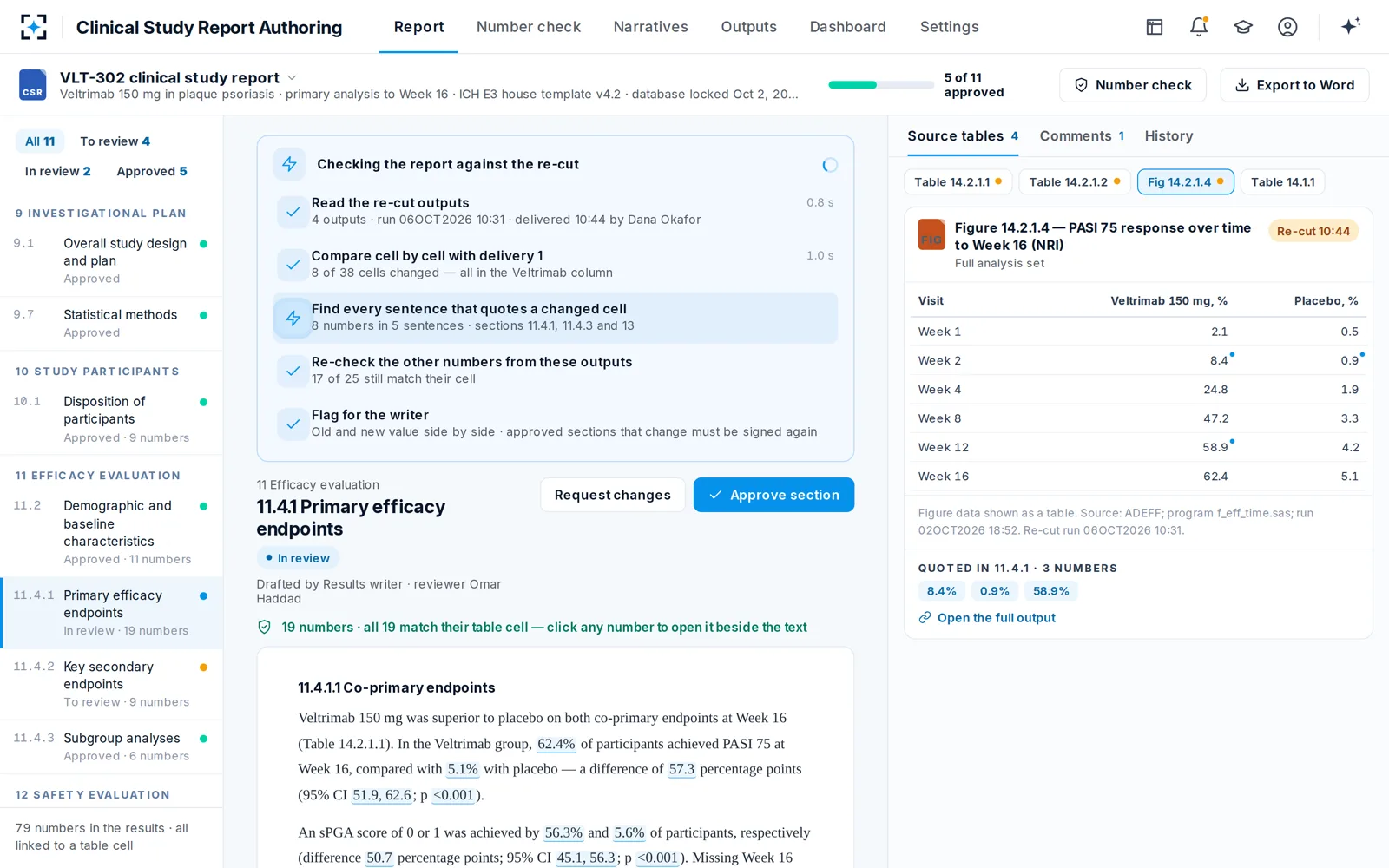
Step 4 matters as much as step 3. A re-run output does not make every quote from it stale, and confirming the 17 that still match is what lets reviewers skip them.
How far one fix travels: from four outputs to one signature
8 numbers, 5 sentences, 3 sections: the change impact in full
The change impact of this re-cut was eight numbers, each off by 0.2 or 0.3 points, in two efficacy sections and the conclusions. Laid out in full, they make the case against fixing them by eye. Not one would look wrong to someone reading the report on its own. Every one would look wrong to someone reading it beside Section 14.
Every number the re-cut changed, with the cell it quotes
| Section | What the number is | Was | Now |
|---|---|---|---|
| 11.4.1 | PASI 75 response, VeltrimabTable 14.2.1.1 · 267 (62.4) → 266 (62.1) | 62.1% | |
| 11.4.1 | Difference vs placeboTable 14.2.1.1 · one cell holds the difference and its CI | 57.0 | |
| 11.4.1 | 95% confidence intervalTable 14.2.1.1 · same cell as the difference | 51.7, 62.3 | |
| 11.4.1 | Multiple imputationTable 14.2.1.2 · 63.8 → 63.6 | 63.6% | |
| 11.4.1 | Per-protocol setTable 14.2.1.2 · 262/403 → 261/403 | 64.8% | |
| 11.4.3 | Biologic-naive subgroupTable 14.2.1.3 · 191/296 → 190/296 | 64.2% | |
| 11.4.3 | Weight ≤100 kg subgroupTable 14.2.1.3 · 201/309 → 200/309 | 64.7% | |
| 13 | PASI 75 response, restated in the conclusionsTable 14.2.1.1 · the same cell as the first row | 62.1% |
Two holds keep the draft honest while the numbers are stale. Approval of an affected section is on hold, because five numbers in 11.4.1 now quote a cell the re-cut changed. Export to Word is held too: "8 numbers are flagged by the re-cut; update them first". Nothing in the text changes until a person accepts it.
The sample report is deliberately small: eleven sections and 79 linked numbers in the results. A complete report also restates these cells in the synopsis and in in-text summary tables, so any method of finding stale numbers has to reach those too. A by-hand check that stops at the efficacy section stops too early.
When the re-cut reaches a section that is already signed
A signed section cannot simply absorb a correction, because the signature is a statement about specific text. Section 11.4.3, Subgroup analyses, had been approved and signed by the biostatistics lead, Omar Haddad, at 09:40 that morning, 64 minutes before the re-cut arrived. Two of its six numbers changed: the biologic-naive response rate (64.5% to 64.2%) and the response in participants weighing 100 kg or less (65.0% to 64.7%).
A signed section, reached by the re-cut
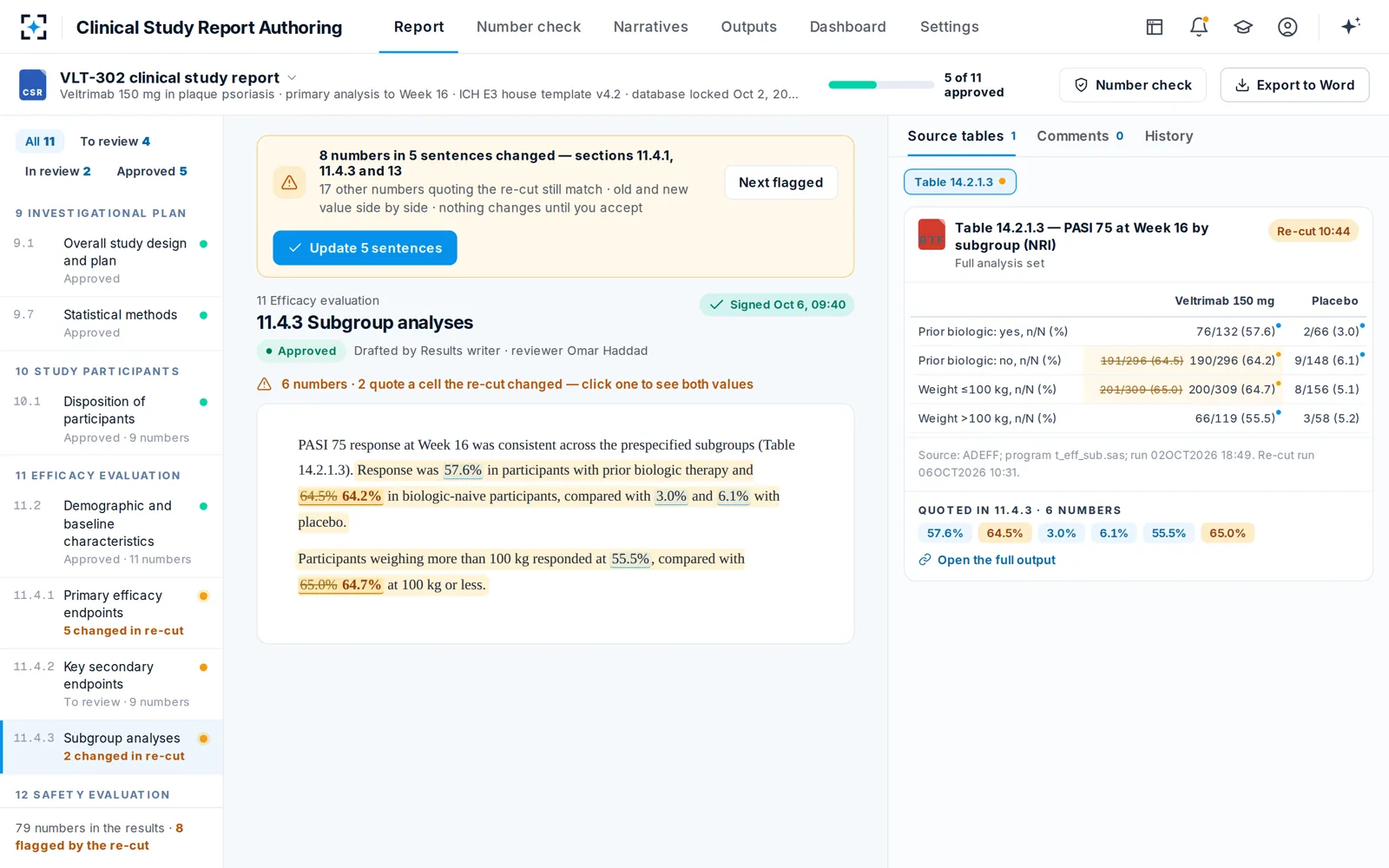
This is the moment every re-cut process is really about: what happens to the signature. The five people who sign a clinical study report each sign different parts of it, and a re-cut can reach any of them.
Updating the text is one decision, not eight edits
The writer decides once, for all five sentences, after seeing every replacement and its consequence. Once the writer has reviewed the flags, "Update 5 sentences" opens a confirmation that lists every replacement by section and states what will happen to each section's status before anything changes.
Every replacement, and every status change, shown before it happens
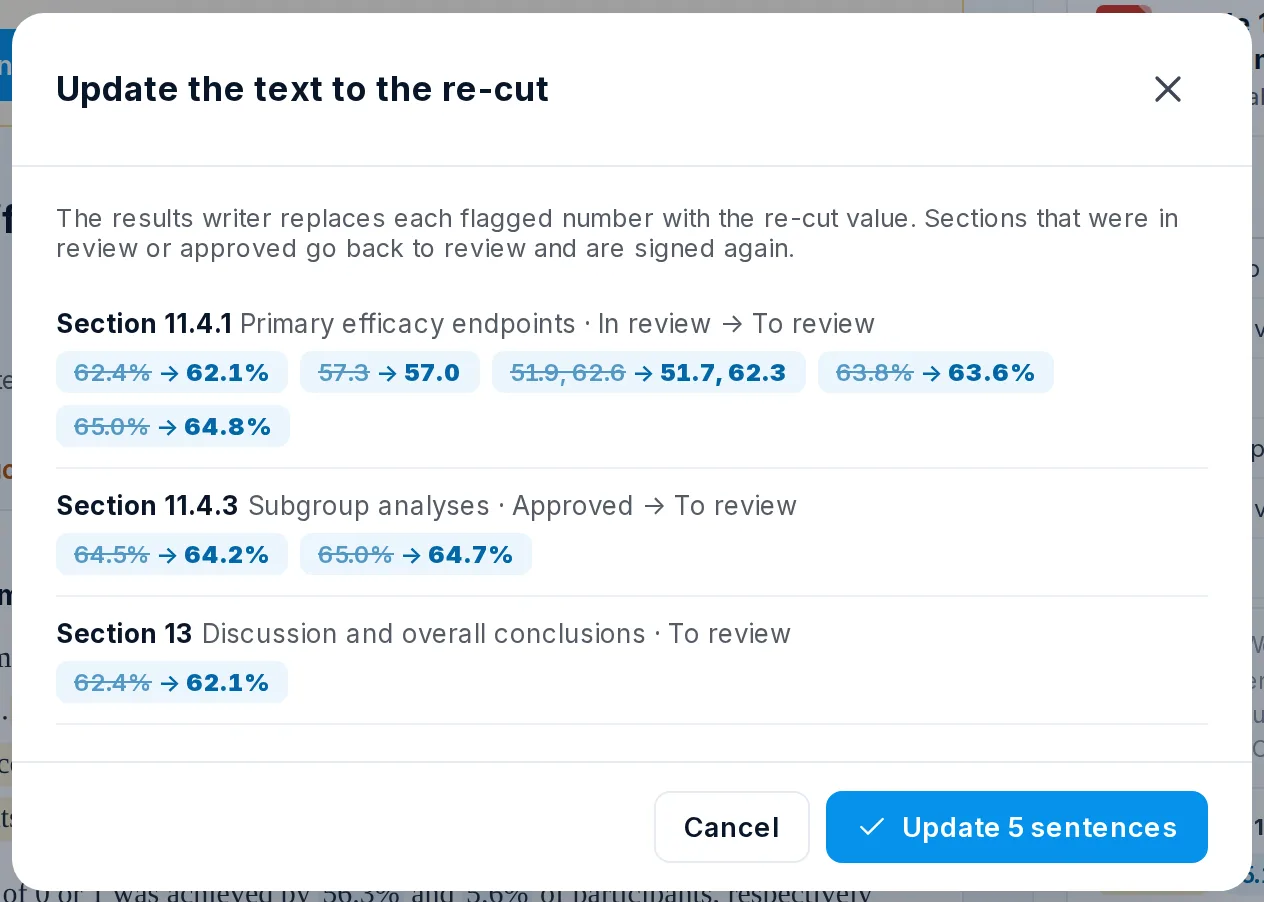
The results-writing agent replaces each flagged number with the value from its re-cut cell. Nothing else in the sentence is rewritten. The draft moves from version 0.2 to 0.3, the earlier version is kept, and the number check reads "Every number matches the latest delivery". Export works again, and the Word file carries each number's link as a comment.
Who does what after a re-cut lands
Agent
Output readerReads the four re-run outputs and compares them with the previous delivery, cell by cell.
Never: round or reformat a value
Agent
Number verifierFinds the 8 numbers that quote a changed cell, confirms the 17 that still match, and holds approval and export.
Never: let a section be approved with a stale number
A person decides
Lead medical writerReviews old and new values side by side and chooses to update the 5 sentences.
Agent
Results writerReplaces each flagged number with its re-cut value. The draft becomes version 0.3.
Never: approve or sign a section
A person decides
Biostatistics leadRe-reads the two changed numbers in 11.4.3 and signs it again.
Does a signed CSR section need re-approval after a re-cut?
Yes, if any number in it changed. The signature should be withdrawn and given again on the new version, and only for the sections that changed. The US rule on electronic signatures, 21 CFR Part 11, never mentions re-cuts. It does set out what a signature is. A signed item must show the signer's name, the date and time, and "the meaning (such as review, approval, responsibility, or authorship)" of the signature (§11.50). Signatures must be linked to what they sign "to ensure that the signatures cannot be excised, copied, or otherwise transferred to falsify an electronic record by ordinary means" (§11.70). And audit-trailed changes "shall not obscure previously recorded information" (§11.10(e)).
Read together, those clauses point one way. Omar's signature means "I approved this text". If 64.5% becomes 64.2% underneath it and the signature stays, it now vouches for a sentence he never read. Nobody copied anything, but the effect is the one §11.70 is written to prevent. There are three ways to handle it:
Three ways to treat a signed section after a re-cut
1 · Update silently, keep the signature
The numbers are corrected; the approval stays in place.
The signature then attests to text the signer has not seen: the failure the rule exists to prevent.
2 · Keep the old text, add a note
The signed text stands; a comment says the table has changed.
The signature then stays true, but covers numbers that contradict Section 14, and they travel into the submission.
3 · Withdraw it, update, re-request
The section returns to review with old and new values visible; earlier versions are kept.
The signature then means what it says again, once the signer re-reads the change and signs version 0.3.
The withdrawal is scoped. Only 11.4.3 loses its signature, and the report drops from five of eleven sections approved to four. The other four approvals stand, because none of their numbers changed. Omar re-reads two numbers, not the efficacy chapter. A precise blast radius is what makes a strict rule affordable.
The signature goes, and the reason stays on the page
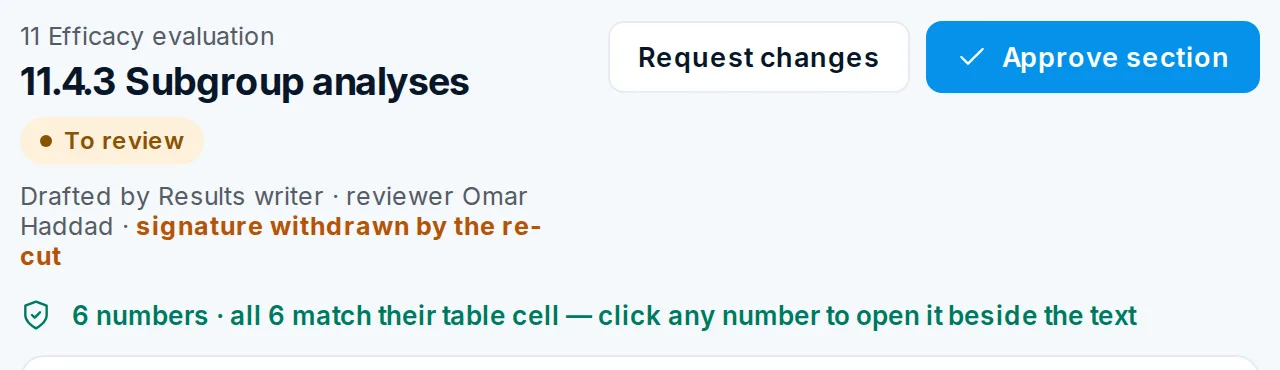
The sample screens illustrate the rule; they are not a validated signature system. In the full product, signing requires the signer to re-authenticate, each signature is bound to a fingerprint of the exact version signed, and any later edit marks it superseded. Whether that satisfies a given quality system is for the sponsor to validate. What an AI-drafted report has to show a regulator is the subject of a separate page on the rules. Pfizer's authors, reporting a blinded test of AI-drafted report sections, name the same three needs: "traceability of generated text to source data, immutable logs, and documented human review".
How to handle a TLF re-cut, with or without agents
Keep every delivery, compare values cell by cell, keep a map from sentence to cell, and withdraw only the signatures the change touches. Nothing about this needs software to understand. The software makes it cheap. A team working in Word can apply most of it today, at the cost of keeping the map between text and cells by hand.
A re-cut playbook a reporting team can adopt today
- Keep every delivery, and compare values, not file names
A re-run output can change nothing; a re-issue can change one cell. Only a cell-by-cell comparison says which.
- Keep a map from sentence to cell while you draft
Even a spreadsheet of section, number and table cell turns the next re-cut into a lookup.
- Trace by participant, not by table
List every population and subgroup the affected participants belong to; each one is a numerator that moved.
- Never fix stale numbers with find-and-replace
In this case two different "65.0%" changed to two different values.
- Confirm the numbers that did not change
Showing that 17 still match is what lets reviewers skip them, and proves the check was done.
- Search beyond the results sections
Conclusions, synopsis and in-text tables restate the same cells, and are the most read.
- Withdraw only the signatures the change touches
Re-review what moved; leave untouched approvals in place.
- Hold export while anything is stale
A draft that leaves the building with one stale number has to be corrected in every copy.
The difference software makes is in where the time goes. By hand, every step above is a person reading. With every number linked to its cell, the search is a computation and people spend their time on the decisions.
The same re-cut by hand and in Clinical Study Report Authoring
Kept by hand: An email lists re-run outputs; someone decides whether the text is affected.
Traced to the cell: The delivery is compared with the last one; a banner names the outputs the report actually quotes.
Kept by hand: Re-check every number from the affected outputs, or search for old values and hope they are unique.
Traced to the cell: Each changed cell points to the sentences that quote it: 8 numbers in 5 sentences.
Kept by hand: Implied by the QC sign-off.
Traced to the cell: Shown: 17 of 25 numbers from the re-run outputs still match their cells.
Kept by hand: Depends on someone noticing that a signed section quotes a re-run table.
Traced to the cell: The signature is withdrawn, with the reason on the section, and re-requested from the same signer.
Kept by hand: A tracked-changes document and an email thread.
Traced to the cell: A new version, the old values kept, and every number matching the latest delivery.
The solution's design target is about two minutes to find every sentence a re-cut changed, still to be measured in a live deployment. In our own tests on synthetic study data, the list of affected sentences was ready 6.4 to 10 seconds after a re-cut was uploaded, and 600 deliberately seeded cell changes were all found with none falsely flagged. That is a test on synthetic data, not a customer result. The number to track on a real study is the stale-number rate, which the page on measuring the accuracy of an AI-drafted CSR sets out alongside the other number-level measures.
Re-cuts will keep coming, because the control that produces them is doing its job. What can change is whether each one starts a re-check of the whole report or a short review of the five sentences it actually touched. To see this traced on your own study outputs, start from the Clinical Study Report Authoring solution.
Questions people ask
What is change impact analysis for a CSR?
It is the work of finding which statements in the report depend on outputs that changed between two TLF deliveries. Done properly it runs at cell level: which cells changed, which sentences, in-text tables and summaries quote them, and which signed sections those sit in.
How do you compare two TLF deliveries?
Compare values, not files. Two runs of the same program usually differ in their run-date stamp even when every number is identical, so a file comparison flags everything. A comparison of each cell, keyed by table, row, column and population, flags only what moved; in this case 8 of 38 cells.
What is a TLF shell?
A shell, or mock, is the empty layout of an output: its title, rows, columns, populations and footnotes, with placeholders where the numbers will go. Shells are usually agreed alongside the statistical analysis plan before lock, which lets a writer build the in-text tables and draft sentences against known cells; EMWA's scheduling guidance recommends completing unpopulated in-text tables before the final outputs arrive.
Does every re-cut mean signing the CSR again?
No. Only sections whose quoted numbers changed lose their signature. In this case the re-issue on 5 October changed no text and reopened nothing; the re-cut on 6 October reopened one signed section out of five approved.
What about numbers written as words, or rounded in the summary?
They are the easiest to miss: "nearly two thirds" quotes 62.1% just as surely as the numeral does. A traced draft has to link them to a cell or justify them in writing, or they become the stale numbers nobody flagged.