A Reg E denial letter is the written report a bank sends when its investigation of a debit card or other electronic fund transfer error finds no error, or a different error from the one the customer described. Under 12 CFR 1005.11(d)(1) it "shall include a written explanation of the institution's findings and shall note the consumer's right to request the documents that the institution relied on in making its determination", and the documents must be provided promptly on request. If provisional credit is being reversed, a second set of notices applies. For credit cards, Regulation Z's billing error rule requires an explanation of "the reasons for the creditor's belief that the billing error alleged by the consumer is incorrect", and copies of the evidence on request. The letter is only as defensible as the investigation behind it, and that is where desks struggle: evidence sits in four systems and each charge runs on its own clock. Botminds' Card Dispute Management gathers the evidence per charge, drafts a per-charge letter that names it, and sends nothing until an analyst signs, with a second signature on larger fraud denials.
The claim in the examples is sample data on a fictional customer and a fictional bank.
The Reg E and Reg Z lines a denial letter has to meet
3bus. days
to report results after a Reg E investigation ends
45days
to finish a Reg E investigation with provisional credit; 90 for point-of-sale and foreign
90days
outer limit for resolving a Reg Z billing error: two complete billing cycles
5bus. days
of honouring items after notice that provisional credit is debited
What must a Reg E denial letter contain?
Three things, by rule: the results of the investigation, a written explanation of the findings, and a statement that the customer may request the documents the bank relied on. The rule's text is short: "The institution's report of the results of its investigation shall include a written explanation of the institution's findings and shall note the consumer's right to request the documents that the institution relied on in making its determination. Upon request, the institution shall promptly provide copies of the documents" (12 CFR 1005.11(d)(1)).
"Explanation of findings" is the phrase a weak letter fails. "We have reviewed your claim and determined the transaction was authorized" states a conclusion, not a finding. A finding names the evidence: a chip read with the customer's PIN, a delivery to the customer's address, a device that matches the customer's banking app. Where a claim covers several charges, the explanation has to be per charge, because each is a separate alleged error with its own outcome.
A Reg E denial letter, element by element
| Element | Required by | What a defensible letter says |
|---|---|---|
| Outcome per charge | 1005.11(c) report of results; (d) if no error or a different error | Each disputed charge, credited or denied, with its amount |
| Written explanation of findings | 1005.11(d)(1) | The evidence each finding rests on, in plain words |
| Right to request documents relied on | 1005.11(d)(1) | That the customer may ask, and how |
| Copies on request, in understandable form | 1005.11(d)(1); comment 11(d)(1)-1 | Readable records, with codes explained |
| Provisional credit: date and amount debited | 1005.11(d)(2)(i) | The calendar date and the amount |
| Provisional credit: items honoured for five business days | 1005.11(d)(2)(ii) | Which items the bank will pay without overdraft charges, and until when |
What examiners have cited in Reg E denial letters
The CFPB has published the failures it finds, and they are the letter's three elements. In Supervisory Highlights, Issue 22 (Summer 2020), examiners found institutions "failing to provide an explanation of its findings within the report of results," others "providing an inaccurate or irrelevant response to the consumer when it determined that no error or a different error occurred," and letters "missing the required notice of the consumer's right to request the documents that the institution relied on." The Bureau's reading of the first is the standard to write to: "the meaning of an 'explanation' is not synonymous with that of a 'determination.' Financial institutions must go beyond just providing the findings to actually explain or give the reasons for or cause of those findings."
The same issue found two upstream defects that end in a wrong denial. Some institutions required customers, in the deposit agreement, to "cooperate" with error investigations, including "providing affidavits and notifying law enforcement authorities," which the CFPB treated as an unlawful waiver of the right to have an error investigated. And some measured the 60-day notice window from the transaction date rather than from the statement, treating timely ACH claims as late. A denial built on either is wrong before the letter is drafted, which is why a letter review that does not also read the reason codes and the agreement misses the largest problems.
The Reg Z version: denying a credit card billing error
For a credit card, the equivalent letter states the reasons and offers the evidence, and it also tells the customer what is now owed and when. Regulation Z requires the creditor to "mail or deliver to the consumer an explanation that sets forth the reasons for the creditor's belief that the billing error alleged by the consumer is incorrect in whole or in part" and to "furnish copies of documentary evidence of the consumer's indebtedness, if the consumer so requests" (12 CFR 1026.13(f)). It must then "promptly notify the consumer in writing of the time when payment is due and the portion of the disputed amount and related finance or other charges that the consumer still owes" (1026.13(g)(1)).
Two denial letters for the same customer: debit and credit
Reg E, debit card: Written explanation of findings; right to request documents relied on
Reg Z, credit card: Reasons the alleged error is incorrect; copies of evidence on request; amount owed and when due
Reg E, debit card: Results within 3 business days of finishing; investigation within 10 business days, or 45 (90) days with provisional credit
Reg Z, credit card: Within two complete billing cycles, never more than 90 days; acknowledgment within 30 days
Reg E, debit card: Provisional credit if past 10 business days; reversal needs its own notice
Reg Z, credit card: The customer need not pay the disputed amount and the creditor may not collect it
Reg E, debit card: No specific rule in 1005.11
Reg Z, credit card: No adverse report pending resolution; after denial, delinquency only after the grace period or 10 days, whichever is longer
Which rule applies is decided per transaction, not per customer, and a letter that applies the wrong rule's language to a charge has the wrong content. How desks sort the two is set out in Reg E vs Reg Z disputes.
When is the denial letter due?
Under Reg E, within three business days after the investigation is completed. The investigation itself must be decided within 10 business days, or within 45 days if the bank gives provisional credit within the first 10 business days; the 45 becomes 90 for transfers not initiated within a state, point-of-sale debit card transactions and transfers within 30 days of the first deposit to an account (12 CFR 1005.11(c)). Under Reg Z, the resolution, including the explanation, is due "within 2 complete billing cycles (but in no event later than 90 days) after receiving a billing error notice."
Business days are where desks slip. A clock counted in calendar days through a bank holiday is a day short. In the sample, the debit claim's day-10 line fell two business days after a long weekend with Columbus Day excluded; the bank's standing rule posted the $612.75 provisional credit automatically at 06:00 one business day before the line, and the claim closed a day early on every clock.
Reversing provisional credit: the second notice
A denial that reverses provisional credit needs its own notices. On debiting a provisionally credited amount, the bank must "notify the consumer of the date and amount of the debiting" and that it will honour checks, drafts and preauthorised transfers payable to third parties, without overdraft charges, "for five business days after the notification" (12 CFR 1005.11(d)(2)). The official interpretation allows an alternative: notify the customer that the account will be debited five business days from transmittal, "specifying the calendar date on which the debiting will occur" (comment 11(d)(2)-1).
Two errors recur here. The reversal is posted on the day the letter is generated, leaving no honouring window, or the letter omits the date and amount, leaving the customer to discover the debit on a statement. Both are mechanical, which is why the reversal notice should be generated from the same decision as the denial, not written separately by servicing.
Denying a late claim: the 60-day rule and what still applies
A late notice changes what the bank owes, but rarely removes all of it, and the letter has to say which part. The error resolution procedures apply to a notice "received by the institution no later than 60 days after the institution sends the periodic statement ... on which the alleged error is first reflected" (12 CFR 1005.11(b)(1)(i)). The official interpretation adds the limit that matters most: for a later notice the bank need not follow 1005.11, but "where the consumer's assertion of error involves an unauthorized EFT, however, the institution must comply with § 1005.6 before it may impose any liability on the consumer" (comment 11(b)(1)-7).
Section 1005.6 sets the liability, transfer by transfer (12 CFR 1005.6(b)). An illustrative case: a statement sent on March 31 first shows an unauthorised transfer of $400; more follow in April ($900), May 20 ($600), June 5 ($700) and June 25 ($500), and the customer reports on July 10. Sixty days from March 31 is May 30. Under 1005.6(b)(3), the customer's liability for the periodic-statement failure "shall not exceed the amount of the unauthorized transfers that occur after the close of the 60 days and before notice," and only those the bank "establishes would not have occurred had the consumer notified the institution within the 60-day period": at most the June transfers, $1,200. The $1,900 through May 30 stays with the bank, subject only to the $50 or $500 tiers of (b)(1) and (b)(2) if a lost or stolen card was involved.
Two more lines belong in the procedure. The bank must extend the limits "to a reasonable period" where the delay "was due to extenuating circumstances" (1005.6(b)(4)), so the file should show the question was asked. And a letter that says only "your claim was not reported within 60 days" when part of the loss is still the bank's is the inaccurate response examiners cite. The per-charge format handles it: each transfer, its date against May 30, and the outcome.
After the denial: when the customer reasserts the same error
A bank that has fully complied owes no second investigation of the same error. Regulation E says such an institution "has no further responsibilities under this section should the consumer later reassert the same error" (12 CFR 1005.11(e)), and Regulation Z says the same of "substantially the same billing error" (12 CFR 1026.13(h)). The protection depends on the first round being complete: a denial letter missing the explanation or the documents notice did not fully comply, so the reassertion reopens the obligation.
New evidence is different from reassertion. A customer who comes back with a police report, a carrier record or a merchant's refund promise has given information the first investigation did not have, and many desks reopen on that basis as a matter of policy. A withdrawn claim can be reasserted, the commentary says, unless the bank had already completed every step, but "within the original 60-day period" (comment 11(e)-1). The desk's system should therefore link a returning claim to the first, show whether that one fully complied, and leave the decision to reopen with an analyst who records the reason.
The investigation a denial must rest on
The letter can only explain findings the investigation produced, and Reg E's official interpretation sets a floor. Where the bank has no agreement with the third party involved, it "may not limit its investigation solely to the payment instructions" if its own records could help, and the information it may review includes the transaction history "for a reasonable period of time immediately preceding the allegation of error" and "the location of either the transaction or the payee in question relative to the consumer's place of residence and habitual transaction area" (comment 11(c)(4)-5).
Two procedural limits shape what a bank may demand. A bank "may request a written, signed statement from the consumer relating to a notice of error", but "it may not delay initiating or completing an investigation pending receipt of the statement" (comment 11(b)(1)-2). And on unauthorised transfers, "negligence by the consumer cannot be used as the basis for imposing greater liability than is permissible under Regulation E" (comment 6(b)-2): a PIN written on a card is not a ground for denial. How a desk structures the investigation is covered in how banks investigate card disputes.
One claim, three charges, one denial: a worked letter
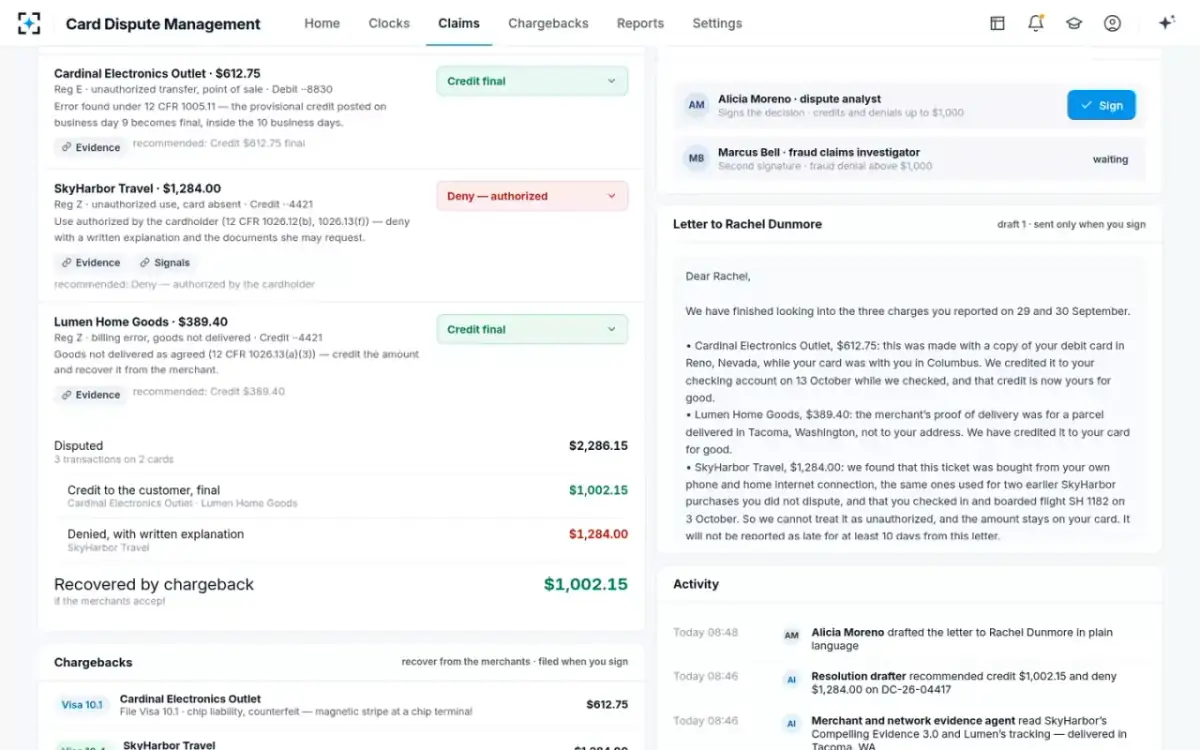
A claim with mixed outcomes shows what per-charge explanation means. In the sample, a customer disputed three charges totalling $2,286.15 on two cards. The agents gathered evidence for each in one minute and 25 seconds; by hand, the desk's median from notice to evidence gathered had been 46 hours.
Three disputed charges, three findings, one letter
| Charge | Evidence found | Outcome | Recovery |
|---|---|---|---|
| $612.75, Reno, debit card | Chip and PIN read in her home city at 16:51 ET; magnetic stripe at a chip-capable terminal 1,950 miles away at 17:06 ET | Credited, final: counterfeit | Visa 10.1 chargeback |
| $389.40, online bookcase, credit card | Carrier record ends at a front desk in another state from the shipping address | Credited, final: merchant proof does not hold | Visa 13.1 chargeback |
| $1,284.00, airline ticket, credit card | Two earlier undisputed purchases from the same airline, same phone and home IP as her banking app; checked in from that phone and boarded four days after disputing | Denied, with the evidence named | — |
The denial rests on evidence about this ticket, not on the customer's history. A first-party screen rated the airline charge strong on three of five signals and noted two earlier disputes in 24 months, both small and both decided in her favour: no pattern. The solution shows such signals to the investigator with their sources and never decides on a signal. The letter, drafted in plain language, gave each charge's outcome and reason, said which documents she could ask for, and was sent to her app inbox and by mail only after both signatures. No affidavit or police report was demanded, and no late reporting would follow for 10 days.
Card Dispute Management drafts a per-charge letter that names the evidence
Documents relied upon: what to send when the customer asks
Send what the decision actually rested on, in a form the customer can read. The official interpretation says copies must be provided "in an understandable form", and that if the bank relied on machine records "it must convert the applicable data into readable form, for example, by printing it and explaining any codes" (comment 11(d)(1)-1). An authorisation log showing "entry mode 90" means nothing to a customer; a line saying the card's magnetic stripe was swiped at a terminal that could read the chip does.
Model wording for each Reg E notice, from acknowledgment to final determination, is collected in Reg E letter samples. The practical consequence for the desk is that the evidence behind each finding must be kept, with its source, from the day of the decision. A letter that cites a carrier record the desk can no longer produce cannot be supported when the customer, an examiner or a court asks.
Where Reg E denial letters fail
Nine checks a compliance reviewer can run on denial letters
- Does the letter give an outcome for each disputed charge?
Not one outcome for the claim.
- Does each denial name the evidence it rests on?
A finding, not a conclusion.
- Does it state the right to request the documents relied on?
Required by 1005.11(d)(1) on every Reg E denial.
- Were requested documents sent promptly and made readable?
Codes explained, as comment 11(d)(1)-1 requires.
- Was the letter sent within three business days of the decision?
Counted on the bank's business-day calendar.
- Does a provisional credit reversal give the date, the amount and the five-day window?
Or the alternative calendar-date notice.
- Was the investigation completed without waiting for a signed statement?
Comment 11(b)(1)-2.
- Does any denial rest on the customer's negligence or history alone?
Neither is a basis on its own.
- For Reg Z denials, does the letter state the amount owed and when?
And is delinquency held until the time to pay has passed?
How Card Dispute Management gets a denial to the customer
From notice of error to a signed denial letter
Agent
Notice reader and clock keeperSplit the notice into transactions, name the rule for each and start each clock on the bank's business-day calendar.
Never: Never moves a deadline
Agent
Transaction investigatorPulls each authorisation (entry mode, chip, device, IP, location) with card status and 90 days of activity.
Never: Never contacts the customer
Agent
Merchant and network evidenceReads representments, checks carrier tracking against the customer's address and Compelling Evidence 3.0.
Never: Never accepts unverified merchant evidence
Agent
Resolution drafterRecommends credit or deny per charge with the rule, and drafts the letter and the chargebacks.
Never: Never sends without a signature
A person decides
Senior dispute analystDecides each charge and signs: "Investigated, decide as shown."
A person decides
Fraud claims investigatorCo-signs any fraud denial above the analyst's $1,000 limit before the letter goes out.
The limits are the bank's controls, not the tool's convenience. The agents never close or deny a claim, never move a deadline or stop a running clock, and never treat a first-party signal as a decision. The analyst signs with a stated meaning, and the signature, time, each decision and its evidence go on the audit trail. What a denial costs when it is wrong is modelled in the cost of a card dispute.
Questions people ask
What must a Reg E denial letter include?
A report of the investigation's results with a written explanation of the findings, and a note of the customer's right to request the documents the bank relied on, which must be provided promptly on request, under 12 CFR 1005.11(d)(1).
How long does a bank have to send a Reg E denial?
Three business days after completing the investigation. The investigation must finish within 10 business days, or 45 days with provisional credit, extended to 90 days for point-of-sale debit, foreign and new-account transfers.
What notice is required when provisional credit is reversed?
The date and amount of the debit, and notice that the bank will honour third-party items and preauthorised transfers without overdraft charges for five business days. Alternatively, notice that the debit will occur five business days from transmittal, with the calendar date.
Can a bank require an affidavit or police report before deciding a Reg E claim?
It may request a written, signed statement, but the official interpretation says it may not delay starting or completing the investigation while waiting for it. The rule does not make a police report a condition of investigation.
What must a Reg Z billing error denial contain?
The reasons the creditor believes the alleged error is incorrect in whole or in part, copies of documentary evidence if the customer asks, and written notice of the amount still owed and when payment is due.
Can a bank deny a Reg E claim because the customer was careless with the card?
No. The official interpretation says consumer negligence cannot be used to impose greater liability than Regulation E allows; writing a PIN on the card, for example, does not change the customer's liability.