Most SBA eligibility rules can be checked by a lender at first contact, long before the file is complete, and that is the useful part of what borrowers call the SBA loan pre-approval process, which is not an SBA process at all. SBA approves a 7(a) guaranty by issuing a loan number on a lender's complete application, and for most loans the lender itself makes the credit decision under delegated authority. What a business owner calls "pre-approval" is the lender's early view: a conversation about terms, a prequalification, or, at some lenders, a written conditional commitment. The work that actually shortens an SBA loan happens in the same window, before the file is complete: SOP 50 10 8.1 says eligibility "should be completed and documented by the Lender as early as practicable", and most of the eligibility checks need only names, tax IDs and an ownership chart. Botminds' Business Loan Application Portal starts that work at the owner's first answers, tracing every owner through holding companies and trusts, because a single missed owner can make the loan ineligible however good the credit.
Examples follow a fictional sample bank and borrower; the rules are SBA's and the CFPB's, quoted as in force in October 2026.
Eligibility checks at the end of collection, or at first contact
- Returns, statements, entity papers14 d
- Not started
- Screens, ownership, transcripts3 d
- IRS slow: Second Request after 10 business days14 d
- Screens, ownership, transcripts3 d
- Answers ready while documents arrive
What is SBA loan pre-approval?
It is a lender's term, not SBA's. SBA's own decision is the guaranty, and it arrives as a loan number. For a loan under a lender's PLP delegated authority, SBA "does not review the Lender's analysis of the credit or structure of the loan or line of credit prior to issuing a loan number"; for a non-delegated loan, "SBA will make the final determination as to the eligibility and creditworthiness of the Applicant" on the application the lender submits through the SBA Loan System (SOP 50 10 8.1). Neither happens before the application is complete.
What owners are offered before then varies by lender: a conversation about whether the loan fits, a prequalification based on a few figures, or a conditional commitment letter. Each has a different weight under Regulation B, set out below, and none binds SBA. The honest description for a borrower is "the lender's early view of whether this can be an SBA loan, and on what terms".
Inquiry, prequalification, preapproval and application under Regulation B
What it looks like: An owner asks about rates and terms; the banker explains them.
How Regulation B treats it: Not an application. The commentary’s examples include explaining "basic loan terms" without saying whether the person qualifies.
What it looks like: A preliminary view of whether the business would likely qualify, and for how much.
How Regulation B treats it: Becomes an application if the lender "evaluates information", "decides to decline the request, and communicates this", and then needs an adverse action notice.
What it looks like: A written commitment, valid for a set period, to lend up to an amount, subject only to limited conditions.
How Regulation B treats it: An application if issued after "a comprehensive analysis of [the applicant’s] creditworthiness"; no notice of incompleteness is required for it.
What it looks like: The request made under the lender’s procedures; for SBA, the file behind the loan number.
How Regulation B treats it: Full Regulation B timing: 30 days from a completed application for most small businesses.
Is a prequalification an application under Regulation B?
It can become one, depending on what the lender does, not what the owner asks. The commentary is explicit: "Whether the inquiry or prequalification request becomes an application depends on how the creditor responds to the consumer, not on what the consumer says or asks." If in answering the lender "evaluates information about the consumer, decides to decline the request, and communicates this", it "has treated the inquiry or prequalification request as an application and must then comply with the notification requirements" (comment 2(f)-3).
For a business lender the lesson is about the word "no". A banker who tells an owner "this won't work as an SBA loan" after looking at the numbers has, on this reading, declined an application and owes the notices that go with it. A banker who explains the requirements and offers to take an application has not. Written prequalification scripts should say which of the two the bank intends. A true preapproval, a written commitment after a full credit analysis, is an application, and comment 9(c)(1)-1 exempts it from the notice of incompleteness.
Can SBA eligibility be checked before the application is complete?
Yes, and SBA expects it. SOP 50 10 8.1 calls eligibility "a required and critical step in the SBA loan process" that "should be completed and documented by the Lender as early as practicable", and adds that "the Applicant must meet all core requirements at the time of application and throughout loan closing and disbursement". Since June 1, 2025, the determination has been the lender's: as SBA's Inspector General put it, SBA "has restored this responsibility back to the lenders" (SBA OIG Report 26-07).
Most eligibility checks need very little: the business's name and tax ID, its industry code, the names of its owners and officers, and an ownership chart. A lender that runs them as soon as it has those, rather than when the credit file is complete, finds an ineligible owner or business before the owner has assembled three years of returns, which saves both sides the most time of anything in the process.
What checks can a lender run at first contact?
Nine, all drawn from the SOP, and none needs the full credit file. The checklist gives each with the rule behind it; several must be documented, so "run" means run and keep the evidence.
Nine eligibility checks a lender can run before the SBA file is complete
- Ownership traced to 100%
Every direct and indirect owner, through companies and trusts, percentages summing to 100%; this is what the other checks run on.
- Citizenship and residence of every owner
All U.S. citizens or nationals with a principal residence in the United States since March 1, 2026; ineligible if any owner was an Ineligible Person in the six months before the loan number, unless fully divested.
- SAM.gov exclusions
The applicant, 20% owners, officers, directors and key employees; keep a screenshot of the results.
- CAIVRS
Prior losses and delinquent federal debt for the applicant and its Associates; keep the evidence in the file.
- OFAC sanctions lists
The business and its owners, “at the time of application”.
- Ineligible business types
13 CFR 120.110, from lending and loan packaging to gambling and lobbying; Form 1919 question 7 asks directly.
- Size, with affiliates
The industry size standard, or the alternative of $20 million tangible net worth and $6.5 million average net income.
- Franchise Directory
If the brand meets the FTC definition of a franchise, it must be on SBA’s Directory.
- Existing SBA loans
An existing SBA loan more than 29 days past due when the new loan number issues makes the applicant ineligible.
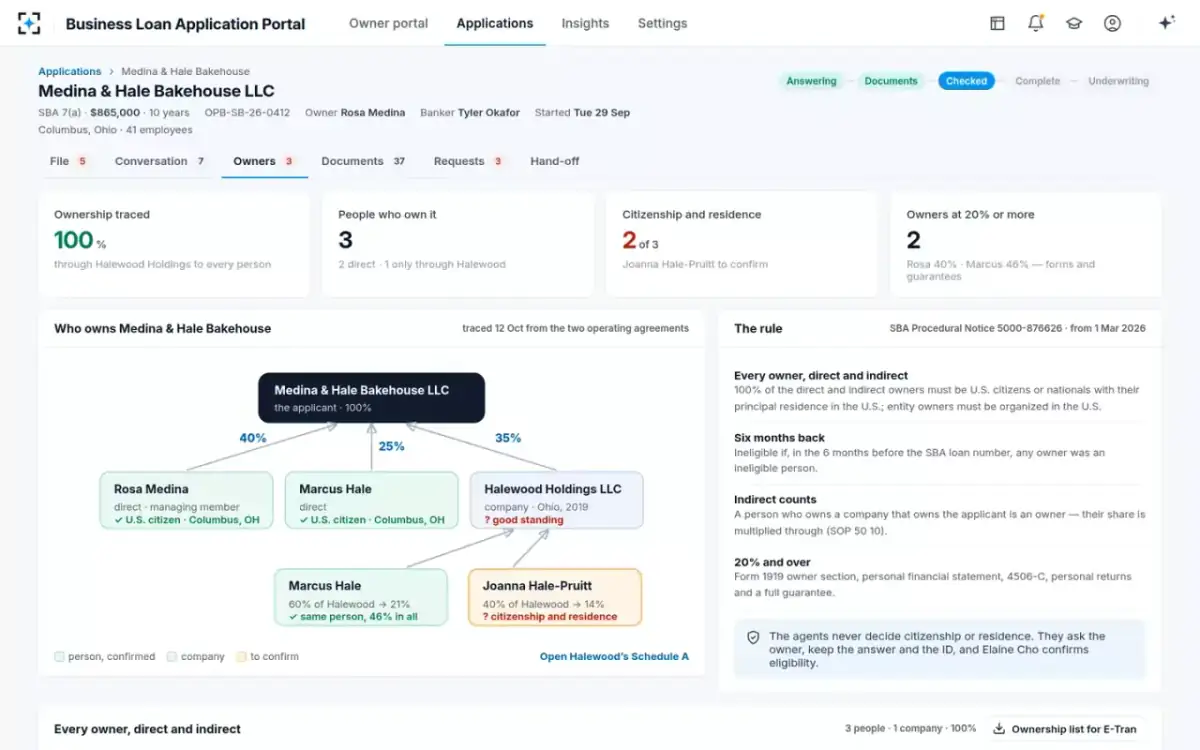
Ownership comes first because every other check depends on it. A SAM.gov search on the people the applicant listed misses the owner the applicant did not list. In the sample application, the bakery's return showed a holding company with 35%; the portal asked who owned it, sent the co-owner his own link for its operating agreement, and found a third owner at 14%. Her 2019 address in that agreement was in Canada. The agents did not treat that as an answer: they asked her to confirm citizenship and residence and upload an ID, and the SBA lending manager confirmed eligibility before the loan number was requested.
Ownership traced through a holding company, with the rule beside it
What is CAIVRS, and who has to be checked?
CAIVRS, the Credit Alert Verification Reporting System, is the federal database lenders use to see whether an applicant has caused a loss on, or is delinquent on, a federal loan. SOP 50 10 8.1 says "all SBA Lenders must check the Credit Alert Verification Reporting System (CAIVRS), to determine if the Applicant is ineligible for a 7(a) or 504 loan because the Applicant or a business owned, operated, or controlled by the Applicant or any of its Associates has a Prior Loss", and "must retain documentation of the CAIVRS check in the loan file". A federal debt is "delinquent" when "not paid within 90 days of the payment due date".
One 2026 change narrows the prior-loss test. Policy Notice 5000-879464, effective June 1, 2026 and folded into SOP 50 10 8.1, provides a waiver of the prior-loss rule for a "Non-controlling Minority Equity Investor", one who held less than 20 percent of the equity of the business with the prior loss. Form 1919's question 2 asks the applicant the same thing CAIVRS checks, which makes the two a natural cross-check at first contact.
How early should a lender order tax transcripts?
As soon as the owner can sign the 4506-C, which is usually at the first conversation. IVES transcripts arrive in two or three business days by fax, faster online (IRS), but a rejected form or a slow IRS response can add two weeks, and SBA's rule is that the lender sends a "Second Request" if nothing has arrived in 10 business days. None of that waiting needs the rest of the file.
Transcripts also answer an eligibility question early. They confirm the business filed its returns, and "if an Applicant has not filed required Federal tax returns, the Applicant is not eligible for SBA financial assistance". They give revenue for the size test as the IRS has it. And if the IRS has no record of a required year, "no disbursements may be made on the loan", which is much better learned in week one than at closing. Why IVES rejects a 4506-C for business covers the form.
How long does SBA pre-approval take, and how does SBA approval work?
There is no SBA pre-approval step to time. Most SBA 7(a) loans are approved by the lender itself: by our count of SBA's loan data, 64.1% of FY2025 7(a) approvals were made under PLP delegated authority and 30.9% under SBA Express, which is delegated only; 4.2% went through SBA's non-delegated process (SBA 7(a) FOIA data). For delegated loans the time to approval is the lender's own, and is mostly the time to a complete file.
Who approves an SBA 7(a) loan
64.1%
of FY2025 7(a) approvals under lenders’ PLP delegated authority
30.9%
under SBA Express, a delegated-only program
4.2%
through SBA’s non-delegated processing
6months
lookback on every owner before the loan number is issued
Two dates in the rules sit at the end of the process and are worth knowing at the start. Size, for delegated loans, "is determined as of the date of approval of the loan by the SBA Lender", so a business near its size standard needs its numbers checked against the approval date it expects. And the citizenship lookback counts back six months from "the date of issuance of the SBA loan number": an owner who was an Ineligible Person in that window makes the business ineligible unless the person "completely divests" before the number issues.
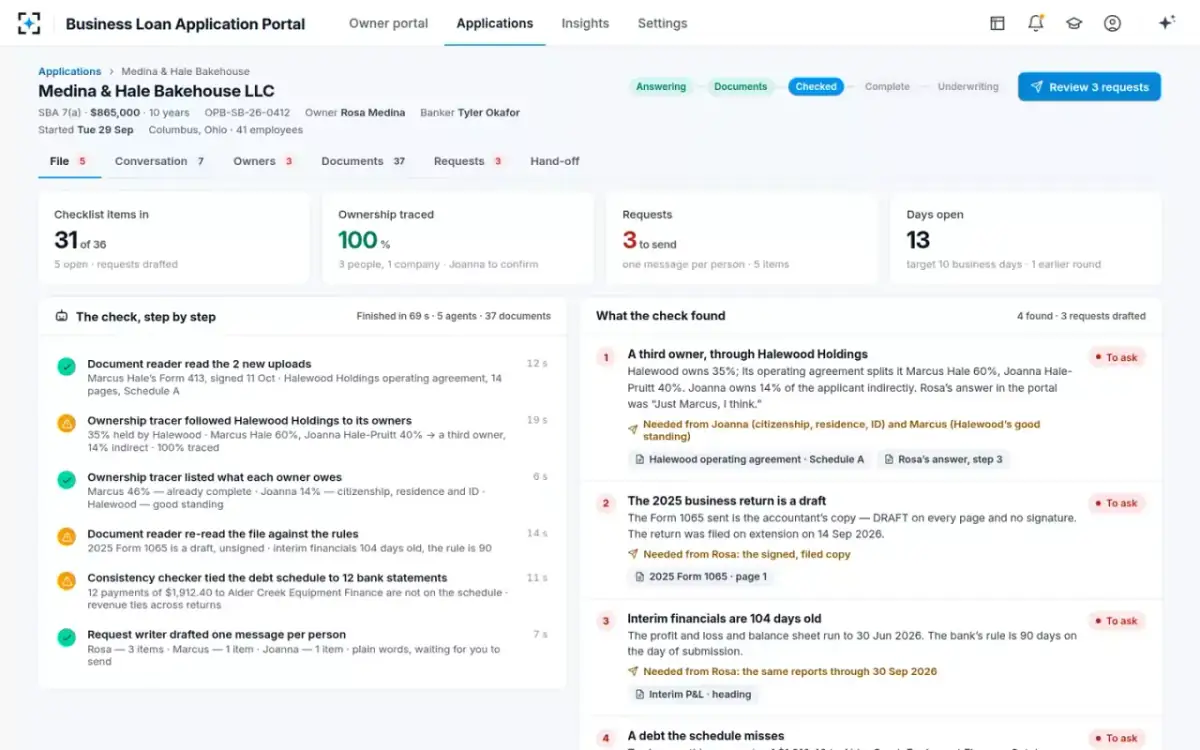
The check on a complete file: four findings, each with its source
A lender that wants to give owners a meaningful early answer can do so without pretending SBA has approved anything: "you look eligible on ownership, size, business type and the federal screens, and here is what we need for the credit decision". That is a stronger statement than most pre-approval letters, and it rests on checks the lender would have to run anyway. What Regulation B requires when the file is still incomplete covers the notices that follow, and SBA Form 1919, annotated shows which answers set off which checks. To see the ownership trace on a sample file, start from the Business Loan Application Portal.
Questions people ask
Does SBA pre-approve borrowers?
No. SBA guarantees loans that lenders make; it does not pre-approve businesses. Its approval is the loan number on a complete application, and under delegated authority the lender makes the credit decision itself. A letter that says "SBA pre-approved" is describing the lender's view, not SBA's.
What credit score does SBA require for a 7(a) loan?
SBA's own score screen for 7(a) Small loans, the FICO Small Business Scoring Service, was sunset on March 1, 2026; those loans now need debt service coverage of at least 1.10 to 1 and a review of two months of bank statements. Lenders apply their own credit policies, and a lender's scoring model may not rely solely on consumer credit scores.
Can a green card holder own part of an SBA borrower in 2026?
No. Since March 1, 2026, lawful permanent residents may not own any percentage of an SBA 7(a) or 504 borrower, and the six-month lookback applies. An Ineligible Person other than an undocumented alien may still give a limited guaranty where one is required.
Is a pre-approval letter binding on the lender?
That depends on the letter. Under Regulation B's commentary, a true preapproval is a written commitment, valid for a set period, subject only to limited conditions such as adequate collateral and no material change in the applicant's condition. Most SBA pre-approval letters are conditional on the full file and SBA eligibility, and say so.
What happens if an ineligible owner is found after approval?
The loan should not have been made, and the lender bears the risk. The applicant must meet core requirements "throughout loan closing and disbursement", and SBA reviews eligibility when a lender asks it to buy the guaranty. Finding the owner at first contact is cheaper for everyone than finding them at a purchase review.