The SBA loan application checklist for a 7(a) loan comes from Appendix 20 of SBA's SOP 50 10 8.1: a signed SBA Form 1919 for each co-borrower, a personal financial statement for every owner of 20% or more and each guarantor, three years of business financial statements or tax returns plus interim statements with a detailed debt schedule, IRS tax transcripts, and the documents the loan's purpose calls for, such as a lease, equipment quotes or a purchase agreement. Every lender turns that list into its own checklist, and every processor ticks it. The trouble is that a tick shows that a document arrived, not that it satisfies the rule: the ownership may not reach 100%, the statement may be stale by the day the file goes to SBA, the return may be the accountant's draft. Botminds' Business Loan Application Portal reads each upload against the rule behind its checklist line, so "received" and "complete" stop being the same word.
The examples follow a fictional sample lender, Orchard Point Bank, and one fictional application: Medina & Hale Bakehouse, an Ohio bakery asking for an SBA 7(a) loan of $865,000. SBA's rules are quoted from the SOP and notices in force in October 2026.
Seven checklist lines that can be ticked while the file still fails
What the checklist shows: Form 1919 ownership section filled in: every owner of 20% or more.
What SBA's rules actually need: 100% of direct and indirect owners listed in the SBA Loan System, percentages summing to 100%, each a U.S. citizen or national living in the U.S.
What the checklist shows: Signed borrower form received.
What SBA's rules actually need: Signed form plus the applicant certifications Procedural Notice 5000-876626 requires to be attached until SBA publishes an updated form.
What the checklist shows: Form 413 received from each 20% owner.
What SBA's rules actually need: Signed and dated within 90 days of submission to SBA, not of receipt.
What the checklist shows: Profit and loss and balance sheet received.
What SBA's rules actually need: Dated within 120 days before submission to SBA, with a detailed debt schedule; the bank’s own rule may be stricter.
What the checklist shows: Three years of business returns received.
What SBA's rules actually need: Signed, filed returns that IRS transcripts can be reconciled to; a draft cannot be.
What the checklist shows: Schedule received.
What SBA's rules actually need: Every debt included; for 7(a) Small loans, checked against two months of operating-account statements.
What the checklist shows: Quotes received.
What SBA's rules actually need: Quotes that agree with the purpose amounts on every Form 1919 and with the loan request.
What is on the SBA loan application checklist?
The checklist has a fixed core and a variable tail. The core comes from the "General Requirements" of Appendix 20, which "consolidates the contents of the lender's application for guaranty requirements applicable to all 7(a) loan programs". The tail depends on the purpose: real estate brings an appraisal, a signed purchase agreement and an environmental questionnaire; a business acquisition brings the buy-sell agreement, a business valuation, a pro forma balance sheet and three years of the seller's financial statements, each "dated and either signed or certified by the seller within 120 days prior to submission to SBA".
The program changes the core, too. The table shows the main differences between Standard 7(a), 7(a) Small (loans of $350,000 or less) and SBA Express (up to $500,000).
The SBA 7(a) loan application checklist by program, under SOP 50 10 8.1
| Item | Standard 7(a) | 7(a) Small | SBA Express |
|---|---|---|---|
| SBA Form 1919, each co-borrower; its data into the SBA Loan System | Required | Required | Required |
| 100% of direct and indirect owners in the SBA Loan System | Required | Required | Required |
| Personal financial statement, 20%+ owners and guarantors, within 90 days | Required | Required | Required |
| Three years of business financials or returns, interim within 120 days, debt schedule | Required | Required | Required |
| IRS tax transcripts, reconciled before first disbursement | Required | Required | If underwritten on business financials; otherwise to confirm filing and size, no reconciliation |
| Two most recent months of operating-account statements reviewed | Lender’s own analysis | Required, to find every debt | Lender’s own credit process |
| Purpose items: lease, equipment quotes, asset and collateral lists | As applicable | Only as needed for uses of proceeds and the credit analysis | Only as needed for uses of proceeds and the credit analysis |
Lenders add their own items to this core, and SBA expects them to: the file must include "the forms and information the Lender requires in order to make an informed credit decision". The sample bank's six checklists run from 14 items for a line of credit to 47 for a 504 loan, with 34 for a Standard 7(a) and 22 for a 7(a) Small. The count is less important than what each line is checked against.
Why is my complete SBA application still not ready?
Because "complete" on a checklist means received, and SBA's rules care about content, dates and signatures. The seven lines in the comparison above are the usual culprits. Each one is a document that exists, sits in the file and still cannot be relied on: an ownership section that stops at 20%, a statement that was current when it arrived and is stale when the file is submitted, a return that says DRAFT on every page.
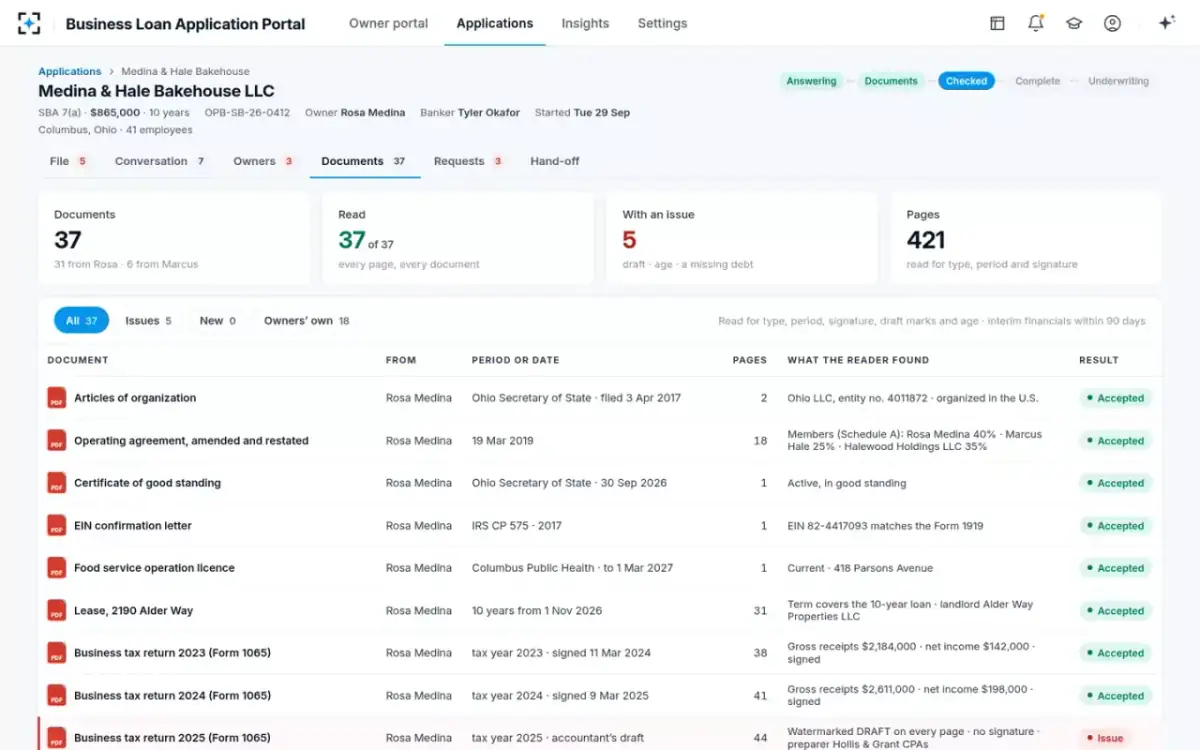
The sample bakery shows how it happens. When the processor opened the file on 12 October, 37 documents were in and the checklist showed 31 of 36 items. A check of the documents against the rules found four problems the checklist could not see: a 35% owner that was itself a company, whose own owners included a woman nobody had mentioned; the 2025 Form 1065 marked DRAFT and unsigned; interim financials to 30 June, 104 days old against the bank's 90-day rule; and twelve monthly payments of $1,912.40 to an equipment lender that the debt schedule did not list. Every one of those documents had already been ticked.
Every document read for type, period, signature and age, not just received
Do all owners have to be listed on an SBA application?
Yes, all of them, though the form and the system ask differently. Form 1919's ownership section, in the version on SBA's form page, asks for entities owning 20% or more, the people behind them, and enough beneficial owners to reach 51% (SBA Form 1919, 02/2025). The lender's obligation is wider: under SOP 50 10 8.1 it "must list in the SBA Loan System 100% of the total direct and indirect ownership of the Applicant", and "the ownership percentages of all listed owners must equal 100%".
The gap between 20% and 100% is where files fail. Since March 1, 2026, every direct and indirect owner must be a U.S. citizen or U.S. national with a principal residence in the United States; Policy Notice 5000-876441 made lawful permanent residents ineligible to "own any percentage interest" (SBA Policy Notice 5000-876441). A 14% owner two companies up the chain does not appear on a 20% ownership section, and does not need to sign a guaranty, but does need to be eligible. The bank's own beneficial-ownership data does not close the gap either: under FinCEN's February 2026 order, banks identify beneficial owners at the 25% threshold (FinCEN order, Feb 13, 2026).
Ownership traced to 100%, through a holding company, beside the rule it is checked against
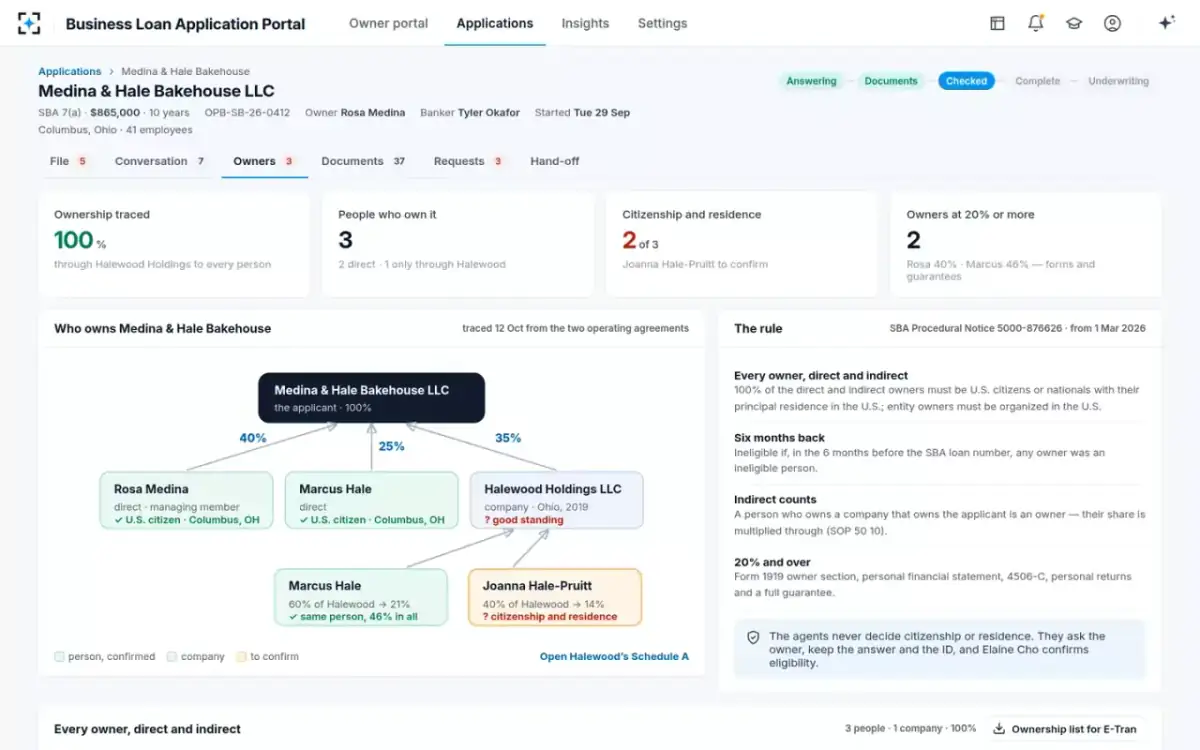
The arithmetic is simple once the documents are in: Halewood owns 35% of the bakery, Joanna owns 40% of Halewood, so she owns 14% of the applicant. The hard part is getting the documents, because the person filling in the application often does not know who owns the companies that own them. SBA Form 1919, annotated goes through the ownership section and each question that follows it.
The age of a document is measured on the day the file goes to SBA
SBA's age limits count back from submission, not from receipt. A personal financial statement must be "signed and dated within 90 days of submission to SBA"; business financial statements "must be dated within 120 days of submission to SBA"; interim statements "must be dated within 120 days prior to submission to SBA". A file that sits waiting for one missing item can age out of compliance on items that were fine when they arrived.
Many banks set tighter limits than SBA. The sample bank requires interim financials no older than 90 days, which is why its reader flagged statements that would have passed SBA's 120-day rule. A checklist that notes only "received" cannot show either limit; one that records the statement date and the planned submission date can show both, and show which items will expire first if the file waits.
The Form 1919 on SBA's form page is not the whole Form 1919
The version of SBA Form 1919 that SBA's form page lists, dated 02/2025, still carries an old applicant certification: majority ownership by citizens or lawful permanent residents. That is no longer the rule. Procedural Notice 5000-876626 explains that SBA "is in the process of updating SBA Form 1919", and until it does, lenders attach the new applicant certifications to the form as a supplement the applicant signs (SBA Procedural Notice 5000-876626).
A checklist line that says "Form 1919, signed" is ticked by the form alone. The complete item is the form and the signed supplement, in which the applicant certifies that none of its direct and indirect owners or SBA-required guarantors is an Ineligible Person and that all are U.S. citizens or nationals with a principal residence in the United States. SBA's August 2026 notice issuing SOP 50 10 8.1 repeats that it "is in the process of updating application forms" (SBA Information Notice 5000-880695), so the supplement remains part of the checklist until a new form appears.
Drafts, signatures and the return that cannot be reconciled
A tax return in the file is there to be compared with the IRS's own copy. Except on SBA Express and Export Express loans, the lender has to reconcile the returns to IRS transcripts before the first disbursement, and a missing IRS record for a required year stops the disbursement altogether. An accountant's draft cannot be reconciled to anything; it is a forecast of a return.
Signatures fail the same way. A 4506-C missing a signature is rejected by the IRS, and the Form 1919 answer on incarceration and indictment needs an original initial or an acceptable electronic signature, not a typed one. At the sample bank, 29% of third-quarter applications sent a draft or unsigned return on first upload, and 19% an unsigned 4506-C. Why IVES rejects a 4506-C for business covers the transcript side in detail.
The debt the checklist cannot see
A debt schedule can be complete on its face and wrong. SOP 50 10 8.1 requires lenders on 7(a) Small loans to review the latest two months of the primary operating account to confirm that every debt is in the coverage calculation. The rule exists because owners leave debts off schedules, most often equipment leases and sales-based financing that is repaid by daily or weekly debit.
The sample bakery's schedule listed a line of credit of $22,400 and a van loan of $31,800. Its statements showed twelve payments of $1,912.40 to Alder Creek Equipment Finance; asked, the owner explained a lease-to-own on a 2023 oven with $48,200 left. Nothing was hidden. It was simply easy to forget, and no checklist line was going to remember it.
What is the SBA 7(a) checklist for lenders, and who keeps it current?
SBA sets the contents in Appendix 20 and publishes centralized submission instructions through its loan guaranty processing center; each lender turns those into its own checklist, built with its credit policy, and has to keep it current as SBA changes the rules. That last duty is heavier than it looks. Between June 2025 and October 2026, SBA replaced its lending SOP twice and folded nine policy and procedural notices into SOP 50 10 8.1; each notice carries an expiry date a year out, because it is meant to be absorbed into the next SOP.
A checklist that does not change with the rules goes stale
2SOPs
SOP 50 10 8 (June 1, 2025) and 8.1 (October 1, 2026)
9notices
policy and procedural notices folded into SOP 50 10 8.1
100%
of owners in the SBA Loan System, citizens or nationals, since March 1, 2026
62of 77
unsupported error-code clearances in OIG’s sample that concerned affiliation
The OIG figure is a warning about documentation rather than about lenders. Reviewing loans SBA screened itself before eligibility returned to lenders on June 1, 2025, the Inspector General found that for loans with a cleared affiliation code "the files did not include source documentation to support the affiliation or size analysis" (SBA OIG 26-07). An ownership line ticked without the operating agreement behind it is the same weakness, at the lender's desk.
What “complete” should mean for each line of an SBA checklist
- The document, read
Its type, tax year or period, signer and date, recorded from the document itself.
- Checked against its rule
The SOP limit or the bank’s stricter one: 90 days, 120 days, three years, signed and filed.
- Checked against the other documents
Revenue across returns and financials; debts across the schedule and statements; uses across quotes and the 1919.
- Owners to 100%
Every company and trust opened up until people remain, and each person’s eligibility confirmed by that person.
- Dated against submission
Each age limit shown against the day the file will go to SBA, not the day it arrived.
- The version of the checklist kept
Which revision of the bank’s checklist, under which SOP, the file was completed against.
A file that meets all six is complete in the sense an underwriter, a closing attorney and a purchase reviewer will each test. To see a checklist read item by item on a sample file, start from the Business Loan Application Portal.
Questions people ask
What documents are required for an SBA 7(a) loan?
The core set under SOP 50 10 8.1 is a signed Form 1919 for each co-borrower, personal financial statements for 20% owners and guarantors, three years of business financials or returns with interim statements and a debt schedule, and IRS tax transcripts. The loan's purpose adds items such as a lease, equipment quotes, an appraisal or, for an acquisition, the purchase agreement, a business valuation and the seller's financials.
Is there an official SBA 7(a) checklist for lenders?
Appendix 20 of SOP 50 10 8.1 is the official list of what a lender's application for guaranty must contain, and it points lenders to SBA's centralized 7(a) loan submission instructions at the loan guaranty processing center. Each lender builds its own checklist from these and its credit policy, and should version it as SBA's notices change the rules.
How old can financial statements be for an SBA loan?
Under SOP 50 10 8.1, business financial statements and interim statements must be dated within 120 days before submission to SBA, and personal financial statements signed and dated within 90 days of submission. Many lenders set shorter limits for interim statements; the sample bank uses 90 days.
Does a 7(a) Small loan need the full checklist?
Most of it. Appendix 20 applies the general requirements to 7(a) Small loans, but some purpose-specific items are required "only to the extent necessary to sufficiently document the eligible uses of proceeds and to support the credit analysis". Since SBA sunset the FICO SBSS score on March 1, 2026, 7(a) Small loans need debt service coverage of at least 1.10 to 1 and a review of two months of bank statements instead.
Do I need a separate Form 1919 for each borrower?
Yes, for each co-borrower, for example an eligible passive company and its operating company. SOP 50 10 8.1 says the "Purpose of the loan" amounts across all the Forms 1919 "should equal the total amount of the loan request", so the forms have to be read together as well as one by one.