An online commercial loan application at a bank is still the exception. In the FDIC's Small Business Lending Survey, covering 2022, about a quarter of banks accepted a formal small business loan application through an online portal, 40% let customers complete some steps online, and "only 6 percent of banks have a fully online application process"; 60% had no online step at all (FDIC, Small Business Lending Survey, Section 6). The reasons are not mainly technical. Banks value relationships built in person, signing documents online is rare, and a business loan file, above all an SBA 7(a) file, needs documents, signatures and ownership details that a simple online form cannot check. Botminds' Business Loan Application Portal is built for that harder half: owners apply through their own link, answering one plain question at a time, while the processor sees the same file fill at the bank, every upload read and checked as it lands.
The research figures below come from the FDIC, the Federal Reserve Banks' Small Business Credit Survey and peer-reviewed studies; the product examples come from a fictional sample bank and borrower.
Most banks take no part of a small business application online
Banks by online steps, 2022
- No steps online · 60%
- Some steps · 34%
- All steps · 6%
Formal application accepted online, 2016
- Online · 11%
- Not online · 89%
Formal application accepted online, 2022
- Online · 25%
- Not online · 75%
How many banks offer online business loan applications?
About a quarter accept the application itself online, and very few run the whole process there. The FDIC split the application into four steps and asked how each could be completed. Online, 19% of banks could consult about products, 25% could take a formal application, 23% could take financial statements and supporting documents, and 13% could have the borrower sign documents for an approved loan. Almost every bank, more than 90%, could do every step at a branch.
The trend is up from a low base. "Only 11 percent of banks accepted applications online in 2016, compared with 25 percent in 2022." Large banks moved faster: by 2022, 42% of large banks and 24% of small banks accepted an application online, against 23% and 11% in 2016. One caveat matters for SBA lenders. The FDIC keyed its question to each bank's highest-volume small business product "excluding credit cards and government-guaranteed products", so the survey says nothing directly about SBA loans; if anything, the heavier SBA file makes a fully online process rarer still.
Why are bank business loan applications hard?
Applicants say so themselves, and they say it most about large banks. In the Federal Reserve Banks' Small Business Credit Survey, 26% of large-bank applicants and 18% of small-bank applicants reported a difficult application process in 2025, against 11% at online lenders; 24% of large-bank applicants cited "unclear criteria for approval" (Small Business Credit Survey, 2026 Report on Employer Firms). The difficulty is mostly about not knowing what the bank needs and why, which is a problem of communication before it is one of technology.
Banks approve more applicants; online lenders feel easier
57%
of small-bank applicants fully approved in 2025, the highest of any lender type
38%
of online-lender applicants fully approved
26%
of large-bank applicants found the application difficult
60%
of online-lender borrowers said costs were higher than expected
Do online lenders approve more small businesses?
No. Small banks approve the most: "Applicants that sought financing at small banks were more likely to be fully approved (57%) than those that sought financing from other lenders" (SBCS 2026). Online lenders fully approved 38%, large banks 43%. What online lenders offer is an easier process, and borrowers pay for it: "Sixty percent of those that borrowed from online lenders reported that actual borrowing costs were higher than expected", against 37% at small banks and 32% at large banks, and 61% of online-lender applicants cited high interest rates as a challenge.
That is the opening for a bank. Its approval rates and prices are better; its application is harder. The share of applicants going to online fintech lenders "has increased over the last five years, from 17% in the 2020 survey to 29% in the 2025 survey". A bank that matched the online lenders' ease while keeping its own underwriting would be competing on the one dimension where it now loses.
Why most banks stop at "some steps online"
Because most banks do not believe the portal is where relationships are won. Asked to value each way of taking an application, banks rated branches (94%), on-site visits (89%) and remote communication (77%) far above online portals (36%). Even among banks that offer a portal, only 38% call it very or extremely valuable. The FDIC concluded that "banks that do not offer an online portal are not at a significant disadvantage to those that do" (FDIC SBLS).
“Taking loan applications through an online portal remains relatively rare.”
FDIC, Small Business Lending Survey (2024 report)
The finding deserves to be taken seriously rather than argued away. Speed is the advantage banks claim most often after relationships: in the same survey, banks said they distinguish themselves on "decision speed (75 percent), speed of service (74 percent), and funding speed (70 percent)". A portal that only moves the paperwork online, leaving the same rounds of requests and the same missing documents, adds a channel without adding speed. The case for going further rests on what happens to the file, not on where it is uploaded.
What is a fully online commercial loan application?
One in which every step the FDIC measured can be done without a branch visit: learning what is needed, applying, sending financial statements and supporting documents, and signing. For an SBA 7(a) loan, each step carries requirements that a generic online form does not meet, which is the practical reason the 6% is so small.
Some steps online, and all steps online, on an SBA 7(a) application
Some steps online (the common case): A PDF checklist on the bank’s website.
All steps online, done properly: A checklist built from the loan type and the owner’s answers, in plain words, in the owner’s language.
Some steps online (the common case): An online form; the owner types what the tax return already says.
All steps online, done properly: The return read on upload; only what it could not answer is asked.
Some steps online (the common case): Uploads to a folder, checked by a person days later.
All steps online, done properly: Each upload read for year, period, signer and draft marks as it lands, with the reason if it falls short.
Some steps online (the common case): A table the applicant fills in.
All steps online, done properly: Each owner given a link; ownership traced through companies and trusts to 100%, each confirming citizenship with an ID.
Some steps online (the common case): Print, sign, scan.
All steps online, done properly: Signatures captured where the rules allow, with the boxes IVES requires for electronic signing.
Some steps online (the common case): A pile of files.
All steps online, done properly: The same file filling live, with what is still missing and who can supply it.
Signing is the hardest row. The IRS accepts an electronically signed 4506-C only from IVES participants authorised for electronic signatures, and only with the "electronically signed" box ticked (IRS IVES FAQs). SBA Form 1919's question on incarceration and indictment needs an original initial or an acceptable electronic signature, never a typed one (SBA Form 1919). None of this rules out a fully online SBA application; it means the software has to know the rules of each form.
The owner reads the filled application once, and sends it
Does automation improve access to credit?
The best evidence says it can, if verification keeps pace. Studying the Paycheck Protection Program, Howell, Kuchler, Snitkof, Stroebel and Wong found that "process automation reduces racial disparities in credit access through enabling smaller loans, broadening banks' geographic reach, and removing human biases from decision-making", and that after traditional banks automated their loan processing, "their PPP lending to Black-owned firms increased" (NBER Working Paper 29364; Journal of Finance, 2024). Erel and Liebersohn found that fintech lending in PPP "mostly expands, rather than redistributes, the supply of financial services" (Journal of Financial Economics, 2022).
The same program supplies the counterweight. Griffin, Kruger and Mahajan found measures of potential misreporting "consistently concentrate in certain FinTech lenders", and that "suspicious lending by FinTechs in 2021 is four times the level at the start of the program" (Journal of Finance, 2023). An online application that removes friction by removing checks buys access with losses. One that removes friction by doing the checks earlier, reading the return, tying the debts to the bank statements, tracing the owners, keeps both.
Can an SBA loan application be completed online?
Yes, as far as SBA's content rules go; they govern what the file contains and who signs, not the channel it arrives through. The lender already submits SBA's data electronically: under SOP 50 10 8.1 only the information on Form 1919 goes into the SBA Loan System, while the signed form stays in the lender's file. What an online process must still deliver is every item on the lender's checklist, every signature in a form the IRS and SBA accept, and 100% of the business's direct and indirect owners.
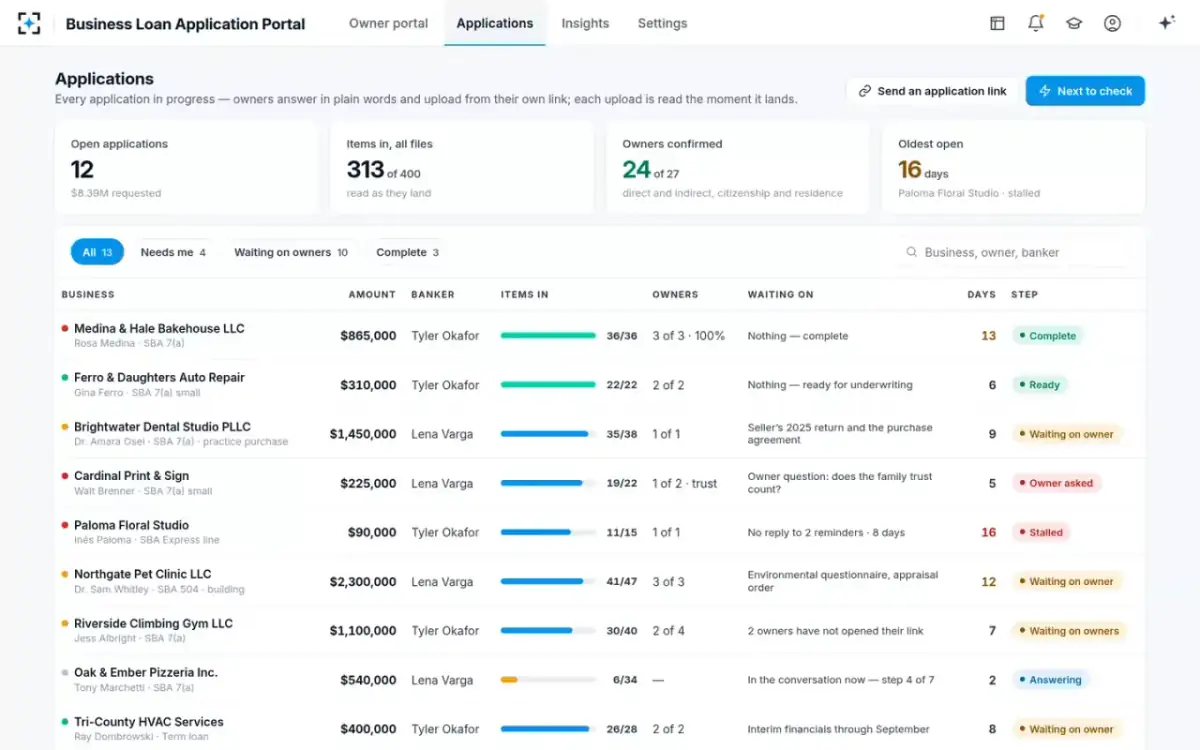
The sample bank shows what that looks like in practice. Twelve applications were open on one day, $8.39 million requested, with 313 of 400 checklist items in and 24 of 27 owners confirmed; each line showed what the file was waiting on, from an owner who had not opened a link to a question about whether a family trust counts.
Every open application, with what each is waiting on
What a fully online SBA application looks like on one file
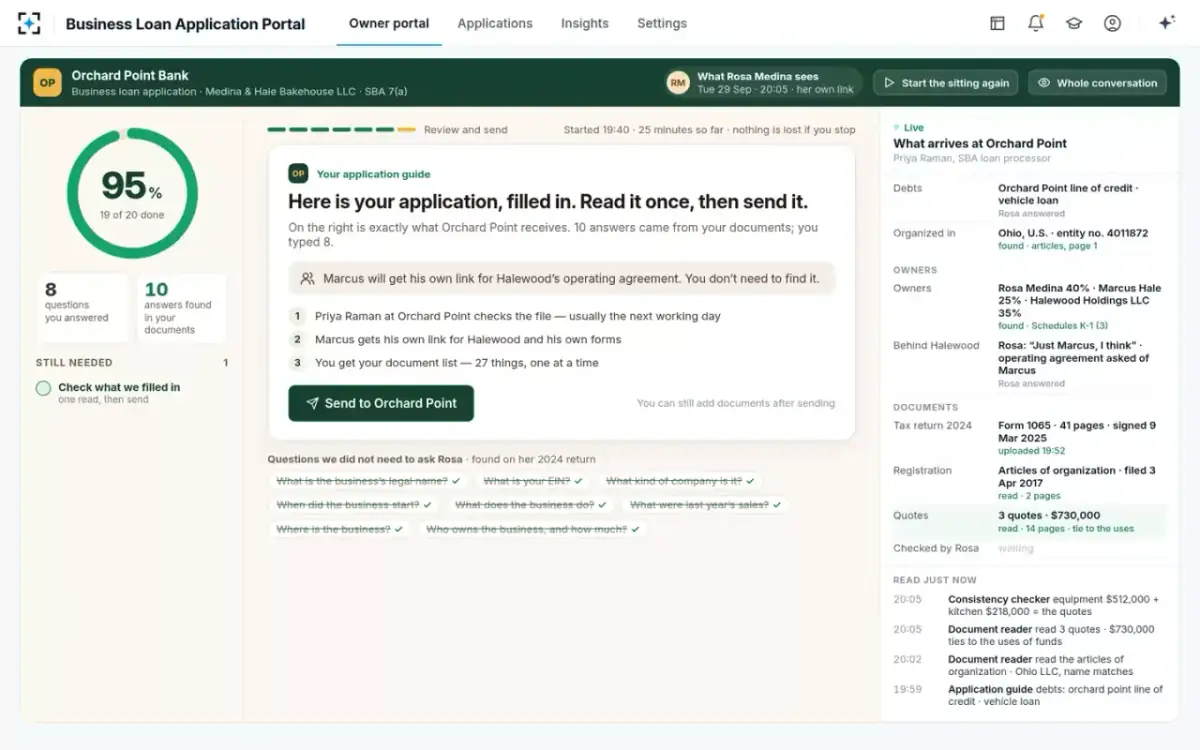
Follow one sample file from the link to underwriting. The bakery's managing member opened the application link from her banker on a Tuesday evening at 19:40, between bakes, and answered the first questions on screen: the amount, what it was for, who was applying, how many people the business employs. She dropped in last year's partnership return; the portal read it and filled eight answers, each with the page it came from, then asked only what the return could not say, starting with who owns the holding company behind 35% of the business. She read the filled application once and sent it the same evening.
Nothing about the rest required a branch. The holding company's co-owner received his own link and uploaded its operating agreement and his personal financial statement on a Sunday night. When the processor ran the check on Monday morning, it took 69 seconds across 37 documents and returned four findings: a third owner nobody had mentioned, a return marked DRAFT, interim financials 104 days old against the bank's 90-day rule, and a monthly equipment payment missing from the debt schedule. Three plain-words messages went out at 09:21, one per person; the last answer came back at 09:47, and the file was complete 13 days after the first document.
The point of the example is not speed for its own sake. Apart from signing the loan documents, which comes after approval, every step the FDIC counted was done online, and the file that reached underwriting was checked against the rules a purchase reviewer would apply years later. That combination, rather than the upload button, is what the 94% of banks without a fully online process are missing.
What to look for if your bank is among the other 94%
Start from the file, not the front end. A bank that already takes some steps online usually has the form; what it lacks is the reading and checking that makes the form worth filling in. The table sets out what to test, and where Botminds' solution stands on each.
Testing an online commercial loan application for an SBA lender
| What to test | Why it matters | In the Business Loan Application Portal |
|---|---|---|
| Uploads read on arrival | A draft return or stale statement caught at upload saves a round | Each upload read for type, year, period, signer, date and draft marks |
| Questions only for gaps | Owners abandon forms that make them re-type their return | A return fills what it can; the guide asks only the rest |
| Ownership to 100% | SBA requires every direct and indirect owner | Traced through companies and trusts; each owner confirms citizenship and residence |
| Plain language | Unclear criteria is a top complaint about banks | Grade-7 reading level by default, English or Spanish |
| People decide | Requests and eligibility carry legal weight | The processor sends and marks complete; a manager confirms eligibility |
| Measured from day one | A portal that does not shorten files is a channel, not a fix | Complete at first submission, days to complete and rounds, by month and loan type |
Two limits belong on the same page. The solution does not make credit decisions or replace a loan origination system, and it does not take the relationship out of relationship lending: the banker still sends the link and still calls the owner. And from January 1, 2028, the CFPB's rewritten Section 1071 rule will require covered lenders to collect and report small business application data, which any online application will need to accommodate; our Section 1071 readiness guide covers that rule. For the economics, see what a business loan application portal saves per day of waiting; for the go-live list, what to bring to an online loan application software project. To see the sample bank, start from the Business Loan Application Portal.
Questions people ask
What share of banks accept documents online for a business loan?
About a quarter. In the FDIC's survey of 2022 practice, 23% of banks accepted financial statements and other supporting documents through an online portal, and 25% accepted the formal application. Far more, 88%, accepted documents by remote communication such as email or file transfer.
Why don't more banks offer online business loan applications?
Most banks value in-person and remote relationships more than portals: 36% of banks rated online portals very or extremely valuable, against 94% for branches. The FDIC suggests some small banks may consider implementation cost-prohibitive, or think a portal does not fit their underwriting or market.
Are online business loan applications safe?
They can be as safe as the checks behind them. Research on the Paycheck Protection Program found suspicious lending concentrated in certain fintech lenders, which is an argument for verification, such as IRS transcripts and bank-statement reviews, built into the online process rather than skipped.
How fast can a bank approve a business loan applied for online?
The FDIC found that three in ten banks, including more than half of large banks, can approve a small and simple loan within one business day, and three in four approve their typical loan within ten business days (FDIC SBLS). Those clocks start once the file is complete, which is what an online application should speed up.
Do SBA loan applicants apply online more often now?
Public data does not say. The FDIC excluded government-guaranteed products from its question, and the Federal Reserve survey reports where applicants applied, not how. What is known is that SBA loans had the hardest outcomes in the 2025 survey: 32% of applicants fully approved and 40% denied.