Online loan application software for an SBA lender needs ten inputs from the bank before it can do anything useful: a written checklist for each program, the SBA and IRS forms it must collect, the age limits each document is read against, the ownership and eligibility policy, the route for tax transcripts, the wording and timing of requests, the Regulation B notice policy, who approves what, the exceptions the bank allows, and a sample of past files to test on. None of them is software. All of them decide whether the software works. Botminds' Business Loan Application Portal turns each input into a versioned setting, which is why this guide is written as a list of what to bring rather than a list of features: a lender that has the ten written down can test any product, including ours, on its own files.
Examples come from a fictional sample lender, Orchard Point Bank, whose settings appear in the screenshots. SBA's rules are quoted from SOP 50 10 8.1, effective October 1, 2026.
Ten things to bring before buying online loan application software
- A checklist per program, written down
Standard 7(a), 7(a) Small, SBA Express, 504 and each conventional product, every line tied to the SOP paragraph or credit policy it comes from.
- The forms, in their current versions
Form 1919 with the applicant certifications SBA requires as a supplement, Form 413 or your equivalent, Form 4506-C or 8821, Form 159 for agents.
- The age limits you actually apply
SBA’s 90 days for personal financial statements and 120 days for business financials, or your stricter rule.
- The ownership policy
Trace to 100% through companies and trusts; who owes a guaranty, a financial statement and a 4506-C at which threshold.
- The transcript route
Your own IVES enrolment, an IVES participant you contract with, or Form 8821.
- Request wording and reminders
Reading level, languages, and how often reminders go for items already requested.
- The Regulation B notice policy
When an informal request becomes a written notice of incompleteness, its deadline, and who sends it.
- Who approves what
Who sends new requests, who marks a file complete, who confirms eligibility, by name or role.
- Your exceptions
The deviations you allow, who may allow them, and where they are written down.
- Twenty or thirty past files
Including the messy ones, to test whether the software finds what your processors found.
What do you need to implement online loan application software?
You need your own rules in a form a machine can read. Every SBA lender has a checklist, but at many lenders it lives in three places: a document on a shared drive, the processor's memory, and a set of email templates. Software can only enforce the version that is written down, so implementation starts with writing down the other two. The checklist above is ordered by how often it is the thing that delays a launch.
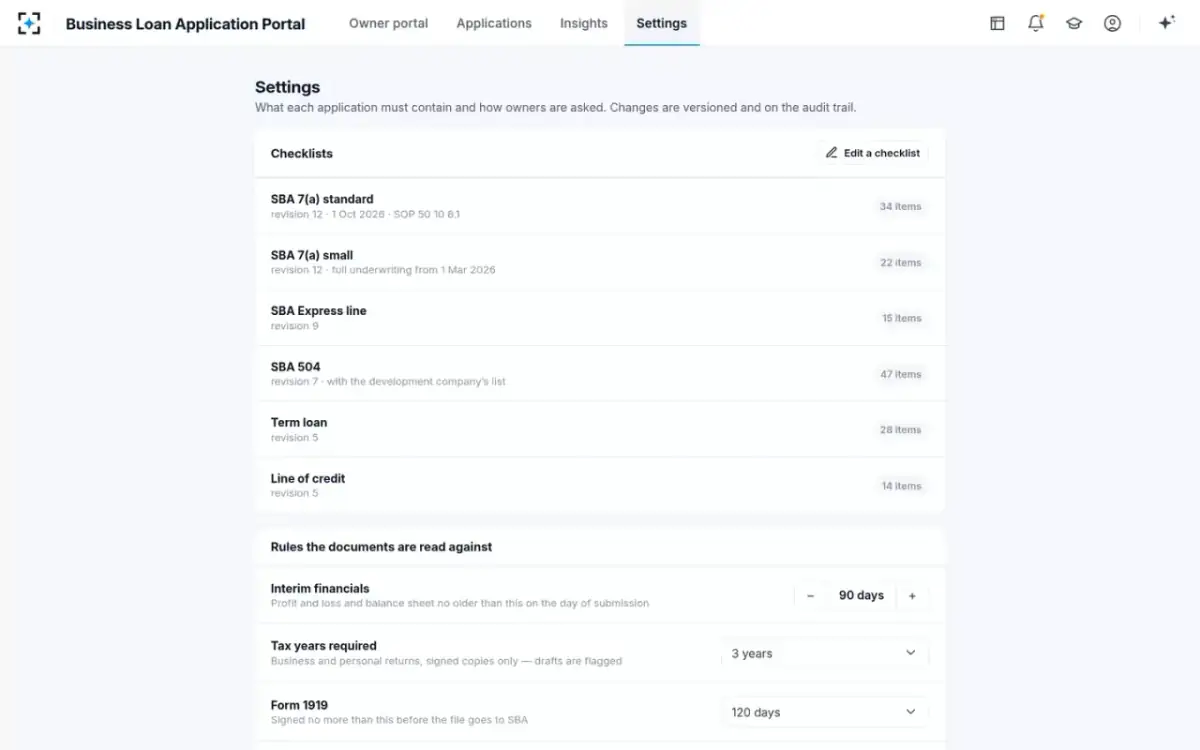
The reason is that the rules move. SBA replaced its lending SOP on June 1, 2025 and again on October 1, 2026, and in between changed who may own an SBA borrower, sunset the FICO SBSS score for 7(a) Small loans and raised the combined 7(a) and 504 limit. A lender whose checklist is a setting can change it on the effective date and know which files were completed under which version. In the sample bank's settings, the Standard 7(a) checklist is at revision 12, dated October 1, 2026 and labelled SOP 50 10 8.1.
Checklists by loan type, and the rules every document is read against, as versioned settings
What checklist does each SBA program need?
A separate one for each program, because SOP 50 10 8.1 sets different requirements and the portal has to know which applies before it asks the owner anything. The program is usually known from the amount and purpose, so a good portal builds the checklist from the owner's first answers. The table lists the program facts that change what the checklist contains.
What changes the checklist between SBA 7(a) programs
| Program | Size | What the checklist must reflect |
|---|---|---|
| Standard 7(a) | Up to $5,000,000 | Full Appendix 20 list; debt service coverage of at least 1.15 to 1, and 1 to 1 on a global basis; transcripts reconciled before first disbursement. |
| 7(a) Small | $350,000 or less, term only | Debt service coverage of at least 1.10 to 1 since the SBSS score was sunset on March 1, 2026; two months of operating-account statements reviewed for every debt; some purpose items only as needed. |
| SBA Express | $500,000 or less | Delegated only; 50% guaranty; transcripts reconciled only if underwriting uses business financials, otherwise to confirm filing and size. |
| Change of ownership | Any 7(a) program | Purchase agreement, business valuation, seller’s financials within 120 days; debt service coverage of 1.25 to 1 on historical results for an initial acquisition; quality of earnings report for initial acquisitions and expansions at a purchase price of $3 million or more. |
Two lines in that table are easy to get wrong in software configured from older templates. The 7(a) Small row changed on March 1, 2026: SBA stopped screening those loans on the FICO Small Business Scoring Service score, so a checklist that still asks for a score and skips the bank statements is out of date. And the change-of-ownership row brings its own checklist on top of whichever program applies.
Which SBA forms should a portal collect?
Four at application, in their current versions. SBA Form 1919 for each co-borrower, with the applicant certifications Procedural Notice 5000-876626 requires as a signed supplement until SBA publishes a revised form (SBA PN 5000-876626). A personal financial statement for each owner of 20% or more and each proposed guarantor, on SBA Form 413 or the lender's own form. IRS Form 4506-C, or Form 8821, for tax transcripts. And SBA Form 159 whenever an agent is involved, one for each agent, plus one the lender completes for its own fees "in excess of $2,500".
Four forms, four different signature rules
1per co-borrower
Form 1919, signed; its question 4 initialled, not typed
90days
age limit for a personal financial statement at submission to SBA
1form type
per 4506-C: a 1065 and an 1120 need two forms
1per agent
Form 159, plus one for lender fees over $2,500
Electronic signature is where portals most often disappoint. The IRS accepts an electronically signed 4506-C only from IVES participants authorised for it, and "forms submitted with electronic signatures by unauthorized participants are rejected" (IRS IVES FAQs). Form 1919's question on incarceration and indictment needs an original initial or an acceptable electronic signature, not a typed one. A vendor should show which forms its portal can collect signed, and how.
Can a portal handle SBA Form 1919?
Yes, and it should fill most of it from what the owner has already provided. Form 1919 asks for the business's legal name, tax ID, industry code, start year, entity type, address, employees, the purpose of the loan by category, the owners and thirteen yes-or-no questions. A tax return answers the first half; the owner answers the questions. Under SOP 50 10 8.1, the form's information goes into the SBA Loan System and the signed form stays in the lender's file.
So the portal has two jobs with the form: produce a signed copy for the file, and produce clean data for the SBA Loan System, including the ownership list that must sum to 100%. In the sample, the hand-off to the SBA lending manager includes "the ownership list for E-Tran: 3 people, 1 company, 100%". SBA Form 1919, annotated goes through every question; why a ticked SBA checklist is not a complete file covers the supplement.
The transcript route: enrol in IVES, or contract with a participant
SOP 50 10 8.1 lets lenders obtain tax transcripts "through the IRS's Income Verification Express Service (IVES) program", either by enrolling or by contracting with an IVES participant, or "by fully completing and submitting IRS Form 8821" with the lender as designee. It also closes one door: the borrower, its tax preparer or its enrolled agent may not file the Form 8821 for an SBA loan.
The choice matters to the software. An enrolled lender's staff each register for IRS e-Services, a process the IRS says "takes about two weeks to complete", and transcripts arrive in a secure mailbox for a small per-transcript fee (IRS IVES). The IRS's online channels deliver them as soon as the taxpayer approves, against roughly two to three business days by fax. A portal can prepare and collect the 4506-C; whether it can also submit it depends on which route the bank uses. Why IVES rejects a 4506-C for business covers the form itself.
Who decides what: write the approval rules before the software
Every portal makes choices a bank should make first. Who may send a new request to an owner? Do reminders go automatically, and how often? Who marks a file complete? Who confirms that every owner is eligible before the loan number is requested? If these are not written down, the software's defaults become the bank's policy without anyone deciding.
A generic online form builder, and software built for SBA files
Generic online application form: The same form for every applicant.
What an SBA lender should require: A checklist built from the program and the owner’s answers, asking only what the documents did not already answer.
Generic online application form: Stored in a folder.
What an SBA lender should require: Read for type, tax year, period, signer, date and draft marks, and accepted or rejected with the reason.
Generic online application form: A table the applicant fills in.
What an SBA lender should require: Traced through operating agreements, trust certifications and K-1s to 100%, each owner confirming citizenship and residence.
Generic online application form: Automatic emails listing every unchecked box.
What an SBA lender should require: One plain-words message per person, drafted for the processor, who edits and sends.
Generic online application form: All boxes checked.
What an SBA lender should require: Marked complete by a named processor; eligibility confirmed by a named manager.
Generic online application form: Form submission time.
What an SBA lender should require: Every request, reminder, upload and decision dated on the file.
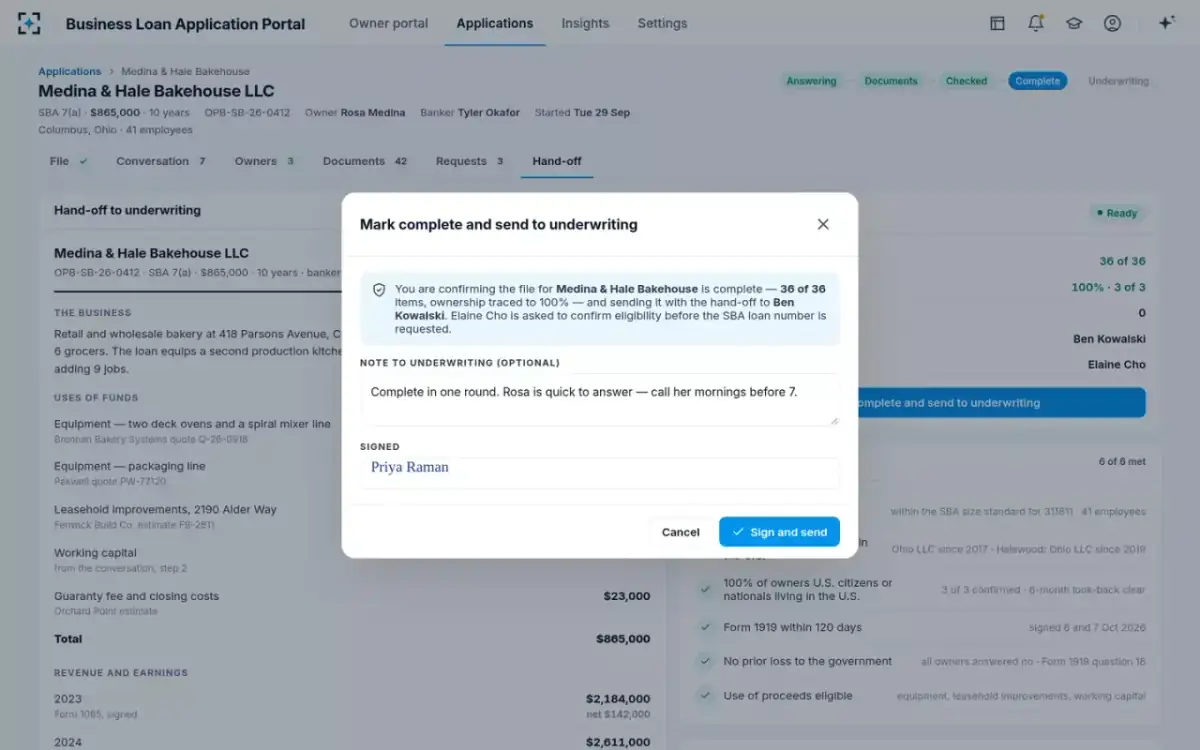
In the sample bank's settings, new requests go only from the processor; reminders for items already requested go every two business days; and eligibility and the ownership list are confirmed by a named SBA lending manager. Each of those is a setting a bank chooses, and each choice is on the audit trail.
Two named sign-offs: the processor marks complete, the manager confirms eligibility
How long does it take to launch a business loan portal?
As long as it takes to assemble the ten inputs, which is mostly a question of how much of the bank's practice is already written down. There is no public benchmark worth quoting. What a lender can control is the order: write the checklists and rules first, then run the software on past files and compare its findings with what the processors found at the time, then launch on one loan type before the rest.
The comparison on past files is the most useful test available, because it measures the thing that matters. If the software misses a draft return or an owner two companies up that a processor caught, it is not ready; if it finds problems the processors missed, the bank has learned something about its own files. We run the Business Loan Application Portal on a lender's own checklists and a sample of its past files before anything goes live, for exactly this reason.
How to test online loan application software on your own files
Test it the way an examiner or a purchase reviewer would test a file: against what was actually wrong. Pick twenty or thirty closed SBA applications across your programs, including ones that needed several rounds of requests, and write down what your processors found in each before the vendor sees them: draft or unsigned returns, statements past your age limit, debts missing from the schedule, owners found late, rejected 4506-Cs. Then run the software on the files as the owners first sent them, and compare.
A pilot on past files: what to measure and why
| Measure | How to count it | What it tells you |
|---|---|---|
| Findings caught | Problems your processors found that the software also found, by type | Whether it reads documents, or only stores them |
| Findings missed | Problems your processors found that the software did not | Where a person must still look; any missed owner or eligibility issue is serious |
| New findings | Problems the software found that your files did not record, each checked by a person | Whether your own process has blind spots |
| False flags | Items flagged that a processor judges acceptable | How much checking of the checker the processors will do |
| Every finding sourced | Share of findings that cite the page they rest on | Whether a processor can confirm a finding in seconds |
| Request wording | Drafted requests read by someone outside lending | Whether owners can act on a request in one pass |
Two rules keep the test honest. The software sees only what the owner first sent, not the corrected file, because the point is what it would have caught at intake. And every disagreement is judged by a person who knows the SOP, because a "new finding" can be a real gap in the bank's process or a misreading by the software, and the difference decides whether the tool is ready. A vendor unwilling to be measured this way is telling you something about what it expects the result to be.
What should online loan application software not do?
It should not decide credit, decide eligibility, or speak for the bank without a person. The Business Loan Application Portal is built to those limits: no agent gives credit advice, judges creditworthiness or recommends approval or terms; citizenship and residence are asked of each owner, never inferred from an address; and no new request leaves without the processor.
It should also not collect what the bank is not allowed or not ready to use. Demographic questions are the clearest case. Form 1919 carries an optional owner demographic section, "collected for program reporting purposes only", and the CFPB's rewritten Section 1071 rule takes effect for compliance on January 1, 2028 (91 FR 23530). How and where those answers are kept away from credit decisions is a compliance design question, set out in our guide to Section 1071 readiness; a portal should make the separation a setting, not an afterthought. For the economics of the decision, see what a business loan application portal saves per day of waiting, and to see the settings on a sample bank, start from the Business Loan Application Portal.
Questions people ask
What is the best online loan application software for SBA lenders?
The one that finds, on your own past files, what your processors found. Ask any vendor to run its software on twenty or thirty of your SBA files and report draft returns, stale statements, unsigned 4506-Cs, missing debts and untraced owners, each with the page it rests on, then compare with your own records.
Does online loan application software replace a loan origination system?
Usually not. Application software collects and checks the file before underwriting; the origination system carries the loan through approval, documentation and closing. The Business Loan Application Portal hands underwriting a complete file and a one-page summary, and the SBA lending manager an ownership list for the SBA Loan System.
Can software submit a loan to SBA's E-Tran system?
The SBA Loan System, which SOP 50 10 8.1 defines to include E-Tran and its successors, receives the data from Form 1919 and the loan terms. How that data reaches it depends on the lender's own systems and SBA's interfaces; the portal's job is to make the data complete and consistent, including ownership that sums to 100%.
Do owners need an account to use an application portal?
Not necessarily. In the Business Loan Application Portal each owner gets a personal link by email and text, so a co-owner who holds a holding company's papers can upload them without sharing the main applicant's access.
How should a portal handle Spanish-speaking applicants?
By asking every question and request in the owner's language, at a plain reading level, while keeping the bank's checklist wording for staff. In the Business Loan Application Portal the owner chooses English or Spanish at the start, and the default reading level is grade 7.