The SBA 7(a) loan process at a lender has six stages: intake from the applicant, a complete file, underwriting and the credit memo, eligibility checks, submission through E-Tran for an SBA loan number, then closing and disbursement. Under SOP 50 10 8.1 a lender with delegated (PLP) authority approves the credit itself and SBA does not review its analysis before issuing the loan number; a non-delegated lender submits the file and SBA makes "the final determination as to the eligibility and creditworthiness of the Applicant". Either way the lender owns the file, and the slowest stage is usually the first: getting 30 to 45 checklist items, every direct and indirect owner and every recency rule right before underwriting can start. Botminds' Business Loan Application Portal runs that stage: the owner answers one plain question at a time, agents read each upload against the 7(a) checklist and trace ownership to 100%, and the processor sends one request per person and marks the file complete by name.
The bakery, its owners and the bank in the examples are sample data on fictional people and businesses.
Days to a complete SBA file at a sample lender
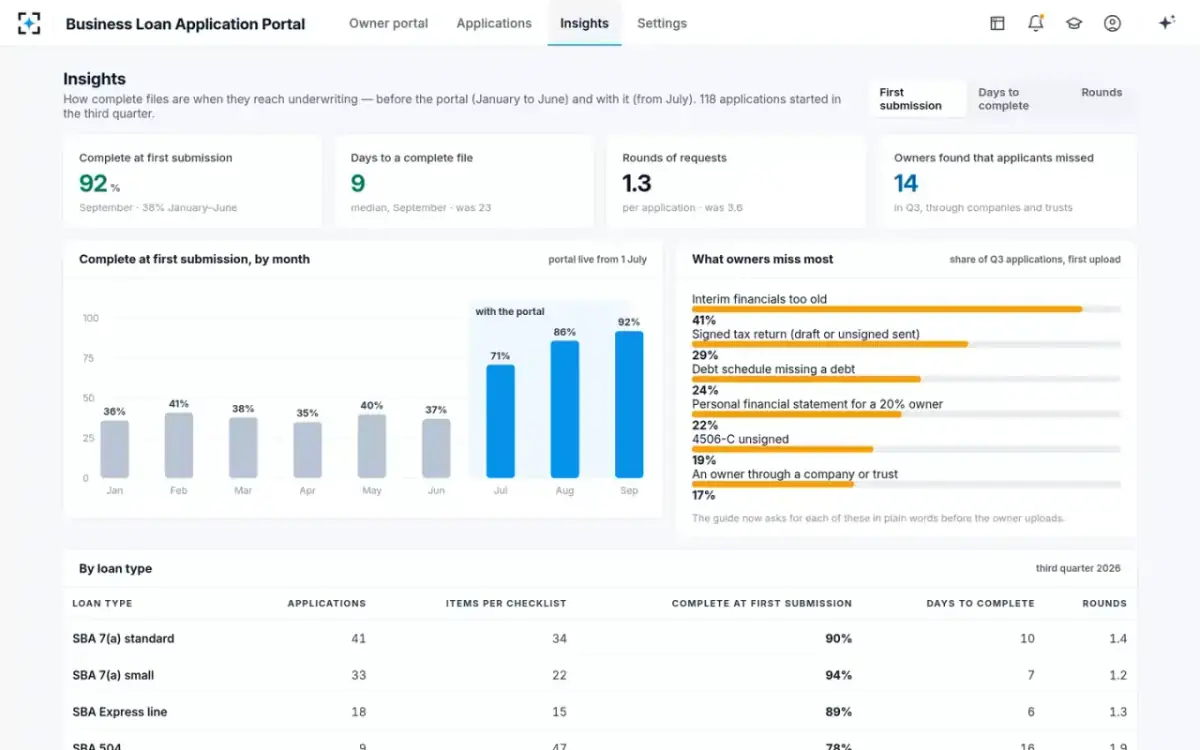
23days
from first document to a complete file before the portal
9days
median with the portal, in the solution's Insights
17%
of third-quarter applications missed an owner held through a company or trust
30–45
items on a typical 7(a) checklist, by loan type
What are the stages of the SBA 7(a) loan process at a lender?
Six stages, each with an owner and a document that marks its end. The table sets them out for a standard 7(a) loan; delegated and non-delegated lenders differ only at the fourth and fifth.
The 7(a) loan process inside a lender, stage by stage
| Stage | Owner | Ends when | Typical stall |
|---|---|---|---|
| 1. Intake | Business banker, applicant | The applicant has sent what they have | The applicant does not know what an SBA file needs |
| 2. Complete file | SBA loan processor | Every checklist item is accepted and ownership traces to 100% | Draft returns, stale financials, missing owners, unlisted debts |
| 3. Underwriting | Credit analyst or underwriter | The credit memo is approved | Questions that should have been answered at stage 2 |
| 4. Eligibility | SBA lending or eligibility manager | Size, use of proceeds, ownership and Ineligible Person checks are documented | An owner's citizenship or residence unconfirmed |
| 5. E-Tran submission | SBA lending manager | SBA loan number issued | Non-delegated: SBA review; delegated: data errors in E-Tran |
| 6. Closing and disbursement | Closing team | First disbursement | Tax transcripts not reconciled; equity injection not verified |
Stage 2 decides the pace of the rest. In the sample lender's own split, 23 days from first document to complete file break down as five days of the owner working out what the bank needs, nine days of rounds of requests, three days finding owners through companies and trusts, four days checking years, signatures, dates and debts, and two days packaging the file for underwriting. Underwriting has not started.
Delegated or non-delegated: who decides what
The lender's authority decides who reviews the credit before the loan number is issued. The SOP is precise about both paths.
Two 7(a) paths to an SBA loan number
Non-delegated: SBA "will make the final determination as to the eligibility and creditworthiness of the Applicant"
Delegated (PLP): The lender; SBA "does not review the Lender's analysis of the credit or structure of the loan … prior to issuing a loan number"
Non-delegated: The application and supporting documents, including a credit report dated within 90 days, through E-Tran
Delegated (PLP): The E-Tran data and the lender's certifications
Non-delegated: Before approval
Delegated (PLP): "When the Lender requests SBA to purchase its guaranty or when SBA is conducting lender oversight activities"
Non-delegated: Time, at SBA review
Delegated (PLP): Possibly the guaranty, years later
The fourth row is the reason file quality matters most to delegated lenders. A non-delegated file with a gap is caught and returned; a delegated file with the same gap closes, and the gap surfaces when the loan defaults and SBA reviews the file before purchasing the guaranty. The complete-file stage is where that risk is cheapest to remove.
How long does the SBA 7(a) loan process take?
SBA's own part is short and published; the lender's part is longer and is not. On its types of 7(a) loans page, SBA gives a turnaround of 5 to 10 business days for a standard 7(a) loan ($350,001 to $5 million, guaranteed at 75%) and 2 to 10 business days for a 7(a) small loan (up to $350,000, guaranteed at 85% up to $150,000 and 75% above). Standard loans go either through PLP delegated authority or non-delegated through the Loan Guaranty Processing Center. Those figures start when a complete package reaches SBA. Everything before that date belongs to the lender.
That is why a lender quoting "two weeks at SBA" to a borrower is usually quoting the smallest share of the calendar. An illustrative standard loan at the sample bank: 23 days to a complete file, then underwriting and the credit memo, then eligibility, then 5 to 10 business days at the processing center if non-delegated, then closing, where tax transcripts and equity injection are verified. A delegated lender removes the processing-center step but not the others, and still waits on the same documents from the same owners. The figure that moves when a lender changes how it works is the first one, which is why the sample bank's Insights report it by month.
Two dates inside the file also run against the calendar. Interim financials age out at the bank's limit (90 days at the sample bank) and Form 1919 must be signed within the window the bank allows before it goes to SBA (120 days in the solution's settings). A file that takes six weeks to complete can lose a document it already accepted, and the processor requests it a second time. Counting re-requests caused by ageing, separately from requests for missing items, shows how much of the delay the lender's own pace created.
Why does a 7(a) file stall before underwriting?
Because the applicant sends what they have, not what the checklist asks for, and the processor finds the gaps one email at a time. A typical first upload has a draft return instead of the filed one, interim financials past the bank's age limit, a debt schedule that leaves out a lease, and no paper at all for an owner held through another company.
Where 23 days to a complete file go at the sample lender, before and with the portal
The rounds of requests are the largest share because each defect found separately is a separate round. In the sample, a Monday check of 37 documents found four issues at once: a third owner nobody had mentioned, a 2025 return marked DRAFT and unsigned although it had been filed on extension, interim financials 104 days old against the bank's 90-day rule, and twelve payments of $1,912.40 to an equipment finance company missing from the debt schedule. Found one by one, that is four rounds; found together, it was one. Why incomplete applications recur, and how lenders measure them, is covered in the incomplete loan application.
Ownership to 100%: the stall that can make a loan ineligible
Ownership is the stall with the highest stakes, because a missed owner is an eligibility failure, not a paperwork gap. SOP 50 10 8.1 requires lenders to certify in the SBA loan system "that, to the best of their knowledge, no direct or indirect owner or SBA-required guarantor is an 'Ineligible Person'", and states that "no loan may be made if any direct or indirect owner or SBA-required guarantor is an Ineligible Person." A six-month lookback applies to owners before the loan number is issued.
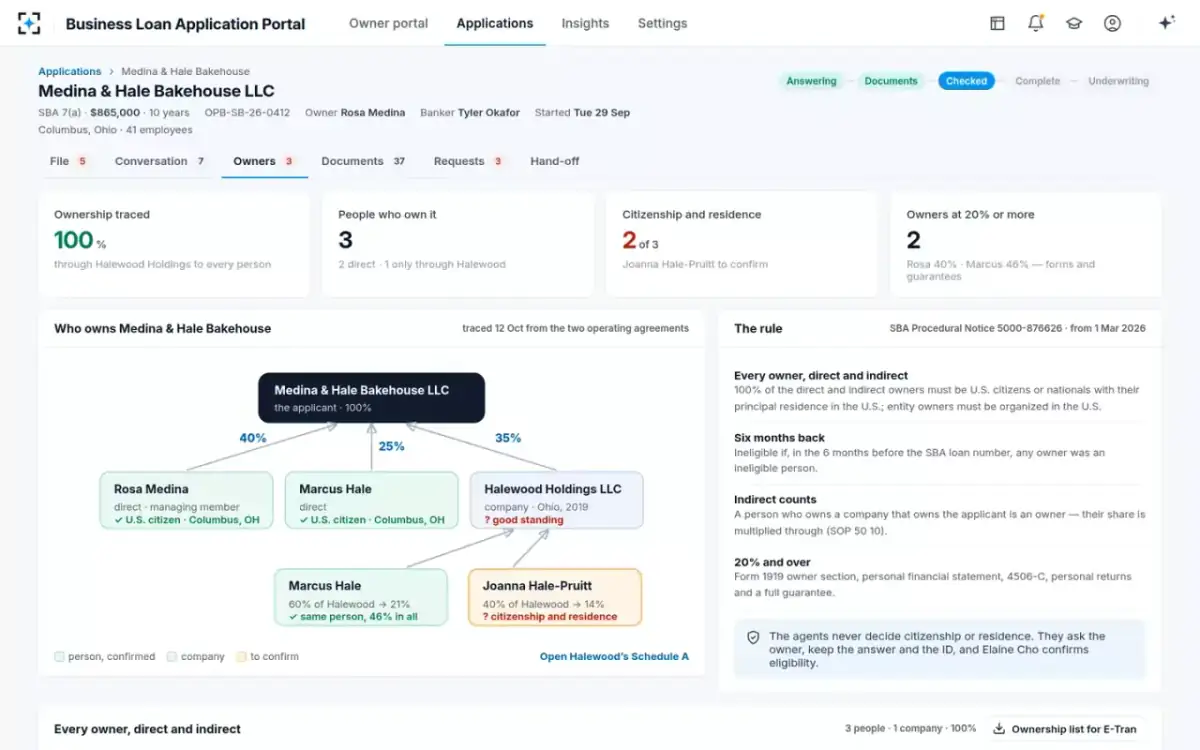
Applicants rarely know their indirect owners. In the sample, the bakery's K-1s showed a holding company owning 35%; the managing member guessed that her business partner owned it alone. Schedule A of the holding company's operating agreement split it 60% to the partner and 40% to a third person, who therefore owned 14% of the bakery. That person's 2019 address in the agreement was outside the U.S., so the ownership tracer asked them to confirm citizenship and residence rather than guess. At the sample bank, 17% of third-quarter applications missed an owner through a company or trust at first upload.
Business Loan Application Portal traces ownership to 100% through a holding company
Checks that must be done, and documented, before the loan number or disbursement
Several 7(a) checks have hard points in the process, and a processor who knows them can collect the evidence at intake instead of at closing. Three examples from the SOP: every lender "must check the Credit Alert Verification Reporting System (CAIVRS)" for prior losses on federal debt and "must retain documentation of the CAIVRS check in the loan file"; a non-delegated submission must include "a copy of the credit report, dated within 90 days"; and lenders "must obtain tax return transcripts and reconcile any discrepancies with the Applicant's financial data against the tax transcripts" before first disbursement on a 7(a) loan.
Tax transcripts show why the order matters. The transcript request needs a signed Form 4506-C from the business and from each owner who owes one, and a discrepancy between transcript and return found at closing delays disbursement. Collected at intake, the same form costs nothing. The form itself is covered in Form 4506-C for a business, and Form 1919 in SBA Form 1919, annotated.
Equity injection: the closing check that puts guaranties at risk
Equity injection is set at underwriting, verified before disbursement and tested again if the loan defaults, so its evidence has to survive all three. SOP 50 10 8.1 treats a business in operation for one year or less as a start-up and requires "an equity injection (Applicant contribution) of at least 10 percent of the total project costs". For a change of ownership the minimum is also 10%, and for an initial acquisition it "cannot be reduced or eliminated"; for business expansions and owner buyouts the lender may reduce or waive it if the borrower has enough liquidity and working capital.
The verification rule is specific. Outside SBA Express and Export Express, lenders "must verify the SBA-required equity injection prior to disbursing any loan proceeds" and keep the evidence, and the SOP warns that failing to do so "may warrant a repair or partial/full denial". A cash injection needs three things: a copy of the check or wire with proof it was processed into the borrower's account or escrow; the most recent statement, covering at least 30 days, from the account the money came from; and a statement or settlement statement showing where it went. "A promissory note, 'gift letter,' or financial statement is not sufficient evidence of cash injection without corroborating evidence."
An illustrative initial acquisition shows how it lands on the processor's desk. A buyer acquires a business for $1,250,000 with $80,000 of closing costs and working capital, a total project cost of $1,330,000. The minimum injection is $133,000. The buyer plans $90,000 from savings and $43,000 gifted by a parent. The processor needs 30 days of the buyer's savings statement showing the $90,000 before it moved, the parent's statement showing the $43,000 with the gift letter, and the wire confirmations into escrow. Asked for at intake, these are four documents from two people. Asked for the week before closing, they are the reason the closing moves.
What SBA tests when a 7(a) loan defaults
When a lender asks SBA to purchase the guaranty, SBA reviews the file the lender built, and the regulation that governs the outcome is short. Under 13 CFR 120.524, SBA is released from liability "in whole or in part, within SBA's exclusive discretion" if, among other events, the lender "failed to comply materially with any Loan Program Requirement", "failed to make, close, service, or liquidate a loan in a prudent manner", misrepresented or failed to disclose a material fact, or "failed to use required SBA forms or exact electronic copies". If SBA finds such an event after paying, it "is entitled to recover any moneys paid on the guarantee plus interest from the Lender."
The defects SBA's Inspector General finds in early-defaulted loans are the ones a complete-file stage exists to catch. Its fiscal 2019 review of eight early-defaulted loans found "material lender origination and closing deficiencies that justified denial of the guaranty for five loans in the amount of approximately $8.7 million", and named the issues as similar to earlier years': "business valuations, affiliates, equity injection, and repayment ability." Affiliates are an ownership question, equity injection is a document question, and repayment ability rests on financials that were current and complete when the credit memo was written.
For a delegated lender, this is the real audit of the intake stage, years after the fact and with the guaranty at stake. Each stage in the table at the top of this page ends with evidence the purchase reviewer will ask for: the ownership list traced to 100%, the CAIVRS check, the credit report, the reconciled transcripts, the equity evidence. A file that can produce each by name, tied to the request that obtained it, defends the guaranty without a reconstruction exercise.
From complete file to underwriting: what the hand-off should carry
The hand-off should let the underwriter start on credit, not on the file. In the sample, five open items became three plain-words messages, one per person who could answer them; all three replied within 26 minutes, the file reached 36 of 36 items 13 days after the first document, and the hand-off writer produced a one-page summary for underwriting, each figure linked to its document. The processor marked the file complete by name with a note on how best to reach the applicant, and the SBA lending manager confirmed eligibility and the ownership list for E-Tran: three people, one company, 100%.
Stages 1 and 2 of the 7(a) process in Business Loan Application Portal
Agent
Application guideRuns the owner portal one plain question at a time, fills what uploads already answer and builds the checklist for the loan type.
Never: Never says a loan will be approved
Agent
Document readerReads each upload's type, tax year, period, signer, draft marks and age against the recency rules.
Never: Never edits or fixes a document
Agent
Ownership tracer and consistency checkerTraces every owner to 100%; ties the debt schedule to bank statements and uses of funds to quotes.
Never: Never assumes citizenship or residence
Agent
Request writerGroups open items by person and drafts one message each, with the checklist wording beside each item.
A person decides
SBA loan processorSends the requests, reviews the findings and marks the file complete by name.
A person decides
SBA lending managerConfirms eligibility and the ownership list for E-Tran.
Measuring the 7(a) process
A lender that measures only approval time measures the stage it controls least. The useful measures sit in stages 1 and 2, and the sample bank's Insights track them by month.
Eight measures for the front of a lender's 7(a) process
- Share of files complete at first submission
The single best predictor of days to a complete file.
- Days from first document to complete file
Median and spread, by loan type and by banker.
- Rounds of requests per file
Each round is a client touch and a delay.
- What applicants miss most
Signed returns, interim financials, debts, indirect owners.
- Owners found after first upload
Indirect owners through companies and trusts, as a share of files.
- Recency failures
Financials past the bank's age limit; Form 1919 older than the bank allows before it goes to SBA.
- Files returned by underwriting for file defects
Not credit questions: items stage 2 should have caught.
- Defects found at closing
Transcript discrepancies, unverified equity, unconfirmed owners.
Insights: complete at first submission, days to a complete file, and what owners miss
What Business Loan Application Portal covers, and what it does not
The solution covers stages 1 and 2 and the hand-off: the owner portal, document reading, ownership tracing, consistency checks, requests and the underwriting summary. Its settings encode the lender's rules: interim financials no older than 90 days, three tax years, Form 1919 signed no more than 120 days before it goes to SBA, a personal financial statement and 4506-C for every owner of 20% or more, and eligibility confirmed by a named manager.
It does not underwrite, write the credit memo, decide eligibility, submit to E-Tran or close the loan; those stay with the lender's people and systems. Demographic answers are optional and hidden from decision makers. A lender evaluating it should run last quarter's files through it and count how many of the defects underwriting returned would have been caught at intake; how to choose software for this work is set out in online loan application software for SBA lenders.
Questions people ask
What are the steps in the SBA 7(a) loan process for a lender?
Intake, a complete file, underwriting and the credit memo, eligibility checks, submission through E-Tran for an SBA loan number, then closing and disbursement. Delegated lenders approve credit themselves; non-delegated lenders submit the file for SBA's determination.
Does SBA review a PLP lender's credit analysis?
Not before issuing the loan number. SOP 50 10 8.1 says the analysis is subject to SBA's review when the lender requests guaranty purchase or during lender oversight.
Why do SBA files take so long to complete?
Mostly rounds of requests: applicants send drafts, stale financials and incomplete debt schedules, and miss owners held through companies. At the sample lender, nine of 23 days to a complete file were rounds of requests.
Does every indirect owner matter for 7(a) eligibility?
Yes. The SOP says no loan may be made if any direct or indirect owner or required guarantor is an Ineligible Person, and lenders certify this in the SBA loan system, with a six-month lookback before the loan number.
When must tax transcripts be reconciled on a 7(a) loan?
Before first disbursement, except under SBA Express and Export Express. Collecting Form 4506-C at intake keeps the reconciliation off the closing table.
What does a non-delegated 7(a) submission need beyond the application?
Among other things, a credit report dated within 90 days, submitted with the documents in E-Tran, and documentation of the CAIVRS check retained in the file.