SBA Form 1919, the "SBA 7(a) Borrower Information Form", is required for every SBA 7(a) loan: one signed form for each co-borrower, collecting the business's identity, the purpose of the loan, its owners and thirteen yes-or-no questions about eligibility, debts, fees and conflicts. The lender keeps the signed form and enters its data, not the form itself, into the SBA Loan System. The version on SBA's form page is dated 02/2025, and since March 1, 2026 it is no longer complete on its own: its citizenship certification was overtaken by SBA's new ownership rule, so lenders must attach a signed supplement until SBA publishes a revised form. Each answer on the form triggers a check, from a search of federal exclusion lists to a fee disclosure, and a false "no" has sent an applicant to prison. Botminds' Business Loan Application Portal fills most of the form from the owner's tax return and entity documents, asks the owner the rest in plain words, and traces the owners the form does not ask about.
Where the guide uses an example, it is a fictional sample application, Medina & Hale Bakehouse at Orchard Point Bank. The form text is quoted from SBA Form 1919 (02/2025), OMB control number 3245-0348, expiring June 30, 2027.
SBA Form 1919, section by section: what it asks, and the check behind it
Business identity
What it asksLegal name, operating company if any, tax ID, six-digit NAICS code, SAM.gov Unique Entity ID, year operations began, entity type, address.
The check behind itThe NAICS code must match the business activity code on the IRS filings; it sets the size standard the business is tested against.
Employees and jobs
What it asksExisting employees, jobs retained and jobs created.
The check behind itCount everyone, part-time and affiliates included, “do not convert to FTE”: headcount feeds the size test.
Purpose of the loan
What it asksAmounts by category: equipment, real estate, working capital, inventory, change of ownership, refinancing, other.
The check behind itThe amounts across every co-borrower’s Form 1919 should equal the loan request, and tie to the quotes.
Ownership (mandatory)
What it asksEntities owning 20% or more, the people who own them, and at least 51% of beneficial owners: name, title, %, TIN, home address.
The check behind itThe lender must list 100% of direct and indirect owners in the SBA Loan System. The form asks for less than the system needs.
Demographics (optional)
What it asksVeteran status, sex, race and ethnicity for each 20% beneficial owner.
The check behind it“Collected for program reporting purposes only”; disclosure is voluntary and has “no bearing on the loan application decision”.
Thirteen questions
What it asksDebarment, federal debt, other businesses, incarceration, exports, fees paid, ineligible revenue, conflicts of interest, legal actions.
The check behind itEach “yes” needs details; several trigger a check or end eligibility (table below).
Applicant certification
What it asksCompliance with Loan Program Requirements; ownership “at least 51 percent” by citizens or lawful permanent residents.
The check behind itOut of date: SOP 50 10 8 required 100% from June 1, 2025, and since March 1, 2026 permanent residents are excluded. Attach the signed supplement Procedural Notice 5000-876626 requires.
Signature
What it asksAuthorized representative of the applicant and the operating company.
The check behind itFalse statements are punishable under 18 U.S.C. 1014 by up to thirty years and $1,000,000.
What is SBA Form 1919, and is it submitted to SBA?
Form 1919 is the applicant's sworn description of itself for a 7(a) loan, and it is not sent to SBA as a document. Under SOP 50 10 8.1, "only the information required on SBA Form 1919, and not the form itself, must be submitted into the SBA Loan System, although the Lender must obtain and retain the signed form in its file" (SOP 50 10 8.1, Appendix 20). For a loan sent to SBA for non-delegated processing, the lender submits its application for guaranty through the same system; for a loan approved under the lender's delegated authority, SBA sees the signed form only if it asks for the file, typically when the lender requests that SBA buy the guaranty.
The form's own instructions say that "a separate SBA Form 1919 for each co-Applicant (e.g., EPC and OC) must be completed and signed by the authorized representative of the Applicant", and that the purpose amounts across all of them "should equal the total amount of the loan request". The paperwork estimate printed on the form is 31 minutes. In its February 2026 notice SBA estimated 103,817 responses a year and 32,850 hours of burden, about 19 minutes each by our arithmetic (91 FR 8567).
The ownership section: 20% on the form, 100% in the system
The ownership section is where the form and the rules diverge most. The form asks the applicant to "identify all entities that own at least 20% of the Applicant, including the natural persons who own those entities, and at least 51% of the Beneficial Owners". The lender's obligation is larger: under SOP 50 10 8.1 it enters every direct and indirect owner in the SBA Loan System, with percentages that add up to exactly 100%.
The gap matters because eligibility now runs to every owner. Since March 1, 2026, all direct and indirect owners must be U.S. citizens or U.S. nationals with their principal residence in the United States, and the business is ineligible if any owner was an Ineligible Person at any point in the six months before the loan number is issued, unless that person fully divested first. A 14% owner who holds her stake through a family company appears nowhere on a 20% ownership section, but her citizenship and residence decide the loan. Why a ticked SBA checklist is not a complete file works through the sample bakery's hidden owner.
Thirteen questions, and the check each one triggers
Every "yes" on Form 1919 needs details "in a separate attachment", and most questions point to a specific rule the lender must then apply. The table pairs each question, in the form's own order, with the check behind it.
Form 1919's questions and the lender check each one sets off
| # | What it asks | What a lender does with the answer |
|---|---|---|
| 1 | Is the applicant or any Associate suspended, debarred or excluded by a federal agency, or in bankruptcy? | Search SAM.gov exclusions for the applicant, 20% owners, officers, directors and key employees, and keep the screenshot. |
| 2 | Is any of them delinquent on, or has any defaulted on, an SBA or other federal loan, or guaranteed one? | Check CAIVRS for a prior loss; keep the evidence in the file. |
| 3 | Does the applicant or any owner own another business? | List each on Addendum A with its TIN and share; test affiliation and size, including affiliates. |
| 4 | Is the applicant or any Associate incarcerated, on a sentence, or under indictment for a felony or financial misconduct? | “Yes” makes the applicant ineligible. The answer must be initialled, not typed. |
| 5 | Are products or services exported, or will they be? | Export sales and countries; separate detail for an Export Working Capital loan. |
| 6 | Has the applicant paid, or committed to pay, anyone to help prepare the application, or a broker or referral agent? | Name and fee to the lender; a Form 159 for each Agent. |
| 7 | Does revenue come from gambling, loan packaging, lending, lobbying or prurient content? | Test against the ineligible business types in 13 CFR 120.110 and the SOP’s revenue thresholds. |
| 8–12 | Is a 10% owner, officer or household member an SBA employee, a former SBA employee within a year, a member of Congress or GS-13-or-above federal employee, or an advisory council or SCORE member? | Conflict-of-interest review under 13 CFR Part 105. |
| 13 | Is the applicant, any owner or any affiliate in a legal action, including divorce? | Details on the attachment; the lender assesses the effect on repayment and collateral. |
Three questions carry more weight than the rest. Question 4 is the only one where "yes" ends the application outright, which is why the form insists on an initial, "originally initialed, or an acceptable electronic signature, and not typed". Question 6 connects the application to SBA's fee rules: "Separate SBA Forms 159 are required for each Agent", and failure to complete one "may result in suspension or revocation of the Agent's privilege to conduct business with SBA". Question 13, on legal actions, is the one where a convenient "no" has done the most damage.
What happens if you answer a Form 1919 question falsely?
The form spells it out above the signature. A false statement to obtain an SBA-guaranteed loan is punishable "under 18 U.S.C. 1001 and 3571 by imprisonment of not more than five years and/or a fine of up to $250,000", and "if submitted to a federally insured institution, under 18 U.S.C. 1014 by imprisonment of not more than thirty years and/or a fine of not more than $1,000,000". These are not dormant clauses.
What two false answers cost
120months
in prison for a Kansas borrower who said “no” to the legal-actions question
$2.17M
SBA’s loss when that $3.6 million loan defaulted
3people
sentenced after applications falsely said no broker had helped
$4.08M
restitution ordered across the three
In the Kansas case, the borrower "falsely responded 'no' to questions on the loan applications concerning whether he or companies he controlled were involved in any legal actions"; SBA approved a $3,600,000 loan in March 2018, and the company defaulted in June 2019 with a loss to SBA of $2,173,766 (FDIC OIG). In the Massachusetts case, two brokers and a bank loan officer were sentenced after SBA Express applications "falsely indicated that no broker had assisted in preparing or referring the loan applications, when they in fact charged borrowers excessive fees" (FDIC OIG). The lesson for a lender is not that applicants lie, but that the two questions most often answered by reflex are the two worth checking against documents: litigation searches and the fee trail.
What changed on SBA Form 1919 in 2026?
The rules changed; the form, so far, has not. On March 1, 2026, Policy Notice 5000-876441 rescinded a short-lived exception for small foreign and resident-alien ownership and made lawful permanent residents ineligible to own any part of an SBA borrower, and Procedural Notice 5000-876626 wrote the 100% citizen-or-national rule into the SOP. The 02/2025 form still certifies ownership "at least 51 percent" by "citizens of the U.S. or ... Lawful Permanent Residents", a test already narrower than the SOP before 2026: SOP 50 10 8, effective June 1, 2025, limited financing to businesses with "100% direct and/or indirect owners" who were citizens, nationals or permanent residents. To bridge the gap, the notice says that "until the updated forms are published, the SBA Lender must attach the certifications below as a supplement to the application to be signed by the Applicant" (SBA PN 5000-876626).
Form 1919 and the ownership rule, from the 02/2025 form to SOP 50 10 8.1
- From Jun 1, 2025: 100% citizens, nationals or permanent residents6.6 mo
- Up to 5% exception
- From Mar 1, 2026: 100% citizens or nationals; form plus signed supplement7 mo
- Form 1919 (02/2025) in use: “at least 51 percent” certification
- Feb 23, 2026: revision proposed; supplement attached until a new form is published
SBA has twice announced how the form will change. The February 2026 notice proposes adding, for each owner, "date of birth (or date of formation for an entity owner); the owner's citizenship status; for entity owners, the type of entity; and the spouse's legal name if the spouse is also a direct or indirect owner", and revising the instruction so the applicant identifies "100% of the direct and indirect" owners. Until a new form appears, a lender's checklist should list the supplement as its own item and its software should collect the extra fields anyway, because the SBA Loan System already needs them.
What is Form 1919 Addendum A?
Addendum A is the separate sheet the applicant attaches when question 3 is answered "yes": every other business owned by the applicant or its owners, "including their TINs, percentage of ownership", and the relationship. It is the raw material for the affiliation and size tests. Under SOP 50 10 8.1, when no owner holds more than 50%, a 20%-or-more owner that is a business "in the same 3-digit NAICS subsector as the Applicant" is affiliated with it, and size is measured "including its affiliates".
Addendum A is also where incomplete answers cost lenders later. In its 2026 review of loans SBA had screened itself, SBA's Inspector General found that most of the error codes cleared without documentation concerned affiliation, with no source documents in the files to support the affiliation or size analysis. An Addendum A that lists the other businesses, with the documents that show who owns what, is the evidence those files lacked.
How a portal fills Form 1919 from the owner's documents
Most of the first page of Form 1919 is already in the business's tax return. In the sample, when the owner dropped her 2024 Form 1065 into the Business Loan Application Portal, eight answers filled themselves, each with the page it came from: legal name, employer ID number, entity type, start date, industry code 311811, 2024 sales of $2,611,000, address, and the owners on the K-1s. The questions only the owner can answer are then asked one at a time, in plain words.
One tax return fills the identity half of the form, each answer with the page it came from
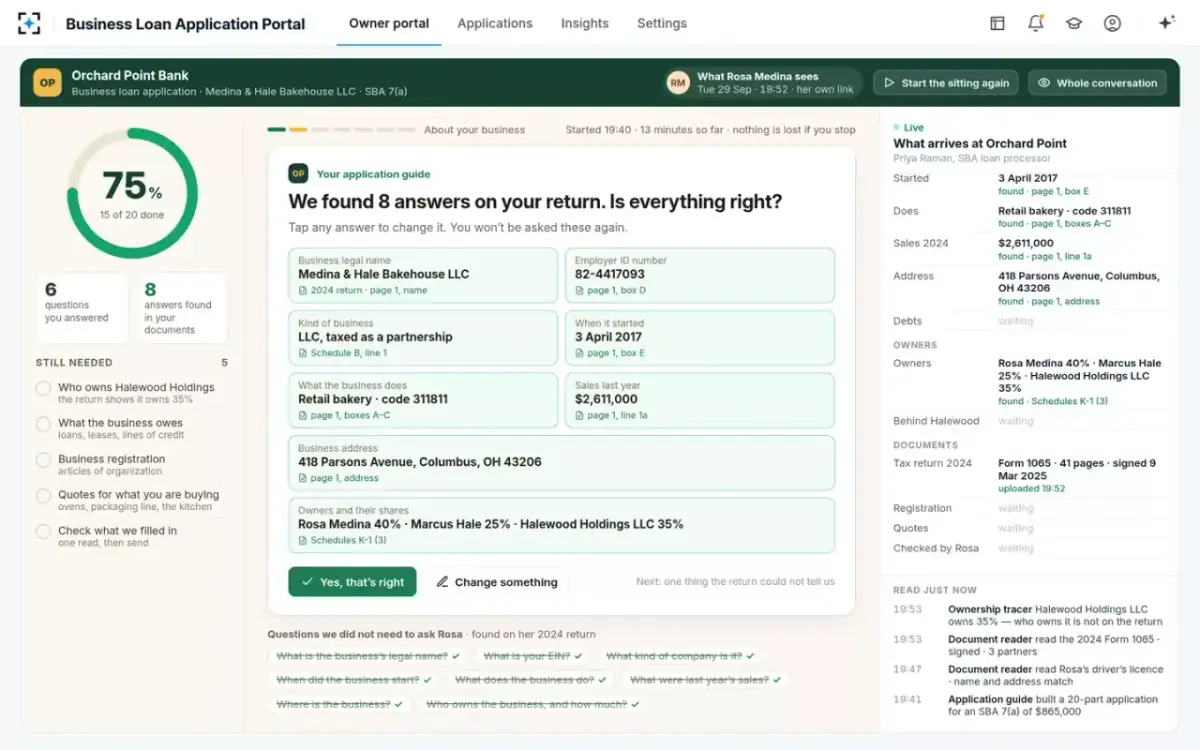
The ownership section is where the portal does more than the form asks. The K-1s showed a holding company with 35%; the form would have stopped there, since the holding company's own owners each held less than 20% of the applicant directly. The portal asked who owns the holding company, sent the co-owner his own link for its operating agreement, and traced a third owner at 14% whom the applicant had not mentioned. That owner was asked to confirm her citizenship and residence with an ID; the agents never infer citizenship from an address, and the SBA lending manager confirms eligibility.
Read once, then send: the filled application and what happens next
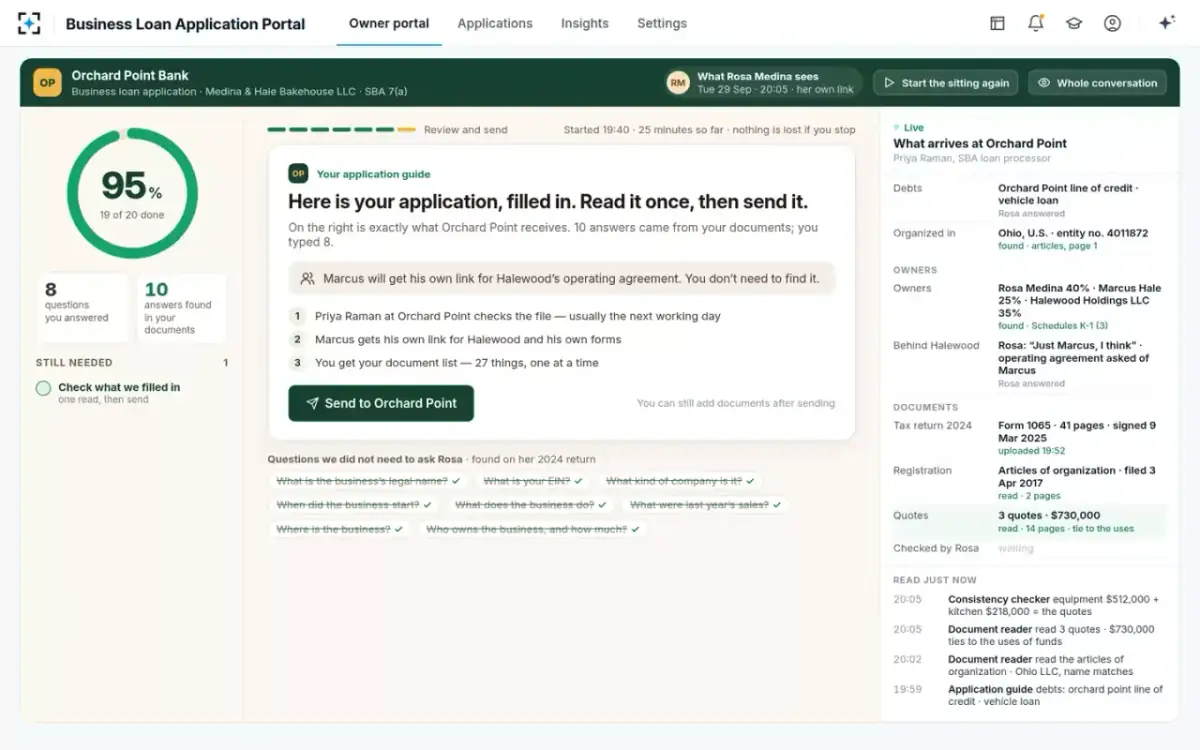
A portal cannot make the answers true. It can make the questions plain, check the answers that documents can check, such as revenue, entity type, owners and uses of funds, and keep the signed form and its supplement together. The checks a lender can run before the file is complete covers SAM.gov, CAIVRS and the other searches the answers set off. To see the form filled on a sample file, start from the Business Loan Application Portal.
Questions people ask
Who has to sign SBA Form 1919?
The authorized representative of the applicant, and of the operating company where there is one. Each co-borrower signs its own form. The signer certifies that the information "is true and accurate in all material respects", for the business and its owners.
Is SBA Form 1919 required for every 7(a) loan?
Yes. The form says it is "for use with all SBA 7(a) Loan Programs", and Appendix 20 of SOP 50 10 8.1 lists it as a general requirement, which covers Standard 7(a), 7(a) Small and SBA Express alike. 504 loans use a different form, SBA Form 1244.
How do I fill out the ownership section of Form 1919?
List every entity that owns 20% or more, the people who own those entities, and enough beneficial owners to reach at least 51%, with each owner's name, title, percentage, tax ID and home address. Then expect the lender to ask for more: it must enter 100% of direct and indirect owners in the SBA Loan System, so owners below 20% and owners behind other companies will be needed too.
Do green card holders still answer the citizenship certification?
The certification on the 02/2025 form allows lawful permanent residents, but that is no longer the rule. Since March 1, 2026, lawful permanent residents may not own any percentage of an SBA 7(a) or 504 borrower, and the applicant signs a supplement certifying that all direct and indirect owners are U.S. citizens or nationals with a principal residence in the United States.
How long is a signed Form 1919 good for?
SOP 50 10 8.1 sets age limits for financial statements, not for Form 1919, so the limit is the lender's policy. Many lenders refresh the form if it is old by the time the file goes to SBA; the fictional sample bank requires it to be signed no more than 120 days before submission.