A business loan application portal is a secure link where a business owner applies for a loan: answers questions, uploads documents and sees what is still needed, while the lender's staff watch the same file fill in. Its value is not the form on the screen. It is the number of days an application stops waiting for documents, because a lender cannot decide, and Regulation B's 30-day decision clock does not start, until the application is complete. On SBA loans, where the file runs to dozens of items and every owner must be traced, that collection period is usually the longest part of the process. Botminds' Business Loan Application Portal reads each upload as it lands and asks the owner only for what is missing; this guide prices what that is worth, day by day.
The worked figures come from a fictional sample lender, Orchard Point Bank, as its applications run through the solution, and from public data where it exists. Where neither exists we say so and use an illustrative input, marked as such, for you to replace with your own.
One day of waiting, priced: a worked example to replace with your own inputs
Applications started a quarter
118
Sample bank, third quarter 2026
Days from first document to a complete file
23 → 9
Sample bank; the split by step is the solution’s own estimate
Rounds of requests per application
3.6 → 1.3
Sample bank, before and with the portal
Processor time per round of requests
45 min
Illustrative: time your own
Loaded cost of a processor hour
$34.36
BLS median wage $24.05 ÷ 70.0% wage share of employer cost (our arithmetic)
Applications lost per week of waiting
1 in 100
Illustrative: use your own withdrawals
Net value of one funded loan to the bank
$5,000
Illustrative: use your own
Staff time released
118 × 2.3 rounds × 0.75 h × $34.36
$6,994 a quarter
Applications kept that waiting would have lost
118 × 2 weeks × 1%
2.4 a quarter, about $11,800
Value of one day saved, per quarter
($6,994 + $11,800) ÷ 14 days
about $1,340
What is a business loan application portal, and what should it do?
At minimum, a portal replaces email and paper with one place where the owner answers and uploads. That alone saves little: an owner who uploads the wrong year's return to a portal has made the same mistake as one who emails it. A portal earns its price when it does three further things. It reads what arrives, so a draft return or a stale statement is caught on upload rather than in underwriting. It asks only for what the documents could not answer, so the owner is not re-typing what the tax return already says. And it shows staff and owner the same list of what is still missing, so the next request is specific.
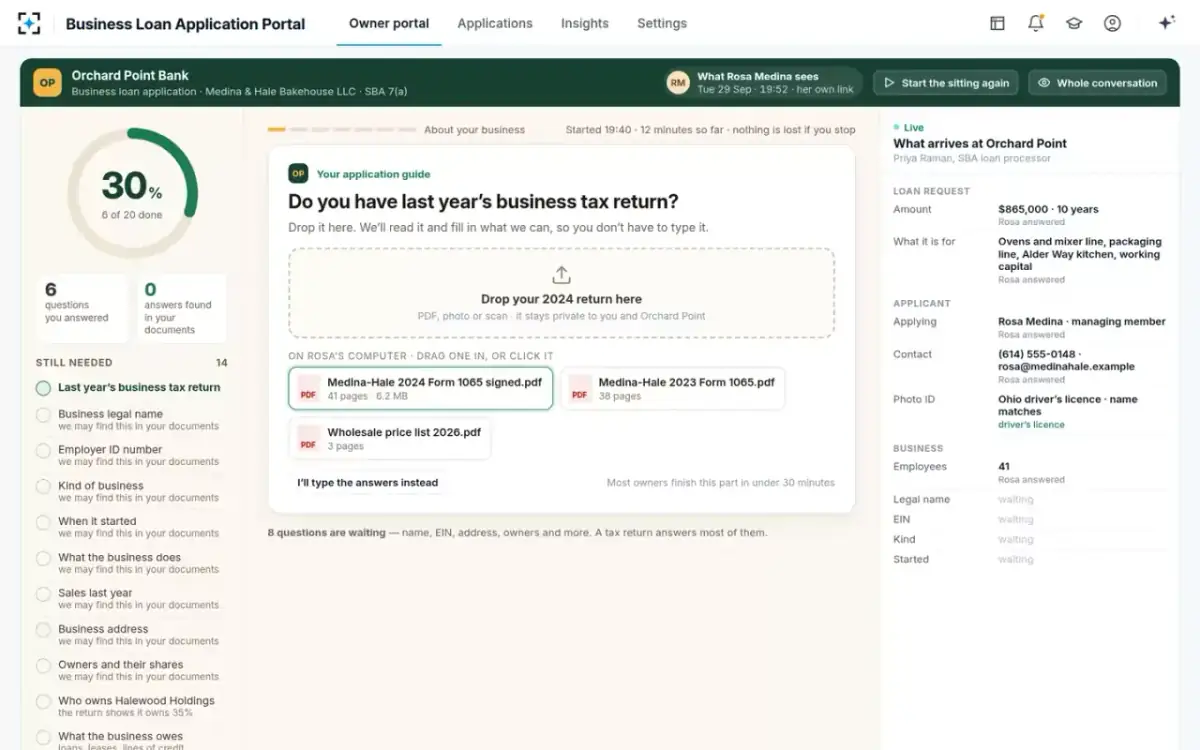
In the Business Loan Application Portal, the owner answers one plain question at a time. When the sample bakery's owner dropped her 2024 Form 1065 into the portal, eight answers filled themselves, each with the page it came from: the legal name, the employer ID number, the entity type, the start date, the industry code, the year's sales, the address and the owners on the K-1s. The next question was the one the return could not answer: who owns the holding company that owns 35% of the bakery.
The owner's side: one plain question at a time, and the bank's copy filling on the right
How long does an SBA loan application take? Most of it is collection
Deciding is usually the short part. The FDIC's Small Business Lending Survey found that "three in four banks approve their typical loan within ten business days" (FDIC SBLS, executive summary), but that clock describes underwriting a file the bank already has. Getting the file is the variable part, and no public survey measures it for SBA loans. The best a lender can do is measure its own, from first document to complete file.
Where 23 days to a complete file went at the sample bank, and where 9 went with the portal
- Owner works out what the bank needs5
- Rounds of requests9
- Finding every owner3
- Checking years, signatures, debts4
- Packaging2
- What the bank needs2
- Requests3
- Owners1
- Checks2
- Packaging1
The largest block is rounds of requests: nine of the 23 days. That is where an owner who sent the draft return learns it was the wrong one, and where the processor's question about a missing debt waits behind the owner's working week. The sample bank averaged 3.6 rounds per application before the portal and 1.3 with it. The days fall because the rounds fall, not because anyone works faster.
How many hours does a business owner spend on a loan application?
The most-cited figure is about 25 hours. Harvard Business School researchers, citing the Federal Reserve Bank of New York's 2013 Small Business Credit Survey, put it at "the average of about 25 hours that small businesses spend on filling out paperwork at an average of three conventional banks before securing some form of credit" (Mills and McCarthy, HBS Working Paper 15-004). The number is from 2013 and should be read as an order of magnitude, but nothing more recent and equally direct has replaced it.
The current survey measures the experience instead of the hours. In the Federal Reserve Banks' 2026 report on employer firms, 26% of applicants at large banks cited a difficult application process and 21% a long wait for a credit decision or funding, against 11% and 8% at online lenders (Small Business Credit Survey, 2026 Report on Employer Firms). Online lenders drew more complaints overall, mostly about price: 61% of their applicants cited high interest rates.
Large-bank applicants complain about the application, not the price
What does a slow business loan application cost a bank?
An idle day costs a bank in three ways, and only one of them shows up in a budget. The first is staff time: every round of requests is a processor re-reading a file, writing an email and logging the reply. The second is applications that leave: an owner who is still waiting in week three may accept another lender's offer, and owners often apply at more than one bank: the survey HBS cites found an average of three. The third is income that starts later: a loan that closes two weeks later earns two weeks less interest in its first year.
The value of a day an application does not wait
Staff time
rounds saved × time per round × loaded hourly cost
The sample bank saved 2.3 rounds an application; time your own rounds.
Lending operations
Applications kept
applications × weeks saved × share lost per week × value of a funded loan
No public figure exists for withdrawals; use your own pipeline report.
Head of small business banking
Income brought forward
funded amount × note rate ÷ 365 × days saved
Per funded loan; often the smallest term, but it compounds across the book.
Finance
Cost of the portal
licence + set-up + time to maintain checklists
Set against the sum of the three gains.
Project lead
The worked example at the top of the page puts numbers on the first two terms. With the sample bank's 118 applications a quarter, its 2.3 rounds saved per application and 14 days saved, and illustrative assumptions of 45 minutes per round, one application in a hundred lost for each extra week of waiting and $5,000 of net value per funded loan, a day saved is worth about $1,340 a quarter. Change the assumptions and the answer moves; the point of the exercise is that each input is a number a lender already has or can measure in a month.
The loaded hourly cost is the one input public data can supply. BLS reports a median wage of $24.05 an hour for loan interviewers and clerks (BLS), and wages and salaries "accounted for 70.0 percent of employer costs" in private industry in June 2026 (BLS ECEC), which gives about $34 an hour once benefits are added.
Why do business owners abandon loan applications?
No public survey measures abandonment directly, so a lender has to read the reasons from what owners report about the process. Three stand out in the Federal Reserve survey: a difficult application, a long wait, and not knowing what the bank approves on, which 24% of large-bank applicants reported. Each is a version of the same experience, an owner who does not know what the bank still needs or why.
Fallout does not stop at approval, either. By our count of SBA's own 7(a) loan file, 13,982 of the 78,078 loans approved in FY2025, 17.9%, had been cancelled by mid-2026 (SBA 7(a) FOIA data). SBA's data does not say why, and many cancellations have nothing to do with the application process, but the figure is a reminder that a lender's pipeline leaks at every stage, and that the stages a lender controls are worth tightening.
What is the Reg B 30-day rule, and does a portal change it?
Regulation B requires a lender to notify an applicant of its decision "within 30 days after receiving a completed application", and, for an incomplete one, to decide or send a written notice of incompleteness within 30 days (12 CFR 1002.9). For businesses with more than $1 million of revenue the decision notice is due in a reasonable time instead. A portal does not change these rules. It changes two things around them.
It shortens the time before the clock starts, because the 30 days run from a completed application. And it makes "completed" a date the lender can prove. Regulation B ties completeness to the information the lender normally uses for that kind of loan, and expects the lender to pursue it with diligence (12 CFR 1002.2(f)). A portal that dates every request, upload and reminder shows both. What an incomplete loan application obliges a lender to send covers the notice rules in detail.
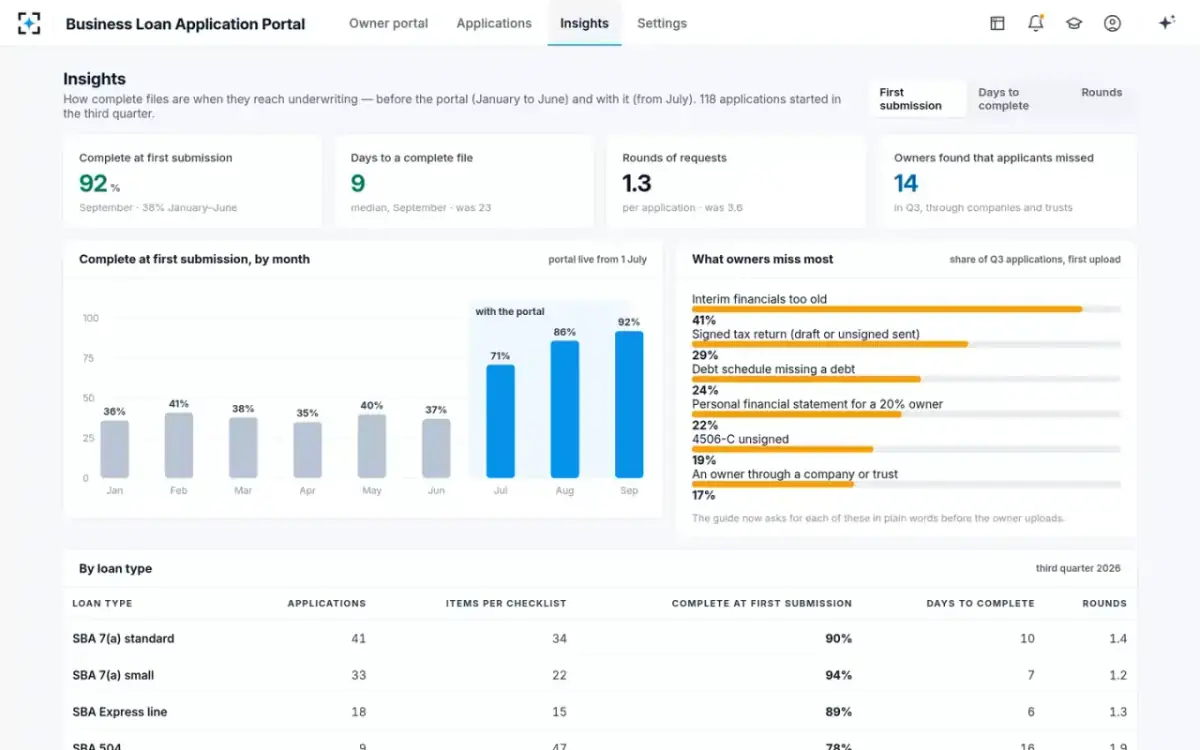
The buyer's view: complete at first submission, days to a complete file, rounds of requests
What should a lender look for in a business loan application portal?
Look for evidence that the portal reads documents against your rules, not just that it collects them. A portal demonstration on a clean sample file proves little; one run on a handful of your own past files, including the messy ones, shows whether the software finds what your processors found. The questions below separate a document drop box from a portal that will shorten files.
Eight questions to ask before buying a business loan application portal
- Does it read uploads, or only store them?
Ask it to find a draft return, a stale statement and an unsigned 4506-C in your own files, and to show the page each finding rests on.
- Does it ask only what the documents could not answer?
An owner should never re-type what a tax return already says.
- Does it trace owners to 100%?
Through holding companies and trusts, multiplied through, with each owner confirming citizenship and residence.
- Are checklists yours, by loan type, and versioned?
Standard 7(a), 7(a) Small, Express and conventional products differ; each change should be dated.
- Who sends requests?
Drafting can be automatic; sending a new request should be a named person’s decision.
- Can it show diligence?
Every request, reminder and upload dated, for Regulation B and for your own reviews.
- What does underwriting receive?
A complete file and a summary in which every figure links to its document, or a folder.
- What will you measure?
Complete at first submission, days to a complete file and rounds of requests, by month and loan type, from day one.
Where the Business Loan Application Portal fits, and where it does not
The solution fits a lender whose time goes on collecting and checking business loan files, above all SBA 7(a) files, where ownership tracing and document ages matter most. Six agents read every upload as it lands, ask the owner only what is missing, trace every owner and tie the debt schedule to the bank statements; the processor decides what is sent and when the file is complete; the SBA lending manager confirms eligibility. It hands underwriting a complete file and a one-page summary, and hands the SBA lending manager the ownership list for the SBA Loan System.
It is not an underwriting system or a loan origination system. The agents never give credit advice, judge creditworthiness or recommend approval or terms, and they never decide citizenship or eligibility; they ask the owner, keep the answer and the ID, and a named manager decides. A lender that wants automated credit decisions, or a replacement for its core loan system, needs something else. A lender that wants its processors to stop chasing and its underwriters to receive complete files is the buyer this guide is for. What to bring to an online loan application software project sets out the go-live work, and why only 6% of banks take a business application fully online sets the market context. To see the sample bank's files, start from the Business Loan Application Portal.
Questions people ask
Is a loan application portal the same as a borrower portal?
Not quite. A borrower portal often means the place an existing customer checks balances and makes payments; a loan application portal is for the application itself. The useful distinction is whether the portal only stores uploads or reads them against the lender's checklist and asks for what is missing.
Does a faster application mean a riskier loan?
It need not. The time a portal removes is waiting for documents, not underwriting. Research on the Paycheck Protection Program found suspicious lending concentrated in certain fintech lenders (Griffin, Kruger and Mahajan, Journal of Finance, 2023), which is why verification steps such as IRS transcripts and bank-statement checks should stay in the process, only earlier.
How long does SBA take to approve a loan once the lender submits it?
For loans made under a lender's delegated authority, which were 64.1% of FY2025 7(a) approvals by our count of SBA's data, the lender approves and SBA issues the loan number without reviewing the credit first. Non-delegated loans go to SBA's loan guaranty processing center, which makes the final determination on eligibility and creditworthiness before SBA approves or declines the loan in the SBA Loan System.
What should a lender measure after launching a portal?
Three numbers: the share of files complete at first submission to underwriting, the median days from first document to complete file, and rounds of requests per application. At the fictional sample bank those moved from 23 days to 9 and from 3.6 rounds to 1.3; a lender should set its own baseline from the months before launch.
Can owners apply in Spanish?
In the Business Loan Application Portal the owner chooses English or Spanish at the start, and every question and request is written at a grade-7 reading level by default. Staff see the checklist's own wording beside each plain-words item.