A 4506-C for business is IRS Form 4506-C, "IVES Request for Transcript of Tax Return", signed by an authorised person for the business so that a lender, or the verification company it uses, can get the business's tax return transcripts directly from the IRS. The IRS rejects the form if a required signature is missing, if the participant or client fields are incomplete, or if more than one tax form type is listed: "a 1065 and an 1120 cannot be requested on the same F4506-C" (IRS IVES FAQs). A business with a holding company, an operating company and owners whose returns the lender also wants therefore needs several forms, each complete. On an SBA 7(a) loan the stakes are higher than a delay: the lender must reconcile the transcripts before the first disbursement, and if the IRS has no record of a required year, no money goes out. Botminds' Business Loan Application Portal prepares one 4506-C for each return type the file needs and checks each signed form before the processor sends it.
Examples come from a fictional sample application at a fictional bank. The IRS and SBA rules are quoted from the IRS's IVES pages, updated in May 2026, and SBA's SOP 50 10 8.1, effective October 1, 2026.
The 4506-C for a business loan, step by step, and who does each step
Agent
List the forms neededReads the returns on file and lists one 4506-C per return type and taxpayer: the operating company, any holding company, owners the bank’s policy covers.
Never: Signs or dates a form for a taxpayer.
A person decides
Each taxpayer signsThe business’s authorised signer, and each individual listed, sign their own section; an authorised representative ticks the box that says so.
Agent
Check before it goesEvery required line filled, one form type on line 6, each signature present, the form’s revision October 2022 or later; anything missing goes back to the person who can fix it.
Never: Fills a blank line with “N/A”.
A person decides
Submit to IVESThe processor submits through the bank’s IVES enrolment or its contracted participant, and follows up with a “Second Request” if nothing arrives in 10 business days.
A person decides
Reconcile before disbursementThe underwriter compares the transcripts with the returns and financial statements and resolves any significant difference.
What is a 4506-C for business, and what is IVES?
IVES, the Income Verification Express Service, is the IRS program through which lenders and verification companies receive tax transcripts with the taxpayer's consent. Form 4506-C is that consent. Participants "who received taxpayer consent on Form 4506-C can use the faxing option to receive transcripts in approximately 2-3 business days", and "there are online options for faster turnaround times"; a "$4 fee is imposed on each transcript requested" (IRS, IVES faxing for participants).
For a business, the form names the business as the taxpayer, lists the one return type it files, the tax years wanted, and the IVES participant and client who will receive the transcripts, and is signed by someone with authority for the business. The transcript the lender receives is the IRS's own summary of the return as filed, which is why SBA relies on it: it lets the lender test whether the return the applicant handed over is the return the IRS received.
Can a 1065 and an 1120 be on one 4506-C?
No. The IRS's answer is direct: "Only one form type can be requested per 4506-C (i.e., a 1065 and an 1120 cannot be requested on the same F4506-C)." Line 6 "should only list the tax form number that was filed", and "forms with multiple tax forms listed will be rejected". Taxpayers who file separately must also be "listed on separate Form 4506-C requests". The table shows what that means for common SBA borrower structures.
How many 4506-C forms a business loan file needs
| Who files | Return | 4506-C forms |
|---|---|---|
| Operating company taxed as a partnership (multi-member LLC) | Form 1065 | One, for the company |
| Holding company taxed as an S corporation that owns it | Form 1120-S | One more: a different taxpayer and a different form type |
| Sole proprietor or single-member LLC | Form 1040 with Schedule C | One, for the individual; SBA has the lender verify the Schedule C |
| Married owners filing jointly | Form 1040 | One can cover both spouses, each signing; separate filers need separate forms |
| Seller of a business being acquired | The seller’s return type | One, for the seller: SBA has the lender verify the seller’s financial data |
The count grows faster than owners expect. An operating company owned in part by a holding company is two business forms before any owner signs anything, and a bank whose checklist also asks each 20% owner for a 4506-C adds one per owner or couple. The sample bank's first round of requests on its bakery file included a 4506-C for a co-owner; in its third-quarter figures, an unsigned 4506-C was among the most common gaps on an owner's first upload, in 19% of applications.
Why was my 4506-C rejected? The rejections the IRS lists
Almost every rejection is a blank or a box. The IRS's FAQ lists them: "Forms with missing signatures will be rejected"; taxpayers on lines 1a and 2a must "complete their assigned signature section"; the form "will be rejected if missing any information for Lines 5a", the IVES participant's details; "Forms with missing client information will be rejected", the client on line 5d; and a form with more than one tax form on line 6 is rejected. The faxing page adds that client fields "cannot be blank or marked not applicable (N/A)".
Two more rejections catch electronic signing. An authorised representative signing for the taxpayer must tick "Form 4506-C was signed by an Authorized Representative", and a taxpayer who signs electronically must tick "Signatory confirms document was electronically signed"; without the box, the form is rejected. Ticking the electronic box on a wet-signed form is also rejected, and only participants authorised for electronic signatures may send them at all. The IRS accepts only "Forms 4506-C with a revision date of October 2022 or later".
A 4506-C for business that IVES will accept
- The current revision
October 2022 or later; older revisions are not accepted.
- One taxpayer, one form type
The business on line 1a; the single return type it filed on line 6.
- Participant lines complete
Line 5a with the IVES participant’s name, address and participant ID.
- Client lines complete
Line 5d with the client company’s name, address and phone; never blank, never “N/A”.
- Tax years that match the request
The years the lender needs, as tax periods ending on the right dates.
- Every listed taxpayer signs
With the attestation box checked above the signature line.
- The right boxes for how it was signed
Authorised representative, or electronically signed, only when true.
Who signs a 4506-C for a business?
A person with authority to sign for the business, in the signature section for the taxpayer on line 1a, with the attestation box above the signature line checked. "Signatures are required for any taxpayer listed", so if a second taxpayer appears on line 2a, as with a joint personal return, that person signs too. If someone signs on the taxpayer's behalf as an authorised representative, the representative box must be ticked.
For an SBA loan the practical rule is to have the business's signer complete the form at the same sitting as Form 1919, where the same person certifies the application. In the sample bakery's file, the owner who signed for the operating company was not the person who could sign for its holding company; the portal sent the holding company's co-owner his own link for its papers and his own forms.
How long do IVES transcripts take?
About two to three business days by fax, excluding weekends and holidays, and faster online. Through the IRS's online channels, transcripts are delivered "in real time after the taxpayer approves the request". Requests "received after midnight (Eastern time) will be considered received on the next business day", and a fax batch is "limited to 50 tax periods". A lender setting up its own access should allow for each user's registration with IRS e-Services, which the IRS puts at about two weeks.
The IVES numbers a processor plans around
2–3business days
typical fax turnaround after a complete 4506-C
$4
IRS fee per transcript requested
10business days
after which SBA has the lender send a “Second Request”
1form type
per 4506-C; a second return type is a second form
A rejection costs more than its own turnaround. The form goes back to the person who must fix it, waits for a signature, and only then re-enters the two-to-three-day queue. SBA's rule assumes the IRS will sometimes be slow: if the lender "does not receive a response from the IRS or the copy of the tax transcript within 10 business days", it must resubmit "with the notation 'Second Request' in the top right-hand side". Ordering transcripts at the start of the file, rather than at closing, keeps both clocks off the critical path; the SBA 7(a) loan process stalls on clocks like these.
How many years of tax transcripts does SBA require?
Three years when size is measured by the industry size standard, two under the alternative size standard, and every year in operation for a younger business. SOP 50 10 8.1 says transcripts are needed "for the last 3 years" when the applicant qualifies under its NAICS size standard, and "for the last 2 years" under the alternative standard, which caps tangible net worth at $20 million and average net income at $6.5 million, including affiliates (13 CFR 121.301(b)).
Two timing rules soften this. Tax information for the most recent fiscal year is not required "if the fiscal year-end is within 6 months of the date SBA received the application". And if the applicant has filed an extension, the lender "must obtain a copy of the extension along with evidence of payment of estimated taxes". The sample bakery's 2025 return had been filed on extension and arrived as the accountant's draft; the filed, signed copy was what the lender needed to reconcile against.
What if the IRS has no record of a business return?
Then the loan cannot be disbursed until it is resolved. "If the IRS advises that it has no record on the Applicant or no record of any of the required years of transcripts, no disbursements may be made on the loan and either the loan must be canceled, or the closing must be postponed until the issue is resolved." A business that has not filed required federal returns "is not eligible for SBA financial assistance".
SBA allows one narrow exception. Where three years are required and the transcript shows "Record Not Found" for the middle year only, the lender has verified the other two, and the applicant has a record of a refund or tax payment for the missing year, the lender "may reasonably assume that the Applicant filed a return for the missing year", provided it documents each step. For amended returns not yet on transcript, the lender keeps the signed amended return and proof of filing, such as an IRS acceptance report or a certified mail receipt.
IVES or Form 8821?
Either, under SBA's rules. Lenders may obtain transcripts through IVES, by enrolling or "contract[ing] with an IVES participant", or "by fully completing and submitting IRS Form 8821", the tax information authorisation, with the lender named as designee on line 2; if a lender service provider is involved, both are named. One route is closed: "SBA will not permit the borrower or its own tax preparer or enrolled agent to file IRS Form 8821 for an SBA loan." The transcript has to come to the lender from the IRS, not through the applicant.
Delegated lenders have one more choice, with a price. A lender processing under its delegated authority "may proceed to close and disburse the loan", but if it then cannot obtain the transcript and reconcile it, "the guaranty may be subject to repair or denial". SBA Express lenders may disburse immediately if the borrower asks, but must follow up and verify, on the same terms.
Each document read for type, year, signer and draft marks before it is accepted
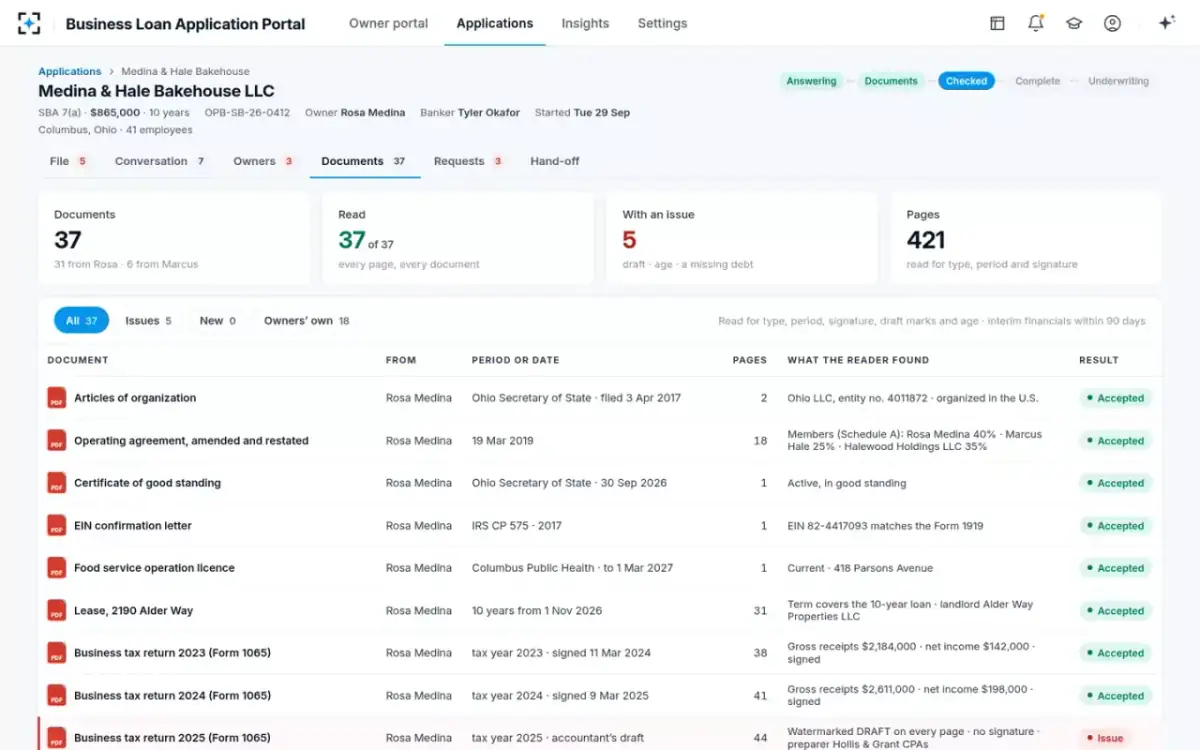
The Business Loan Application Portal treats the 4506-C as part of the application rather than a closing task. It fills the form from the owner's answers, sends it to each person who must sign, and reads the signed form like any other upload, so an unsigned page or a second form type is caught before the processor submits it. Why a ticked checklist is not a complete file puts the form in the wider file. To see the sample file's documents, start from the Business Loan Application Portal.
Questions people ask
What does 4506-C stand for?
It is the IRS form number; its title is "IVES Request for Transcript of Tax Return". The IRS's current revision, dated October 2022, added the IVES participant ID to line 5a and made the client lines mandatory, and the IRS accepts only that revision or later.
How do I fill out a 4506-C for a business?
Enter the business as the taxpayer on line 1a with its taxpayer identification number, the IVES participant's details on line 5a and the client's on line 5d, the single return type the business files on line 6, and the tax years requested. Then have an authorised person sign, check the attestation box, and tick the representative or electronic-signature box only if it applies.
Does an SBA Express loan need a 4506-C?
Yes, in most cases. If the lender underwrites on business financial statements or returns, it follows the full transcript process; if it uses a credit scoring model instead, it must still obtain transcripts "to verify that the returns were filed and for the purpose of determining the Applicant's size", though reconciliation is not required.
Can my accountant request the transcripts instead?
Not for an SBA loan. SBA does not permit "the borrower or its own tax preparer or enrolled agent" to file Form 8821 for the loan. The request must come from the lender, its lender service provider or its IVES participant.
Is there a fee for IVES transcripts?
Yes. The IRS charges "a $4 fee" for each transcript requested through IVES, so three years of one business's returns cost $12. Wage and income transcripts are charged by form type, taxpayer and year: the IRS's own example, three forms for two taxpayers, "will incur six charges per year requested".