An incomplete loan application is one that lacks information the lender regularly obtains and considers for that kind of credit, and Regulation B tells the lender what to do with it. Within 30 days of receiving an application "that is incomplete regarding matters that an applicant can complete", the creditor must either take action on it or send a written notice "specifying the information needed, designating a reasonable period of time for the applicant to provide the information", and warning that failure to provide it "will result in no further consideration being given to the application" (12 CFR 1002.9(c)). For a business lender, especially on SBA loans with long document lists, that turns every missing tax return into a compliance question. Botminds' Business Loan Application Portal was built for this moment: it reads each upload as it lands, asks the owner only for what is missing, and keeps the date and wording of every request.
The examples come from a fictional sample lender, Orchard Point Bank, and a fictional borrower, Medina & Hale Bakehouse, applying for an SBA 7(a) loan of $865,000. The rules are quoted from the current eCFR text of Regulation B and its official interpretations.
A notice of incompleteness, annotated: three things Regulation B requires, and three it does not say
Orchard Point Bank · Columbus, Ohio · 12 October 2026
Dear Applicant: Thank you for your application for credit. The following information is needed to make a decision on your application:
- 2025 business tax return, signed. The copy received is marked DRAFT on every page and is unsigned.
- Interim profit and loss statement and balance sheet through 30 September 2026. The statements received run to 30 June 2026.
- Payments of $1,912.40 a month to Alder Creek Equipment Finance: what they are for and the balance owed.
We need to receive this information by 26 October 2026. If we do not receive it by that date, we will regrettably be unable to give further consideration to your credit request.
Required by 1002.9(c)(2)
1 · The information needed, specified. Not "updated financials": the document, the period and why the one received does not serve.
2 · A reasonable period, designated. A date, not "at your earliest convenience". The regulation leaves the length to the lender.
3 · The consequence, stated. No further consideration if the information does not arrive.
What a good notice adds
4 · Who can provide it. The accountant can send the filed return; a co-owner holds the holding company's papers.
5 · The checklist's own wording, kept beside the plain words, so staff can see the request matches policy.
6 · The date it went out, kept with the file, as evidence of diligence.
What is an incomplete loan application under Regulation B?
An application is incomplete when the lender has not yet received everything it regularly uses to decide that type and amount of credit. Regulation B lets each lender set that list: the official commentary says a creditor "has the latitude under the regulation to establish its own application process and to decide the type and amount of information it will require from credit applicants" (Supplement I, comment 2(f)-1). An SBA lender's checklist, built on Appendix 20 of SOP 50 10 8.1, is therefore the measure of completeness for its SBA files.
Two consequences follow. A bank cannot call an application incomplete for lack of something it does not normally require; the commentary defines "procedures" as "the actual practices followed by a creditor for making credit decisions as well as its stated application procedures". And the bank's own checklist becomes evidence: if it asks for three years of returns on every 7(a) loan, a file with two is incomplete by the bank's own standard, whatever the owner thinks.
What is a completed application under Regulation B?
A completed application is one "in connection with which a creditor has received all the information that the creditor regularly obtains and considers in evaluating applications for the amount and type of credit requested" (12 CFR 1002.2(f)). The definition names what that includes: "credit reports, any additional information requested from the applicant, and any approvals or reports by governmental agencies or other persons that are necessary to guarantee, insure, or provide security for the credit or collateral."
That last clause matters for SBA lending. On our reading, for a loan the lender will make only with an SBA guaranty, the guaranty approval is part of what makes the application complete, so the 30-day decision clock in 1002.9(a)(1) would run from the point the lender has everything including SBA's answer on a non-delegated loan. The rule's text supports that reading; we found no CFPB commentary applying it to SBA loans specifically, so a compliance officer should treat it as an interpretation, not settled guidance. The same clause carries a duty: "The creditor shall exercise reasonable diligence in obtaining such information."
What must a notice of incompleteness say?
Three things, and only three are mandatory: the information needed, a reasonable deadline, and the warning that without it the application will not be considered further. Regulation B's Appendix C gives a sample, Form C-6, which is four sentences long: a thank-you, a blank for "the following information is needed", a blank for the date, and the warning. Using the form properly satisfies the rule; the difficulty is in filling the first blank.
The rule says "specifying", and a vague notice does not specify. "Please send updated financials" leaves the owner to guess which statements, through which date, and why the ones already sent fail. Each guess that misses costs a round. The annotated notice above names the document, the period and the defect in each line, which is what a processor's best email already does, written down so that every notice does it.
The regulation also lets a lender ask orally first. "At its option, a creditor may inform the applicant orally of the need for additional information," but "if the application remains incomplete the creditor shall send a notice" under 1002.9(c)(1). The commentary is precise about timing: if the applicant does not respond to an oral request, the creditor "must send a written notice to the applicant within the 30-day period" (comment 9(c)(3)-1). Calls and portal messages can do the asking; the written notice remains the backstop.
Can a lender deny an incomplete application instead of sending a notice?
Yes, if the missing information leaves it unable to decide. The commentary allows it plainly: when an application is incomplete about information the applicant can provide "and the creditor lacks sufficient data for a credit decision, the creditor may deny the application giving as the reason for denial that the application is incomplete" (comment 9(a)(1)-3). The notice of incompleteness is the alternative, not a requirement on top.
The reverse case is a trap. If the file is missing something but "provides sufficient data for a credit decision", the creditor may decide on it, but if credit is denied, "missing information or 'incomplete application' cannot be given as the reason for the denial" (comment 9(a)(1)-4). A lender that declines a weak file and writes "incomplete" on the notice has given an inaccurate reason. And if the owner sends the information after the deadline, the lender "may require the applicant to make a new application" (comment 9(c)(2)-1), which is why the deadline should be real.
How long does a lender have to respond to a business loan application?
Thirty days from a completed application for most small businesses; "a reasonable time" for larger ones. Regulation B splits business applicants at $1 million of gross revenue in the preceding fiscal year. For businesses at or below that line, the lender follows the consumer timing, including the 30-day notice after a completed application and the 30-day window for an incompleteness notice, though the statement of action "may be given orally or in writing" (1002.9(a)(3)(i)). Above it, the lender must "notify the applicant, within a reasonable time, orally or in writing, of the action taken", and give written reasons only if asked within 60 days.
Two clocks, one file: incomplete on arrival, and complete on arrival
- Decide, or send the written notice≤ 30 days
- Applicant’s deadline (lender sets it)14 days, illustrative
- Complete: notify the decision≤ 30 days
- Notify the decision≤ 30 days
The line matters in practice. The sample bakery reported $2,611,000 of sales on its 2024 return, so it sits in the "reasonable time" tier; a $300,000-revenue sandwich shop applying for an SBA 7(a) Small loan the same week sits in the 30-day tier. The commentary lets a lender "rely on the applicant's assertion about the revenue size of the business" (comment 9(a)(3)-1), but a lender has to know which assertion it relied on. Many banks simply run every business file on the 30-day clock, which is the safer default.
Reasonable diligence: the duty to chase, and the evidence it leaves
Regulation B does not let a lender wait for the owner to notice what is missing. The commentary on completed applications says that although the creditor sets its own information requirements, "the creditor must act with reasonable diligence to collect information needed to complete the application", should request third-party information such as a credit report "promptly after receiving the application", and, if more is needed from the applicant, "should contact the applicant promptly" (comment 2(f)-6).
Promptly is measured in days, and the evidence is the request itself. A lender that can show what it asked for, from whom and when has shown diligence; one that can show only a thread of forwarded emails has shown activity. This is the duty a portal can make routine: every request dated, every reminder logged, every upload timestamped against the item it answers.
Ask only for what the documents could not answer, and say why
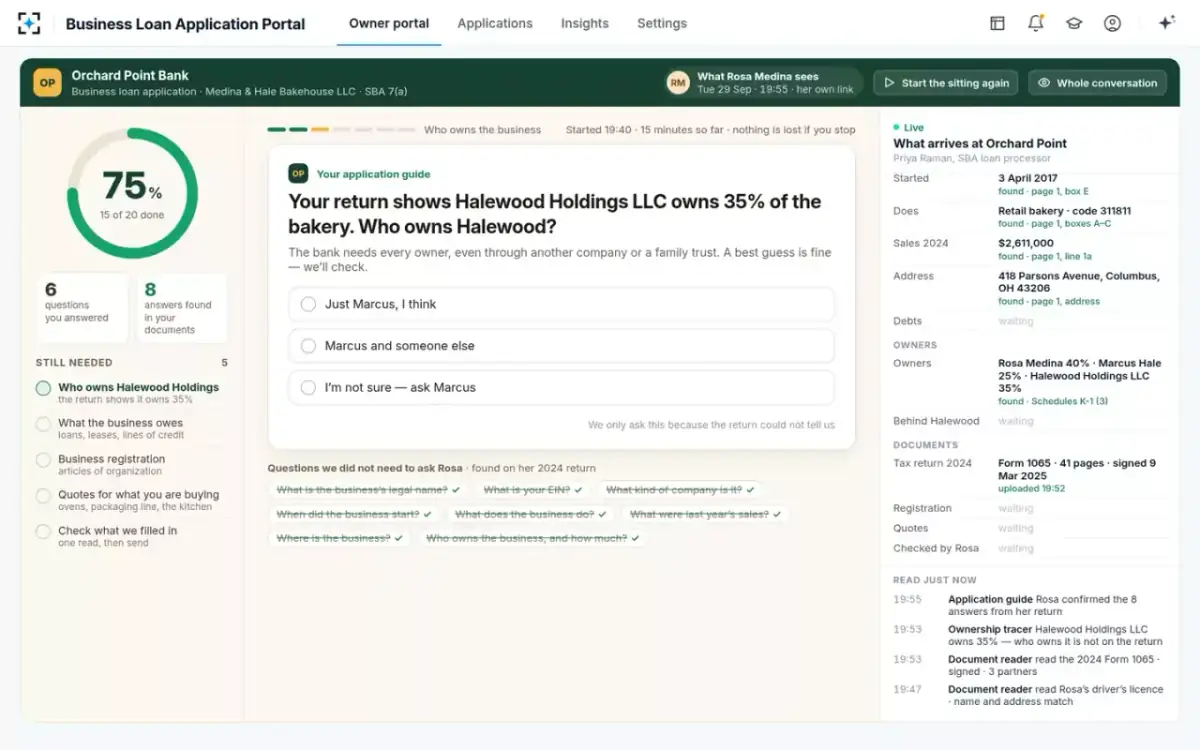
Vague requests restart the clock: what a specific one looks like
A request that the owner cannot act on in one pass is the most common reason an application stays incomplete. In the sample bank's own figures, applications needed 3.6 rounds of requests each before the portal and 1.3 with it. The difference is mostly wording: the same five items, asked so that each can be answered once.
The same gaps, asked two ways
The request owners usually get: Please provide signed tax returns for the last three years.
The request that closes the gap: The 2025 return you sent is your accountant’s draft — it says DRAFT at the top. Please send the copy that was filed and signed. Your accountant can send it to us directly if that is easier.
The request owners usually get: Updated financial statements required.
The request that closes the gap: Your profit-and-loss and balance sheet run to 30 June. We need them through 30 September — the same reports, three more months.
The request owners usually get: Debt schedule appears incomplete; please revise.
The request that closes the gap: Your bank statements show $1,912.40 a month to Alder Creek Equipment Finance. What is it for, and how much is still owed?
The request owners usually get: Provide organisational documents for all entity owners.
The request that closes the gap: Thank you for Halewood’s operating agreement. One more thing for Halewood: a certificate of good standing from the Ohio Secretary of State. It is free online.
Each right-hand request names the defect, the period and the person, which is exactly the specificity 1002.9(c)(2) asks for. Notice also what it leaves out: no form numbers the owner has never heard of, no "per SBA requirements". The checklist's own wording ("IRS Form 1065 for tax year 2025, signed and dated by an authorized member") is kept beside the request for staff, not sent to the owner.
A notice that does not say which document, which period and what is wrong with the one received is a reminder, not a request.
Can an AI agent request missing documents? Where the processor stays in charge
Regulation B does not say who drafts a request; it says what the creditor must send and when. A lender may use software, a processor or an agent to find gaps and draft the words, and remains responsible for every notice. The design question is therefore not whether an agent may ask, but which decisions stay with a named person.
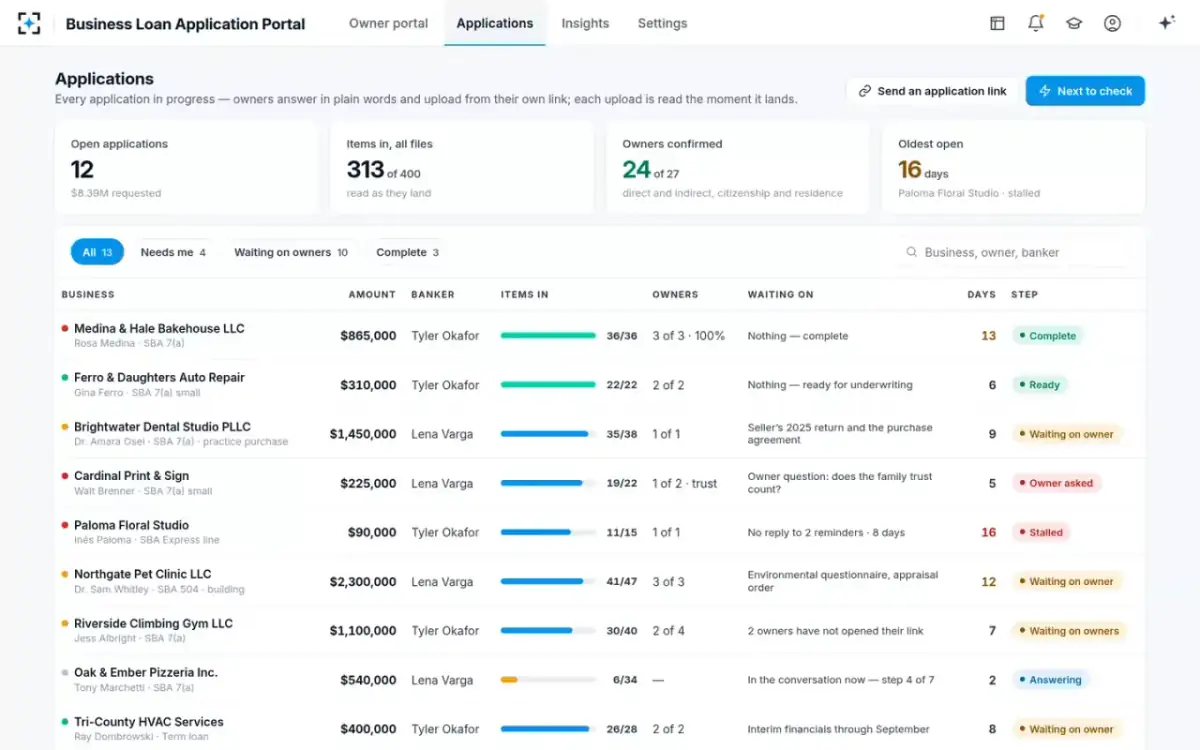
In the Business Loan Application Portal, the request writer groups open items by the person who can provide them and drafts one plain-words message per person, at a grade-7 reading level, with the checklist wording beside each item. It never sends a new request on its own: the processor edits and presses Send. Only reminders for items already requested go out automatically, every two business days at the sample bank, and every message and upload sits on the file's audit trail. The formal Regulation B notice, its deadline and the decision to stop considering an application remain the bank's own, set by its compliance policy.
Every open application, with what each is waiting on
Six tests for any request that asks an applicant for missing information
- Names the document and the period
The 2025 Form 1065, signed; statements through 30 September. “Specifying the information needed” is the rule’s own word.
- Says what is wrong with what arrived
Draft, unsigned, out of date, or missing a debt. Otherwise the owner sends the same thing again.
- Goes to the person who has it
The co-owner with the holding company papers, or the accountant with the filed return.
- Carries a date
A real deadline in the formal notice; a dated request in every message before it.
- Is approved by a person
The processor sends; the software drafts.
- Leaves a trail
Sent, opened, answered and the upload it produced, kept with the file as evidence of reasonable diligence.
The tests are also a fair way to judge any portal. One that cannot say what is wrong with a document cannot write the first test's request; one that sends without a person fails the fifth. The checks a lender can run before the file is complete shows how to shorten the list of gaps before the first request goes out. To see the drafted requests on a sample file, start from the Business Loan Application Portal.
Questions people ask
Does a notice of incompleteness count as an adverse action?
No. A notice under 1002.9(c)(2) asks for information; it does not decline the application. An adverse action notice is required if the lender denies the application, including a denial for incompleteness, which comment 9(a)(1)-3 allows when the lender lacks enough data to decide.
How long should the deadline in a notice of incompleteness be?
Regulation B says only "a reasonable period of time" and sets no number. A deadline should allow for documents the owner must get from someone else, such as a filed return from an accountant or a certificate of good standing. Whatever the length, the same period for the same kind of item across applicants is easier to defend.
Do the Regulation B incompleteness rules apply to business loans?
Yes. Regulation B covers business credit, and 1002.9(a)(3) sets how the notice rules apply by size. For businesses with gross revenue of $1 million or less, the 30-day timing applies, with the statement of action allowed orally; for larger businesses, notice of action is due "within a reasonable time".
Can a lender ask for missing information by phone?
Yes, at its option. Under 1002.9(c)(3) a creditor may tell the applicant orally what is needed, but if the application remains incomplete it must send the written notice within the 30-day period. A phone call is a good first request, not a substitute for the notice.
What happens if the applicant sends the information after the deadline?
The lender may treat it as a new application. Comment 9(c)(2)-1 says that if the information arrives after the period the creditor designated, "the creditor may require the applicant to make a new application". Many lenders reopen the file instead when little time has passed; either choice should follow written policy.
Do preapprovals need a notice of incompleteness?
No. The commentary exempts them: "The requirement to provide a notice of incompleteness does not apply to preapprovals that constitute applications under § 1002.2(f)" (comment 9(c)(1)-1). Once a real application follows, the normal rules apply.