A re-aged invoice is a past-due invoice that reappears as current: a credit memo cancels it, a new invoice reissues the same amount with a later date, and nothing about the underlying sale — no new shipment, no new order — has actually changed. On Brennick Industrial Supply's certificate 41, eleven invoices to one customer, Dunmore Implement, went through exactly this sequence between June and September, moving $281,630 from a bucket that would have made them ineligible into one that looked current. The fictional case below, run through Borrowing Base Verification, follows the invoices from their original dates to the decision they produced.
Eleven invoices, one pattern, found in one aging comparison
11
Dunmore Implement invoices cancelled and reissued with later dates
$281,630
moved from the 61–90 day column back to current on the certificate as submitted
94–110days
how old the invoices actually were, counted from their original June dates
One pattern, four months: from the original invoices to the comparison that caught them
- Original invoice dates12–28 Jun
- Aging normally, into the 61–90 day column and past 90 days29 Jun–23 Sep
- Credit memos, all eleven, one day: 24 Sep
- Reissued with new dates, no shipment: 25–29 Sep
- Certificate 41, as of this date: 30 Sep
- Aging comparison flags the pattern12 Oct
September 24: eleven credit memos, same day
The eleven invoices originated between 12 and 28 June, numbered 05112 through 05470, totaling $281,630 owed by Dunmore Implement. By the normal course of an aging report, invoices dated in June were about to cross 90 days from their invoice dates by the end of September, the line the credit agreement draws for simple delinquency. Instead, on 24 September, each of the eleven was cancelled by a credit memo, every one on the same day, each marked with the same note: "pricing correction."
A pricing correction is an ordinary, legitimate reason to cancel and reissue an invoice — a wrong unit price, a discount applied late, a quantity correction. What made the pattern worth a second look was not the reason given but the shape of it: eleven invoices, one customer, one day, all old enough to be a problem on the aging that was due in six days.
September 25–29: the same amounts, reissued with new dates
Over the following week, Dunmore's eleven invoices reappeared, same amounts, new invoice dates between 25 and 29 September. On a receivable aging that buckets invoices by age from their invoice date, a reissued invoice dated 27 September reads as three days old on 30 September, not as the three-month-old invoice it replaced. Nothing else about the eleven transactions changed: same customer, same dollar amounts, same goods already shipped months earlier. Only the date, and the bucket it produced, had moved.
What moved, and what did not
05112 through 05470 (11 invoices)
12–28 June
24 September, all eleven, same day, marked "pricing correction"
25–29 September, same amounts
No shipment to Dunmore Implement
94 to 110 days
1 to 5 days — inside the current bucket
October 12: the aging comparison that catches it
None of the eleven invoices looks wrong on the September aging by itself; a current invoice from a long-standing customer is unremarkable on its own. What exposes the pattern is a comparison with the prior month's aging, invoice by invoice, which is exactly what the aging change detector agent runs every time a new certificate arrives. On 12 October, comparing September's aging against August's, it found the same eleven amounts, the same customer, sitting in August's 61–90 day column under their original June dates — and sitting in September's current column under new dates about thirteen to fifteen weeks later, with no shipment in between.
The same eleven invoices, one month apart
August aging: 61–90 days
September aging, as submitted: Current
August aging: 12–28 June (original)
September aging, as submitted: 25–29 September (reissued)
August aging: $281,630
September aging, as submitted: $281,630, unchanged
August aging: June, at original shipment
September aging, as submitted: None in September
Eleven invoices, moved from 61–90 days to current
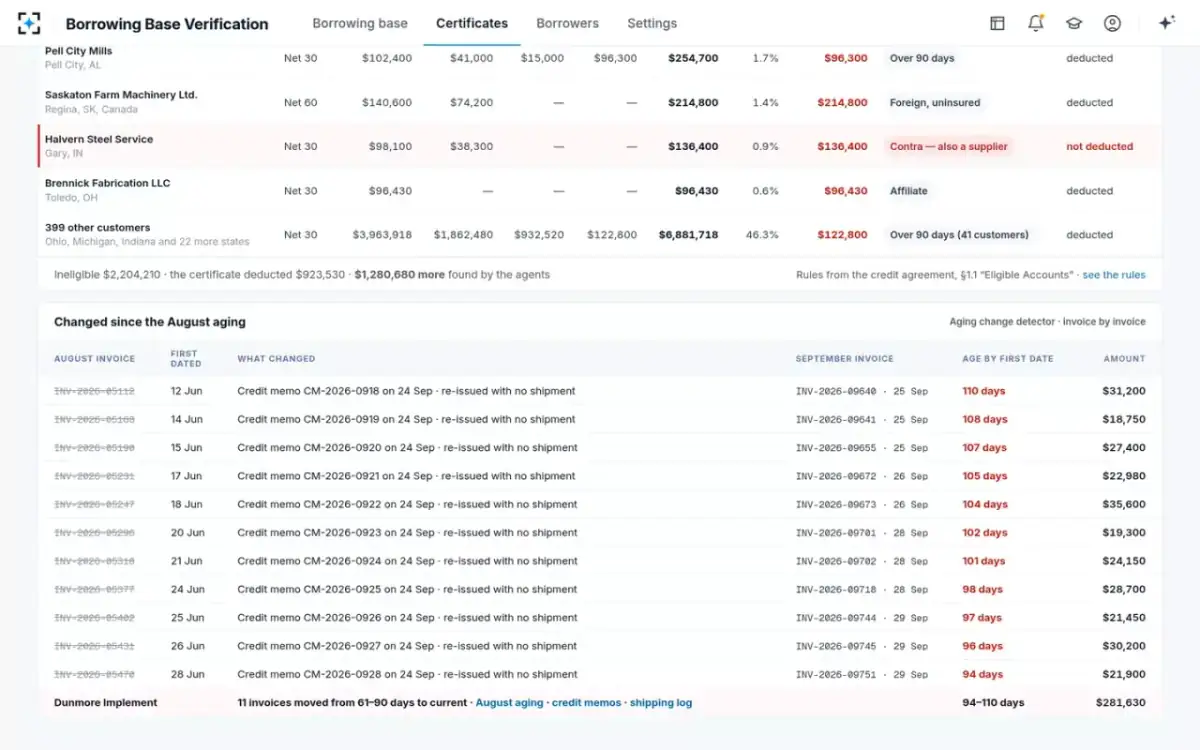
By the first dates: 94 to 110 days old, not current
Counted from their original June dates, the eleven invoices were 94 to 110 days old as of 30 September — past the over-90-day line the facility uses for simple delinquency, which matches the OCC's description of an account as ineligible when it is past due by three times the terms, "90 days for 30-day terms". Counted from their reissue dates, the same invoices were one to five days old. The gap between those two numbers is the entire finding: nothing about the underlying transactions changed between June and September except which date a reader was shown.
$281,630: what the certificate did not deduct
Brennick's certificate as submitted deducted three categories of ineligibles — receivables over 90 days, foreign uninsured balances, and affiliate receivables — and the Dunmore invoices, reading as current under their new dates, triggered none of them. The $281,630 simply was not on the certificate's ineligibles line, because by the date the certificate used, the invoices did not look past due. Recalculated from the invoices' original dates, all eleven cross the ineligibility threshold the credit agreement sets at three times normal terms, and the full $281,630 comes out of eligible receivables.
That figure was one of six differences the recalculation found on certificate 41, alongside a cross-aged customer, a concentration breach, a contra account, and invoices billed before shipment — together $1,279,528 of availability the certificate had overstated. The other eight reasons a receivable can be ineligible, re-aging among them, are worked through on their own page; this one follows the single pattern that is hardest to see from one month's aging.
What is a re-aged invoice?
A re-aged invoice is one whose apparent age has been reset without a change in the underlying transaction — usually by cancelling it with a credit memo and reissuing the same amount under a new invoice date, so it moves from a late bucket on the aging back into the current one. The OCC's handbook names it directly among the characteristics commonly designated as ineligible: "Re-aged receivables for which the probability of collection is reduced." The logic behind the rule is that a customer whose invoices need re-dating to stay current is a customer whose actual likelihood of paying has already fallen, whatever the aging now shows.
The decision: fund, hold, and order a targeted field exam
Finding the pattern is not the same as deciding what to do about it. The recalculation changed Brennick's certified excess availability of $2,094,528 to a recalculated $815,000, and the decision Renée Okafor made walked from one figure to the other, a step per difference, with the Dunmore invoices among the largest pieces. She funded $815,000 and held $335,000, and because the total differences exceeded $250,000, the decision went to Martin Halloran, the portfolio manager, for a second signature — he co-signed on mobile two minutes later.
From the finding to the field exam, in four steps
Agent
Aging change detectorCompares September’s aging with August’s, invoice by invoice, and flags the eleven invoices whose dates moved with no shipment behind the change.
Never: Never calls anything fraud — it shows the evidence to a person.
A person decides
Renée Okafor, collateral analystOpens the eleven flagged invoices against the shipping log and confirms no shipment reached Dunmore in September.
A person decides
Renée Okafor, collateral analystDecides to fund $815,000, hold $335,000, and ask for a targeted field exam of the re-dated and pre-billed invoices.
A person decides
Martin Halloran, portfolio managerCo-signs because the differences exceed $250,000; the exam is scheduled for Monday 19 October, at the borrower’s cost.
The field exam Renée ordered was targeted, not a full re-audit: the eleven Dunmore credit memos and reissued invoices, the three Corwell invoices billed before shipment, and a sample of September shipments generally. Ravel Field Examinations can have an examiner on site the following Monday, 19 October, at Brennick's own cost under the credit agreement's exam-cost clause — a scope an analyst can set precisely because the recalculation already named exactly which invoices need a closer look, rather than leaving the examiner to find them cold.
That precision is itself part of what the recalculation changes about the exam. A field exam scheduled on the usual quarterly cadence, with no prior finding to work from, would normally open by sampling broadly across the aging to look for problems nobody has flagged yet — useful, but slower, and no more likely to land on Dunmore's eleven invoices than on any other customer. An exam scheduled against a named list, by contrast, spends its time confirming or clearing a specific pattern: calling Dunmore to ask about the 24 September credit memos, checking the shipping log against the carrier's own records, and widening the sample only if what it finds raises a broader question. The targeting does not make the exam optional; it makes the hours it does spend count toward the question that actually needs answering.
The decision, with a step for each difference
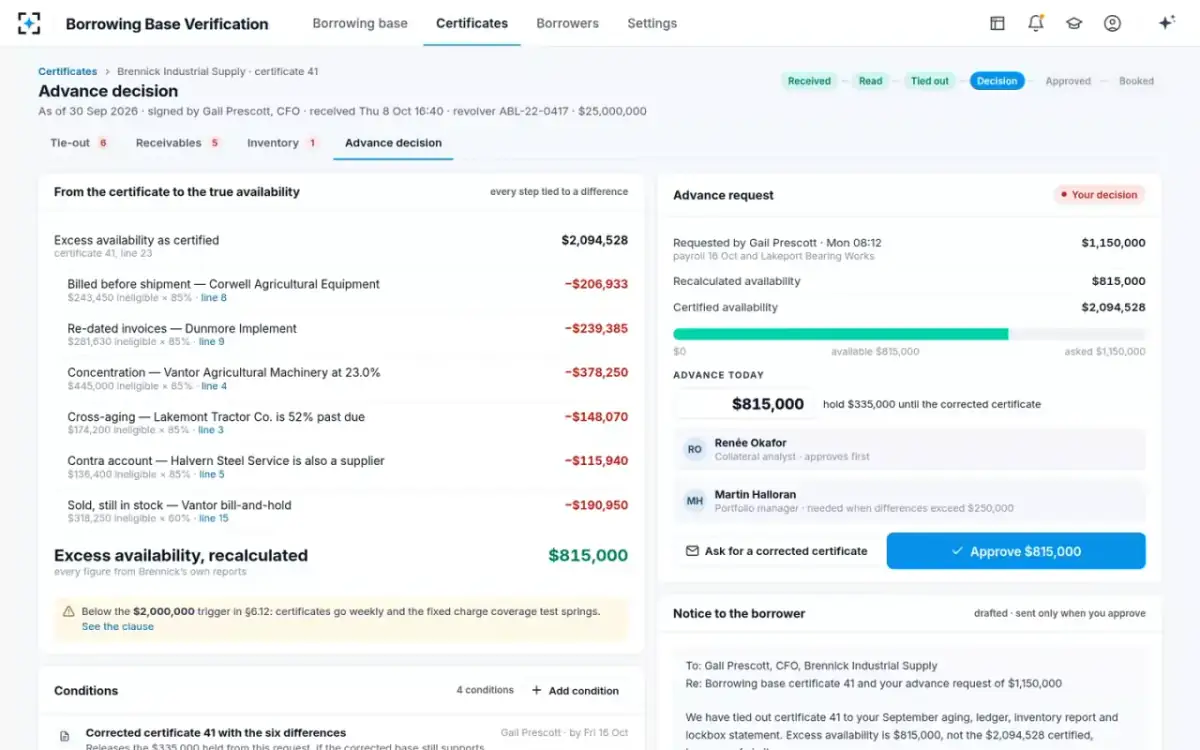
Evidence, not an accusation: what the file shows a person
Nothing in the aging change detector's finding, or in Renée's decision, calls the pattern fraud. The agent's job is to compare two agings and show what moved; whether a customer re-dated eleven invoices to manage a cash shortfall, to correct a genuine pricing error on an unusual scale, or for some other reason is a question for the people who can ask Dunmore directly — which is exactly what the targeted field exam is for. The file records what changed, when, and what evidence supports it: the credit memo dates, the reissue dates, the shipping log search, each linked to its source, so the field examiner starts from a specific list of invoices rather than a blank aging.
That restraint matters because the cost of getting it wrong runs in both directions. Regulators' own enforcement cases show what unchecked re-aging can become at scale: the SEC's complaint against the former executives of auto lender Tricolor Holdings describes a scheme in which, to conceal dead loans, the defendants set up an off-the-books entity "to house dead loans and apply fake payments to make them appear current," and the IRS's criminal investigation into First Brands' executives quotes an FBI assistant director describing a scheme that "inflated invoices, double- and triple- pledged collateral, and falsified financial statements to unlawfully trick lenders into giving them billions of dollars." Neither case started with a courtroom finding; both started with a pattern in the numbers that someone, eventually, compared month to month. On Brennick's certificate, that comparison took the aging change detector agent a fraction of the 1 minute 52 seconds the six agents spent rebuilding the whole base — and it was the thing a certificate review done by hand, reading one month's aging in isolation, would have had no reason to run at all.
Questions people ask
How do credit memos hide a past-due invoice?
By cancelling the original invoice and reissuing the same amount with a later date, a credit memo resets what a receivable aging shows as the invoice's age. The aging buckets by invoice date, so a reissued invoice reads as new even though the sale, the shipment and the customer are unchanged. On the Dunmore invoices, the reissue moved them from the 61–90 day column to the current one, one to five days old.
How does an aging comparison catch a re-dated invoice?
By matching invoices across two months' agings on amount and customer rather than only on invoice number, and flagging any that disappear from one bucket and reappear in another with no transaction behind the move. A single month's aging cannot show this on its own; the pattern only exists in the difference between one month and the next.
Is re-dating an invoice fraud?
Not automatically. A credit memo and a reissued invoice are ordinary tools for correcting a real pricing or billing error. What a lender's own process should do is treat a pattern — many invoices, one customer, one day, each old enough to matter — as a fact to investigate rather than an accusation to make; a targeted field exam, not a label, is the usual next step.
What happens after re-dated invoices are found?
The amount moves back to ineligible, recalculated from the invoices' original dates, and the borrowing base and excess availability are recalculated from there. Where the differences are material, a second signature is required before funding, and a targeted field exam is often ordered on the specific invoices involved, so an examiner can confirm directly with the customer and the shipping records what actually happened.
What does a field examiner check for re-aged invoices?
Whether a shipment or a new order actually supports the reissued invoice date, by checking the shipping log and, where needed, confirming the balance directly with the customer. An examiner working from a list already narrowed to the specific invoices a month-over-month comparison flagged can confirm or clear the pattern far faster than starting a full aging review from nothing.
What is a cross-aged receivable, and is it the same as a re-aged one?
No — the two are easy to confuse but test different things. Cross-aging takes a customer's entire balance out of the base once enough of it is genuinely past due; re-aging is a receivable whose apparent age has been reset so it no longer looks past due at all. How cross-aging works, with its own worked example, covers the first; this page covers the second.