A borrowing base audit is the work of proving a borrower's certificate before a lender advances against it: tying the receivable aging to the general ledger and the bank, testing eligibility customer by customer, checking inventory, and recalculating excess availability. Three methods do that work today, and they are not interchangeable: a collateral analyst with a spreadsheet, a field examiner on site a few times a year, and software that recalculates every certificate from the borrower's own reports. Run Brennick Industrial Supply's certificate 41 through each, conceptually, and the honest answer is that each method finds a different, real share of what was wrong with it — none finds all of it, and none should be mistaken for the others.
One certificate, $1,279,528 of overstated availability, three ways to look for it
412
customers on the certificate; a by-hand review samples a fraction of them
100%
of customers an agentic recalculation tests, every certificate
1:52
for six agents to rebuild the base from 7 reports, against about a day by hand
One certificate, three ways to prove it
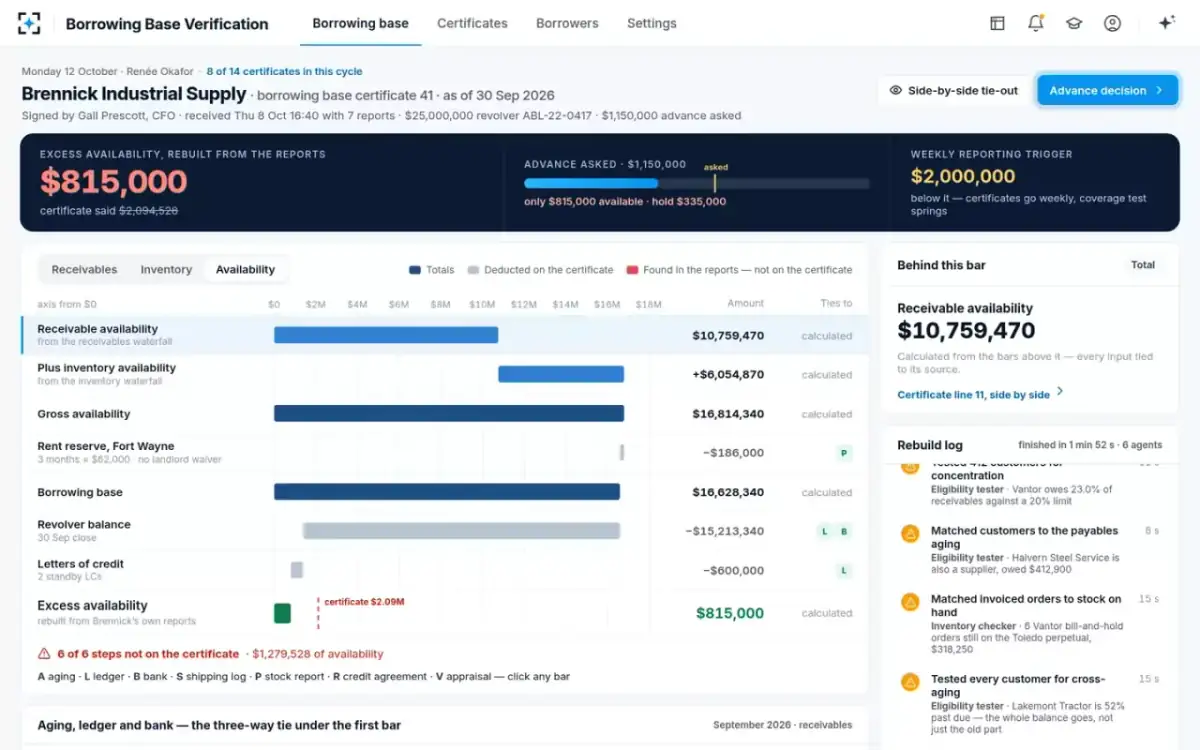
Certificate 41 certified $2,094,528 of excess availability against a $1,150,000 advance request. Recalculated from the receivable and payables agings, the general ledger, the lockbox statement, the inventory report and the shipping log, the real figure was $815,000 — six differences, $1,279,528 apart, spread across a cross-aged customer, a concentration breach, a contra account, invoices billed before shipment, goods sold but still on the stock report, and eleven re-dated invoices. The question this guide asks is not which method is best in the abstract, but which of those six a spreadsheet tie-out would have found, which a field exam would have found, and which only a full recalculation actually catches.
By hand: a day, a sample of customers, and what gets missed
A spreadsheet tie-out is the default at most asset-based lenders, and it is not a weak method — an experienced analyst working carefully can tie gross receivables to the general ledger, test a sample of customers against the eligibility rules, and compare this month's aging with last month's by eye. The constraint is time: tying out one certificate by hand runs to roughly a day once the supporting reports arrive, which is workable for one certificate but not for the nine certificates a single analyst at a mid-sized lender might carry in the first two weeks of a month. Something has to give, and what usually gives is coverage — testing a sample of customers against each eligibility rule rather than all 412, and a careful look at this month's aging rather than a systematic line-by-line comparison with last month's.
On certificate 41, that trade-off has a real cost. A sample draw of 412 customers has no particular reason to land on Lakemont Tractor, Vantor or Halvern — the three customers behind the cross-aging, concentration and contra-account differences — and the month-over-month comparison that catches the eleven re-dated Dunmore invoices only exists if the analyst happens to run one, invoice by invoice, rather than reading September's aging on its own. Billed-before-shipment and bill-and-hold inventory both need a document — the shipping log — that a spreadsheet tie-out does not always pull in by default. None of this is a failure of the analyst; it is the arithmetic of a method that trades completeness for speed under real time pressure.
The field exam: thorough, and a few times a year
A field exam is the deepest of the three. An examiner on site traces a sample of invoices to shipping documents and customer confirmations, counts inventory against the perpetual report, and tests the borrower's own internal controls — work a desk review, by spreadsheet or by software, cannot do, because it depends on being physically present with the records and sometimes with the customer. The OCC's handbook calls a field audit "usually the best means of evaluating internal controls, information systems, and operating systems," and sets an ordinary cadence of "often quarterly but more frequently if risk dictates" for an ordinary asset-based relationship.
What a field exam cannot do is run on every certificate. Between visits — roughly ninety days at a quarterly cadence — the certificate is advanced against without the independent check a field exam provides, and even the exam itself samples rather than testing every customer. A pattern like the Dunmore re-dating, visible only by comparing two consecutive months' agings, is something an exam would likely find if it happened to review the right two months; it is not something the exam's own cadence guarantees it will see before several more certificates have already been funded against the same unverified number.
Agents: every customer, every month, in under two minutes
A continuous agentic recalculation runs a third way: every certificate, against every eligibility rule, for every customer, the day the reports arrive. On certificate 41 that meant all six differences in one pass — the cross-aged customer, the concentration breach, the contra account, the billed-before-shipment invoices, the bill-and-hold inventory, and the eleven re-dated invoices — each tied to the document that proves it, in 1 minute 52 seconds against roughly a day by hand. What it does not do is replace the judgment a spreadsheet tie-out or a field exam still needs: it recommends, a collateral analyst decides and signs, and material differences still go to a second signature or a targeted field exam.
Every difference, tied to its source, in one pass
What each method catches on one certificate
Certificate 41, the same six differences, by method
Billed before shipment: aging $243,450 above the ledger
By handLikely — a standard tie-out step
Field examYes — within an exam’s scope
AgentsYes, every certificate
Cross-aged customer, $174,200
By handOnly if sampled
Field examLikely, if that customer is reviewed
AgentsYes, every certificate
Concentration breach, $445,000
By handLikely — a standard tie-out step
Field examYes — within an exam’s scope
AgentsYes, every certificate
Contra account, Halvern
By handOnly if payables aging is cross-checked
Field examLikely, if tested
AgentsYes, every certificate
Re-dated invoices, $281,630
By handOnly with a month-over-month comparison
Field examLikely, if that comparison is run during the visit
AgentsYes, every certificate
Bill-and-hold inventory, $318,250
By handOnly if shipping log is cross-checked
Field examLikely — inventory counts are core to an exam
AgentsYes, every certificate
Customers actually tested against every eligibility rule, by method
What is a borrowing base audit?
A borrowing base audit is the general name for proving that a borrower's certificate is correct before a lender relies on it: tying the aging to the general ledger, testing eligibility, checking inventory, and recalculating availability. The term covers all three methods on this page — the word describes the goal, not a specific technique, which is part of why "borrowing base audit," "field exam" and "tie-out" get used loosely and sometimes interchangeably in practice, when they describe different depths of the same underlying work.
The looseness causes real confusion in practice. A credit officer who asks whether a borrower's borrowing base has been "audited" this quarter may get a yes from a desk that ran a spreadsheet tie-out on a sample of customers, from an examiner who confirmed inventory counts on site, or from software that recalculated every customer against every rule — three very different answers to the same question, each technically honest. The useful follow-up question is not whether an audit happened, but which method ran, on how much of the book, and how recently.
What none of the three methods should ever do
Whichever method a lender uses, two lines should not move. No method should advance funds or approve a request on its own — a person decides, with a second signature where the differences are material, and that stays true whether the recalculation was done by a spreadsheet, an examiner's report, or six agents. And no method should call a borrower dishonest. A re-dated invoice or a bill-and-hold shipment is evidence to investigate, usually through a targeted field exam, not an accusation any of the three methods is positioned to make on its own. Regulators' own enforcement cases exist precisely because that discipline broke down somewhere in the chain: the IRS's criminal investigation into First Brands' executives quotes an FBI assistant director describing a scheme that, allegedly, "inflated invoices, double- and triple- pledged collateral, and falsified financial statements to unlawfully trick lenders into giving them billions of dollars." The methods on this page exist to surface a pattern like that early and hand it to a person to investigate — not to replace the investigation, and not to skip the finding on the way to an approval.
Which approach fits which lender
None of the three methods is free, and the honest comparison is not "cheap and risky" against "expensive and safe." A spreadsheet tie-out costs an analyst's time, roughly a day per certificate, and scales only by adding analysts. A field exam costs an examiner's time on site (the OCC notes that ABL fees typically include customer charges for field audits), and it tests what no desk review can — real invoices, real inventory, a real conversation with the borrower's own controls. A continuous recalculation costs the setup of connecting to the borrower's reports, and it buys complete, monthly coverage at a fraction of the time, while still depending on a field exam for anything that needs eyes on site. What a review actually costs, worked through in dollars, follows this comparison with the arithmetic.
The same certificate, three timelines
- Re-keying, tie-out, a sample tested≈ 8 hours
- On-site days, a sample of this certificate’s evidenceDays on site, within the visit
- Six agents, every customer, every rule1:52
Which approach fits which situation
- A new or small relationship, light volume
A careful by-hand tie-out, with a field exam before booking, is often proportionate.
- A growing book, many certificates a month
By-hand coverage thins as volume rises; a recalculation keeps every certificate fully tested without adding analysts.
- A high-risk or workout relationship
The OCC’s handbook says weekly or daily audits may be appropriate in a high-risk or workout relationship — no desk method substitutes for eyes on site here.
- A borrower with a pattern already found
A targeted field exam on the specific invoices or customers a recalculation flagged, not a full re-audit from nothing.
What should not get lost in the comparison is that fraud remains, in the OCC's own words, "a leading cause of loss in both secured lending and ABL," for which "regular collateral monitoring and timely field audits are the best deterrent." That is true whichever method does the monitoring. And the collateral itself is not a minor line in a lender's recovery: senior secured loan creditors, one NBER study of leveraged loans found, "historically recover about 70 cents on a dollar" — a recovery rate that assumes the collateral behind the loan was what the certificate said it was. Proving that, every certificate, is what all three methods are ultimately for. To see the six-agent recalculation run on your own certificates, start from Borrowing Base Verification.
Questions people ask
What does a spreadsheet tie-out miss?
Mainly what a sample does not reach and what a single month's aging cannot show on its own: customers outside the sample tested for eligibility, a cross-aged or concentrated balance that happens to fall outside the sample, a contra account that needs the payables aging cross-checked, and a re-dated invoice, which only a month-over-month comparison can catch. None of these are failures of care; they are the predictable limits of testing a sample under real time pressure.
How does a field exam compare to continuous monitoring?
A field exam goes places continuous monitoring cannot — on site, counting inventory, confirming balances directly with customers — but it runs on its own schedule, often quarterly at an ordinary asset-based relationship. Continuous monitoring recalculates every certificate from the borrower's own reports every time one arrives, which closes the gap between exams without replacing what the exam alone can confirm.
How much does each method of auditing a borrowing base cost?
In time more than in a single published dollar figure: a by-hand tie-out runs to roughly a day of an analyst's time per certificate; a field exam costs an examiner's time on site, at a cadence the OCC's own guidance sets by risk; a continuous recalculation costs the setup to connect to the borrower's reports, after which each certificate is tested in minutes. The cost that is easiest to overlook is the one a missed difference leaves behind in an over-advance.
Is spreadsheet-based borrowing base review still safe?
It can be, for a relationship where volume is light enough that full, careful coverage is realistic — but it is not automatically safe at scale, because a sample tested under time pressure is, by definition, not every customer, and a single month's aging cannot show a pattern that only exists across two months.
What is a borrowing base audit checklist?
A list of what to tie out before trusting a certificate: gross receivables to the general ledger control account, collections to the lockbox statement, every customer against the facility's eligibility rules, inventory to the perpetual report and appraisal, the loan balance to the lender's own system, and this month's aging against last month's for re-dated or newly concentrated balances. The five documents behind those lines, line by line, are covered in a dedicated guide to the certificate itself.