Double-pledging collateral means using the same asset — most often the same receivable or invoice — as security for more than one loan at once, so that two lenders each believe they have a claim only one of them can actually collect on. It is an old fraud with a new set of headlines: in 2026 federal authorities brought charges over two companies built on exactly this kind of collateral: the Securities and Exchange Commission sued three former executives of Tricolor Holdings, a subprime auto lender, and federal prosecutors in New York, working with IRS Criminal Investigation, charged the founders of First Brands, an auto-parts maker, over billions of dollars of financing. Botminds' Borrowing Base Verification exists because a borrowing base certificate is only as trustworthy as the independent tie-out behind it, and both cases show what a lender loses when that tie-out never happens.
What follows uses the public record of both cases — the SEC's complaint and press release on Tricolor, and the IRS's announcement on First Brands — alongside Brennick Industrial Supply, Botminds' fictional sample borrower, to show the same mechanism caught at a much smaller scale inside a working certificate review.
Two 2026 cases, one mechanism
Tricolor Holdings, a subprime auto lender, filed for Chapter 7 bankruptcy on September 10, 2025. The SEC's complaint, filed in the Southern District of New York, alleges that between at least 2020 and September 2025 former executives Daniel Chu, Jerome Kollar and Ameryn Seibold put loans into asset-backed securities pools that were already pledged to other Tricolor lenders, and counted loans that should have been written off as if they were current. Internally, the complaint says, "Chu and other Tricolor executives called these uncollectible loans 'dead loans' because the borrowers were not making payments—but nonetheless reported them to investors as current and impermissibly counted them in collateral pools". The same filing puts a number on the result: "Defendants' fraudulent conduct led to a shortfall of approximately $800 million in Tricolor's collateral base".
First Brands, an auto-parts manufacturer, went bankrupt the same month. The U.S. Attorney's Office for the Southern District of New York and IRS Criminal Investigation charged its founders with a scheme the agency describes as routinely submitting "fake invoices, fraudulently inflated invoices, and double-pledged invoices" to the lenders that financed its receivables, part of a broader pattern to "double- and triple-pledge loan collateral". At its bankruptcy, the company — which reported roughly $5 billion in annual sales — "declared just $12 million in cash in its corporate bank accounts and over $9 billion in liabilities".
Two cases charged in 2026, built on the same idea
$800M
Tricolor's collateral shortfall, per the SEC complaint
$9B
First Brands' liabilities against just $12 million in cash
2
lenders a double-pledged receivable can appear current to at once
What double-pledging collateral means
Mechanically, double-pledging is simple: the same receivable, inventory lot or invoice is presented to a second lender as security without telling the second lender — or the first — that it already secures another facility. Both cases show the classic form and a variation. At Tricolor, the SEC alleges loans were included in securitization pools though "already pledged to other Tricolor lenders," and, separately, that loans that should have been written off were kept "current" — the same deception applied to a loan's status rather than to its ownership. At First Brands, prosecutors describe both forms directly: invoices "double- and triple-pledge[d]" to more than one factoring counterparty, and separately, invoices simply invented or inflated to create collateral that never existed at all.
Commercial law has an answer for who wins when a receivable really is pledged twice, but it is an answer about priority, not about honesty. The Uniform Commercial Code states the rule plainly: "Conflicting perfected security interests and agricultural liens rank according to priority in time of filing or perfection". The first lender to file generally wins the asset. That rule protects a lender that filed correctly against a lender that filed later; it does nothing for a lender that never finds out the pledge was duplicated in the first place, which is the actual failure in both 2026 cases.
Tricolor: an $800 million shortfall built from "dead loans" called current
The Tricolor complaint reads less like a single clever fraud and more like a set of ordinary-sounding euphemisms repeated for years. Loans that borrowers had stopped paying were moved into an off-the-books entity the complaint says was referred to internally as "Company 23," used, prosecutors allege, specifically to "house dead loans and apply fake payments to make them appear current." Across the company's asset-backed securities offerings, the SEC's account is that executives were "manipulating various loan metrics to make non-paying or defaulted loans appear current and therefore eligible for inclusion in the securitization pools".
The number that matters to a lender reading this case is not the size of the fraud but the length of time it ran. An $800 million shortfall is not built in one certificate; it accumulates certificate by certificate, month after month, each one slightly wrong in the same direction, for as long as nobody independently re-derives the figures from the loans' own payment records. That is the specific failure a monthly, independent rebuild is built to interrupt — not because it is smarter than the people filing the certificate, but because it checks every month instead of trusting the running total.
First Brands: $12 million in cash against $9 billion in liabilities
First Brands' scheme ran on a different mechanic — invoices rather than loan status — but the same underlying gap. Receivables were pledged to factoring partners who advanced cash against them, and the same invoices, or invoices that did not represent real sales at all, were pledged again to a second counterparty or simply inflated. "In some instances, invoices were generated for transactions that had never occurred, while in others the dollar amounts on invoices were altered to make them appear more valuable," the IRS's announcement states.
The gap between $12 million in cash and $9 billion in liabilities is the arithmetic result of years of advances made against collateral that was double-counted, invented, or both. No single certificate review would have shown the whole $9 billion gap at once — but a certificate review that ties every invoice to its own shipping and billing record, every month, is exactly the check that a fabricated or duplicated invoice cannot pass twice without leaving a trace.
Who wins when the same receivable is pledged to two lenders?
Under the UCC's priority rule, the lender that filed or perfected its security interest first generally has the superior claim; a later lender's filing does not erase the first one. In practice that is a thin consolation. A lender with technical priority over collateral it did not know was shared still has to find out the sharing happened, usually after a default, and still has to fight for an asset a second lender may have already sold, collected against, or spent down. Priority settles a legal dispute after the fact; it does not prevent the dispute, and it does nothing for either lender's exposure in the months the duplication went unnoticed.
The tests a defensible file passes
Pulling the two cases apart into their separate moving parts gives a short, concrete list of what a defensible borrowing base file actually has to show, independent of the borrower's own certificate.
Four tests, and which 2026 case exposed each one
| Test | What it catches | Which case exposed it |
|---|---|---|
| Every receivable ties to the general ledger and a shipment | An invoice billed, re-dated or invented with no matching shipment | First Brands: fabricated and inflated invoices |
| The same receivable is checked against being pledged elsewhere | A receivable or lot used as collateral for more than one facility | First Brands: double- and triple-pledged invoices |
| A loan or invoice's current status is re-derived, not re-reported | A delinquent balance carried forward as "current" month after month | Tricolor: "dead loans" kept current across securitization pools |
| The aging this month is compared with the aging last month | A balance that moved age brackets with no transaction to explain why | Tricolor: delinquency fields allegedly altered so loans stayed current month after month |
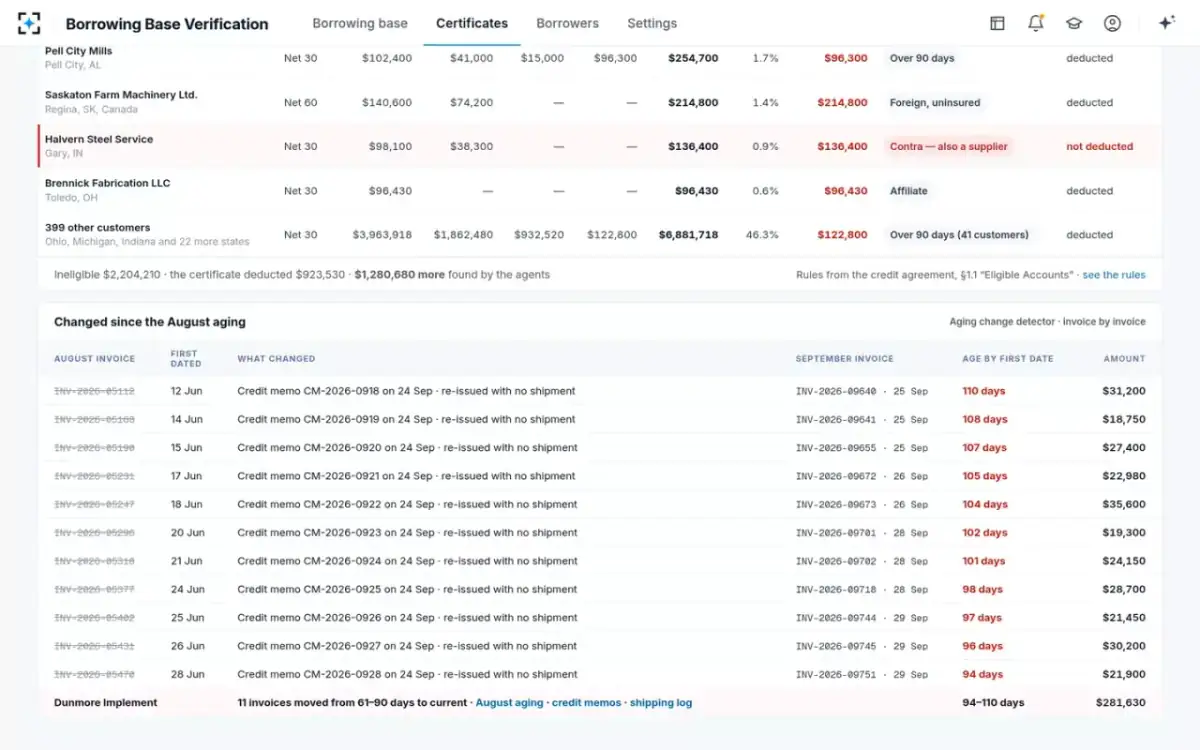
On Brennick Industrial Supply's certificate 41 — Botminds' fictional sample file — the same four tests ran and found a smaller-scale version of the second and fourth: eleven invoices cancelled by credit memo and re-issued days later with no new shipment, moving $281,630 from the 61–90 day column back to current. What the six agents behind that rebuild actually do walks through the mechanics; here the point is only that the test exists and ran automatically, on every certificate, not as a special investigation after something had already gone wrong.
What a field audit is supposed to catch, and how often it runs
Before any of this was software, it was a person's job. The OCC's handbook on accounts receivable and inventory financing is explicit about the risk a field examiner is sent to find: "A fraudulent borrower can submit falsified sales and collection documentation, use the same receivables as collateral to obtain financing from more than one lender, divert cash or collateral proceeds, misrepresent purchase orders, or overstate inventory levels". That sentence is close to a checklist of what happened at both Tricolor and First Brands. The same handbook calls fraud "a leading cause of loss in both secured lending and ABL" and names regular monitoring and timely field audits as the best available deterrent.
A field audit is thorough precisely because it is independent and on-site — it is also, by its nature, occasional. A certificate rebuild that runs every month cannot replace a field examiner walking a warehouse floor or calling a sample of customers to confirm an invoice is real. What it can do is flag, every month instead of every few, exactly the kind of pattern — an invoice re-dated with no shipment, a customer that never appears to have taken delivery — that turns a routine field exam into a targeted one.
How does an agent show evidence without accusing anyone?
Both 2026 cases are built on inferences a lender made in good faith from documents a borrower controlled. A certificate review that wants to be useful without becoming a second source of unfounded accusations has to separate what it can see from what it is willing to conclude. In Borrowing Base Verification, the agent that compares one month's aging with the last does exactly that: it reports that eleven invoices were cancelled by credit memo and reissued days later with no matching shipment, with the dates and documents cited, and stops there. It does not call the pattern fraud, and it does not name an intent. That conclusion, and the decision to call a field examiner, belongs to the collateral analyst and, where it matters, to counsel.
Evidence, not accusations: a re-dated invoice is listed with its proof for the analyst and the field examiner — not called fraud by the system that found it.
The governance rule built into Borrowing Base Verification
The distinction matters for a reason beyond fairness to a borrower who may have an innocent explanation. A system that names fraud on thin evidence trains the people reading it to stop checking the evidence themselves; a system that shows the dates, the credit memo and the missing shipment, and nothing more, keeps the human reviewer doing the one part of the job that cannot be delegated — deciding what a pattern actually means.
Eleven invoices, re-dated with no shipment behind them
Why "the certificate says so" is not evidence
Both Tricolor and First Brands produced certificates, servicing reports and financial statements that, read on their own terms, said the right things: loans current, invoices valid, collateral sufficient. That is the actual lesson of both cases for anyone reviewing a borrowing base: a certificate's own internal consistency is not evidence that it is true, because the same hand that wrote the ineligible deduction also wrote the figure it is supposed to be checking. A defensible file is one where every certified figure has been independently re-derived from a source document the borrower did not get to choose how to present — the general ledger, the lockbox statement, the shipping log, the appraisal — and where the comparison between this month and last month happens whether or not anyone thinks to ask for it.
A certificate taken at face value, against one tied to its sources
Taken at face value: Accepted as reported, carried forward certificate after certificate.
Tied to its sources, every month: Re-derived from payment history and the shipping or collection record behind it.
Taken at face value: Trusted as pledged to this facility alone, on the borrower's word.
Tied to its sources, every month: Tied to the general ledger and tested for the signs double-pledging leaves — timing, re-dating, unmatched shipments.
Taken at face value: Reviewed on its own; drift accumulates unseen.
Tied to its sources, every month: Compared invoice by invoice every month, so a changed date or a reissued balance is caught the month it happens.
Neither Tricolor nor First Brands is a Botminds customer, and nothing here claims to know what either company's internal review process actually looked like. What the public record does show is the shape of the gap a defensible file has to close: a figure that is independently re-derived, every month, from documents the borrower cannot simply restate. What that kind of review actually costs, against what it used to cost by hand, is where the arithmetic goes next; to see the agents that run these tests on one certificate, start from Borrowing Base Verification.
Questions people ask
What is double-pledging collateral?
Using the same asset — a receivable, an invoice or a loan — as security for more than one lender or investor pool at once, without either side knowing the collateral is shared. In cases charged in 2026, First Brands' founders are accused of double- and triple-pledging invoices to factoring partners, and Tricolor's former executives of putting loans already pledged to other lenders into securitization pools while reporting dead loans as current.
How did the Tricolor fraud work?
According to the SEC's complaint, executives pledged the same loans to more than one lender or securitization, and moved loans that should have been written off as uncollectible — "dead loans" internally — into an off-the-books entity and reported them to investors as current, counting them in collateral pools they should not have been eligible for. The complaint alleges this led to an approximately $800 million shortfall in the company's collateral base before its 2025 bankruptcy.
What happened in the First Brands fraud case?
Federal prosecutors and IRS Criminal Investigation charged First Brands' founders with routinely submitting fake and inflated invoices and double- and triple-pledging loan collateral to the financing partners that advanced cash against its receivables. At its 2025 bankruptcy, the company — which reported about $5 billion in annual sales — held just $12 million in cash against over $9 billion in liabilities.
Can the same receivable be pledged to two lenders?
Not legitimately, but it can be done, which is exactly the fraud both 2026 cases describe. Under UCC §9-322, if it happens, the lender whose security interest was filed or perfected first generally has priority over the later one — but that rule resolves a dispute after it surfaces; it does not stop the duplication or protect either lender's exposure while it goes unnoticed.
How do lenders catch fake or double-pledged collateral?
By independently re-deriving every certified figure from source documents the borrower does not control the presentation of: the general ledger, the lockbox, the shipping log, the inventory appraisal. Comparing this month's receivable aging with last month's, invoice by invoice, is specifically what catches an invoice that was re-dated or a balance kept artificially current — the pattern behind both the Tricolor and First Brands cases.
What makes a borrowing base certificate defensible?
That every line on it has been tied to an independent source — not just accepted as the borrower reported it — and that the tie-out happens every certificate, not only when something already looks wrong. A certificate that has never been checked against anything but its own arithmetic offers no evidence either way about whether the collateral behind it is real, shared with another lender, or current.