An ineligible receivable is one a credit agreement will not count toward a borrowing base, even though it sits on the aging like any other. There are nine reasons, by the regulator's own count, and all nine answer one question in different ways: will this money actually arrive, in full, on time, to a lender with an unclouded claim on it? A receivable that fails any one of the nine comes out, whatever its face value, because the certificate's job is to measure collateral a lender could actually collect, not revenue the borrower has already booked.
"The following are characteristics of receivables commonly designated as ineligible."
OCC Comptroller’s Handbook: Asset-Based Lending
Nine branches, one question: will this money actually arrive?
The OCC's handbook lists the nine characteristics it expects an examiner to look for in a borrowing base. Each has a different mechanism, but they sort into three families: some test whether the customer will pay at all (delinquent past the point collectability is in doubt, insolvent, affiliate, over concentration); some test whether the receivable is real and current yet (unbilled, re-aged); and some test whether a lender's claim on the money is clean (contra-accounts, foreign, government). A credit agreement writes its own version of each, inside a range the handbook itself describes, and a different document usually proves each one.
Nine reasons a receivable is excluded, and what each one needs to be tested
Delinquent past three times terms
Past due beyond three times the trade terms — 90 days on 30-day terms, 21 days on seven-day terms.
Already deducted by Brennick on certificate 41, as "over 90 days."
Over the concentration limit
A single customer’s share of the receivables book exceeds the facility’s own limit.
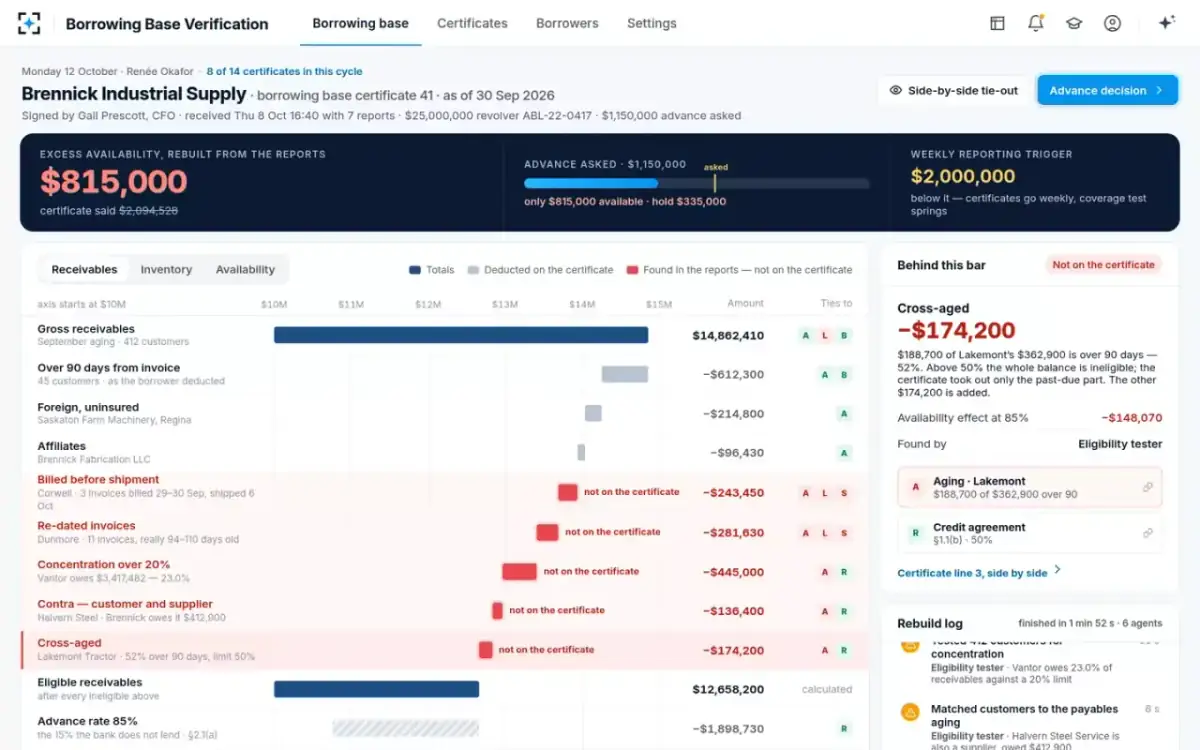
Vantor’s balance, $445,000, was over 20% of receivables and not on the certificate.
Affiliate receivables
A customer related to the borrower, whose financial condition can deteriorate with the borrower’s own.
Already deducted by Brennick on certificate 41.
Re-aged receivables
Delinquency hidden by a credit memo and a new invoice number, with no new shipment behind it.
Eleven Dunmore Implement invoices, $281,630, cancelled and re-issued with later dates.
Government receivables
Unique perfection and documentation requirements under federal assignment-of-claims rules.
Not present on this certificate; Brennick’s customer base is private industrial buyers.
Foreign receivables
Legal, pricing and country risk that can disrupt payment without a letter of credit or insurance behind it.
Already deducted by Brennick on certificate 41, as "foreign uninsured."
Contra-accounts
The customer is also a supplier, so it can net what it owes against what it is owed.
Halvern’s balance was removed as a contra account.
Insolvent customer
The receivable is owed by a customer already in insolvency proceedings.
Not present on this certificate.
Unbilled receivables
No invoice has actually been issued — a close cousin of billing before the goods ship.
Related: three Corwell invoices billed before shipment, $243,450, removed as ineligible.
Delinquent beyond three times normal terms
The oldest and plainest of the nine is simple delinquency. The OCC's handbook puts it in one line: "Normally, an account is considered ineligible collateral when it is past due by three times the terms, e.g., 90 days for 30-day terms and 21 days for seven-day terms." It adds that accounts delinquent to that extent and still in the borrowing base "should raise examiner concern." Past that point, the handbook treats the receivable as past the line, and an agreement that advances against it anyway is advancing against collateral the regulator itself would flag.
Cross-aged: when one customer's balance takes the rest with it
Cross-aging is a harsher rule than ordinary delinquency, because it does not stop at the late invoices; it takes the whole customer. The handbook's own glossary defines it this way: "Cross-aging: The practice of making all of the accounts receivable from a single account party ... ineligible to be included in the borrowing base if a specified proportion of the total accounts receivable from that party is delinquent." The logic is that a customer who is badly behind on some invoices is a credit risk on all of them, current ones included, because the same cash shortage that produced the late invoices threatens the current ones too. The same glossary adds that the rule is "sometimes referred to as the '10 percent rule' because 10 percent of an individual party's accounts is a common delinquency threshold," and the body of the handbook notes that "most underwriting agreements specify that all of a party's accounts are designated ineligible collateral when any (or some percentage) of that customer's receivables become ineligible."
On Brennick's certificate, $188,700 of Lakemont Tractor's $362,900 balance was over 90 days, 52% of the total. Brennick's credit agreement sets the cross-aging trigger at 50%, five times the 10% the OCC calls common; above it, the whole balance becomes ineligible, not just the delinquent part. The certificate as submitted had deducted only the $188,700 that was actually past due. The other $174,200, current on its face, came out too, because Lakemont crossed the line the agreement draws for the whole relationship, not invoice by invoice.
Cross-aged: the whole balance, not just the late part
Over the concentration limit
Concentration asks a different question: not whether one customer is paying late, but what happens if one large, perfectly current customer stops paying altogether. The handbook sets a range: "A bank normally considers receivables to be concentrated if there are single accounts representing 10 percent or more of the total receivables portfolio. A bank extending credit to a borrower with a concentrated customer base should limit concentrated accounts to no more than 10 percent to 20 percent of the receivables borrowing base." Brennick's agreement sets its concentration limit at 20%, the wide end of the handbook's own range rather than outside it, and Vantor's $445,000 balance crossed it — a current, undisputed customer, excluded purely because of its size relative to the rest of the book.
Affiliate, contra, and foreign receivables
Three more reasons share a theme: the customer relationship itself, not the invoice, is the problem. An affiliate receivable is owed by a company related to the borrower, whose finances can deteriorate on the same schedule as the borrower's own — useful collateral only if the affiliate's fortunes are genuinely independent, which related companies rarely are. A contra-account exists when a customer is also a supplier: the Accounts Receivable and Inventory Financing handbook's glossary explains why that is a problem for a lender's claim, not just an accounting curiosity — "They arise when a borrower has both accounts receivable and accounts payable with the same entity because the party is both a customer and a supplier of the borrower. These accounts are usually considered ineligible collateral." A customer who is owed money by the borrower can net it against what it owes, leaving the lender's claim on a receivable that may never actually be paid in full. On certificate 41, Halvern was both a customer and a supplier of Brennick, and its balance came out for exactly this reason.
Foreign receivables add country and currency risk a domestic facility was never priced for; an agreement that allows them at all usually does so only behind a letter of credit or export insurance. Brennick's certificate had already deducted its foreign uninsured balance, so no new difference came from this branch on this certificate — a reminder that some of the nine reasons are the ones a borrower reliably applies, and others are the ones a certificate is more likely to miss.
Re-aged invoices: delinquency hidden by a new date
A re-aged receivable is delinquency in disguise: the same debt, cancelled and reissued with a later date, so it reads as current when nothing about the underlying sale has changed. The handbook names it directly among the nine — "Re-aged receivables for which the probability of collection is reduced" — because a customer whose invoices need re-dating to stay current is, almost by definition, a customer whose probability of paying on time has already fallen. Eleven Dunmore Implement invoices, $281,630, were cancelled by credit memo on 24 September and reissued 25–29 September with no new shipment behind them; by their original dates they were 94 to 110 days old, not current. Catching a re-aged invoice needs a month-over-month aging comparison, not just this month's snapshot, which is why it is often the branch a certificate review misses.
What is cross-aging in asset-based lending?
Cross-aging is the rule that a sufficiently delinquent customer loses its entire receivable balance from the borrowing base, not only the invoices that are actually past due. A credit agreement sets the trigger as a share of that customer's own balance; the OCC's handbook says 10% "is a common delinquency threshold," which is why the rule is sometimes called the 10 percent rule. Once a customer's delinquent share crosses the trigger, the whole relationship is treated as a credit risk rather than only the late portion of it.
Unbilled, government, and insolvent-customer receivables
The remaining three reasons are the ones a well-run accounts-receivable process should rarely produce, which is partly why they draw less attention than concentration or cross-aging. An unbilled receivable has no invoice behind it yet — a close cousin of billing before the goods actually ship, which is what tripped up three of Corwell's invoices on certificate 41, recognized before the shipping log showed anything had left the dock. A government receivable carries its own perfection and documentation requirements under federal assignment-of-claims rules, which most commercial lenders are not set up to perfect against. And a receivable owed by a customer already in insolvency proceedings is, almost definitionally, money the court process controls rather than the customer itself — a claim in a proceeding, not cash a lender can expect on the usual terms.
What all three share is that they rarely surface in a certificate's own numbers; nothing about an unbilled or government receivable looks unusual on an aging report that only shows amount, customer and date. Catching them depends less on recalculating a formula than on asking a different kind of question of the same data: whether an invoice exists for every dollar claimed, whether any account party is a government body, and whether any customer has filed for bankruptcy protection since the last certificate — checks that sit beside the arithmetic rather than inside it.
Where credit agreements set their own line, inside the rule's range
None of the nine reasons comes with one number every agreement uses; the handbook gives a reference point for some, and each credit agreement sets its own figure for the specific borrower and facility. Brennick's agreement sets concentration at 20%, at the wide end of the handbook's 10–20% band, and cross-aging at 50%, well above the 10% the handbook calls a common threshold. A looser setting is not automatically wrong — it is a credit decision the bank made about this specific borrower — but it is not free: it leaves more delinquent and concentrated balances inside the borrowing base than the regulator's own reference point would.
What a looser setting does buy the borrower is headroom that a tighter one would not: at a 50% cross-aging trigger, Lakemont Tractor's 52% delinquent share crossed the line by two points, whereas the same balance under a 60% trigger would have stayed eligible, and under the handbook's common 10% threshold it would have come out long before. Neither number is wrong on its own; the question a lender should keep asking is whether the agreement's settings, taken together, still leave the borrowing base a true measure of collateral the lender could actually collect, or whether successive loosenings have quietly moved the certificate further from what the regulator's own description treats as the ordinary case.
Testing one customer against every reason, cross-aging included
- Delinquency
Any portion past three times normal terms, from the aging.
- Cross-aging
Share of the customer’s own balance that is delinquent, against the agreement’s trigger.
- Concentration
Customer’s balance as a share of total receivables, against the agreement’s limit.
- Affiliate
Is the customer related to the borrower by ownership or control?
- Contra-account
Does the borrower also buy from this same customer, from the payables aging?
- Foreign
Is the customer outside the country, and is a letter of credit or insurance in place?
- Re-aged
Compare this month’s aging with last month’s for the same invoice numbers and amounts.
- Government
Is the account party a government entity, with its own perfection requirements?
- Insolvent
Is the customer in bankruptcy or insolvency proceedings?
- Unbilled or pre-shipment
Does an invoice exist, and does the shipping log show the goods actually left?
Testing all nine, on every customer, is mechanical once the documents are in hand — which is also why a certificate prepared under time pressure is more likely to apply the three or four reasons that are top of mind and miss the rest. Fraud involving collateral a lender was never shown is not hypothetical: the IRS's criminal investigation into First Brands' executives describes a scheme in which, an FBI assistant director said, the defendants "inflated invoices, double- and triple- pledged collateral, and falsified financial statements to unlawfully trick lenders into giving them billions of dollars." Testing every customer against every reason, every certificate, is what keeps a borrowing base from resting on whichever rules the preparer happened to remember.
The eleven re-dated Dunmore invoices carry their own timeline and their own field-exam referral; that case study follows them day by day. To see all nine reasons tested on every customer, every certificate, start from Borrowing Base Verification.
Questions people ask
What makes a receivable ineligible in a borrowing base?
Nine conditions, by the OCC's own description: delinquency past three times normal terms, exceeding the concentration limit, being an affiliate receivable, being re-aged, being a government receivable, being a foreign receivable, being a contra-account, being owed by an insolvent customer, or being unbilled. A credit agreement sets the specific trigger for each, usually inside the range the regulator describes.
What is a contra account and why is it ineligible?
A contra-account exists when a customer is also a supplier to the borrower. The customer can set off what it owes the borrower against what the borrower owes it, so the lender's claim on the full invoice amount is not reliable; the regulator's own description calls such accounts usually considered ineligible collateral for that reason.
Are affiliate receivables eligible collateral?
Generally not. A receivable owed by a company related to the borrower is excluded because the affiliate's financial condition can deteriorate on the same schedule as the borrower's own, and affiliate relationships can also increase the potential for fraud in times of financial stress, in the regulator's own description.
What is the concentration limit on receivables?
The OCC describes 10% or more of total receivables from a single customer as a concentration, and suggests limiting concentrated accounts to no more than 10% to 20% of the receivables borrowing base. A specific credit agreement sets its own figure inside or near that range — Brennick's facility sets its limit at 20%.
Can foreign receivables be in a borrowing base?
Sometimes, with conditions. Foreign receivables carry legal, pricing and country risk that can disrupt payment, so an agreement that allows them eligible at all commonly requires a letter of credit or an insurance policy with minimal deductibles behind each one; without that protection, most agreements exclude them outright.