A borrowing base review starts with the collateral analyst, certificate after certificate, every month. At a mid-size asset-based lender that means: re-key a borrowing base certificate into a spreadsheet, tie the receivable aging to the general ledger control account, test eligibility customer by customer against the credit agreement, and only then hand a number to someone who can sign for it. Botminds' Borrowing Base Verification does the re-keying and tying out itself, in under two minutes, and this guide follows the four seats that carry one certificate from received to wired — the collateral analyst, the portfolio manager, loan operations, and the head of business credit — what each did before, and what each does now.
The seats below are Brennick Industrial Supply's certificate 41, as it runs through the solution: Renée Okafor, the collateral analyst; Martin Halloran, the portfolio manager who co-signs; Terrence Boyd, loan operations; and Nicole Hart, the head of business credit. Brennick, its people and its figures are fictional sample data in the product, used here to show how the work actually moves from one seat to the next.
Who touches a borrowing base certificate, end to end
Four seats, one certificate. The collateral analyst receives it with its seven supporting reports and either trusts it or rebuilds it. If the rebuild finds differences above the facility's tolerance, the portfolio manager reviews the bridge from the certified figure to the recalculated one and co-signs. Loan operations books the advance and wires it before the day's cut-off. None of this touches the head of business credit directly — her seat is the portfolio, not the file — but it is her budget that pays for the field exams this chain sometimes triggers, and her page that shows whether this borrower is one of many drifting the same way.
The same four seats, before Borrowing Base Verification and after
Today
“I spend a day proving the certificate and five minutes deciding the advance.” Fourteen borrowers, nine certificates in the first two weeks of every month.
With agents
Rebuilds each certificate from the borrower’s own reports in under two minutes, every difference tied to its line, and spends her thirty-eight minutes on the decision, not the re-keying.
Today
“Show me what moved availability and where it came from.” Co-signs advances when the differences are material and sets reserves.
With agents
Sees the bridge from the certified figure to the recalculated one, a step per difference, and co-signs on his phone within minutes of Renée’s approval.
Today
“Give me a signed number by one.” Books the advance and wires it before the 2 pm cut-off, often chasing a second signature to get there.
With agents
Gets a booked advance with both signatures already on the file, well before the cut-off, with nothing left to chase.
Today
Owns the portfolio, the field exam budget and the audit findings — and sees each borrower’s collateral tested on a sample, a few times a year.
With agents
Sees every borrower’s certified and recalculated availability month by month, with dilution, certificate history and field exams, on one page.
Reading the four cards in order is reading the certificate's own path: analyst, then — only when the differences are material — portfolio manager, then loan operations, with the head of business credit watching the whole book rather than any one file. The order rarely changes; what changes is how long each stop takes and how much of it is arithmetic versus judgment.
The collateral analyst: tying out, not re-keying
Renée's month is nine certificates in the first two weeks, across fourteen borrowers. For each one she used to open the certificate as a spreadsheet, re-type the receivable aging total, the ineligible deductions, the inventory figure and the loan balance, and tie each to its source document by hand: the general ledger control account for gross receivables, the lockbox statement for collections, the perpetual inventory report and its appraisal for stock, the loan system for the balance and letters of credit. A single wrong keystroke in a formula could overstate availability by hundreds of thousands of dollars and nobody would know until a field exam, months later, found it.
With the rebuild, she clicks one button and six specialist agents do the re-keying and the tying out: they tie the aging to the general ledger, roll receivables forward against the lockbox, test eligibility customer by customer against the credit agreement, compare this month's aging with last month's invoice by invoice, tie inventory to its appraisal, and recalculate availability. What is left for Renée is the part that was always hers — deciding whether a difference means fund less, ask a question, or order a field exam. She can ask the system directly why a figure moved, and the answer cites the credit memo or the aging line it rests on rather than asserting a conclusion. Tying out stopped being her job; deciding what the tie-out means still is.
The portfolio manager: the second signature that matters
Martin's seat exists because one signature is not always enough. In Botminds' sample facility, a collateral analyst can approve alone up to $500,000, as long as the certificate is within tolerance. Above $250,000 of differences between the certified and recalculated figures, Martin co-signs; an advance above recalculated availability — an over-advance — needs the credit officer as well. These thresholds are settings on the facility, not fixed rules, and a bank can tighten or loosen them inside the range its own credit policy allows.
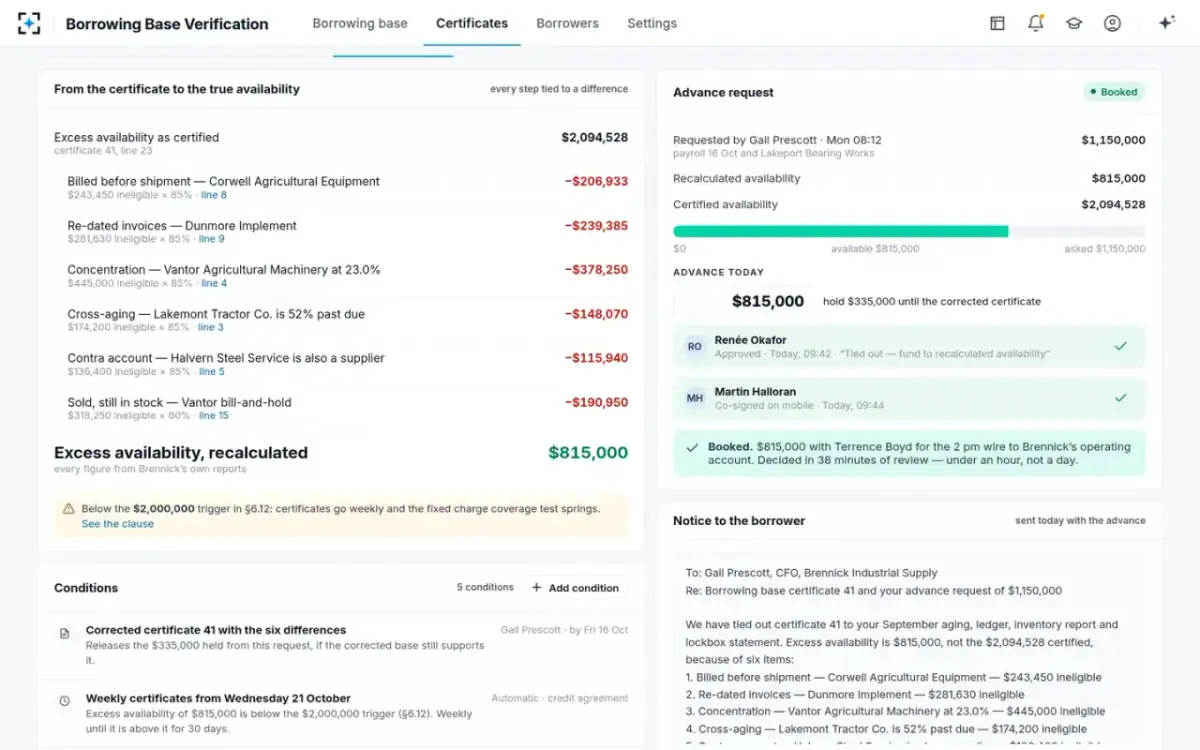
What changed for Martin is what he is looking at when he opens the request. Before, he saw a number and had to ask where it came from. Now he sees the bridge: the certified figure, each of the six differences that moved it, and the figure it lands on, with the document behind every line one click away. On certificate 41, that meant seeing cross-aging, a re-dated-invoice finding and four other differences laid out before he co-signed — not a round number with a note attached. He still decides; he decides faster, and on more evidence.
Loan operations: booking and wiring before the cutoff
Terrence's job has one clock: the wire has to go out before the day's cut-off, 2 pm in Brennick's case. Before, that often meant booking against a certificate that only had one signature, then chasing the second while the clock ran, or holding the wire a day. After, the file that reaches him already carries both signatures, because the analyst and the portfolio manager worked from the same recalculated figure instead of a round of phone calls to reconcile their own numbers. His part of the job did not get smaller; it got free of waiting on everyone upstream of him.
The head of business credit: the portfolio, not the file
Nicole never opens certificate 41 the way Renée does. Her page shows every borrower's certified and recalculated availability, month by month, next to dilution, the certificate history and a timeline of field exams, appraisals and amendments. Before the rebuild, her view of collateral quality came from a sample — the handful of borrowers a field exam reached that quarter — and a quarter is a long time for a borrower's collateral to drift unnoticed. After, every certificate from every borrower is tested the same way every month, so a borrower whose certified and recalculated figures have been quietly pulling apart for a year shows up on her page before the next scheduled field exam would have found it.
That does not retire the field exam. It changes what it is for: instead of being the only check most borrowers get, it becomes the targeted follow-up Renée can request the moment the monthly rebuild finds something worth a closer look on site — invoices, a customer relationship, inventory that a desk review cannot confirm on its own.
What does a collateral analyst do all month?
Across fourteen borrowers and nine certificates in two weeks, a collateral analyst's month is really the same five steps repeated: receive the certificate and its reports, tie the numbers to their sources, test eligibility, compare with last month, and decide. Done by hand, each pass takes most of a working day, and the five steps compete for the same hours every certificate — which is why the busiest two weeks of the month are also the ones where a shortcut is most tempting and most dangerous. The rebuild does not change the five steps; it removes the four of them that are pure arithmetic and leaves the one that was always the actual job: deciding what a certificate's differences mean for this month's advance.
One certificate, four seats, two minutes for the agents and thirty-eight for the person who decides
A person decides
Renée Okafor · Collateral analystRebuilds certificate 41 from Brennick's own reports in 1:52, ties out six differences, and reviews the bridge from $2,094,528 certified to $815,000 recalculated — about 38 minutes in total.
A person decides
Martin Halloran · Portfolio managerCo-signs because the differences exceed $250,000, about two minutes after Renée approves, usually from his phone.
A person decides
Terrence Boyd · Loan operationsBooks the advance and wires it before the 2 pm cut-off, with both signatures already on the file when it reaches him.
A person decides
Nicole Hart · Head of Business CreditSees certified and recalculated availability for every borrower every month, not just this certificate — the portfolio she is paid to watch, not the one file.
Why banks keep dedicated field-audit staff
Even with every certificate rebuilt monthly, regulators expect asset-based lenders to keep people whose job is to go and look. The OCC's handbook on accounts receivable and inventory financing is direct about it: "ABL units should have dedicated field audit staffs that include certified public accountants". Its companion handbook on asset-based lending puts the same expectation in its own words: "An ABL unit should have dedicated field audit staff that includes skilled accountants". Neither version leaves field audit as a task anyone on the desk can pick up between certificates — it calls for people trained to test a borrower's books on site.
The reason is fraud, not just error. "Fraud is a leading cause of loss in both secured lending and ABL," the same OCC handbook notes, and regular monitoring plus timely field audits are what it names as the best deterrent. A monthly rebuild from a borrower's own reports and a periodic, independent look at the borrower's premises and records answer different questions: the rebuild proves the certificate's arithmetic against the reports submitted; the field exam checks whether those reports themselves are honest. A desk that has automated the first still needs people equipped for the second — which is exactly why Renée's seat, on certificate 41, ends with a request for a targeted field exam, not a decision that makes one unnecessary.
What changes in each seat when the tie-out takes two minutes
The clearest way to see what changed is to look at where the hours went before, and where they go now. On one certificate with its supporting reports, re-keying, tying the aging to the general ledger and the lockbox, testing eligibility, comparing agings and checking inventory used to account for almost the whole day. What is left once agents do that work in under two minutes is the one step that was never arithmetic in the first place.
A certificate's day, before and after: everything but the decision goes to zero
By hand, about a day
- Re-keying and checking arithmetic · 10%
- Tying the aging to the general ledger and lockbox · 30%
- Testing eligibility, customer by customer · 30%
- Comparing with last month's aging · 10%
- Inventory, appraisal and stock on hand · 10%
- Deciding, signatures and the borrower notice · 10%
With the rebuild, about 38 minutes
- Deciding, signatures and the borrower notice · 100%
That single bar on the right is the argument in one picture. Nothing about the decision itself got easier — the rebuild still finds cross-aged customers, re-dated invoices and inventory that no longer matches the appraisal, and someone still has to weigh what each one means for this advance. What disappeared is the re-keying and tying out that used to stand between the certificate landing on a desk and that decision getting made. For the portfolio manager and loan operations, the effect shows up as the file reaching them already resolved rather than half-argued; for the head of business credit, it shows up as a portfolio tested every month instead of a sample tested a few times a year.
Both signatures, before the wire
A seat-by-seat view like this one only goes so far without seeing what moved the number in the first place; the six agents behind the rebuild, and what none of them may ever do, picks up from here. To see the certificate itself move through all four seats, start from Borrowing Base Verification.
Questions people ask
What is the difference between a collateral analyst and a credit analyst?
A credit analyst underwrites the loan at origination and renewal — the borrower's financial statements, projections and the structure of the facility. A collateral analyst's job starts once the facility is in place: proving, certificate by certificate, that the collateral actually backing today's advance is what the borrower says it is. The two seats often sit in the same credit team and share a borrower, but one asks whether to lend; the other asks whether this month's number is real.
Who signs off on a borrowing base advance?
It depends on the size of the differences the rebuild finds. In Botminds' sample facility, the collateral analyst can approve alone up to $500,000 of advance within the certificate's tolerance. Above $250,000 of differences between the certified and recalculated figures, the portfolio manager co-signs, and an advance above recalculated availability needs the credit officer as well. These limits are settings on the facility, not a fixed industry rule.
What does a portfolio manager check before co-signing an advance?
The bridge from the certificate's own figure to the recalculated one, a step per difference, with the document behind each step — the general ledger line, the aging entry, the credit agreement clause. A portfolio manager co-signing on evidence is reviewing exactly what the analyst found, not a summary of it, and can set a reserve on a difference that is real but not yet urgent.
Who books and wires a loan advance?
Loan operations, once every required signature is on the file. On a facility with a same-day cut-off, that seat's whole job is getting a fully signed advance wired before the deadline — which is why a file that already carries both signatures when it reaches loan operations saves the hours that used to go into chasing the second one.
What does a head of business credit do?
Owns the portfolio rather than any one file: the field exam budget, the audit findings, and the question of which borrowers' collateral is drifting away from what they certify. That seat's view is monthly and across every borrower, which is the opposite of a field exam's view — thorough, but on a sample, a few times a year.