AI agents for asset-based lending are not one model doing one job; in a working borrowing base rebuild they are six specialists, each with a narrow task and a stated limit on what it may never do. Botminds' Borrowing Base Verification splits the work this way on purpose: a certificate reader, an aging and general ledger tie-out, an eligibility tester, an aging-change detector, an inventory checker and an availability recommender, each doing one part of what a careful collateral analyst already does by hand, and each fenced off from the parts of the job that stay with a person. This guide walks through all six, what each one is forbidden from doing, and why the fences, not the automation, are the part worth understanding before trusting any of it.
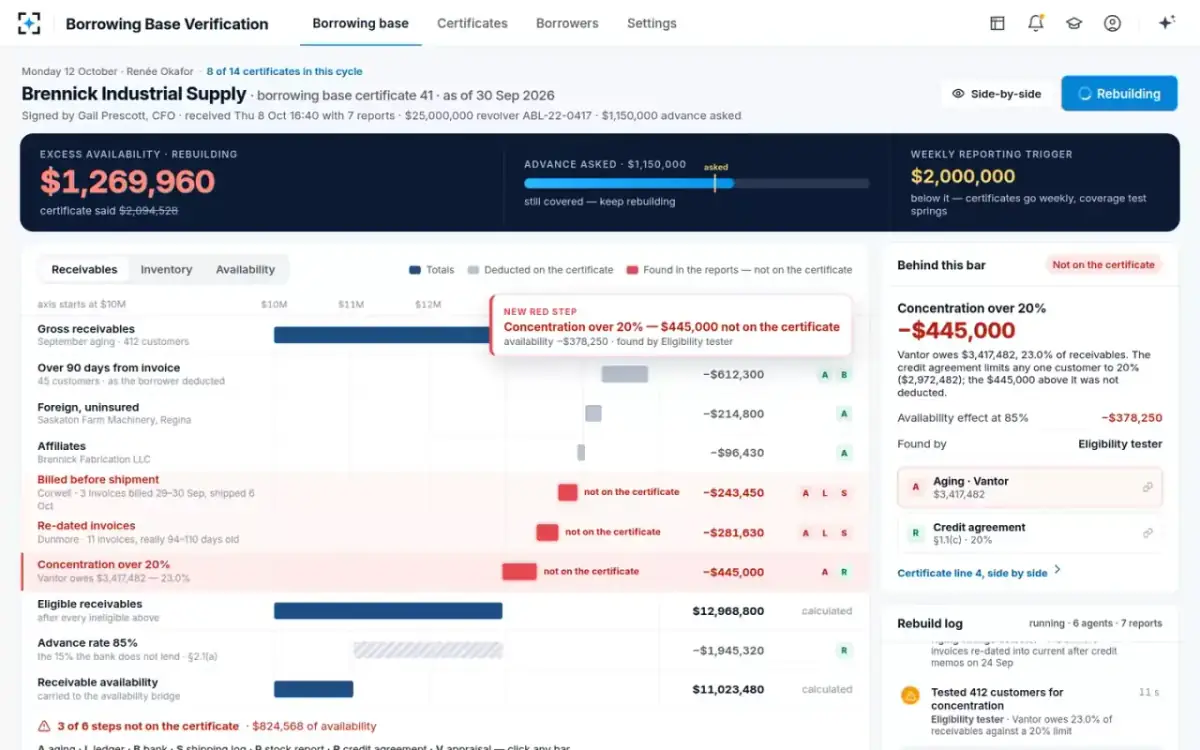
The example below is Brennick Industrial Supply's certificate 41, as it runs through the solution: a $1,150,000 advance requested against a certificate that turned out to overstate availability by $1,279,528. Brennick, its people and its figures are fictional sample data in the product, used here to show what each agent actually finds and what it leaves for a person to decide.
Six agents, one certificate, under two minutes
The rebuild runs as one pass through six roles, each reading a different part of Brennick's seven reports. The certificate reader opens with the certificate itself: its arithmetic, its signer, and the loan balance against the loan system. From there the aging and general ledger tie-out, the eligibility tester, the aging change detector and the inventory checker each work a different document — the trial balance, the credit agreement, last month's aging, the perpetual stock report — and the availability recommender pulls every finding into one recalculated figure. On certificate 41 the whole pass took 1 minute 52 seconds across 412 customers and 3,906 invoices.
Six agents, six limits, and the person who decides
Agent
Certificate readerReads the certificate as submitted — PDF, spreadsheet or portal form — checks its arithmetic and the signer, and checks the loan balance and letters of credit against the loan system.
Never: Never alters a certified figure
Agent
Aging and general ledger tie-outTies the receivable aging to the general ledger control account, rolls receivables forward, and ties collections to the lockbox and bank statements.
Never: Never accepts a difference without the line that causes it
Agent
Eligibility testerApplies the credit agreement's eligibility rules customer by customer and invoice by invoice: over 90 days, cross-aging, concentration, contra accounts, foreign, affiliates, billed before shipment.
Never: Never changes a rule or an advance rate — tests every customer, not a sample
Agent
Aging change detectorCompares this month's aging with last month's, invoice by invoice — re-dated invoices, credit-and-rebill, new large customers.
Never: Never calls anything fraud — shows the evidence to a person
Agent
Inventory checkerTies the perpetual report to the general ledger by location, applies the inventory ineligibles and the appraisal, and matches invoiced orders to stock still on hand.
Never: Never values inventory itself — it uses the appraisal
Agent
Availability recommenderRecalculates availability, sizes the advance, flags the credit agreement's triggers, and drafts the notice to the borrower.
Never: Never approves or moves money, never advances above recalculated availability
A person decides
Renée Okafor · Collateral analystReviews the bridge from certified to recalculated availability and decides what each difference means for this advance.
The certificate reader: arithmetic and the signer, never the figures
Before anything is recalculated, something has to confirm what was actually submitted. The certificate reader reads the certificate as Brennick sent it — a PDF, a spreadsheet, or a form filled in the borrower portal — checks that its own arithmetic adds up, confirms who signed it, and checks the loan balance and any letters of credit it references against the loan system's own records. It cites the line and cell for every value it reads, so a later disagreement points back to a specific place on the page rather than to the agent's word for it. What it never does is change a certified figure: Brennick's $14,862,410 of gross receivables and $2,094,528 of certified excess availability stay exactly as submitted, visible next to whatever the rebuild finds underneath them.
The aging and general ledger tie-out: a difference always needs its line
Every borrowing base starts from the receivable aging, and every aging has to agree with the books behind it. This agent ties the aging total to the general ledger's accounts-receivable control account, rolls receivables forward against the period's activity, and ties collections to the lockbox and bank statements — including a check for customer payments that never passed through the lockbox at all, which is one of the oldest ways cash gets diverted around a lender's control. On certificate 41 it found the aging running $243,450 above the general ledger, a gap that turned out to be three Corwell Agricultural Equipment invoices dated before month-end but shipped six days into the next month.
The rule behind this agent is as strict as the certificate reader's: it never accepts a difference without the line that causes it. A number that does not tie is not quietly adjusted or averaged away; it is reported with the general ledger account, the invoice and the shipping record that explain it, so the analyst is deciding from the same evidence a field examiner would ask for.
The eligibility tester: every customer, never a sample
Eligibility is where a credit agreement's own rules do the most work, and where a hand review is most likely to cut corners under time pressure. This agent applies the facility's eligibility rules — delinquency past three times normal terms, cross-aging, concentration limits, contra accounts, foreign and affiliate balances, billing before shipment — to every customer and every invoice, not a sample large enough to feel representative. On the sample certificate that means testing 412 customers and 3,906 invoices the same way, every month, which is the only way a rule like cross-aging (one customer's delinquency taking out their whole balance) is caught reliably rather than by chance.
What this agent may never do is write its own rules. Advance rates and eligibility thresholds come from the credit agreement, entered as settings and versioned on the audit trail; the eligibility tester applies them, it does not set them, and a bank that tightens cross-aging from 50% to 35% sees every future certificate tested against the new number from the day it is saved, not from whenever someone remembers to update a spreadsheet formula.
The aging change detector: evidence, never an accusation
Some differences only show up by comparing two months side by side. This agent reads this month's aging against last month's, invoice by invoice, looking for the patterns a single snapshot cannot reveal: invoices re-dated with no new shipment behind them, a credit-and-rebill that moves the same balance to a fresher date, or a large new customer appearing with no history to judge. On certificate 41 it found eleven Dunmore Implement invoices, cancelled by credit memo and re-issued days later for the same amount with no matching shipment — by their original dates, 94 to 110 days old rather than current.
Asset-based lenders live with this risk because the OCC names it directly: "A fraudulent borrower can submit falsified sales and collection documentation, use the same receivables as collateral to obtain financing from more than one lender, divert cash or collateral proceeds, misrepresent purchase orders, or overstate inventory levels". Re-dating an invoice is one version of the first of those. The agent's own limit matters as much as its finding: it never calls anything fraud. It shows the evidence — the original dates, the credit memo, the absence of a shipment — and leaves the conclusion, and any call to a field examiner, to a person.
The inventory checker: uses the appraisal, never values stock itself
Inventory collateral depends on two things a lender rarely controls directly: what stock actually exists, and what it is worth. This agent ties the perpetual inventory report to the general ledger by location, applies the facility's inventory ineligibles, and matches invoiced orders against stock still physically on hand — catching, for instance, goods already sold to a customer on bill-and-hold terms that are still sitting on the warehouse report as available collateral. On the sample certificate it found exactly this: inventory already sold but not yet shipped, still counted as eligible stock.
Its limit is specific and deliberate: it never values inventory itself. Valuation is the appraiser's job, done independently and on its own schedule; the agent applies that appraised value and the facility's advance rate against it, and flags where the perpetual report and the physical reality of stock on hand have drifted apart. An agent that both found the inventory and set its own price for it would be grading its own homework, which is exactly the independence a lender's rules are built to avoid.
The availability recommender: sizes the advance, never approves it
Once the other five agents have each done their part, something has to assemble the result into one number a person can act on. The availability recommender carries both waterfalls — certified and recalculated — through the facility's own structure: the inventory and receivable sub-limits, any reserve such as a lease on a warehouse, the revolver and outstanding letters of credit. On certificate 41 that recalculation turned $2,094,528 of certified excess availability into $815,000, and the agent also checked which of the credit agreement's triggers that smaller number springs — in this case, weekly certificates and a fixed charge coverage test that still passed at 1.12x against a 1.00x minimum.
What the certificate certified against what six agents recalculated
Certified by the borrower: $14,862,410, tying to the aging as submitted.
Recalculated by the agents: Aging runs $243,450 above the general ledger control account — three invoices shipped after month-end.
Certified by the borrower: Three deductions: over 90 days, foreign uninsured, affiliates.
Recalculated by the agents: Adds cross-aging, concentration and billed-before-shipment — $1,088,578 more taken out at an 85% advance rate.
Certified by the borrower: Not tested month over month on the certificate itself.
Recalculated by the agents: Eleven re-dated invoices found, $281,630, by comparing this aging with last month's.
Certified by the borrower: Perpetual report taken as submitted.
Recalculated by the agents: $190,950 taken out at a 60% advance rate for goods already sold but still on the report.
Certified by the borrower: $2,094,528, enough to cover the $1,150,000 asked.
Recalculated by the agents: $815,000 — the advance is capped there, and $335,000 of the request is held.
The $1,279,528 gap is not one number but six findings, each from a named agent, and each sized at the advance rate that applies to it. The arithmetic is worth following once, because it is the bridge the analyst actually signs against.
Certificate 41's $1,279,528 gap, finding by finding
| Finding | Agent | Collateral removed | Availability effect |
|---|---|---|---|
| Corwell: three invoices billed before shipment | Aging and general ledger tie-out | $243,450 | at 85% |
| Dunmore: eleven re-dated invoices, 94–110 days old by original date | Aging change detector | $281,630 | at 85% |
| Vantor: balance above the 20% concentration limit | Eligibility tester | $445,000 | at 85% |
| Lakemont: cross-aged, 52% over 90 days, whole balance out | Eligibility tester | $174,200 | at 85% |
| Halvern: contra account against payables | Eligibility tester | $136,400 | at 85% |
| Receivables subtotal | $1,280,680 | $1,088,578 | |
| Vantor: goods sold on bill-and-hold, still on the Toledo report | Inventory checker | $318,250 | $190,950 at 60% |
| Total availability the certificate overstated | Availability recommender | $1,279,528 |
What can't an AI agent do in asset-based lending?
Laid side by side, the six limits are really three rules repeated in different words. No agent changes a borrower's certified figure, a credit agreement's rule, or an advance rate — those stay exactly as submitted or set, with every finding shown next to them rather than over them. No agent approves money moving: the availability recommender sizes an advance and lists its conditions, but the collateral analyst approves with a signature that records what the approval means, and a second signature joins in above a stated materiality. And no agent accuses a borrower of anything: evidence of a re-dated invoice or a bill-and-hold shipment is shown with its source, and the word "fraud" is a person's conclusion, never the agent's.
One rebuild, three limits that never move
0
certified figures an agent may change
0
advances an agent may approve or move money on
0
times an agent calls a finding fraud
The rebuild log, agent by agent
Why separating the roles was already a regulatory expectation
Splitting the work into six narrow roles is not a new idea borrowed from software design; it is close to what examiners already expect of a human collateral desk. The OCC's own guidance on internal controls states it plainly: "The employees responsible for receiving and releasing collateral to borrowers are not those responsible for making entries in the collateral register" — separation of duties, long before any of it was automated. Asset-based lending leans on this kind of structural check more than cash-flow lending does, because, as Ivashina and Vallee put it in an NBER working paper on credit agreements, "Asset Based Lending ('ABL') ... uses few covenants": they compare it to a car loan, where "the lending process relies primarily on the value of the collateral," and call ABL "the corporate equivalent of this type of loan." When the thing actually securing the loan is the collateral, the integrity of the process that verifies it carries more of the weight.
The SEC's own account of the Tricolor collapse shows what happens when that separation breaks down rather than when it holds: executives were charged with "manipulating various loan metrics to make non-paying or defaulted loans appear current and therefore eligible for inclusion in the securitization pools". Six narrow agents, each unable to touch another's job and none of them able to approve anything, is one way to make that kind of manipulation harder to hide inside a single person's — or a single model's — discretion. What made that case, and a second one the same year, catchable follows the mechanism in full.
None of the six agents replace the people around certificate 41 — Renée still decides, Martin still co-signs the material differences, and a field examiner still goes and looks when the evidence calls for it. What changes for each of those seats is where the rest of this series picks up; to see the six agents run on a certificate, start from Borrowing Base Verification.
Questions people ask
How does AI check a borrowing base certificate?
By rebuilding it from the borrower's own supporting reports rather than trusting the certificate's own arithmetic: tying the receivable aging to the general ledger and the lockbox, testing eligibility on every customer, comparing this month's aging with last month's, checking inventory against its appraisal, and recalculating availability from all of it. Each step is done by a specialist agent, and the certified and recalculated figures are shown side by side.
Can an AI approve a loan advance?
No. The availability recommender sizes the advance and lists the conditions attached to it, but approval belongs to a person — the collateral analyst, with a second signature from the portfolio manager above a stated level of differences, and the credit officer for an advance above recalculated availability. No agent in the rebuild moves money or finalizes an approval.
What can't an AI agent do in asset-based lending?
It cannot change a certified figure, change an eligibility rule or advance rate, approve an advance, or call a finding fraud. Every one of those stays with a person: the borrower's own certificate, the credit agreement as written, the signature that approves, and the judgment that a pattern of evidence means something more than a pattern of evidence.
Does the AI call anything fraud?
No. The aging change detector, which is the agent most likely to find something that looks deliberate — a re-dated invoice, a cancelled and reissued balance — is built specifically never to label it. It shows the dates, the credit memo and the missing shipment, and leaves the conclusion, and any decision to call in a field examiner, to the analyst.
Who changes the eligibility rules?
The bank, through the credit agreement for that facility. Advance rates, cross-aging and concentration thresholds, and which categories of receivable are ineligible are entered as settings tied to the agreement and its amendments, versioned so every change is on the audit trail. The eligibility tester applies whatever is set; it does not decide what the rules should be.
Can AI replace a field exam?
No, and it is not built to try. A monthly rebuild proves the certificate's arithmetic against the borrower's own reports; a field exam is an independent, on-site look at whether those reports themselves are honest. The rebuild is more likely to make field exams better targeted — certificate 41's re-dated invoices led directly to a request for one — rather than to remove the need for them.