Borrowing base software — the asset-based lending software that checks a borrower's certificate against the reports behind it — should be piloted on certificates a lender has already signed and already lived with, not trusted first on next month's live advance. Replaying last month's certificates against a new system shows what it would have found before anyone has to decide whether to believe it on a borrower that has not been reviewed yet. This guide sets out what a lender should bring to a pilot of Botminds' Borrowing Base Verification, the pass/fail bar worth agreeing on before the pilot starts rather than after, and how the certificates it replays were chosen.
Where this page draws on a specific file, it is Brennick Industrial Supply's certificate 41, Botminds' fictional sample borrower — used here as a stand-in for the kind of file a lender would actually bring to its own pilot.
Replay before you rely: starting on certificates you already signed
The lowest-risk way to test any certificate-reviewing software is to give it work whose right answer you already know. A certificate from two or three months ago has already been approved, booked and, in most cases, lived with long enough that any problem with it would have surfaced. Running that certificate and its original supporting reports through a new system answers a narrower, safer question than "should we trust this on our next advance": does it reach the same recalculated figure a careful hand review would, and does it find the same differences — or better ones — than the analyst did at the time?
The same logic sets the order of everything else in a pilot. A replay tests the arithmetic against an answer the lender already holds; a certificate with a known past problem tests whether the rules catch what they are meant to; and only a run beside the team on a live certificate tests the whole loop, from the reports arriving to a signed advance. Each step earns the next.
What to bring to a pilot: seven reports, not seven weeks
A pilot does not need a new integration project before it can start. It needs the same documents an analyst already collects every month: the certificate itself, the receivable and payables agings, the general ledger trial balance, the bank and lockbox statements, the inventory report with its appraisal and shipping log, and the credit agreement that sets the eligibility rules and advance rates. A lender that can hand over a sample of three to six months of these, for two or three representative borrowers, has everything a meaningful pilot needs.
The seven things to bring to a borrowing base software pilot
- Three to six months of certificates
Already approved and booked, so the right answer is already known.
- The receivable and payables agings behind each one
This month's and the prior month's, so an aging-change comparison has something to compare against.
- The general ledger trial balance
The accounts-receivable control account and the roll-forward, for the tie-out.
- Bank and lockbox statements
To confirm collections actually arrived where the certificate says they did.
- The inventory report, appraisal and shipping log
For any borrower whose base includes inventory as collateral.
- The credit agreement and its amendments
The actual eligibility rules and advance rates a rebuild has to apply — not a generic default.
- A borrower or two with a known issue in their history
A past cross-aging finding, a re-dated invoice, a concentration breach — so the pilot has something specific to look for.
The pass/fail bar: what must hold before it runs beside your team
Agreeing on what "pass" means before the pilot starts is the single most useful thing a buyer can do, because it is the question most likely to get argued about after the fact if it is left vague. A workable bar has a small number of concrete, checkable conditions rather than a general sense of whether the output "looks right."
A pass/fail bar worth agreeing before the pilot starts
| Condition | How to check it | Why it belongs on the list |
|---|---|---|
| Recalculated availability matches the hand-reviewed figure, within tolerance | Compare against the certificate as it was actually approved at the time | The core promise of the rebuild; if this fails, nothing else matters |
| Every known historical finding is reproduced | Replay a certificate with a documented past issue — a cross-aging breach, a re-dated invoice | Proves the eligibility and aging-change logic actually works on a real case, not a clean one |
| No certified figure is silently changed | Confirm the certificate as submitted is shown unchanged, differences shown beside it | Matches the governance a credit team already expects of a human reviewer |
| Every difference cites its source document and line | Open the citation behind three or four findings and confirm it points to the actual report | A finding with no traceable source is not evidence a field examiner or an auditor can use |
| No step requires an approval the system is not supposed to make | Confirm every advance still needs the analyst's and, where material, the portfolio manager's signature | The agents recommend; a person still has to decide and sign |
Week by week: from past certificates to your next live advance
A pilot that starts on history and only later touches a live advance can run in a few weeks rather than a quarter, because the slow part — collecting and formatting data — is replaced by handing over documents a lender's own analysts already produce every month.
A four-week pilot, from replayed certificates to one live advance
- Week 1: gather certificates and reportsWeek 1
- Week 2: replay 3–6 months, compare to the known resultWeek 2
- Week 3: review disagreements, agree the pass/fail barWeek 3
- Week 4: run it beside the team on one live certificateWeek 4
What a pilot should never be allowed to skip
Two steps are easy to compress under time pressure and expensive to skip. The first is testing on a borrower with a known, documented past problem — a cross-aged customer, a concentration breach, an invoice that was re-dated — rather than only on clean certificates, because a system that performs well on files with nothing wrong proves very little. The second is opening the actual citation behind a handful of findings, not just reading the summary number, because a recalculated figure with no traceable source is exactly the kind of unverifiable output a lender is trying to move away from.
What a pilot has to prove, in order
Agent
Replay historyRuns 3–6 months of already-approved certificates and compares the recalculated figure to the known result.
Agent
Reproduce known findingsRuns a certificate with a documented past issue and confirms the same finding, with its evidence, comes back.
A person decides
The credit teamOpens the citation behind several findings, confirms nothing certified was silently changed, and agrees the pass/fail bar before going further.
Agent
Run beside the teamRuns on one live certificate alongside the analyst's own hand review, not instead of it, for at least one cycle.
How do you test borrowing base software before buying it?
Start with certificates already approved, not with the next live advance. Replay three to six months of a lender's own certificates and their supporting reports, check the recalculated availability against the figure that was actually booked at the time, and specifically test at least one certificate with a documented past issue rather than only clean files. Only once that history checks out should the system run alongside — never instead of — the analyst's own review on a live certificate, for at least one full cycle before either side relies on it alone.
Reading disagreements: some are the old file's errors
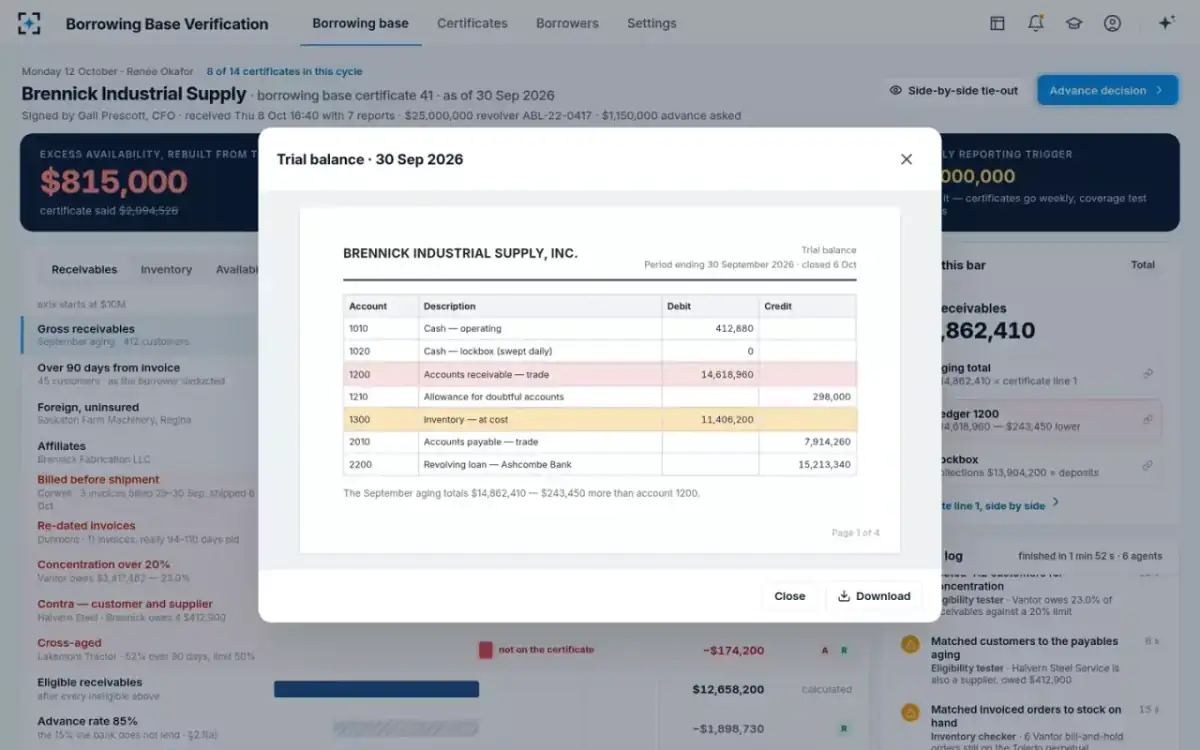
A pilot will sometimes show a recalculated figure that does not match what was originally booked, and the instinct is to treat every mismatch as a bug in the new system. Some of them are not. A hand-reviewed certificate from several months ago can carry its own undiscovered error — exactly the kind of difference an independent rebuild is built to surface. The useful response is not to assume either side is right; it is to open the citation the system gives for the disagreement and check it against the actual source document, the same way a field examiner would. On the sample certificate 41, the aging-to-general-ledger tie-out found a $243,450 gap that traced to three invoices dated before month-end but shipped six days later — a real cut-off problem in the borrower's own reporting, not a software error, and exactly the kind of disagreement a pilot should resolve by opening the shipping log.
A disagreement between a pilot's recalculation and the original certificate
Assume the software is wrong: Flag it as a defect and move on.
Check the citation first: Open the source document the finding cites — the general ledger line, the invoice, the shipping log.
Assume the software is wrong: Unclear without checking.
Check the citation first: Sometimes the original certificate's own undetected error, timing difference, or a rule applied inconsistently by hand.
Assume the software is wrong: Nothing, if the disagreement is never resolved.
Check the citation first: Whether the system's citations are real and checkable — the actual thing being piloted.
Behind one bar in the waterfall: the general ledger, opened
What bank guidance asks of a pilot like this
A pilot is also the evidence a bank's own risk functions will ask for, because borrowing base software is both a vendor relationship and, in parts, a model. The banking agencies' 2023 guidance on third-party relationships says that "conducting due diligence on third parties before selecting and entering into third-party relationships is an important part of sound risk management," and it applies to software vendors as much as to lending partners. Among the contract terms it suggests where bank data is involved are provisions that "provide for the timely return or destruction of the banking organization's data, information, and other resources" — the clause to settle before a pilot vendor receives a quarter of borrower agings.
Where the software scores or estimates anything, the agencies' April 2026 model risk guidance adds its own expectation for bought models: "sound practice includes developing an understanding of the vendor model, including its conceptual soundness, design, development data, and performance," and "conducting ongoing monitoring and outcome analysis to assess whether vendor models are accurate, remain fit for purpose, and continue to be reliable" (SR 26-2). Much of a borrowing base rebuild is arithmetic under the credit agreement's own rules, which the guidance treats as outside the definition of a model; the parts that judge — matching a reissued invoice to the one it replaced, for instance — are where a pilot's replay is the outcome analysis the guidance describes.
What a pilot produces, and which reviewer at the bank uses it
| Pilot output | Who at the bank uses it | What it answers |
|---|---|---|
| Replay of 3–6 months against booked figures | Credit administration, model risk | Does the recalculation match what the bank already decided? |
| A known past finding, reproduced | Collateral desk, internal audit | Do the eligibility and aging-change rules catch what they should? |
| Citations opened and checked | Internal audit, field examiners | Can every difference be traced to a source document? |
| The data-handling terms, in writing | Third-party risk, information security | What happens to borrower data during and after the pilot? |
| One live cycle beside the analyst | Head of business credit | Does the team reach the same decision faster, with the same signatures? |
What "done" looks like: your own borrowers, your own numbers
A pilot is finished when a lender has seen the system reproduce certificates it already trusts, catch at least one issue a prior hand review missed or confirmed independently, and run beside a live analyst for a full cycle without a single certified figure being silently changed. What it should never be asked to prove in a pilot is a vendor's general claim about accuracy or time saved across the industry — those numbers are nobody's certificates in particular. The only numbers worth trusting at the end of a pilot are the ones built from a lender's own borrowers, replayed on a lender's own history, checked against citations a lender's own team opened and read.
Asset-based lending's own structure makes this kind of independent proof more important than it might be elsewhere. An NBER study of credit agreements describes ABL as using "few covenants" and as "the corporate equivalent" of a car loan, where the lending process "relies primarily on the value of the collateral" rather than the borrower's covenants — which is why a lender's own independent check of the collateral matters so much. In the SEC's complaint over Tricolor, the alleged loan manipulation and double-pledging ran "beginning in 2020 and continuing through Tricolor's collapse in 2025", under warehouse agreements that, the complaint says, "prohibited double-pledging" and "imposed eligibility and concentration limits." A pilot's whole purpose is proving, on files a lender already understands, that this kind of independent check actually works before it is asked to run unsupervised on files it does not.
Questions people ask
What does a borrowing base software pilot involve?
Replaying several months of already-approved certificates and their supporting reports through the new system, checking the recalculated figure against what was actually booked, and specifically testing at least one certificate with a documented past issue. Only after that history checks out does the system run alongside a live analyst's review, for at least one full cycle, before either side relies on it alone.
What should a proof of concept for ABL software check?
Three things above all: that recalculated availability matches a hand-reviewed figure within a stated tolerance on certificates already approved, that a documented past finding — a cross-aging breach, a re-dated invoice — comes back when replayed, and that every difference the system reports cites a real, checkable source document rather than an unexplained number.
How many certificates do you need for a pilot?
Three to six months is usually enough to see a pattern, across two or three borrowers chosen so at least one has a documented past issue in its history. More history helps, but the useful minimum is fewer, well-chosen certificates with a known answer rather than many certificates nobody has time to check carefully.
What is a pass/fail bar for AI lending software?
A short list of concrete, checkable conditions agreed before the pilot starts — for example, that recalculated availability matches the known figure within tolerance, that no certified figure is silently changed, and that every finding's citation traces to a real document. Agreeing the bar in advance avoids arguing about what "it worked" means after the results are already in front of everyone.
How long does it take to go live with borrowing base automation?
The replay and comparison stage can run in a few weeks, since it uses documents a lender's analysts already produce every month rather than requiring a new data integration. A vendor's own build-and-deployment process, run from a lender's credit agreements, certificate formats and a sample of past certificates, typically runs alongside that pilot rather than after it, so the first live certificate a system reviews is not the first one it has ever seen.