A borrowing base certificate template is short on purpose: gross receivables, a handful of deductions, eligible receivables, eligible inventory, the loan balance, and the figure every lender actually wants, excess availability. What the template does not show is that each of those lines is a claim about a separate document the borrower also sends — a receivable aging, a general ledger trial balance, a lockbox statement, an inventory report, a credit agreement. A certificate is only as good as whether those documents actually agree with it, and most of the errors a lender finds live in the seam between one document and the next.
One certificate, every line tied to a document
23of 23
lines on certificate 41 tied to the aging, general ledger, lockbox, inventory or agreement
6
differences the tie-out found — five in receivables, one in inventory
$1.28M
of availability the certificate over-stated before the tie-out
The five documents behind every certificate line
Five documents, besides the certificate itself, carry the facts a lender needs to prove it: the receivable aging and the payables aging, invoice by invoice and customer by customer; the general ledger trial balance, for the control account the aging should foot to; the bank and lockbox statements, for collections actually received; the perpetual inventory report and the appraisal, for what is on the floor and what it is worth; and the credit agreement itself, for the advance rates and the rules that decide what counts. A sixth source, the loan system, supplies the balance already outstanding and any letters of credit issued against the facility.
Which document proves which line
Gross receivables
Tied toReceivable aging, trial balance
Ineligibles (nine reasons)
Tied toAging, credit agreement, shipping log, payables aging
Eligible receivables
Tied toGross receivables, less ineligibles
Inventory, eligible
Tied toPerpetual inventory report, appraisal
Loan balance, letters of credit
Tied toLoan system
Availability
Tied toEvery line above, at the facility’s advance rates
None of the five documents is exotic. A borrower that can produce a borrowing base certificate can almost always produce the aging and the trial balance it was built from; the friction is usually in getting them on the same day, in a form that ties cleanly, not in whether they exist. Collecting all five before starting is the first thing that separates a fast tie-out from a slow one.
Gross receivables: tied to the trial balance control account
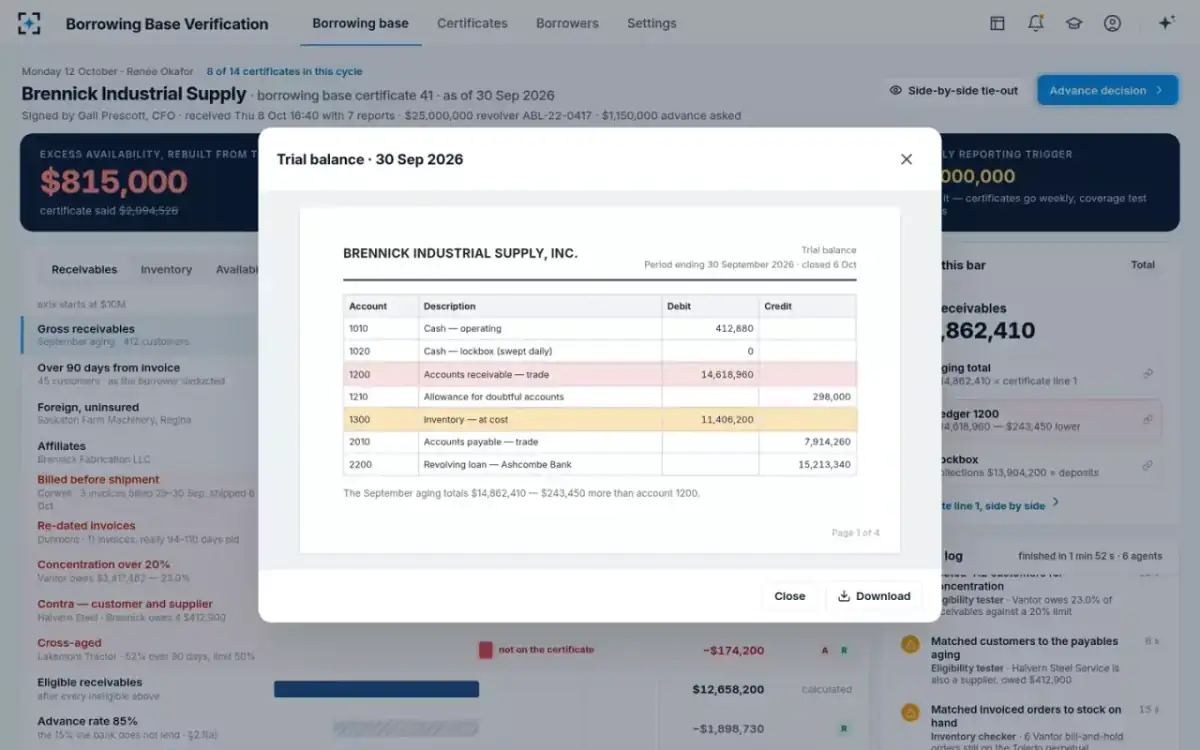
The first line, gross receivables, should equal the sum of every open invoice on the aging, and that sum should in turn equal the accounts receivable control account on the general ledger trial balance. When it does not, the gap is almost always dated at the edges of the reporting period: an invoice booked in the general ledger a day or two before it was actually shipped, or a shipment that left the dock before the invoice was cut. On certificate 41, Brennick's aging totaled $14,862,410 against a general ledger control account of $14,618,960 — a $243,450 gap that traced to three invoices to Corwell Agricultural Equipment, dated 29 and 30 September, that the shipping log showed leaving the dock on 6 October. Billed before shipment is one of the oldest ineligibility rules in asset-based lending for exactly this reason: an invoice without a shipment behind it is a receivable from nobody.
The bank and lockbox statements belong to this same line, because they are what confirms a customer actually paid, not merely that the aging says it should. In most asset-based facilities, the OCC notes, the bank "either controls or reserves the right to control the borrower's cash receipts," usually through a lockbox. Behind that sits a rule of the Uniform Commercial Code that a lender can invoke if it notifies a customer that the receivable has been assigned: "after receipt of the notification, the account debtor may discharge its obligation by paying the assignee and may not discharge the obligation by paying the assignor" — once notified, a customer that pays the borrower directly has not paid the invoice. A tie-out that compares the lockbox statement with collections the aging shows as received is checking whether that control is actually working, not only whether it exists on paper.
The trial balance, opened at the control account
Ineligibles: tied to the aging, the agreement, and the shipping log
The deductions line is where a credit agreement's own rules meet the aging, invoice by invoice. The OCC's handbook lists the usual reasons a receivable is taken out: "Receivables delinquent for a period that calls into question the receivables' collectability... Unbilled accounts receivable" among them, alongside cross-aging, concentration, contra accounts, foreign and affiliate balances. Each reason needs its own source: delinquency and cross-aging come from the aging itself; concentration is arithmetic across it; contra accounts need the payables aging, to see whether a customer is also a supplier; billed-before-shipment needs the shipping log. A certificate that nets these out without showing its work is asking a lender to trust arithmetic nobody can check.
On Brennick's certificate, five of the six differences the tie-out found were receivables ineligibles the certificate itself had not deducted: a cross-aged customer, a concentration limit, a contra account, the billed-before-shipment invoices, and eleven invoices re-dated to look current. Each is tested against the credit agreement's own settings, not a fixed industry number, which is why the same nine reasons can produce a different dollar figure on two different facilities with two different agreements.
Inventory: tied to the perpetual report and the appraisal
Eligible inventory ties to two documents that rarely come from the same source: the perpetual inventory report, for what the system says is on hand by location, and the appraisal, for what it is worth at net orderly liquidation value. A credit agreement usually caps eligible inventory at the lesser of a cost-based percentage and a percentage of the appraisal's value, with a dollar sublimit on top. The perpetual report alone cannot answer the question a lender actually cares about, which is whether the units on the report are still there: on Brennick's certificate, $318,250 of inventory sold to one customer on a bill-and-hold basis was still sitting on the Toledo stock report, invoiced and no longer the borrower's to pledge.
The loan balance and letters of credit: tied to the loan system
The outstanding loan balance and any letters of credit issued against the facility do not come from the borrower at all; they come from the lender's own loan system, which is one reason this line is rarely where a tie-out finds a surprise. Its purpose on the certificate is to let availability net correctly: a borrowing base of $16,628,340 means little without knowing how much of it is already drawn. A UCC search belongs here too, confirming the lender's lien is where the agreement says it should be and that nothing has moved ahead of it; "Conflicting perfected security interests and agricultural liens rank according to priority in time of filing or perfection" is the rule a later-filed lender is relying on when it assumes its own filing controls.
Availability: the one figure every other line builds toward
Excess availability — the borrowing base, less what is already drawn, less any reserves — is the number every other line exists to produce, and it is also the number a borrower has the most reason to want generous. On certificate 41, Brennick certified $2,094,528 of excess availability; recalculated from the five documents, it was $815,000. The gap was not one error; it was six, each small enough to look like a rounding matter on its own and large enough together to change what the analyst should approve.
Brennick's certificate, line by line: certified against recalculated
As certified: $14,862,410, from the borrower’s own aging total
Recalculated from the documents: $14,618,960, tied to the general ledger control account — $243,450 lower
As certified: Three ineligibles only: over 90 days, foreign uninsured, affiliates
Recalculated from the documents: Five items added: cross-aged, concentration, contra account, billed before shipment, re-dated invoices
As certified: The perpetual report’s own total, no bill-and-hold adjustment
Recalculated from the documents: $318,250 removed for goods invoiced and no longer the borrower’s to pledge
As certified: $2,094,528 certified
Recalculated from the documents: $815,000 recalculated — $1,279,528 lower
What is a borrowing base certificate template?
A borrowing base certificate template is the form a borrower fills out each reporting period, usually monthly, to claim a borrowing base and the advance it supports. Most templates share the same skeleton — gross receivables, deductions down to eligible receivables, eligible inventory, the two combined at their advance rates into a borrowing base, less the outstanding balance and any reserves, to excess availability — with the specific deductions and advance rates set by the credit agreement rather than by any standard form. A template tells a lender what the borrower claims; it does not by itself tell the lender whether the claim is right, which is why every line needs a document behind it.
Where each field usually goes wrong
Across certificates, the errors cluster at predictable seams rather than spreading evenly across the form. Gross receivables breaks at the cut-off between the aging and the general ledger, usually a timing difference at the edges of the period. Ineligibles break where a rule needs a document the certificate's preparer did not check against — cross-aging and re-dating both need a comparison the aging alone will not show, which is why a month-over-month aging comparison, not just this month's aging on its own, catches what a single snapshot misses. Inventory breaks where the perpetual report and the physical reality have drifted apart, often through goods already sold but not yet relieved from stock. The loan balance rarely breaks at all, because it comes from the lender's own system rather than the borrower's.
Reading a certificate the way an examiner does
An examiner, or an analyst doing the same job month after month, does not start from the certificate's bottom line and work backward; a false availability figure gives no hint of which of six possible errors produced it. The more reliable order is the one the documents themselves support: tie gross receivables to the general ledger first, because every ineligibility calculation downstream depends on starting from the right total; test ineligibles against the aging and the agreement next, invoice by invoice where the rule requires it; tie inventory to the perpetual report and the appraisal; confirm the loan balance against the lender's own system; and only then let availability fall out of the four lines above it. Read in that order, a $1,279,528 difference stops being one large, unexplained number and becomes six specific, checkable ones.
The order matters for a second reason beyond tracing errors: each line's test depends on the one before it being right. Testing eligibility against an aging total that has not been tied to the general ledger risks deducting the correct percentage from the wrong starting figure, which can hide a timing error inside what looks like a clean eligibility calculation. A reviewer who works top to bottom in this order never has to come back and redo an earlier step because a later one turned up a problem with the inputs it depended on.
The five documents to collect before tying out a certificate
- Receivable and payables agings
This month’s and last month’s — a single aging cannot show a re-dated or cross-aged invoice on its own.
- General ledger trial balance
For the accounts receivable control account the aging total should foot to.
- Bank and lockbox statements
To confirm collections actually arrived where the credit agreement requires them.
- Inventory report and appraisal
The perpetual report for quantity and location, the appraisal for net orderly liquidation value.
- The credit agreement and its amendments
Advance rates and eligibility rules come from the agreement, not from a standard form.
Side by side: 23 of 23 lines tied to a source
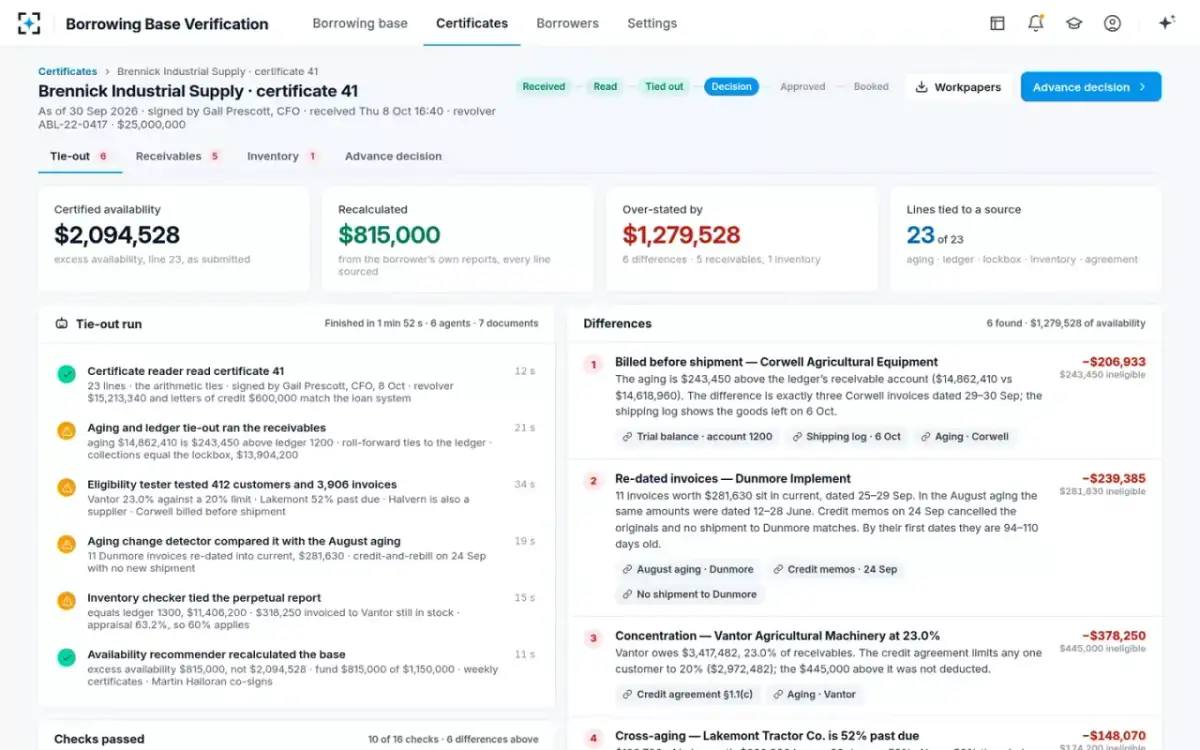
What a certificate cannot do is prove itself; that work belongs to the five documents behind it, read in the order that lets one line's answer feed the next. The nine reasons a receivable becomes ineligible, each with the rule and the document it needs, continues from the deductions line above. To see all 23 lines tied automatically, every certificate, start from Borrowing Base Verification.
Questions people ask
What goes on a borrowing base certificate?
Gross receivables, the deductions that make some of them ineligible, eligible receivables at the facility's advance rate, eligible inventory at its own advance rate, the two added into a borrowing base, the outstanding loan balance and any letters of credit subtracted, and the excess availability that remains. The specific deductions, rates and reserves come from the credit agreement, not from a fixed industry template.
What documents support a borrowing base certificate?
Five, beyond the certificate itself: the receivable and payables agings, the general ledger trial balance, bank and lockbox statements, the inventory report and its appraisal, and the credit agreement that sets the rules. A sixth, the lender's own loan system, supplies the outstanding balance.
What is the difference between gross and eligible receivables?
Gross receivables is every open invoice on the aging, tied to the general ledger control account. Eligible receivables is gross receivables after the ineligible ones are removed — over 90 days, cross-aged, over the concentration limit, a contra account, foreign or affiliate, billed before shipment, or re-dated — each tested against the credit agreement's own rules, not a single industry standard.
What is excess availability?
The borrowing base — eligible receivables and eligible inventory, each at its advance rate — less the loan balance already outstanding and any letters of credit or reserves. It is the figure a borrower is actually asking to draw against, and the one most certificates get wrong when an ineligible that should have been deducted was not.
How do you check a borrowing base certificate against the general ledger?
Start with the accounts receivable control account on the trial balance and compare it with the aging's own total; any difference usually traces to invoices booked on one side of the reporting cut-off and not the other. The same tie applies to inventory against its own general ledger account, and to collections against the lockbox statement.