In pharma manufacturing, MSAT — manufacturing science and technology — is the desk a plant asks when a process question has to be answered from the records rather than from memory: why a step runs the way it does, whether a lot stayed inside its range, what changed between two versions of a batch record, why the same operation starts its clock differently at another site. The work is hard not because the answers are unknown but because they are buried: a single executed lot record can run to three hundred scanned pages of handwriting in the plant's own language, and the parameter's criticality, its registered limit and its validated hold each sit in a different document again. Botminds' Batch Record Search is software that answers those questions beside the scanned page itself, with the step boxed and its criticality marked, for a named reviewer to check at the source and sign.
The examples on this page come from a fictional sample network as it runs through the solution: three products — Veltrimab, Corventa and Talmirex — made at Plants 1, 2, 3 and 5, with 2,598 batch records in search and 3,232 effective documents in all. The people, plants, products and lots are invented. The research figures come from the US Department of Labor, the regulators and a peer-reviewed journal, linked where they appear.
The desk, in two numbers
4
documents one process question touches: the lot record, the criticality analysis, the filing and the hold study
4plants
one MSAT lead answers for in the sample network, in three languages
What does an MSAT engineer actually do?
An MSAT engineer owns the manufacturing process after it leaves development: they transfer it into a plant, keep it running inside the limits it was registered on, explain it when it deviates, and change it under change control when it has to move. In day-to-day terms that means deviation investigations, change controls, campaign reviews, comparability between sites, annual product reviews and the endless stream of questions that arrive from quality, regulatory and the shop floor.
The US Department of Labor describes the underlying occupation plainly. A manufacturing engineer's job is to "design, integrate, or improve manufacturing systems or related processes", and one of the tasks it lists is to "investigate or resolve operational problems, such as material use variances or bottlenecks". In a regulated plant that second task dominates, because every operational problem produces a written investigation, and every written investigation has to be supported from the record of what actually happened.
There is also a formal name for the thing MSAT is holding. ICH Q10 calls it knowledge management — the systematic acquisition, analysis, storage and spread of what is known about products, processes and components (ICH Q10, section 1.6.1) — listing technology transfer activities, process validation studies, manufacturing experience and change management among its sources. That is a fair description of an MSAT engineer's in-tray. It is also a quiet admission that the knowledge exists in documents before anyone asks for it; the systematic part is the acquiring and the disseminating.
The four people who answer for one batch record, and how the question moves between them
MSAT does not answer alone. In a multi-site network four roles share the same documents and hand questions to each other, and each has a different reason for asking. Understanding that path is the first thing to get right when sizing the desk, because a question that visits three people costs three people's time, not one.
Four roles, one executed record
Today
Checks holds, limits and signatures before lots go to release by paging through scanned records, in whatever language the plant writes in.
With agents
Asks in plain words, reads the boxed step on the scanned page with its criticality beside it, and verifies there.
Still theirs: The release decision, and the signature that carries it
Today
Answers process questions from several plants, and spends most of the answer finding the page the answer is on.
With agents
Lines a step up across plants or versions in one table, each cell cited to its page and step.
Still theirs: The judgement about whether a difference matters
Today
Works from the site’s own records in the site’s own language, and translates by hand for anyone outside it.
With agents
Asks about their own site and reads the original step beside its English translation, numbers untouched.
Still theirs: What the site is accountable for
Today
Keeps the batch records and the registered dossier saying the same thing, usually by being told late.
With agents
Is notified when a batch-record range sits outside the filed range, with the filing section cited.
Still theirs: The decision about whether a filing has to move
The quality reviewer's place in that chain is not a matter of local custom. Under US drug GMP every production and control record, packaging and labeling included, has to be reviewed and approved by the quality control unit before a batch is released or distributed (21 CFR 211.192). The reviewer has to be satisfied, and being satisfied means reading the page. MSAT is who they ask when the page does not obviously say what it needs to say.
EU GMP Chapter 4 sets the related expectation on the filing side: for every manufacturing activity it should be clear which record belongs to it and where that record is kept (EU GMP Chapter 4, clause 4.10). Many sites can answer that at the level of a document type and a system. Far fewer can answer it at the level of a step on a page, which is the level at which the questions actually arrive.
A week on the desk: what the questions are really about
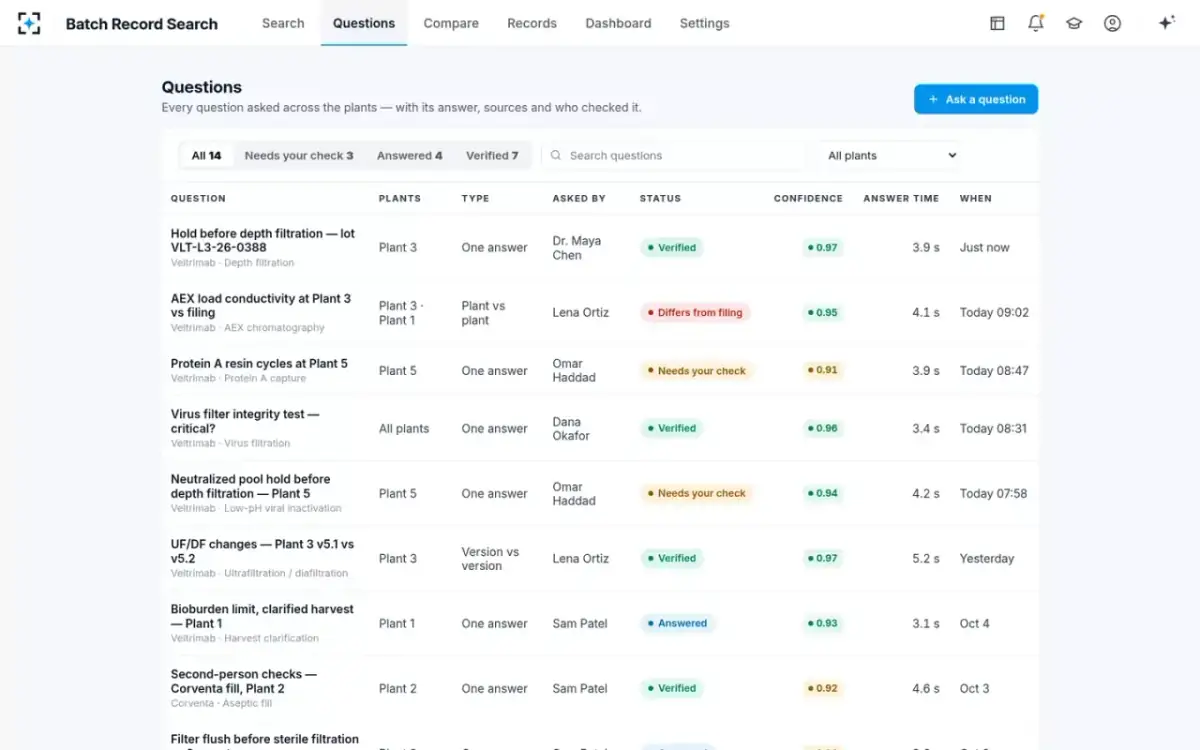
The questions are not evenly spread. In the sample network's thirty-day dashboard, 431 questions were asked across the plants — between 81 and 92 in each weekly bar — and they clustered hard on a handful of process steps. Four steps accounted for more than three hundred of them, and the step asked about most often was also the one on which the plants most often differ.
The steps the plants ask about, and how often the plants disagree
That pattern is the argument for measuring the desk rather than staffing it by feel. A step that generates 112 questions in a month is not generating 112 different questions; it is generating the same handful of questions from different people who cannot see each other's answers. The remedy is not a cleverer engineer. It is an answer that is written once, cited to its page, checked by someone qualified and then reusable by everyone who asks next.
Every question across the plants, with who asked and what it cost
Why the answer is nearly always already written down
Much of what an MSAT engineer is asked in a week requires no new science. The hold ran as long as it ran; the operator wrote it down; a second person checked it and initialled the entry. Patel and Chotai put the point well in the Journal of Young Pharmacists: documentation "helps to build up a detailed picture of what a manufacturing function has done in the past and what it is doing now and, thus, it provides a basis for planning what it is going to do in the future". The picture is there. The difficulty is that it is three hundred pages wide.
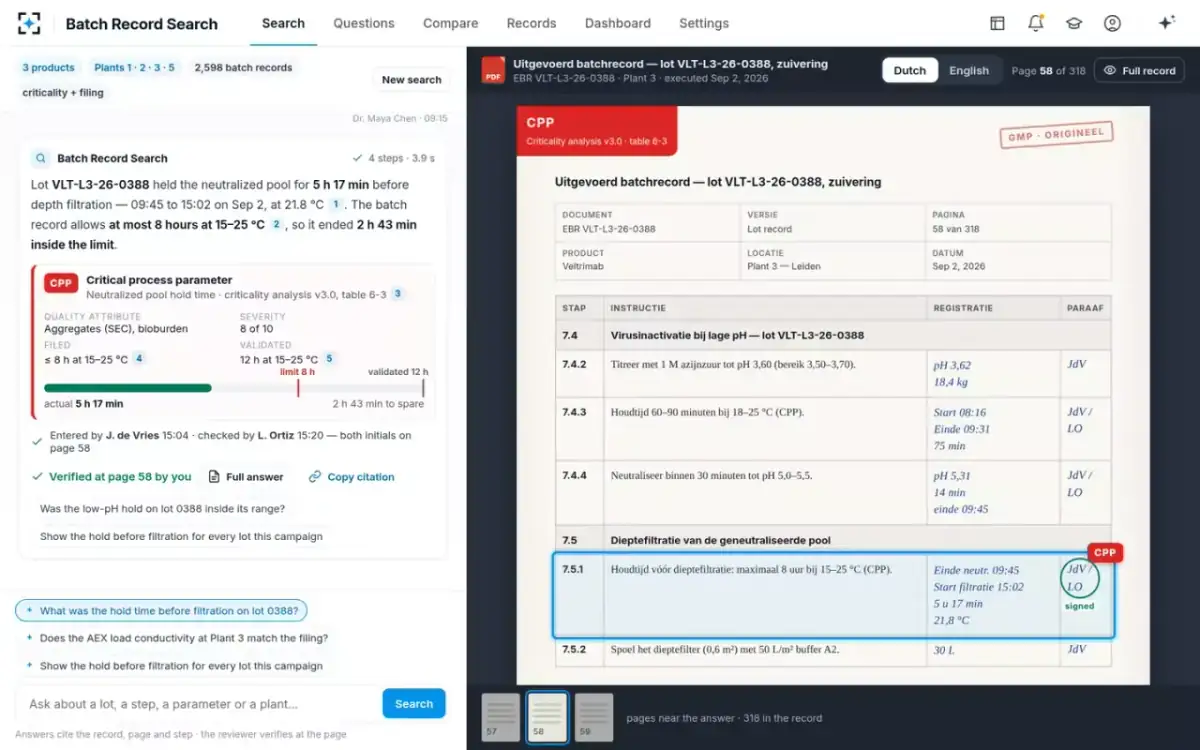
Take one question from the sample network: what was the hold time before filtration on lot VLT-L3-26-0388? The answer is five hours seventeen minutes, from 09:45 to 15:02 on 2 September at 21.8 °C, against a limit of at most eight hours at 15–25 °C. It is written at step 7.5.1 on page 58 of a 318-page executed record, in Dutch, in two hands, with the operator's and the checker's initials beside it. Nothing about finding it is intellectual work; all of it is work.
The answer, and the page it came from, side by side
"The answer is always in the record. Finding page 58 is the work."
Lena Ortiz, MSAT lead at the sample network’s Plant 3
Retrieval work and science work: the split nobody measures
If most of the job is retrieval, that share is worth knowing, and few sites measure it. The solution's own estimate of one batch-record answer, done by hand and properly proved, is 42 minutes: six to find the right plant, record, version and lot; twelve to page to the step in a three- to four-hundred-page scanned record; six to read the handwriting and translate it; six to look the parameter up in the criticality analysis; six to check the filed limit and the validated hold; six to write it up with citations for the reviewer's check.
One proved answer, by hand and through Batch Record Search
- Find plant, record, version, lot6 min
- Page to the step12 min
- Read and translate6 min
- Criticality6 min
- Filing and validated hold6 min
- Write it up6 min
- Find
- Page
- Read and translate3
- Criticality2.5
- Filing and hold2.5
- Reviewer checks and signs5
Group those six steps and the shape of the job appears. Twenty-four of the 42 minutes — 57% — are retrieval: finding, paging, reading and translating. Twelve minutes, 29%, are looking up rules that someone else has already written down. Six minutes, 14%, are the part a reader would recognise as the engineer's own contribution: deciding what the finding means and writing it so that a reviewer can check it.
What falls when the retrieval is automated is almost exactly the retrieval. In the target lane the first three steps drop from 24 minutes to four, while the last step — the reviewer's check and signature — barely moves, and should not: it is the part a regulator is relying on. A site head who wants one number before funding the next MSAT headcount should ask for this one, measured on their own desk over a fortnight. The number is easy to collect and few sites have it.
What retrieval costs an engineering desk
Two things matter for anyone sizing the desk. The first is that MSAT is an engineering desk, not a technician one, which is why spending more than half of it on retrieval, as the estimate above suggests, is expensive in a way a site rarely sees on a cost line. The second is that the reviewer who checks MSAT's answer sits in a different and lower pay band, so a process that pushes work from the reviewer onto MSAT, or the reverse, moves real money without changing anything a customer would notice. The guide to the cost of answering one question from inside a document system puts a figure on both.
What makes the job hard across plants and languages
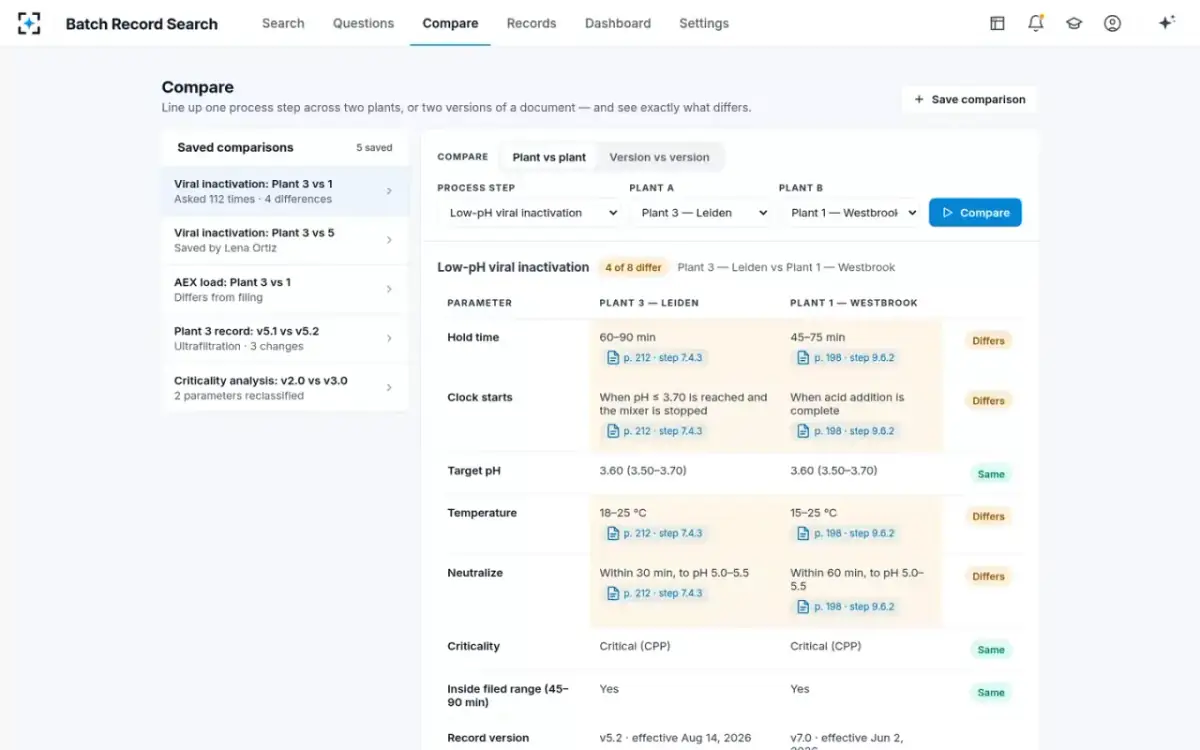
A single-site MSAT engineer has a hard job. A multi-site one has a different job, because the same process step is written differently at every site that runs it, and the differences are rarely flagged as differences. In the sample network, lining up low-pH viral inactivation at Plant 3 against Plant 1 shows four of eight parameters differing: a hold of 60–90 minutes against 45–75, a clock that starts when pH 3.70 is reached and the mixer stops against one that starts when acid addition is complete, 18–25 °C against 15–25 °C, and neutralisation within 30 minutes against within 60. Target pH, criticality and the registered range are identical.
None of those four is an error. All four are legitimately registered process descriptions at two plants, and a comparison that matched on step number instead of on meaning would have missed half of them — the step is 7.4.3 at one plant and 9.6.2 at the other. This is the work that goes wrong quietly: a hold time read against the other plant's range, or a clock start assumed rather than read, lands in a deviation investigation and then in a release decision.
The same step at two plants, with every cell cited to its page
Language is the second multiplier. The sample network's master records run to 412 pages in Dutch at Plant 3, 386 in English at Plant 1 and 398 in French at Plant 5, all for the same drug substance. An MSAT lead who reads two of those three languages is plausible; one who reads all three and the regulatory dossier is much harder to find. What matters for an answer is that the translation never touches the numbers: a comma that becomes a point in the wrong place turns 3,62 into 362. What EU GMP Chapter 4 expects of one record read in three languages covers the regulatory side of that in full.
Eight questions to ask before funding an MSAT desk
Before a site funds MSAT headcount, eight questions separate a desk that does engineering from a desk that does retrieval with an engineering title. A site head who cannot answer them is not yet ready to hire.
Eight questions about the desk, before funding the headcount
- How many sites, in how many languages?
Three sites in three languages is not three times one site. Ask which languages the records are written in and which the candidate is expected to read.
- What share of last quarter went on finding documents?
If nobody can say, that is the answer. Ask for a fortnight’s log before adding headcount.
- Who else may answer a process question, and who signs it off?
A desk that answers but cannot have its answers used is a bottleneck with a job title.
- Where do criticality analyses and registered ranges live, and who owns them?
If they sit outside the document system the batch records live in, every answer is a two-system errand.
- How is a superseded version kept out of an answer?
Citing a retired version in a deviation investigation is among the easier ways to turn an answer into a finding.
- What happens when a batch-record range differs from the filing?
The answer names a person in regulatory affairs and a route. The dishonest one is that it rarely happens.
- How many deviations and change controls land here a month?
Those are the questions with deadlines. Everything else competes with them.
- What would leave the desk within a year?
An organisation that cannot name one task it intends to take off the desk is planning to grow the desk instead.
What Batch Record Search changes when finding the page stops being the work
The useful way to think about software here is narrow. It does not make the process decisions, and it should not: under US drug GMP the production record review and the release decision belong to the quality control unit, and nothing in a search tool changes that. What it can do is collapse the retrieval, keep the citation attached to the claim, and make the answer reusable so the same step is not researched 112 times a month by four people who cannot see each other's work.
In Batch Record Search, that is enforced rather than encouraged. Every claim cites the document, page and step, and citations cannot be turned off. Only effective versions are cited unless a question names a past one. A range that sits outside the registered filing is flagged with the difference and routed to Quality and Regulatory CMC — no agent clears it. Answers used in a deviation or a change control need a named reviewer's signed check, and in the sample network's settings answers about a critical process parameter need a check by the site's MSAT lead, which is the one place where the desk's judgement is made a requirement rather than a courtesy.
That leaves the MSAT engineer with the half of the job that was always the point: deciding whether a difference matters, what a deviation means, and whether the process still fits the dossier it was registered on. If the role is going to be worth an engineer's salary for the next decade, that is the half worth defending. What the draft rules allow an AI to do in a GMP plant sets out where the line between the two halves is being drawn, and Batch Record Search shows the whole sequence on sample records.
Questions people ask
What does MSAT stand for in pharma?
Manufacturing Science and Technology. It is the function that owns a commercial manufacturing process after technology transfer: keeping it inside its registered limits, investigating it when it deviates, and changing it under change control. The term is an industry label rather than a regulatory one — no GMP regulation names MSAT — which is why responsibilities differ noticeably between companies.
Is MSAT part of quality or manufacturing?
In many companies it sits in manufacturing or technical operations rather than quality, and for a reason. Under US drug GMP the quality control unit has to review and approve production records before a batch is released, which means the function that explains the process cannot also be the function that independently approves it. MSAT prepares the technical answer; quality decides what to do with it.
What is the difference between MSAT and process development?
Process development designs the process and defines its parameters before commercial manufacture; MSAT receives it, transfers it into plants and keeps it running there. The handover is technology transfer, which ICH Q10 names as a source of product and process knowledge in its own right. In practice the difference shows in the documents each works from: development works from studies, MSAT works from executed records.
What qualifications should an MSAT hire have?
Typically a degree in chemical, biochemical or process engineering, biotechnology or a related science, plus plant experience in a GMP environment. Beyond the degree, the skills that decide the job are reading an executed record critically, knowing what the registered dossier says, and writing a technical argument a quality reviewer can check at the source. A second language is a practical requirement at any site whose records are not written in English.
How many sites does one MSAT lead cover?
It varies with product count and process complexity rather than with headcount rules. In the fictional sample network on this page, one lead answers for four plants in three languages across three products — a span that works only if finding the page is not the bottleneck. The honest way to size it is to measure the retrieval share of the current desk first, because that share, not the number of sites, is what actually caps it.