Electronic batch record software replaces the printed manufacturing instruction with an on-screen one, captures entries as they are made, enforces the order of steps, and flags an out-of-range value at the moment it is entered rather than at review. It is a genuine improvement, and it is also narrower than the brochure: it changes how records are written from the day it goes live, at the lines it goes live on, and does nothing at all for the lots already released, the plants not yet converted, or the criticality analyses and registered filings that were never batch records in the first place. Botminds' Batch Record Search is built for that remainder — it reads master and executed records, criticality analyses, filings and hold time studies where they already live, read only, and answers questions from them with the document, page and step cited.
The record estate on this page is a fictional sample network inside the solution: three products — Veltrimab, Corventa and Talmirex — at Plants 1, 2, 3 and 5, with 2,598 batch records in search, 3,232 effective documents in all, and master records of 96 to 412 pages in English, Dutch and French. The regulatory material is the European Commission's and FDA's own, linked where it appears; where a text is a consultation draft rather than law, it says so each time.
The estate an eBR programme has to share a site with
2,598
batch records in search across four plants in the sample network
3,232
effective documents in all, including criticality analyses and registered filings
412pages
in the longest master record, in Dutch; the shortest runs to 96, in French
3languages
the same drug substance is written in, at three of the four plants
What electronic batch record software actually changes
An eBR system changes the moment of capture. Instead of an operator reading a printed instruction and writing a value in a box, the instruction appears on screen, the value is typed or read from an instrument, the log-in identifies who entered it, and the system refuses to advance if a required step was skipped. The review that follows can then be by exception — a reviewer looks at what the system flagged rather than at every page — which is where most of the stated saving comes from.
What it does not change is more interesting for a buyer. It does not reach backwards: a lot released last year has an executed record in whatever form it was made in, and that record has to be retained and produced on request for years. It does not reach sideways: a programme that goes live at one line in one plant leaves every other line and plant exactly as it was. And it does not reach outward: the criticality analysis that says whether a parameter is critical, the registered range in the dossier and the hold time study behind the validated limit are not batch records and do not enter a batch record system.
The draft revision of EU GMP Annex 11 states the principle that should govern the whole programme: "Where a computerised system replaces another system or a manual operation, there should be no resultant decrease in product quality, patient safety or data integrity. There should be no increase in the overall risk of the process." It is a consultation text and not in force, but it is the right question to hold a programme against — including at the seams it creates, which is where risk tends to appear rather than disappear.
EBR, MES and paper on glass: three things people mean by the same phrase
Much of the confusion in an eBR evaluation is vocabulary. Three different things get called an electronic batch record in a meeting, and a fourth term — the master batch record the system executes — gets folded into all three. They mean materially different things in a contract.
Four terms, and what each actually commits you to
| Term | What it means | What it changes about the record | What it leaves alone |
|---|---|---|---|
| Master batch record (MBR) | The approved instruction for making a product at a plant: the template every lot is made against. | Nothing by itself — it is the document the system executes. | It still has versions, owners and effective dates, electronic or not. |
| Electronic batch record (eBR) | The executed record of one lot, created and held electronically as the lot is made. | Capture, sequencing, in-line checks and review by exception. | Every lot made before go-live, and every line not yet converted. |
| Manufacturing execution system (MES) | The wider plant system that schedules, dispatches and tracks production; eBR is usually one module of it. | Scheduling, materials, equipment status, as well as the record. | The same backlog and scope limits, at larger cost and longer timeline. |
| Paper on glass | The printed instruction reproduced on a screen, with entries typed instead of written, and little or no system logic behind them. | Legibility and availability, and little else. | The process logic, the in-line checks and most of the saving people expect. |
The distinction that matters most in the room is the last one. Paper on glass is sometimes the right first step — it is quick, it ends illegibility, and it makes a record available in two places at once — but it is bought on the promise of the second row and delivers the fourth. Ask what the system does when a value falls outside its range, and whether a step can be completed out of order; the answers separate the two in about a minute.
The three kinds of paper an eBR programme leaves behind
Scoping the remainder honestly at the start is what separates a programme that lands from one that is still explaining itself in year three. There are three kinds, and they behave differently.
The archive. Every lot already released has an executed record that has to be retained, and in the EU, GMP Chapter 4 sets the retention floor for batch documentation at a year past the batch's expiry or five years past the Qualified Person's certification, whichever runs longer. Those records are the ones a deviation, a complaint, an annual product review or an inspection will reach for, and they are rarely migrated, because a migrated copy of a signed record has to be shown to be a true copy.
The plants not yet converted. A multi-site network converts one line at a time, and for the years in between the same product is documented two ways at two sites. Any question that compares plants — and in the sample network's own usage data, plant-versus-plant questions are among the most asked — has to read both forms at once.
The documents that were never batch records. This is the category buyers tend to forget. Criticality analyses, CTD Module 3 filings, hold time and cleaning validation studies, change control packages: these answer the second half of many process questions, and they live in the quality document system regardless of what happens to batch records. In the sample network they account for the difference between 2,598 batch records and 3,232 effective documents.
What happens to old paper batch records after EBR?
They stay, and they stay retrievable. US drug GMP allows records to be retained as originals or as true copies, from photocopies and microfilm to any other accurate reproduction (21 CFR 211.180(d)), and adds that where reduction techniques such as microfilming are used, "suitable reader and photocopying equipment shall be readily available". The obligation is not to keep paper; it is to keep something that can be read and reproduced.
FDA's data integrity guidance sets the bar for a scan standing in for the original: "Electronic copies can be used as true copies of paper or electronic records, provided the copies preserve the content and meaning of the original record, which includes all metadata ... required to reconstruct the CGMP activity and the static or dynamic nature of the original records." For a paper batch record — a static record — a complete, legible scan with its metadata generally satisfies that. For a dynamic electronic record, the same guidance says the copy must be in a format that preserves content and meaning, with a suitable reader available.
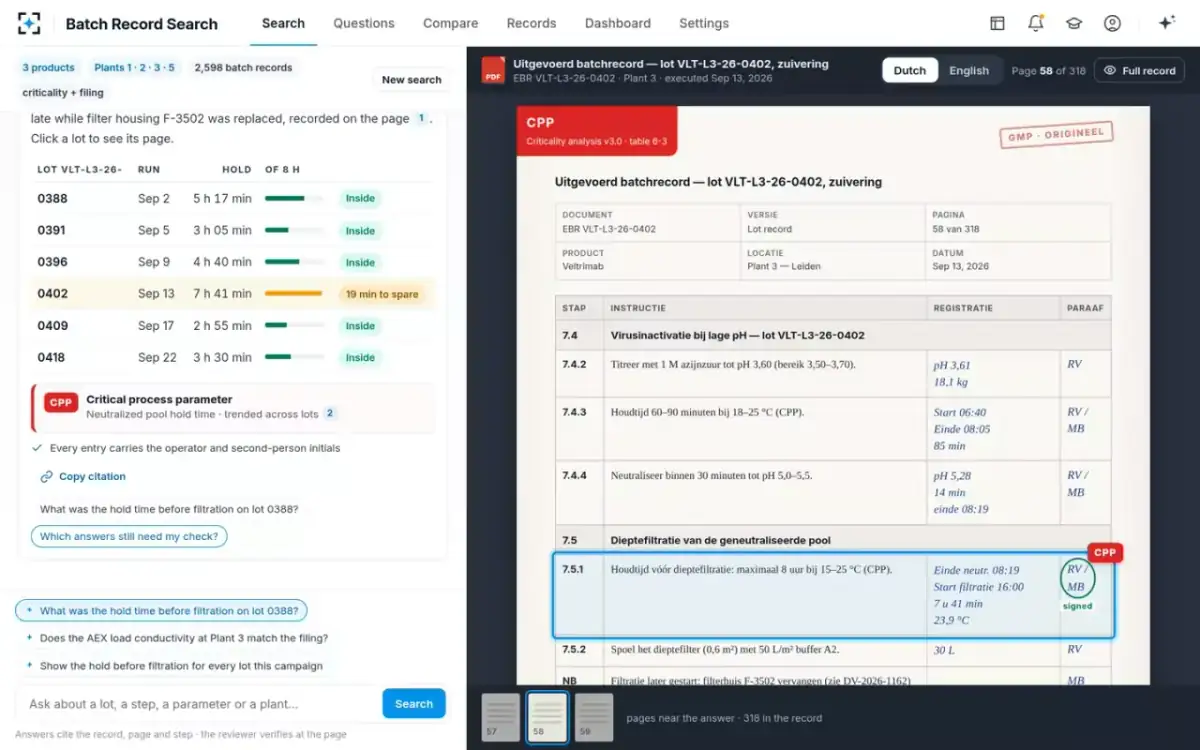
So the archive becomes a pile of scanned pages: legible, complete, lawful, and almost entirely unsearchable in the way a question needs. A filename and a lot number are an index; a question about how long one lot held before filtration, and whether that was inside the registered range, is not a filename question. Why storing a document well is not the same as finding what is in it works that distinction through.
Hybrid records: the state a converting site is actually in
A hybrid record is one where some elements are electronic and some are paper, and it is not an edge case — EU GMP Chapter 4 has described it since 2011, noting that many instructions and records exist partly on paper and partly in electronic form, and requiring the relationships and control measures for master documents, official copies, data handling and records to be stated for hybrid and homogeneous systems alike (EU GMP Chapter 4, clause 4.1). An eBR programme creates hybrids while it runs, and can leave some permanently.
The hybrid seam, and the clause that governs each side of it
Written by the system
A weighing captured from the balance, timestamped, with the operator identified by log-in.
Draft Annex 11 asks that replacing a manual operation brings no decrease in quality, safety or data integrity, and no increase in overall process risk.
Written by hand, on a printout
A hold time entered in pen on a printed instruction, initialled by the operator and a second person.
Chapter 4 already covers hybrid documents: relationships and control measures must be stated for both hybrid and homogeneous systems.
Signed in ink, on a system record
A wet-ink signature on a page printed from the system, filed separately from the electronic entry.
The draft revision says electronic records should be signed electronically and a hybrid system avoided; where paper and electronic signatures exist in parallel, the regulated user must define which one counts.
Reviewed across both
A reviewer checking an electronic parameter against a handwritten note on the same step.
The draft asks for procedures that outline evaluation, approval and archiving of electronic and paper-based data together.
The draft revision of Chapter 4 adds the procedural requirement that most sites discover late: "Procedures should be in place to manage the review of data generated by hybrid systems which clearly outline the process for the evaluation, approval and archiving of electronic and paper-based data." It is a consultation text, not in force, but it describes a gap that already exists at a site mid-conversion: a reviewer looking at one step whose parameter came from a system and whose hold time came from a pen.
Archiving and retrieval: the clause buyers skip
Most eBR evaluations cover validation, audit trails and signatures. Fewer cover what happens at the far end, when the system is retired or the data is archived — and the draft Annex 11 revision has a short clause that is worth reading before signing anything: "It should be possible to retrieve archived data and metadata in a format which allows searching and sorting of the data, or alternatively, to allow export of the data to a tool where this is possible."
Searching and sorting, not merely reading. The draft revision of Chapter 4 makes the same point from the definition of legibility: where the dynamic nature of electronic data — the ability to search, query and trend it — is important to the content and meaning of a record, being able to interact with the data using a suitable application is part of the record's availability. A PDF export of ten years of batch records satisfies "readable" and fails "searchable", and the difference only becomes visible when someone needs an answer in an inspection.
Ask the vendor three things about this before the contract: what the export format is, whether it carries the audit trail and the metadata, and what tool reads it after the system is gone. A programme that cannot answer them has deferred a problem to the people who will run the site in fifteen years.
Scoping the gap before you sign, not after
The useful exercise takes an afternoon. Count the lots whose records are already written. Count the lines and plants that will not be converted in the first three years. List the document types a process question needs that are not batch records. Then take ten real questions from last quarter's deviations and change controls, and mark how many of them the new system would have answered on its own.
An eBR programme, and reading your existing records with Batch Record Search
An eBR or MES programme: How records are written from go-live, at the lines it covers: capture, sequencing, in-line checks, review by exception.
Reading the existing estate with Batch Record Search: Nothing about how records are written. How fast a question about any of them is answered, and with what evidence.
An eBR or MES programme: Untouched. Their records stay in whatever form they were made in, for the full retention period.
Reading the existing estate with Batch Record Search: Read in place, by lot, step and parameter, including scanned handwritten entries and both sets of initials.
An eBR or MES programme: Untouched until their own project runs.
Reading the existing estate with Batch Record Search: Read on the same day as every other plant, in the language each writes in.
An eBR or MES programme: Out of scope — they were never batch records.
Reading the existing estate with Batch Record Search: In scope, and in the same answer: classification, registered range and validated hold beside the entry.
An eBR or MES programme: Process mapping, recipe authoring, interfaces, validation, training, and a change to how every operator works.
Reading the existing estate with Batch Record Search: Give read access where the documents already live, and confirm which version of each is effective.
An eBR or MES programme: Making the next record better.
Reading the existing estate with Batch Record Search: Answering a question about any record, old or new, with the page cited.
Reading records in place instead of migrating them
Migration is the expensive habit this class of problem invites: copy everything into a new system so that it can be indexed there. For GMP records it is also the worst option, because a copy of a signed record is a new record that has to be shown to preserve the content and meaning of the original, and because the copy then has to be kept in step with a source that keeps changing.
The alternative is to read where the documents live. In the sample network the intake agent reads new and revised records in place in the quality document system, labels them by plant, product, lot, version, language and step, maps step numbers to pages, and retires superseded versions once the document's owner confirms the effective date. Nothing is copied or migrated, and the agent is read-only: it never edits a source record.
What Batch Record Search reads: four plants, three languages, six document types
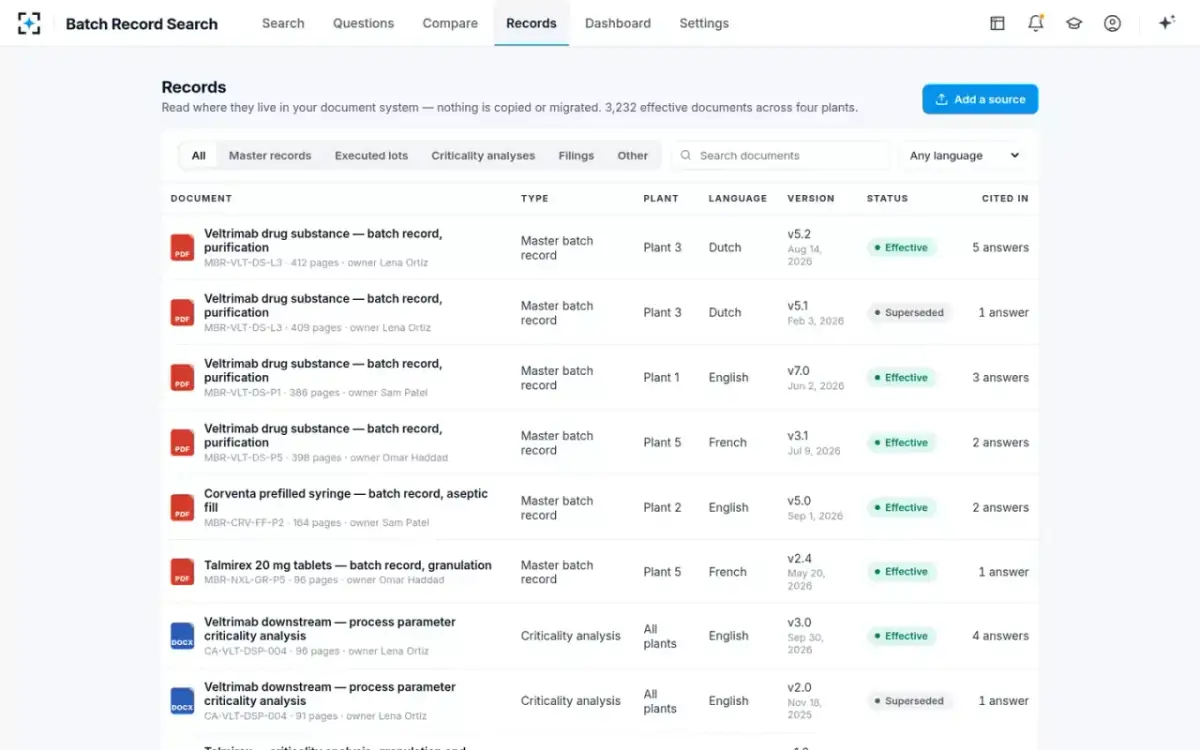
Reading in place also keeps the hybrid seam honest. A step whose parameter sits in a system and whose hold time sits in ink on a printout is one step, and a reader wants one answer about it. A tool that can only see one side of the seam will answer confidently from half the evidence, which is precisely the failure the draft's hybrid-review clause is aimed at.
One question across a campaign, lot by lot, old records and new
Nine questions for an eBR vendor, and three for yourself
The vendor questions are the ordinary ones plus the ones about the remainder, which is where evaluations are often thin. The three at the end are the ones only the site can answer, and they decide more than the vendor comparison does.
Nine for the vendor, three for the site
- Which lines, at which plants, in which order — and what is the date the last one converts?
A complete answer has dates. The gap between the first and last date is how long the site runs hybrid.
- What does the system do with a value outside its range, and can a step be completed out of order?
This separates a real eBR from paper on glass faster than any demonstration.
- How are hybrid steps reviewed, where part of the entry is on paper?
The draft Chapter 4 revision asks for a procedure covering evaluation, approval and archiving across both.
- What is the export format at end of life, and does it carry the audit trail?
The draft Annex 11 revision asks that archived data be retrievable in a format allowing searching and sorting.
- What reads that export once your system is retired?
If the answer is "our viewer", the retention obligation outlives the licence.
- Does the system hold criticality analyses, registered ranges or validation studies?
Usually no. That answer is fine; it just has to be said out loud before the scope is signed.
- What happens to records from plants in other languages?
A system in English over records written in Dutch or French moves the translation problem rather than solving it.
- How is a master record version change handled mid-campaign?
Ask to see the effective-date logic, not the change control form.
- What is the measured review time today, and what will it be after?
A saving quoted without a measured baseline is a forecast. Measure the current review before the project starts.
- For the site: how many lots are already in the archive, and for how long must they be kept?
Work it from your own products’ shelf lives and certification dates; the EU floor is whichever of the two periods runs longer.
- For the site: of last quarter’s process questions, how many would the new system have answered?
Take ten real ones, and count how many needed a document the system will never hold.
- For the site: who answers a question about a lot made in 2022, and how long does it take them?
That person and that number are the scope of the gap, stated as a cost.
None of this is an argument against buying an eBR system. Better capture is better, and the draft Annex 11's no-decrease principle is a reasonable standard to hold a programme to. It is an argument for buying it with the remainder priced in, because the remainder is where the questions come from while the programme runs — and, for the archive, for the whole of its retention period after. What EU GMP Chapter 4 asks of documentation across plants and languages covers the rules side, good documentation practice covers what a handwritten entry has to look like to be readable years later, and Batch Record Search shows the estate being read end to end on sample records.
Questions people ask
What is an electronic batch record system?
Software that creates the executed record of a lot electronically as the lot is made: the manufacturing instruction appears on screen, entries are typed or read from instruments, the log-in identifies who made each entry, and the system enforces step order and in-line limits. It is usually a module of a manufacturing execution system rather than a standalone purchase, and its main operational payoff is review by exception.
What is the difference between MES and EBR?
An MES is the plant-level system that schedules, dispatches and tracks production, tracks materials and equipment, and holds the electronic batch record as one of its functions. eBR is that record-keeping function. A site can buy eBR without the rest of an MES, and some do; buying the MES is a larger programme with a longer timeline and more interfaces, and it leaves exactly the same records untouched.
What is paper on glass?
A printed instruction reproduced on a screen, with entries typed rather than written, and little or no process logic behind it. It ends illegibility and makes the record available in more than one place, which are real gains. It does not give in-line limit checking, enforced step order or meaningful review by exception, so a saving forecast on the strength of those will not arrive.
What is a hybrid record?
A record where some elements are electronic and some are on paper — the normal state of a converting site. EU GMP Chapter 4 has recognised hybrid documents since 2011 and requires that relationships and control measures be stated for hybrid as well as homogeneous systems. The draft revision goes further and asks for procedures covering the evaluation, approval and archiving of electronic and paper-based data together.
Do you still need to review records after EBR?
Yes. Review by exception changes what a reviewer looks at, not whether review happens: under US drug GMP, production and control records must be reviewed and approved by the quality control unit before a batch is released or distributed. And for every lot made before go-live, at every line not yet converted, the review is the one it always was.
What happens to old paper batch records after EBR?
They are retained for their full retention period and must stay retrievable. US drug GMP allows retention as originals or as true copies such as photocopies or microfilm, provided suitable reading and copying equipment is readily available, and FDA's data integrity guidance allows electronic copies as true copies where they preserve the content and meaning of the original, including the metadata needed to reconstruct the activity. They are rarely migrated into the new system, because a copy of a signed record has to be shown to preserve the content and meaning of the original.