Critical process parameters are the process settings whose variability reaches a critical quality attribute of the product, so they have to be monitored or controlled rather than merely recorded. That is nearly the whole of the official definition, and it contains the thing people miss: criticality is a statement about a demonstrated link between a parameter and an attribute, not a property of the number printed on the page. The classification lives in a risk assessment and a criticality analysis; the number lives in the batch record; and the two are often filed in different systems. Botminds' Batch Record Search answers a question about a step by reading both, and says in the answer whether the parameter is critical, key or non-key, with the document that says so.
What follows is the regulatory definition, the test a reviewer can actually apply at the page, and what changes once a step is classified as critical. The worked examples come from a fictional sample network inside the solution: a biologic drug substance made at four plants, with invented lots, people and document numbers. The guidelines are quoted from the published texts and linked where they appear.
Criticality, in four numbers
2009
the date of the ICH Q8(R2) text that carries the one-sentence definition of a critical process parameter still in use
0of 13
items 21 CFR 211.188(b) requires in a batch production record that say whether a parameter is critical
3
documents one criticality answer touches in the sample: the record, the criticality analysis and the filing
Sample data
8of 10
the severity on the sample criticality row for one hold, against aggregates and bioburden
Sample data
What makes a process parameter critical? The definition, clause by clause
A critical process parameter is defined by ICH Q8(R2), the pharmaceutical development guideline, in a single sentence that has stood in the current text since August 2009.
In paraphrase, the glossary makes a critical process parameter any process parameter whose variability has an effect on a critical quality attribute, and which must therefore be monitored or controlled so that the process turns out product of the intended quality (ICH Q8(R2), Glossary, August 2009).
Read it clause by clause and it sets four conditions at once. It must be a process parameter — something the plant sets or holds, not something the product has. Its variability must matter, which means the question is about a range rather than a value. That variability must have an impact on a critical quality attribute, so the chain has to be demonstrated, not assumed. And the consequence of all this is a control obligation: the parameter "should be monitored or controlled", which is why classification changes what the batch record looks like.
Nothing in that sentence can be settled by looking at a batch record page. A hold of 5 h 17 min at 21.8 °C against a printed limit of 8 hours is a fact about one lot. Whether that hold is critical is a conclusion about the process, reached once, written down somewhere else, and still true for every lot made under that version of the process.
The chain the definition hides: parameter, attribute, product quality
The definition of a CPP depends on the definition of a critical quality attribute, which Q8(R2) gives as "A CQA is a physical, chemical, biological, or microbiological property or characteristic that should be within an appropriate limit, range, or distribution to ensure the desired product quality" (ICH Q8(R2), clause 2.2). So the full chain runs from something the patient would care about, back through an attribute of the material, back to a knob on the floor. Each link is somebody's job and lands in somebody's document.
One chain, seven links, seven documents — and only the last one is the batch record
A quality attribute is identified
A property that has to stay inside a limit for the product to be what it claims: purity, potency, aggregate content, bioburden.
Development report, then the dossier
Pharmaceutical development
A parameter is suspected of moving it
Temperature, time, pH, conductivity, pressure. Suspicion is not classification; it only puts the parameter on the list to be studied.
Risk assessment
Development with manufacturing and quality
The link is shown, or ruled out
Experiments, prior knowledge or both demonstrate whether the parameter’s variability reaches the attribute, and over what range.
Study reports, validation data
Development and validation
The classification is recorded
Critical, key or non-key, with the attribute it affects and the severity. This document, not the batch record, is where the word "critical" is defined for this step.
Criticality analysis
Quality, on the risk assessment
The range is registered
The range the authority has approved. Moving outside it is a regulatory matter before it is a quality one.
The dossier, Module 3.2.S.2.2 and 3.2.S.2.4
Regulatory affairs
The limit is printed in the instruction
The number the operator will see beside the blank, which should sit inside the registered range and often inside a tighter internal limit.
Master batch record
The document owner, under change control
The result is written down
The only document in the chain that holds what actually happened — and the only one that says nothing at all about criticality.
Executed batch record
The operator, checked by a second person
ICH Q11 describes the middle of that chain as development work with an explicit output: "Risk assessment can help identify the material attributes and process parameters with the potential for having an effect on drug substance CQAs. Those material attributes and process parameters that are found to be important to drug substance quality should be addressed by the control strategy" (ICH Q11, clause 3.1.5). The control strategy is where a criticality decision turns into something an operator can see: a tighter limit, an in-process control, a second-person check, a recorded result.
CPP, CQA, key and non-key: four words, four jobs
Four words circulate in the same conversation and only two of them are defined by ICH. A CQA is a property of the material or product. A CPP is a setting whose variability moves a CQA. A key process parameter is not an ICH term at all: many firms use it for a parameter that affects process performance, consistency or yield without reaching a quality attribute, and define it in their own procedure. A non-key or non-critical parameter affects neither, and is recorded for traceability rather than for judgement.
Because "key" is a house term, its meaning has to be read from the firm's own criticality procedure before any conclusion is drawn from it. Two plants in the same network can use the word for different things, and a reviewer who assumes the sense they learned at a previous employer will route a deviation to the wrong level. That is also why a criticality answer should always come back with the document and version it came from, not just the word.
How is criticality decided, and by whom?
By a quality risk management process, run by the people who know the science, and documented. ICH Q9(R1) defines the activity as "a systematic process for the assessment, control, communication and review of risks to the quality of the drug (medicinal) product across the product lifecycle", and gives the three questions a risk assessment turns on: "1. What might go wrong? 2. What is the likelihood (probability) it will go wrong? 3. What are the consequences (severity)?" (ICH Q9(R1), section 4 and clause 4.3).
The tool most criticality analyses reach for is the one Q9(R1) names as an extension of failure mode and effects analysis: "FMEA might be extended to incorporate an investigation of the degree of severity of the consequences, their respective probabilities of occurrence, and their detectability, thereby becoming a Failure Mode Effect and Criticality Analysis (FMECA; see IEC 60812)". Q9(R1) is explicit that its output is "a relative risk 'score' for each failure mode, which is used to rank the modes on a relative risk basis" — relative, and only as good as the data behind it. A severity of 8 on a 10-point scale is a ranking inside one firm's framework, not a measurement, and it should never be read across firms.
Who signs it varies, and it matters. The risk assessment is often written by development, manufacturing science and technology, or process engineering, with the quality unit approving. Nobody reclassifies a parameter from the batch record alone, and nobody reclassifies it because a lot happened to pass. A change in classification is a change to the control strategy and travels through change control, which is also what makes the previous version of the analysis worth keeping.
The five-question criticality test a reviewer can apply at the page
- Which quality attribute is this parameter supposed to move?
If no attribute can be named, the step is not critical — it may still be key. ICH Q8(R2) defines a CPP only by its impact on a CQA.
- Where is that link written down, and in which version?
The criticality analysis effective on the manufacturing date, not the one effective today. A superseded classification governs the lots made under it.
- Is the range on the page inside the registered range?
ICH M4Q puts critical processing times, holding times, temperatures and the controls on critical steps into Module 3.2.S of the dossier. A printed limit wider than the registered range is a regulatory question.
- Does the record actually capture the result?
ICH Q7 clause 6.52 asks for "Actual results recorded for critical process parameters" in the batch production record. A critical parameter with no recorded result is a gap, not a pass.
- Who reviewed it, and was that the right person?
For active pharmaceutical ingredients, Q7 clause 6.71 sends critical steps to the quality unit and allows production personnel to review non-critical ones. Classification decides the route.
Where criticality is written down, and why it is not in the batch record
The batch record is not silent about critical steps — it is silent about the decision. European processing instructions must set the work out step by step, including checks on materials, pre-treatments, the order in which materials are added and the critical process parameters such as time and temperature (EU GMP Chapter 4, clause 4.18(d)), so the limit for a critical parameter is printed on the page and often annotated. What is not on the page is which attribute it protects, how severe the consequence is, which version of the analysis said so, or who approved it.
That separation is deliberate and correct. The batch record is per lot and must stay a faithful account of one lot; the criticality analysis is per process and changes on a different clock. Merging them would mean reissuing every record whenever a risk assessment was revised. The cost of the separation is paid at reading time, by the reviewer who has to hold two documents open — and in a paper network, that reviewer is often paging through a scan.
It also explains a common and expensive misreading. An annotation such as "(CPP)" beside a step is a convenience printed from the master record at the version it was issued. It is evidence that somebody classified the parameter; it is not the classification. If the step is contested — in a deviation, a release decision or an inspection — the document that answers is the criticality analysis effective on the manufacturing date, which may be two versions back.
Severity, quality attribute and the rest of the criticality analysis row
A usable criticality analysis is a table, and each row has to carry enough to be read years later. In the sample network, the row for the neutralized pool hold time in criticality analysis CA-VLT-DSP-004 v3.0, table 6-3, names two quality attributes — aggregates measured by size-exclusion chromatography, and bioburden — classifies the parameter as critical, and scores severity at 8 of 10. That single row answers three of the five questions above on its own.
Two attributes on one parameter is common, and it changes what an excursion means. A hold that runs long threatens aggregate formation and microbial growth by different mechanisms and on different timescales, so the investigation has to test both and cannot stop at the first clean result. A row that named only one attribute would quietly narrow the investigation that follows it.
What changes when a step is classified critical
| Non-key | Key | Critical | |
|---|---|---|---|
| What it affects | Neither product quality nor process performance in any demonstrated way. | Process performance, consistency or yield; no demonstrated link to a quality attribute. | A critical quality attribute, by a link that has been demonstrated. |
| Who may review the record (APIs) | Qualified production personnel, under a procedure the quality unit approved (ICH Q7 6.71). | Qualified production personnel, under the same procedure, unless the firm says otherwise. | The quality unit, before the batch is released or distributed (ICH Q7 6.71). |
| Result recorded in the batch record | Recorded for traceability where the instruction asks for it. | Recorded; usually trended for process performance. | Required: "Actual results recorded for critical process parameters" (ICH Q7 6.52). |
| Second-person check on the entry | Rarely. The firm’s procedure decides. | Sometimes, where the result feeds a yield or performance decision. | Usually, and the checker is named on the page (EU GMP 4.20(c)). |
| An out-of-range result | A note, and a look at why the instruction was not followed. | An investigation into process performance; product impact assessed. | A deviation with a product-impact assessment on the named attribute, before any release decision. |
| Changing the range | Change control, local assessment. | Change control, with process performance data. | Change control, plus a check against the registered range — a move outside it is a regulatory change, not an internal one. |
Why an effective version matters more here than anywhere else
Every document in this chain is versioned, and they move independently. The master batch record changes when the instruction changes. The criticality analysis changes when the risk assessment is revisited. The dossier changes when a variation is approved. A lot made in September 2026 was made under whichever versions were effective then, and that is the set a reviewer has to reconstruct — not the set that is effective on the day the question is asked.
The failure mode is quiet. Nothing looks wrong: the reviewer opens the current criticality analysis, finds the parameter, reads "critical, severity 8", and writes it up. If the parameter was key under v2.0 and became critical under v3.0 after the lot was made, the conclusion is about a process the lot was never run under. The same trap works in reverse, and the reverse is worse, because it understates an obligation that existed at the time.
It is why the solution cites effective versions only, unless a question names a superseded one, and why the owner of each document confirms its effective date rather than the date being inferred from a file. The same discipline applies to the printed limit itself: which version of the master record the operator actually held decides what number was on the page.
What changes when a step is critical: who checks, who signs, what an excursion costs
The classification does real work in four places. It decides whether the result must be recorded at all: ICH Q7 lists "Actual results recorded for critical process parameters" among the things documentation of each significant step should include (ICH Q7, clause 6.52). It decides who reviews the record, at least for active pharmaceutical ingredients, under Q7 clause 6.71 — which is an API guideline, and does not transfer to finished drug product, where 21 CFR 211.192 sends everything to the quality control unit. It decides how hard an excursion is to close, because a product-impact assessment has to address the named attribute. And it decides whether the range can be moved without telling anyone outside the firm.
That last one is where criticality meets the dossier. The FDA's process validation guidance frames the whole lifecycle as evidence-building — process validation is "The collection and evaluation of data, from the process design stage through commercial production, which establishes scientific evidence that a process is capable of consistently delivering quality products" (FDA, Process Validation: General Principles and Practices, Glossary) — and a registered range is part of what that evidence supports. In the sample network, one plant prints an anion-exchange load conductivity range of 5.0–8.5 mS/cm where the dossier registers 5.0–8.0 and a sister plant runs the registered range. That is a half-unit of difference and a regulatory conversation, and it is exactly the kind of thing that stays invisible while three plants each read their own record.
Batch Record Search: the hold, the limit, the filed range and the validated hold on one bar
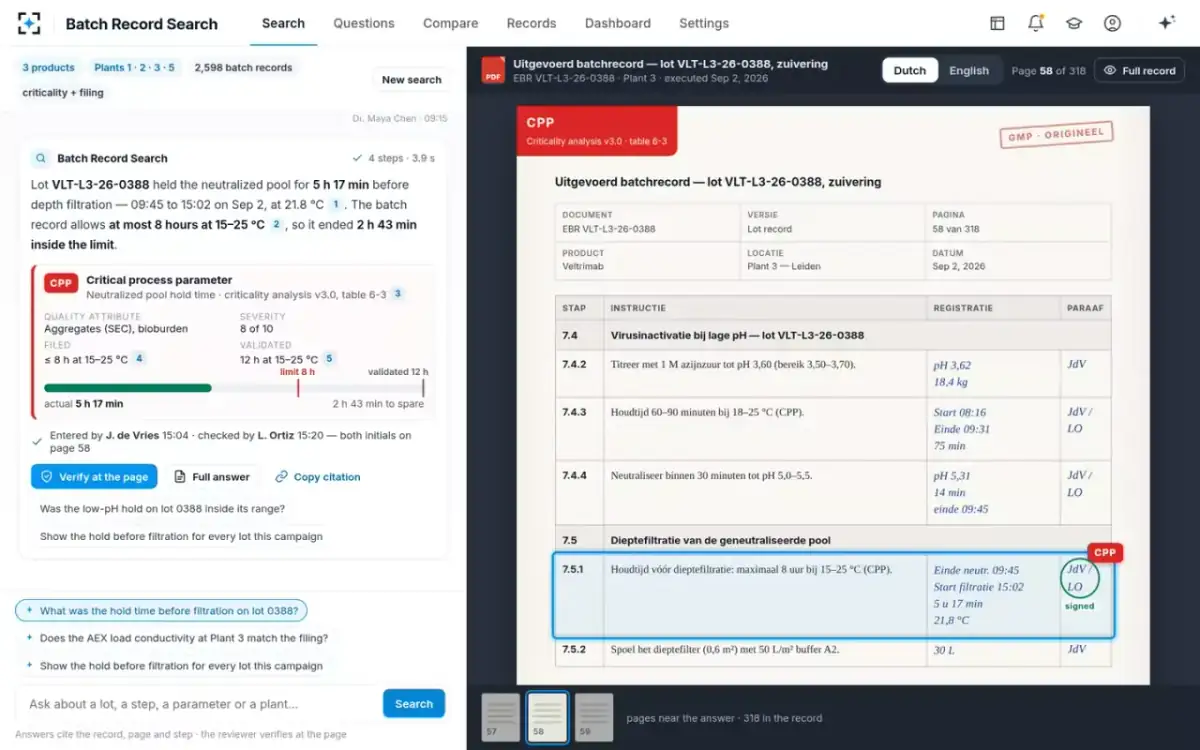
Reading a step and its criticality in one place
The work of answering a criticality question is mostly retrieval, and retrieval is what agents are good at. The judgement — whether the classification is right, whether a difference from the filing is acceptable, whether a lot is fit to release — stays with people, and the solution is built so that it has to.
One question about a critical parameter, from plain words to a signed answer in Batch Record Search
Agent
Find the record, the page and the stepResolves the question to a plant, product, lot and effective version, then to the page and step number where the parameter is recorded.
Never: guesses a step when the question is ambiguous — it says "not found" instead
Agent
Read the entries off the scanned pageReads the handwritten values, units, times and both initials, and boxes the step on the page so the reviewer can see the source rather than a summary of it.
Never: rounds, converts or merges a process range
Agent
Look the classification up in the effective criticality analysisReturns critical, key or non-key with the quality attribute, the severity and the table and version it came from.
Never: infers a classification from an annotation on the batch record page
Agent
Check the registered range in the dossierCompares the batch-record range with the range registered in Module 3.2.S.2.2 and 3.2.S.2.4 and states the difference, with the section cited.
Never: clears a difference from the filing — that always goes to a person
A person decides
The quality reviewer verifies at the page, and signsReads the boxed step on the scan, chooses what the signature means and where the answer is used, and signs. A difference from the filing also needs regulatory affairs.
Two settings decide how much of this a plant sees. One flags any parameter where two plants differ on a critical step, which is how a quiet divergence between sites surfaces before an inspector finds it. Another notifies regulatory affairs whenever a batch-record range sits outside the registered range. Both can be turned off; the requirement to cite the record, page and step cannot.
The rules behind a criticality answer, set once
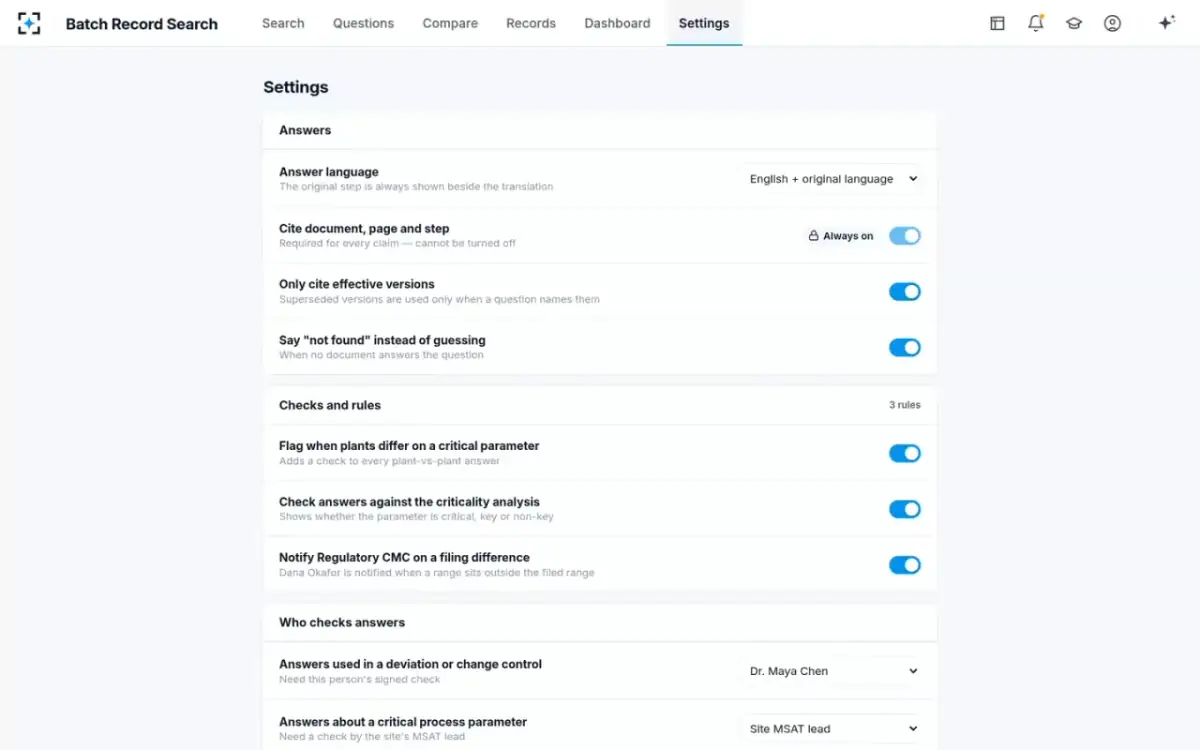
Criticality is only one of the three numbers that govern a step. The printed limit, the registered range and the duration a hold-time study actually validated are three different facts in three different documents. To see all of them answered against one lot, start from Batch Record Search.
Questions people ask
What is the difference between a CPP and a CQA?
A critical quality attribute is a property of the material or product — purity, potency, aggregate content, bioburden — that has to stay inside a limit, range or distribution. A critical process parameter is something the plant sets or holds whose variability moves such an attribute. ICH Q8(R2) defines both. The practical test is which side of the equipment it sits on: an attribute is measured on the material, a parameter is set on the process.
Is a hold time a critical process parameter?
It can be, and often is on a biologic, but only when a study or prior knowledge has shown that varying it moves a named quality attribute. Hold times are explicitly in the dossier's scope: ICH M4Q(R1) asks a biotech dossier's purification flow diagram to give the holding times of each stage alongside the volumes, pH and temperatures. Whether a particular hold is classified critical is answered by the firm's criticality analysis for that step, not by the fact that a limit is printed in the record.
Who decides whether a parameter is critical?
A cross-functional risk assessment, approved by the quality unit, under the firm's own procedure. ICH Q9(R1) describes the method rather than naming the roles: assessment, control, communication and review of risk, turning on what might go wrong, how likely it is and how severe the consequence would be. In many firms development, manufacturing science and technology or process engineering drafts it, and quality approves. It is never decided from a batch record, and never by one person reading one lot.
What happens if a critical process parameter goes out of range?
It becomes a deviation with a product-impact assessment on the named quality attribute, before any release decision on the lot. Where the parameter has two attributes against it, both have to be assessed. If the excursion also takes the result outside the range registered in the dossier, it stops being purely an internal matter and has to reach regulatory affairs. An out-of-range result that passes final testing is still a deviation; the test is not a substitute for the assessment.
Are critical process parameters in the regulatory filing?
The ranges for critical steps are. ICH M4Q(R1) puts the description of each process step, and the controls on critical steps and intermediates, into Module 3.2.S of the Common Technical Document; for a biotech purification train that description carries the processing times, holding times and temperatures stage by stage. The criticality analysis itself usually stays an internal document, which is why a reviewer needs both: the dossier says what range was registered, and the internal analysis says why that step matters.
Where is criticality recorded if not in the batch record?
In the criticality analysis, which carries one row per parameter with its classification, the quality attribute it affects, a severity score and the version and approval behind it — backed by the risk assessment it came from. The batch record carries the limit, and often an annotation such as "(CPP)", but an annotation is evidence that someone classified the parameter, not the classification itself. When a step is contested, the document that answers is the criticality analysis effective on the manufacturing date.