A hold time study is the experiment that establishes how long a material can sit between two process steps, under stated conditions, and still meet its specification — and it is only one of three numbers that govern any particular hold. The second is the limit printed beside the step in the batch record, which the operator actually works to. The third is the range registered in the regulatory dossier, which is what the authority approved. They are often different numbers, they live in three different documents, and a reviewer who checks a lot's clock against the wrong one can clear a hold that should be investigated, or investigate one that is fine. Botminds' Batch Record Search reads the recorded times off the scanned page and puts all three numbers beside them.
The worked lot on this page comes from a fictional sample network inside the solution: a biologic drug substance purified at four plants, with invented lot numbers, people and document references. The guidance is quoted from the published texts and linked where it appears.
One hold, and the numbers around it
3
different numbers govern one hold: the limit printed in the record, the range registered in the dossier, and the duration the study validated
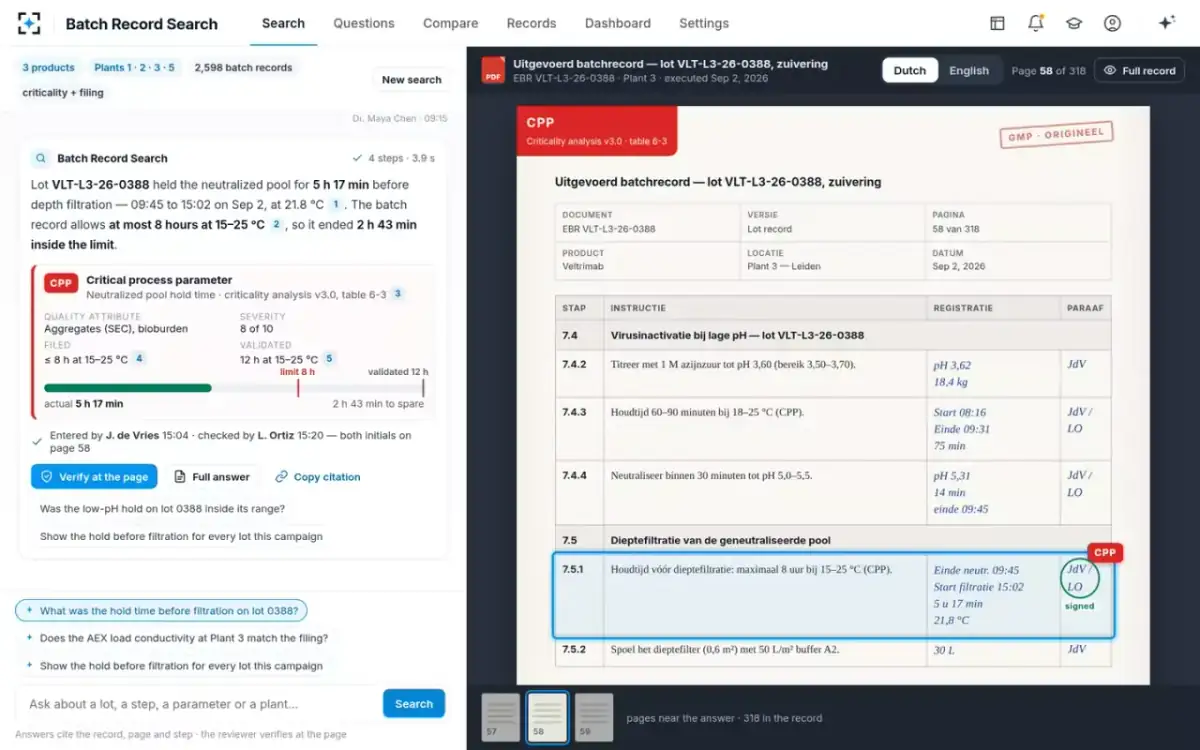
5 h 17min
the sample lot held its neutralized pool before depth filtration, at 21.8 °C
Sample data
19min
the margin left on the closest lot of the sample campaign, after a filter housing was replaced mid-run
Sample data
Excluded
biologicals, active pharmaceutical ingredients and cleaning validation — the three things the WHO hold-time guidance says it does not cover
What does a hold time study prove, and what does it not?
The WHO's general guidance gives a definition many firms' procedures build on: "Hold time can be considered as the established time period for which materials (dispensed raw materials, intermediates and bulk dosage form awaiting final packaging) may be held under specified conditions and will remain within the defined specifications" (WHO TRS 992, Annex 4, clause 4). Two phrases carry the weight. "Under specified conditions" means a hold limit is always a time at a condition — a temperature, a container, a headspace — and a duration quoted without its condition is not a limit. "Remain within the defined specifications" means the study's job is to show the material is still what it was, measured, not to show that nothing visibly happened.
What a hold time study is not is a rule about one lot. It is run on representative material, before or during validation, and its output is a time limit that then has to be written into the instruction before anyone on the floor can work to it. The same annex is explicit that hold times "should normally be determined prior to marketing of a product", and that a change in process, equipment, storage conditions or materials should prompt a risk assessment of whether a further study is needed. A study is a property of the process; a hold is a fact about a lot.
Three numbers for one hold: printed, filed, validated
Ask a plant "what is the hold limit for this step" and three honest answers come back from three functions, because three documents hold three numbers. On the sample lot, the batch record prints at most 8 hours at 15–25 °C, the dossier registers 8 hours at 15–25 °C in Module 3.2.S.2.4, and hold time study HTS-VLT-012 validated 12 hours at the same temperatures. The printed and registered numbers happen to agree here; the validated number deliberately does not.
Printed, registered, validated: which number is which, and what each one is for
| The printed limit | The registered range | The validated hold | |
|---|---|---|---|
| Where it lives | The master batch record, beside the step; reproduced into every executed record. | The regulatory dossier — for a biologic drug substance, Module 3.2.S.2.2 and 3.2.S.2.4. | The hold-time study report, with its protocol and data. |
| Who sets it | The document owner, under change control, on the validation and regulatory inputs. | Regulatory affairs, as approved by the authority. | Validation or manufacturing science, from the study data. |
| What the lot is judged against | This one. It is the instruction the operator was given. | Not directly — but the printed limit has to sit inside it. | Not directly. It is evidence about the process, not a limit on a lot. |
| What a breach means | A deviation on this lot, with a product-impact assessment. | A regulatory matter affecting every lot made under that version of the record. | Nothing on its own. A hold beyond the validated duration means the study no longer supports the limit. |
| Who may change it | The document owner, under change control, with the validation and regulatory evidence behind it. | Only through a variation the authority approves. | Nobody. A new study produces a new number. |
| What an inspector asks for | The version effective on the manufacturing date, and the entry against it. | The section of the dossier, and whether the record agrees with it. | The protocol, the data and the report — and whether the limit in use is supported by them. |
The validated hold is the number most often misused, and the misuse usually runs in the same direction. A lot runs past the printed 8 hours, somebody remembers that the study went to 12, and the excursion is written off as "still within validated". It is not. The lot departed from the approved instruction, which is a deviation on its own terms. The study is excellent evidence for the impact assessment that follows — it is direct data on what happens to this material over that period — but it is evidence, not authority.
Where each number lives, and who owns it
Ownership is the practical reason the three numbers drift apart. The printed limit belongs to whoever owns the master batch record at that plant, and changes when a change control is approved. The registered range belongs to regulatory affairs and changes only when a variation is approved, on the authority's timetable. The validated hold belongs to validation or manufacturing science and changes when a study is repeated. Three owners, three clocks, three approval routes — and no mechanism that makes any of them tell the other two.
That is why a difference between a printed limit and a registered range can persist quietly for years. Nobody is reading them side by side: the plant reads its record, regulatory affairs reads the dossier, and the two documents meet only when something forces them together — an inspection, a transfer to another site, or a question that happens to touch both. Whether the parameter is critical decides how much that difference costs when it is finally found.
How do you calculate a hold on an executed record?
From two timestamps on the page, at the temperature recorded with them. European practice makes the arithmetic possible by requiring the times in the first place: a batch processing record must contain "Dates and times of commencement, of significant intermediate stages and of completion of production" (EU GMP Chapter 4, clause 4.20(b)). Without the intermediate stages, a reviewer has the start and the end of the batch and no way to see the hold inside it.
One hold, worked from two handwritten times on one page
The clock starts
09:45, 2 September
Neutralization ends. Written by hand on page 58 of the executed record, with the operator’s initial.
Executed batch record
The clock stops
15:02, 2 September
Depth filtration begins — the next step on the same page, step 7.5.1.
Executed batch record
The duration, at its condition
5 h 17 min at 21.8 °C
The temperature is part of the answer. A hold limit is a time at a condition, never a time on its own.
The reviewer’s arithmetic
What it is judged against
≤ 8 h at 15–25 °C
The limit printed beside the step in the master record effective on 2 September. This lot had 2 h 43 min to spare.
Master batch record
Three details decide whether the arithmetic is right. The first is which two events bound the hold, which is a question about the instruction rather than about the clock. The second is the temperature: a hold at 26 °C against a limit of "8 hours at 15–25 °C" is outside the limit at four hours, because the condition failed, not the clock. The third is what to do with a recorded range or an ambiguous entry — and the answer is never to normalise it quietly. A printed "15–25 °C" stays "15–25 °C", and an entry that cannot be read is reported as unread rather than guessed.
The same hold, drawn against each of the three numbers
- Held, 09:45 to 15:025 h 17 min
- Room left to the limit2 h 43 min
- Held5 h 17 min
- To the printed limit2 h 43 min
- Studied beyond the printed limit4 h
- Held, filtration started late while a filter housing was replaced7 h 41 min
Starting the clock: why two plants can measure the same step differently
A common disagreement about a hold is not about the duration but about when it began. "Hold before depth filtration" can be timed from the end of neutralization, from the moment the pool is transferred to the hold vessel, from the completion of in-process sampling, or from the recorded pH adjustment. Each is defensible; each gives a different number; and the difference is often larger than the margin a reviewer is arguing about.
Two plants making the same product will settle this differently unless somebody makes them settle it the same way, because each wrote its own instruction around its own equipment. In the sample network the same viral inactivation step is numbered 7.4.3 at one plant and 7.3.4 at another, which is enough on its own to stop a step-number comparison from working: the steps have to be matched by meaning. When the clock definitions also differ, two honest records can report different holds for the same physical operation, and neither is wrong.
The practical defence is to read the definition out of the instruction every time rather than carrying one in your head, and to compare plants on the definition before comparing them on the number. That is also the only way a campaign comparison means anything.
What the WHO guidance covers — and what it explicitly does not
The WHO annex is where many searches for hold time study guidelines lead, and it is worth reading its scope clause before relying on it: "These guidelines focus primarily on aspects that should be considered in the design of the hold-time studies during the manufacture of non-sterile solid dosage forms… These guidelines do not cover aspects for hold times in cleaning validation, or the manufacturing of active pharmaceutical ingredients (APIs) or biologicals" (WHO TRS 992, Annex 4, clause 3).
So for a biologic drug substance — the case on this page — the annex is not the governing document. It remains genuinely useful for two things: the definition, and the list of what a protocol and report should contain, which is a good checklist whatever the dosage form. What it does not do is tell a biologics plant what its hold limits should be or how to justify them. Those come from the firm's own studies, the process validation lifecycle, and what was registered in the dossier.
The annex also contains one line worth lifting into any protocol, whatever the product: "Acceptance criteria are typically more stringent than registered specifications, to provide assurance that the material is well within control." That is the principle behind a printed limit that sits inside the registered range rather than on top of it, and it is why a plant that prints the registered number as its working limit has given itself no margin at all.
What a hold-time protocol and report must carry, and why a reader three years later needs it
- A title, reference number, version and date
A hold limit is cited in deviations for years. Without a version, a reviewer cannot tell whether the study they are reading is the one that supports the limit on the page.
- The objective and the scope
Which material, at which stage, between which two steps. A study of a bulk intermediate does not support a hold on a different intermediate.
- Responsibility, signatures and dates
Who ran it and who approved it, so the study can be weighed in an impact assessment rather than simply cited.
- A description of the material or product
Representativeness is the whole argument. A study on material from one campaign supports a limit for comparable material, and the report has to let a reader judge that.
- Storage conditions and the type of container
A hold is a time at a condition. Same duration, different container or headspace, different answer — the annex asks that worst-case headspace be represented where oxidation is a risk.
- Sampling method, locations, frequency, quantities and pooling
Whether the result is a snapshot or a trend, and whether a pooled sample could have hidden a single bad one.
- Methods of analysis
The annex asks for validated stability-indicating methods: a method that cannot see degradation cannot prove its absence.
- Acceptance limits, results, conclusion and recommendation
The limit the study supports, stated as a number with its condition, so it can be compared with the limit actually printed in the record.
Biologic holds: why the filing carries the answer for drug substance
For a biologic drug substance, the hold limits a reviewer has to work to are the ones in the dossier and the firm's own studies, and the dossier is specific about what it expects. ICH M4Q(R1) asks that a biotech purification description cover "All steps and intermediates and relevant information for each stage (e.g., volumes, pH, critical processing time, holding times, temperatures and elution profiles and selection of fraction, storage of intermediate, if applicable)" (ICH M4Q(R1), section 3.2.S.2.2). Holding times are named in the list, stage by stage, which is why a hold on a purification intermediate is a registered quantity rather than an internal one.
The FDA's process validation guidance supplies the other half: the hold limit is not a thing you set once and stop watching. Continued process verification runs on data, and "Scrutiny of intra-batch as well as inter-batch variation is part of a comprehensive continued process verification program under § 211.180(e)" (FDA, Process Validation: General Principles and Practices). A hold that creeps upward across a campaign is exactly the inter-batch variation that sentence is about, and it is visible only if somebody is reading the holds of several lots together rather than one at a time.
What happens when a lot comes close to the limit
A lot that passes with minutes to spare is a pass and a signal, and many quality systems handle the first and lose the second. In the sample campaign, lot 0402 held 7 h 41 min against the 8-hour limit — 19 minutes of margin — because filtration started late while filter housing F-3502 was replaced, noted on the page with its own deviation reference. The lot is fine. What is not fine is a process whose margin depends on no equipment failing.
Three outcomes for one hold, and who each one goes to
Inside the printed limit, and inside the registered range
Record the result against the limit and move on. Note the margin if it is small: a lot that lands close is a process signal even when it passes.
The quality reviewer, at the page.
Outside the printed limit
A deviation, with a product-impact assessment on the attributes the hold protects — on a purification intermediate that usually means aggregation and bioburden, which have to be assessed separately. The validated hold from the study is evidence for the assessment; it is not a second limit the lot can be judged against.
Production raises it; quality assesses and dispositions the lot.
Inside the printed limit, outside the registered range
The lot followed the instruction, and the instruction does not match what was registered. That is a document problem with a regulatory consequence, and it reaches beyond this lot to every lot made under that version of the record.
Quality and regulatory affairs together, before the next campaign.
The third branch deserves its own habit. A printed limit wider than the registered range means every lot made under that version of the record sat outside what was approved, however comfortably it sat inside the instruction. Finding it on one lot means it has to be asked of the campaign, and then of the version history. That is a document question, and it is answered far faster by reading the record against the dossier than by remembering to compare them.
Six lots' holds against one limit, in Batch Record Search
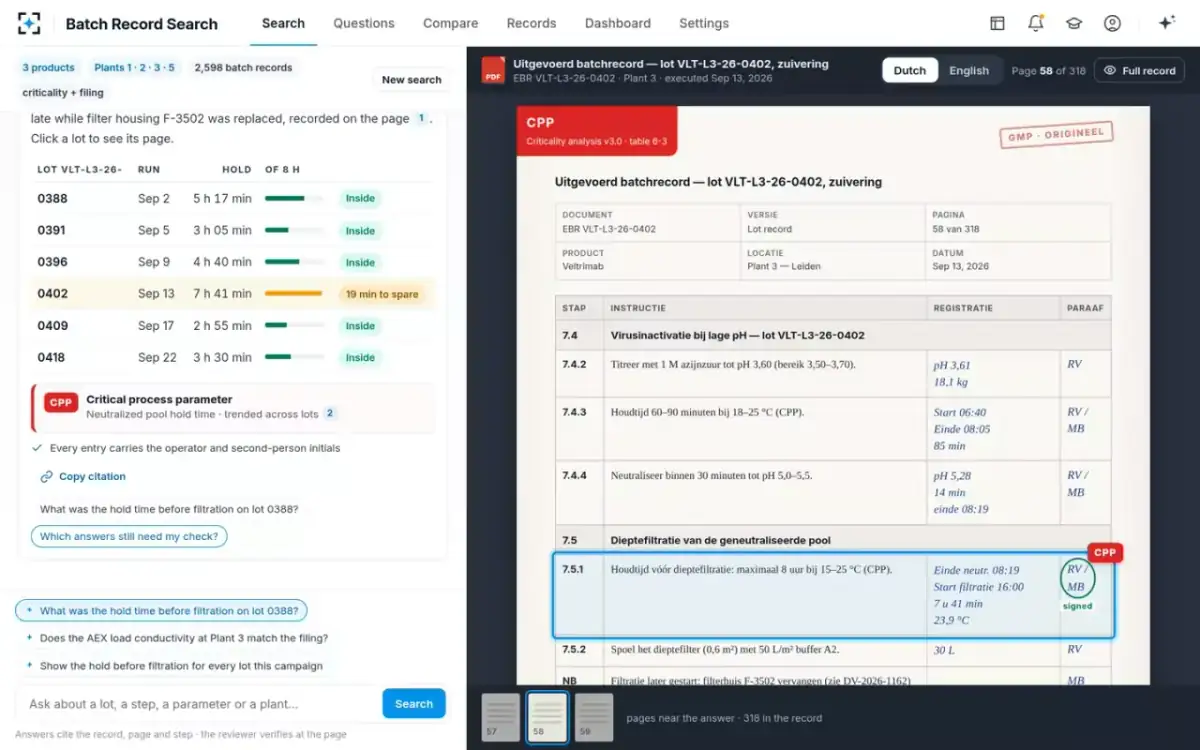
Checking a hold across a whole campaign, lot by lot
Doing this by hand is why it is so often left undone. Six lots means six executed records, six scans, six page-58s, six handwritten pairs of times, one printed limit to confirm per version, one dossier section and one study — and a translation if the plant writes in Dutch or French. The arithmetic is trivial; the retrieval is not.
In Batch Record Search a campaign question is one question. The reading agent resolves it to the right lots and the right step in each, reads the handwritten entries and both initials off each scanned page, and reports the holds together with the limit, the registered range and the validated duration. It never rounds, converts or merges a range, cites the record, page and step for every claim, and says "not found" rather than guessing when an entry cannot be read. The quality reviewer then verifies at the page — the boxed step on the scan, not a summary of it — and signs with the meaning the signature has and where the answer is used.
One lot's hold in Batch Record Search: the limit, the filed range and the validated duration
Hold time, shelf life and the clock a lot is actually on
Hold time and shelf life: two different clocks on the same material
A hold time: How long an intermediate may wait between two process steps.
A shelf life: How long the finished product remains within its specification after release.
A hold time: The processing instruction, beside the step. Registered for critical stages in the dossier.
A shelf life: The product specification and the label, registered in the dossier.
A hold time: A hold-time study on representative material under the production container and conditions.
A shelf life: A stability programme under ICH conditions, with ongoing batches on test.
A hold time: At the end of the preceding step, as the instruction defines it.
A shelf life: The WHO annex puts it at the time the active ingredients are mixed with other ingredients, irrespective of hold times.
A hold time: The reviewer of one lot, from two handwritten times on one page.
A shelf life: The stability programme, and anyone reading the label.
A hold time: A deviation and a product-impact assessment on the attributes the hold protects.
A shelf life: Product that may not be used, and a question about every other batch on the same data.
A hold is also a records question before it is a science question, and the record has to survive the years in which it might be asked about: in the United States a batch record is kept for at least a year past the batch's expiry under 21 CFR 211.180(a), and in the EU for one year past expiry or five past certification. What a handwritten entry has to give up when someone reads it back is the other half of the same problem. To see a hold answered with its limit, its filing and its study, start from Batch Record Search.
Questions people ask
How do you calculate hold time?
Subtract the recorded end of the preceding step from the recorded start of the next, and carry the temperature with the answer. On the worked sample lot, neutralization ended at 09:45 and depth filtration began at 15:02 on the same day, which is 5 h 17 min at a recorded 21.8 °C, against a printed limit of at most 8 hours at 15–25 °C. The hard part is not the subtraction but knowing which two events the instruction says bound the hold, because plants define that differently.
Is a hold time study required for biologics?
Hold limits for a biologic drug substance have to be justified, but the widely cited WHO general guidance is not the source of that obligation: its scope clause rules out biologicals, active pharmaceutical ingredients and cleaning validation. For a biologic the limits come from the firm's own studies, the process validation lifecycle and what was registered — ICH M4Q(R1) asks a biotech purification description to cover the holding times of each stage, so for critical stages the number is in the dossier.
What is the difference between hold time and shelf life?
A hold time limits how long an intermediate may wait between two process steps; a shelf life limits how long the finished product stays within specification after release. They are established by different work — a hold-time study against the production container and conditions, a stability programme under ICH conditions — and breached in different ways. The WHO annex adds that shelf-life is measured from when the active ingredients are mixed with other ingredients, irrespective of any hold times along the way.
What happens if a hold time is exceeded?
It is a deviation on that lot, with a product-impact assessment on the attributes the hold protects. On a purification intermediate that usually means aggregation and microbiological growth, which have to be assessed separately because they behave differently over time. If the study validated a longer duration, that is strong evidence for the assessment — but the lot still departed from the approved instruction, so "within validated" is not a disposition.
Who approves a hold time?
Three different people approve the three different numbers, which is the root of most confusion. The study and its report are approved by validation or manufacturing science with the quality unit. The limit printed in the batch record is changed by the document owner under change control. The registered range changes only through a variation the authority approves. Nobody can move one of the three on their own and leave the other two consistent.
Is a hold time in the regulatory filing?
For critical stages of a biologic drug substance, yes. ICH M4Q(R1) asks the purification description in Module 3.2.S.2.2 to cover each stage's volumes, pH, processing and holding times, temperatures and storage of intermediates, and puts the controls on critical steps and intermediates in 3.2.S.2.4. That is why a printed limit wider than the registered range is a regulatory matter rather than an internal one, and why it reaches every lot made under that version of the record.