Good documentation practices are the rules for making an entry on a controlled record: write it when you do the work, write it legibly in indelible ink, write it in your own hand, sign it, and correct it so that the original can still be read. They are usually taught as writing rules. They are better understood as reading rules, because the whole value of the entry is cashed years later, when a deviation investigator, an auditor or an inspector opens a scanned page and has to establish what happened from somebody else's handwriting. Botminds' Batch Record Search is built for that second moment: it reads the handwritten entries and both initials off the scanned page and puts the answer beside the page itself, with the step boxed, so the reviewer reads the source rather than a summary of it.
The worked page on this page comes from a fictional sample network inside the solution: a biologic drug substance purified at four plants, with invented lots, people and document numbers. The rules are quoted from the regulators' and the inspectorates' own texts and linked where they appear.
What good documentation practice asks of one entry
The European guide states the writing rules in three short clauses, and they are short because they are not complicated. "Handwritten entries should be made in clear, legible, indelible way" (clause 4.7). "Records should be made or completed at the time each action is taken and in such a way that all significant activities concerning the manufacture of medicinal products are traceable" (clause 4.8). And then the one that does most of the work:
Any alteration made to the entry on a document should be signed and dated; the alteration should permit the reading of the original information. Where appropriate, the reason for the alteration should be recorded.
EU GMP Chapter 4, clause 4.9, Good Documentation Practices
Read from the reading end, each of those is a promise to a stranger. Legible: you will be able to read this without me. Indelible: it will still be here when you look. Contemporaneous: the time written next to it is the time it happened, so you can compute a duration from it. And the alteration rule is the strongest promise of the four — whatever was changed, you will still be able to see what it said before, who changed it and when. A correction that obscures the original has not broken a formatting rule; it has destroyed the only evidence that the first value ever existed.
The five letters, and what each one is protecting
ALCOA is the acronym the FDA uses to summarise the same ground. Its guidance treats data integrity as the completeness, consistency and accuracy of data, and says data of that kind should be attributable, legible, contemporaneously recorded, original or a true copy, and accurate (FDA, Data Integrity and Compliance With Drug CGMP, question 1(a)). The guidance's own footnote maps each letter to a regulation, which is the useful part: attributable to 211.188(b)(11) among others, legible to 211.180(e), contemporaneous to 211.100(b) and 211.160(a), original or a true copy to 211.180 and 211.194(a).
Each letter protects a different thing the reader will need. Attributable protects the question "who" — which, three years on, is also the question "can I still ask them". Legible protects every other letter, because an entry nobody can read is attributable to nobody and accurate in no checkable way. Contemporaneous protects durations and sequences, which is most of what a batch record is for. Original or a true copy protects the scan. Accurate is the one the other four make testable.
The European draft revision of Chapter 4, which went out for consultation on 7 July 2025 and closed on 7 October 2025 and is not in force, works from a longer form, ALCOA++, adding complete, consistent, enduring, available and traceable as explicit attributes. The additions are not new obligations so much as a statement of what the original five were always taken to imply — and every one of them is a reading property, not a writing property.
How do you correct an error in a batch record without destroying the original?
One line through the wrong value, the new value beside it, your initials, the date, and the reason where it matters. The single line is the whole technique, and the inspectorates say why in the negative. The PIC/S data-integrity guidance tells an inspector to "Check that the original data is readable not obscured (e.g. not obscured by use of liquid paper; overwriting is not permitted)", and for critical entries to "verify that a valid reason for the change has been recorded and that supporting evidence for the change is available" (PIC/S PI 041-1, section 8.7).
Three habits defeat the rule without anyone intending to. Correction fluid, obviously. Overwriting a digit — turning a 3 into an 8 — which leaves no original at all and is specifically called out. And writing the correction in pencil first: the same guidance asks an inspector to "Check that the records were not filled out using pencil prior to use of pen (overwriting)", which is a check on the habit rather than on the page.
The reason line is easy to skip, and it is often the part a later reader most wants. A reader three years later can see that a time was changed from 15:20 to 15:02 and who changed it. Without a reason they cannot tell whether a transcription slip was fixed within the minute or a number was revised after someone noticed it breached a limit, and the investigation has to establish the difference from somewhere else — if it still can.
Two initials on a line: the operator and the second person
The record names people, not roles. European practice asks a batch processing record to carry the "Identification (initials) of the operator(s) who performed each significant step of the process and, where appropriate, the name of any person who checked these operations" (EU GMP Chapter 4, clause 4.20(c)), and US law asks the record to identify everyone who performed each significant step and everyone who directly supervised or checked it (21 CFR 211.188(b)(11)).
Initials only work if they resolve to a person, which is why the signature log is as much a part of the record as the page. PIC/S asks an inspector to "Check that there are signature and initials logs, that are controlled and current and that demonstrate the use of unique examples, not just standardized printed letters", and to "Ensure that all key entries are signed & dated, particularly if steps occur over time, i.e. not just signed at the end of the page and/or process". Both are reading checks dressed as writing rules: a log that is not retained makes every initial on every page of that period unattributable, and a single signature at the foot of a page tells a reader nothing about when, within a shift, each entry was made.
The second-person initial carries a second fact that is easy to lose: independence. PIC/S expects secondary checks during processing to be "performed by appropriately qualified and independent personnel, e.g. production supervisor or QA". Years later, "independent" can only be established from the procedure and the organisation as they were then — which is a question about the version of the record and the procedure the plant held at the time, not about who reports to whom today.
Eight checks a reader makes at the page, and what a failed one costs
- Is the handwriting consistent for entries made by the same person?
PIC/S section 8.6. Inconsistency is not proof of anything, but it moves an entry from "read it" to "establish who wrote it", which may no longer be possible.
- Is the entry unambiguous — no unknown symbols, no ditto marks?
The same section names ditto marks explicitly. A ditto is readable on the day and unreadable the moment the page it refers to is separated from it.
- Is the data complete, with every page present and correctly paginated?
A missing page in a scan is invisible unless the pagination is checked. A reviewer who does not check it can answer confidently from an incomplete record.
- Is the entry in ink that has not smudged or faded?
PIC/S asks whether the ink will survive the retention period, and warns that thermal printouts fade — an indelible, signed and dated true copy has to be made of those before they do.
- Do the initials resolve to a named person in a controlled signature log?
Without a current log kept for the retention period, attributability is lost for every entry of that period, not just this one.
- Are key entries signed and dated where they occur, not only at the foot?
A page signed once at the end cannot show when, within a shift, each step happened — which is exactly what a hold calculation needs.
- Is every correction a single line, with the original still readable?
Obscured originals and overwriting are the two failures PIC/S names. Both turn a correction into a loss of evidence.
- Was the entry compared with its acceptance criterion at the time?
PIC/S asks reviewers to check that "the data was critically compared to the acceptance criteria". An unchecked entry inside a limit is luck, not control.
Where the inspectorate's checks on a handwritten record fall
Scribes, languages and literacy: the exception and its conditions
The rule that an entry is made by the person who did the work has one recognised exception, and it is narrower than its use. PIC/S treats the use of a scribe — a second person recording on an operator's behalf — as "exceptional", and permits it in two situations: where the act of recording itself puts the product at risk, such as a sterile operator documenting a line intervention, and "To accommodate cultural or staff literacy / language limitations, for instance where an activity is performed by an operator, but witnessed and recorded by a scribe" (PIC/S PI 041-1, footnote 8).
The conditions attached are what make it survivable for a later reader. The scribe's recording must be contemporaneous with the task. The record must identify both the person who performed the task and the person who completed the record. The performer should countersign wherever possible, and the guidance accepts that the countersignature will be retrospective. And the whole arrangement must be described in an approved procedure that specifies which activities it applies to and assesses the risks.
For a reader, a scribe entry is therefore a page with two names where most pages have one, and it should be obvious which is which. Where it is not — where only one name appears, or where neither is identified as the scribe — the entry has lost its attributability, and no amount of reading the page will put it back.
The scan: when a copy of the page becomes a true copy
Later readers rarely handle the paper. They read a scan, and whether that scan is a legitimate record is a question with a precise answer. US law allows a record to be kept as the original or as a true copy, whether a photocopy, microfilm, microfiche or another accurate reproduction (21 CFR 211.180(d)), so a scan can be the retained record. The weight is on "true".
PIC/S sets out how a true copy of a paper document is made: obtain the original, copy it so that no information is lost, verify the authenticity of the copy, and sign and date the new hardcopy as a true copy. For scanned batch records it adds two checks a reviewer can apply from the scan itself — that "true copies issued are identical (complete and accurate) to original records", checked against the original "to make sure there is no tampering of the scanned image", and that the copies are protected to preserve integrity. It also addresses the paper: where true copies are made for distribution, the originals are kept for the retention period; where they are made to aid document retention, it may be possible to retain the copy in place of the original.
Two failures are worth guarding against in any scanning programme, and both are invisible to anyone reading only the scan: a page skipped by the feeder, which pagination checking catches and nothing else does, and a page scanned at a resolution or contrast that drops a faint correction or a light initial. Neither is a reason not to scan; each is a reason the scanning itself has to be a controlled process with a verification step.
Copying has a second risk, and it runs in the opposite direction. PIC/S warns that without security measures "there is a risk that rewriting or falsification of data may be made after photocopying or scanning the template record (which gives the user another template copy to use)". That is about blank forms, not completed pages, and it is why critical blank records such as worksheets and batch records are issued under control, reconciled after use, and accounted for — so that a page with an awkward entry cannot quietly be replaced by a freshly written one.
What a machine can read from a handwritten page, and what it cannot
Machine reading of handwriting has changed enough in the last few years to be worth stating carefully, and carefully means with the evidence labelled. A 2025 peer-reviewed benchmark of multimodal large language models against purpose-trained handwritten-text-recognition systems found that the models "currently show a strong performance on English texts, yet they demonstrate a weaker performance on languages other than English, and do not possess a significant capability for self-correction". The best of them performed best "in particular on modern handwriting", while on historical documents the comparison with a specialist recognition system was "not consistent" (Crosilla, Klic and Colavizza, Journal of Documentation, 2025).
Three things follow for batch records specifically. Modern handwriting on a structured form is the easy case, and a dated, initialled entry in a printed box is about as structured as handwriting gets. Weaker performance outside English is a real problem for a Dutch or French plant, and an argument for keeping the original visible rather than trusting a rendering. And weak self-correction means the honest design is not a confident transcription but a cited one: show the reader the page, box the step, and let them judge.
That is how the solution is built, and the limits are the product's own rather than a claim about accuracy. The reading agent cites the record, page and step for every claim, and that cannot be switched off. It never rounds, converts or merges a process range, so a recorded "15–25 °C" is never quietly turned into "20 °C". It says "not found" instead of guessing. And a named quality reviewer verifies the answer at the cited page and signs it, which is the step that makes the output usable in a deviation or a change control.
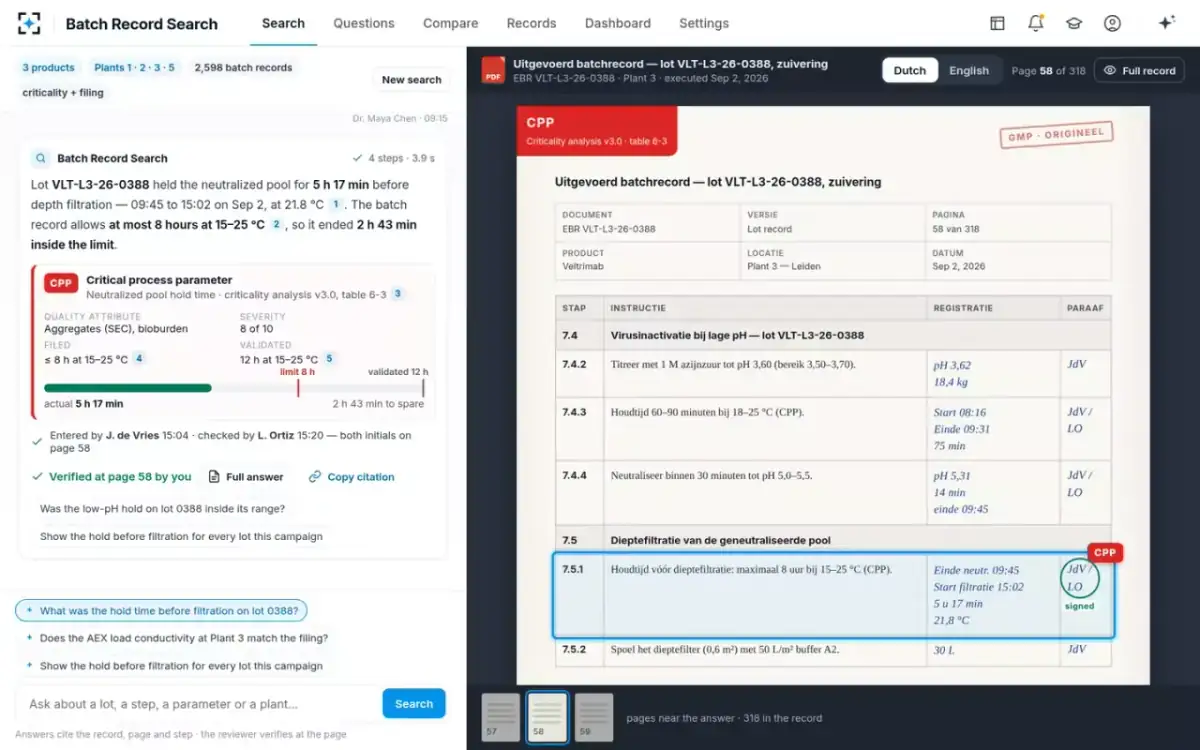
Both initials and the reviewer's own check, recorded at the page in Batch Record Search
Metadata is the half of the record nobody writes down
The FDA's data integrity guidance makes a point about paper that is usually heard as a point about computers: metadata is the context needed to understand a value, and a value without it means nothing — its own example is a bare number that tells you nothing until you know it is in milligrams (FDA, Data Integrity and Compliance With Drug CGMP, question 1(b)). A handwritten batch record is full of the same problem. A box containing "5,17" is meaningless without the step it sits in, the unit the form implies, the date at the head of the page and the decimal convention of the country.
The same answer continues: "Data should be maintained throughout the record's retention period with all associated metadata required to reconstruct the CGMP activity… The relationships between data and their metadata should be preserved in a secure and traceable manner." On paper, that relationship is physical — the entry is on the form, the form is in the record, the record is in the batch file. A scan preserves it only if the pagination, the headers and the order survive the scanning. It is the cheapest thing in the chain to lose and the most expensive to reconstruct.
Where forty-two minutes go when one batch-record question is answered by hand
One answer, by hand, across the record, the criticality analysis and the filing
- Finding the right plant, record, version and lot · 14%
- Paging to the step in a scanned record of several hundred pages · 29%
- Reading the handwriting, and translating it · 14%
- Looking the parameter up in the criticality analysis · 14%
- Checking the filed limit and the validated hold · 14%
- Writing it up with citations and the reviewer’s check · 15%
Read that split as a documentation-practice argument rather than a product one. More than half the effort goes on retrieval and legibility — finding the right version, finding the page, and working out what the writing says. None of it is the skilled work. All of it is the price the reader pays for decisions made at the writing end, years earlier, by people who were following the rules.
Reading one page back: a worked walk through an executed step
Take one step as a reader meets it. The page is a scan of a Dutch executed record; the step is a hold before depth filtration; the question is whether the lot held inside its limit. Below, each element of the page is set against what it lets a reader establish and what it leaves open — because the second column is where good documentation practice is actually spent, and the third is where it runs out.
One scanned step, and what a reader can and cannot establish from it
On the pageThe printed instruction and its limit
What it says"… maximaal 8 uur bij 15–25 °C (CPP)"
What it establishesThe rule the operator was working to, in the version of the record they held.
What it leaves openWhether that version was the effective one on this date, and whether the limit matches the registered range.
On the pageThe first handwritten time
What it says09:45
What it establishesWhen the preceding step ended — one end of the hold.
What it leaves openWhether the plant’s instruction defines the clock as starting here, or at transfer, or at sampling.
On the pageThe second handwritten time
What it says15:02
What it establishesWhen depth filtration began. With the first entry, the duration: 5 h 17 min.
What it leaves openNothing, if both entries are legible and unaltered. Everything, if either is not.
On the pageThe recorded temperature
What it says21,8 °C
What it establishesThat the hold was at a condition inside the printed 15–25 °C range.
What it leaves openWhether the decimal comma is a comma or a smudged full stop — a reader must not silently normalise it.
On the pageA corrected digit
What it saysone line through the original, initialled and dated
What it establishesThe original value, still readable, and who changed it and when.
What it leaves openWhy, unless the reason was written. For a critical entry, the inspectorate expects the reason and the supporting evidence.
On the pageThe operator initial
What it saysJ. de Vries, 15:04
What it establishesWho performed the step, and when they signed for it.
What it leaves openNothing, if the signature log for that period still exists and the initials are unique in it.
On the pageThe second-person initial
What it saysL. Ortiz, 15:20
What it establishesThat an independent person checked, and when.
What it leaves openWhether that person was qualified and independent, which is a question for the procedure in force then.
On the pageThe margin note
What it saysa deviation reference against the step
What it establishesThat something departed from the instruction and was written down at the time.
What it leaves openThe whole of the investigation, which lives in another document with its own number.
Two patterns show up once the page is laid out this way. The entries settle facts; the open column is nearly always about a different document — the version in force, the procedure in force, the signature log, the deviation file, the registered range. And the one row where the page can fail completely is the correction: every other row degrades gracefully, but an obscured original leaves nothing to read back at all.
A question in plain words, answered beside the scanned page, in Batch Record Search
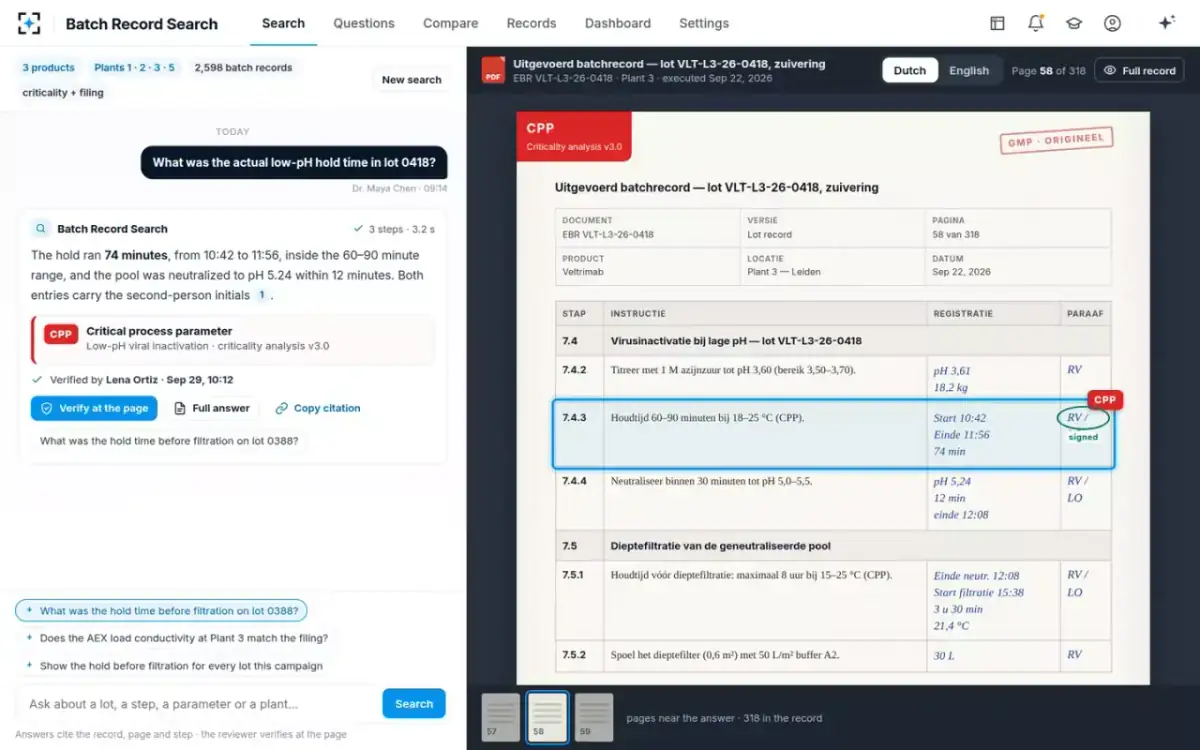
Good documentation practice is, in the end, a discipline about strangers. Everything on the page is written for someone who will not be in the room. When that stranger reads in another language, the demands get sharper still. To see one page answered with its entries, its initials and its limits, start from Batch Record Search.
Questions people ask
What do the letters in ALCOA mean?
Attributable, legible, contemporaneously recorded, original or a true copy, and accurate. The FDA's data integrity guidance uses it to summarise what complete, consistent and accurate data should be, and footnotes each letter to the regulations behind it. The extended form ALCOA++ adds complete, consistent, enduring, available and traceable; the European draft revision of GMP Chapter 4 uses that longer form, and that draft is a consultation text that closed on 7 October 2025 and is not in force.
Can you use a scanned copy of a batch record?
Yes, where the scan is a true copy. 21 CFR 211.180(d) allows records to be retained as original records or as true copies, including photocopies, microfilm, microfiche and other accurate reproductions, and 211.180(c) accepts records retrieved electronically from another location. The copy has to be made under a controlled procedure, verified as complete and accurate against the original, and identified as a true copy — and the pagination has to be checked, because a page missed by a feeder is invisible in the scan.
What makes a scan a true copy?
A copy that has been verified against the original as complete and accurate, and identified as a copy rather than an original. PIC/S describes the act for paper: obtain the original, copy it so no information is lost, verify the authenticity of the copy, and sign and date it as a true copy. For electronic records it asks for an electronic file copy including all required metadata, and warns against making PDFs where metadata would be lost. A document that merely looks like the original is not a true copy.
What is a scribe entry, and when is one allowed?
A scribe entry is a record made by a second person on behalf of the operator who did the work. PIC/S treats it as exceptional and allows it in two cases: where the act of recording would put the product or activity at risk, and to accommodate cultural, literacy or language limitations. The conditions are strict — the recording must be contemporaneous, both people must be identified on the record, the performer should countersign where possible, and the arrangement must be described in an approved procedure.
Can AI read handwritten batch records?
Modern handwriting on a structured, printed form is the case machine reading handles best, and a batch record entry is about as structured as handwriting gets. The published benchmarking is more cautious than the marketing: a 2025 peer-reviewed study comparing multimodal language models with purpose-trained recognition systems found them strongest on English and on modern handwriting, weaker on other languages, and without a significant capability to correct their own errors. The honest design follows from that last point: cite the page, show it, box the step, and let a named reviewer verify.
How legible does a handwritten entry have to be?
Legible enough to be read, unambiguously, by someone who was not there — which is a higher bar than legible to the writer. EU GMP clause 4.7 asks for entries made in a clear, legible, indelible way, and the inspectorate's checklist unpacks it as unambiguous: no unknown symbols, no unexplained abbreviations, no ditto marks, and dates in the unambiguous format defined for the site. The reason for the strictness is retention: an entry may be read for the first time years after the person who wrote it has left.