FDA inspection readiness is usually prepared as a set of documents and a rehearsal, but the thing an investigator actually experiences is retrieval time: how long it takes the back room to put the right page, at the right version, in front of the person who asked. That gap is hard because a single request rarely maps to a single document — proving one process step means producing the executed lot record, the criticality analysis that classifies the parameter, the registered range in the dossier and the study that validated it, each owned by a different function and each with a version history. Botminds' Batch Record Search answers that kind of request from the records a site already keeps, citing the document, page and step for every claim, with a named reviewer checking at the page before anything is used.
The site examples on this page come from a fictional sample network inside the solution: three products made at Plants 1, 2, 3 and 5, with 2,598 batch records and 3,232 effective documents in English, Dutch and French. The inspection figures are FDA's own, from its published citation data and its Office of Pharmaceutical Quality reports, linked where they appear.
What FDA's own FY2025 drug citation data holds
713
Form 483s issued to the drugs programme in FY2025 from FDA’s inspection system
2,837
drug citations in that data, across 316 distinct citation rows
236
of them under 21 CFR 211.192, investigations of discrepancies and failures
972
FDA-conducted drug quality assurance inspections in FY2024, up 27% on FY2023
What inspection readiness is, measured from the back room
Many readiness programmes are measured by what has been prepared: the site master file is current, the presenters are trained, the front room and back room are staffed, the tour route is agreed. Those are necessary and they are not the measure. The measure is what happens in the ninety seconds after an investigator asks for something — whether the back room knows which document answers, which version was in force on the date in question, who owns it, and how long it takes to put it on the table in a form the investigator can read.
That is worth stating as a number because it behaves like one. A site that cannot produce a lot record for a 2024 campaign inside an hour will not discover this during an inspection for the first time; it will discover it every time anyone asks, and the inspection is simply the occasion when the cost becomes visible. The useful readiness exercise is therefore not another mock inspection. It is a stopwatch on ten real requests, run on an ordinary Tuesday.
"All records required under this part, or copies of such records, shall be readily available for authorized inspection during the retention period at the establishment where the activities described in such records occurred."
21 CFR 211.180(c), on where records must be and how fast
What do FDA investigators cite most on drug inspections?
FDA publishes a spreadsheet of the areas of regulation cited on the Form 483s its inspection system generates, by fiscal year and by programme area. In FY2025, the drugs worksheet carries 2,837 citations across 316 rows. The six single rows cited most often are below, and they describe a programme of inspection that is mostly about written procedures, investigations and laboratory control.
The six most-cited single citations on US drug inspections, FY2025
Read as sections rather than single rows, the picture sharpens further. All the rows under 21 CFR 211.192, the production record review and discrepancy investigation requirement, add up to 236 citations — the second-largest section in the drugs data after the quality unit's own procedures. Under it sit rows named "written record of investigation incomplete" (32) and "no written record of investigation" (22). Those are not findings about a process going wrong. They are findings about the record of it.
The FY2025 numbers, and what they say about records
Three section totals in the same data are small enough to be worth looking at closely, because they are the ones that sit squarely on batch documentation. Citations under 21 CFR 211.188, the batch production and control record requirement, total 69. Under 211.186, master production and control records, 16. Under 211.180, general record requirements including retention and annual review, 64 — and six of those are the specific row "records not made readily available to FDA".
Six citations in a year is a small number, and it should be read carefully: the row counts records that were not made available, not records that arrived late. What the data cannot show, because no published dataset measures it, is how many requests were satisfied slowly: the hour in the back room, the call to a retired colleague, the superseded version produced first and corrected later. Those cost nothing in citations, and they still shape how the rest of the inspection goes.
The 236 citations under 211.192 are the more useful signal for a documentation programme. An investigation is only as good as the records it rests on, and an investigation that cannot cite the executed page, the parameter's criticality and the registered range is an investigation an investigator will push on. What makes a process parameter critical covers the classification side of that argument in detail.
How quickly must a record be produced?
There is no stated number of minutes. US drug GMP requires that records, or copies of them, be "readily available for authorized inspection during the retention period at the establishment where the activities described in such records occurred", and that they be available for photocopying or other reproduction as part of the inspection. The same paragraph adds the clause most relevant to a modern site: "Records that can be immediately retrieved from another location by computer or other electronic means shall be considered as meeting the requirements of this paragraph."
"Readily available" and "immediately retrieved" are the standard, and they are judged in the room. An investigator forms a view of a quality system partly from how a site behaves under a document request, and a back room that takes two hours over a lot record has told them something about the system before anyone reads the record.
Electronic records are squarely inside the request, too. FDA's data integrity questions and answers put it plainly: "All records required under CGMP are subject to FDA inspection. This applies to records generated and maintained on computerized systems, including electronic communications that support CGMP activities." The guidance gives an email authorising batch release as an example of a CGMP record FDA may review, and points back at 211.180(c) for the obligation to allow inspection, review and copying, including copying of electronic data.
The four documents behind one typical request
Take a request an investigator makes routinely: show me the hold before filtration on this lot, and show me it was inside what you registered. It sounds like one document. It is four, owned by four functions, and the two in the middle each have a superseded version sitting beside the effective one.
One request, unpacked: four documents, four owners, four version questions
The executed record for the lot
The documentExecuted batch record, 318 pages, Dutch, Plant 3
OwnerPlant 3 document owner
VersionThe lot record as executed on 2 September
Is that step critical?
The documentProcess parameter criticality analysis CA-VLT-DSP-004
OwnerMSAT lead
Versionv3.0, effective 30 September — v2.0 retired
What did you register?
The documentCTD Module 3.2.S.2.4, the registered ranges
OwnerRegulatory CMC
VersionThe version in force for this market
How long is the hold validated for?
The documentHold time study HTS-VLT-012
OwnerProcess validation
VersionThe study the filing rests on
In the sample network the answer to that request is that lot VLT-L3-26-0388 held its neutralized pool for 5 h 17 min before depth filtration, from 09:45 to 15:02 on 2 September at 21.8 °C, written at step 7.5.1 on page 58 of a 318-page Dutch record, with the operator's and checker's initials beside the entry. The batch record allows at most eight hours at 15–25 °C; the criticality analysis classifies the parameter as critical with a severity of 8 out of 10; the registered range in the dossier is the same eight hours; and the hold time study validated twelve. Four documents, one answer, and every number in it attributable to a page.
Version control under pressure: citing a superseded document
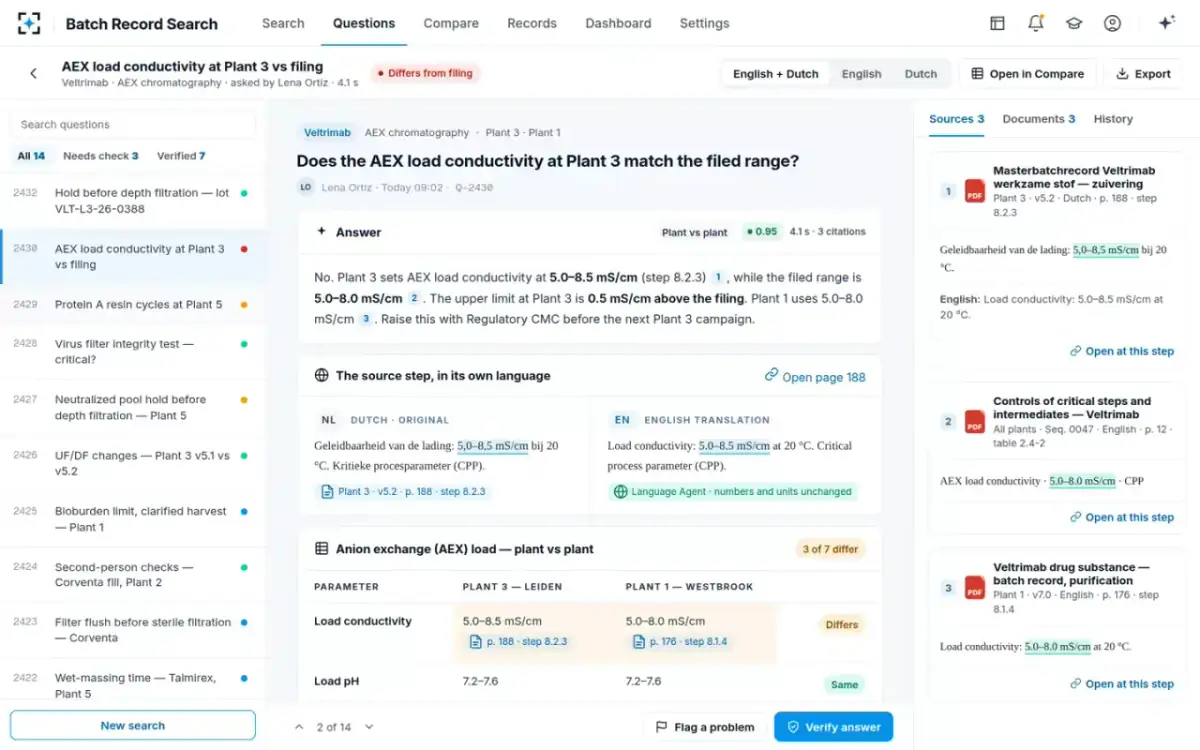
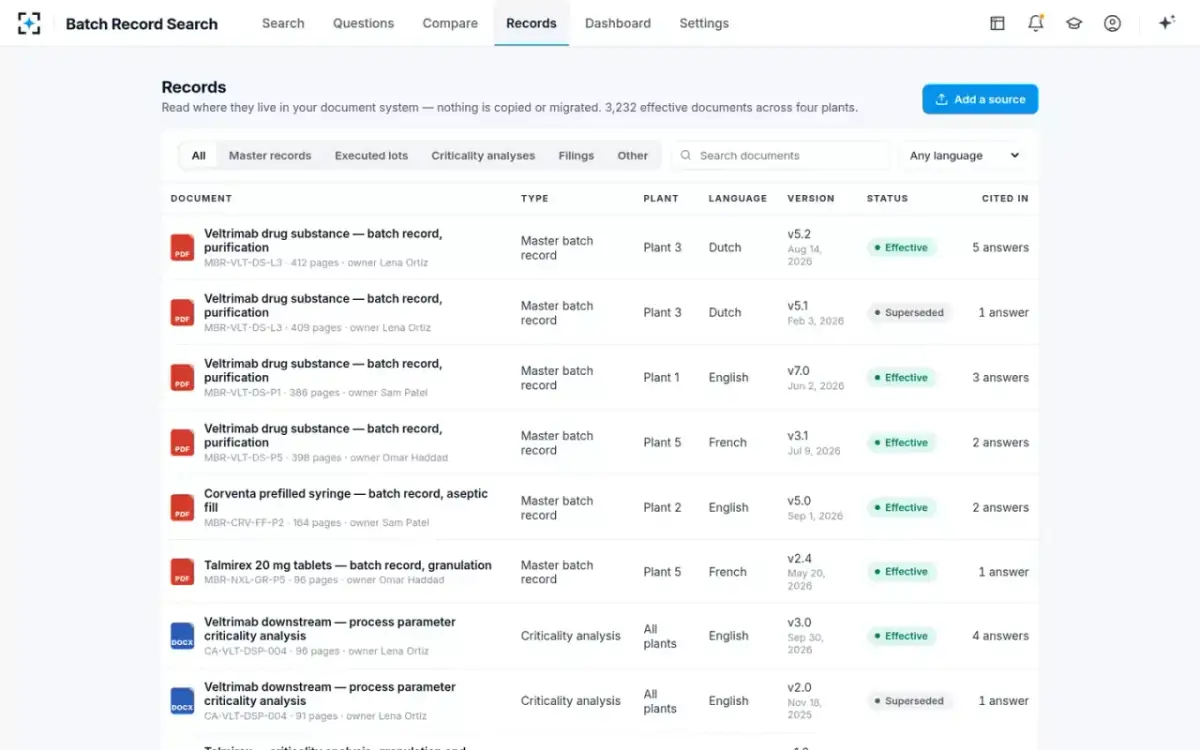
The quiet failure mode of a well-stocked back room is producing the wrong version confidently. In the sample network's records list, the Plant 3 master batch record exists as v5.2, effective 14 August 2026, and as v5.1, superseded — 412 and 409 pages respectively, both in Dutch, both findable, differing in three ultrafiltration steps under one change control. The criticality analysis exists as v3.0, effective 30 September, and v2.0, superseded, with two parameters reclassified between them.
An answer built on v2.0 of that analysis may classify a parameter as non-critical when the effective version calls it critical. If that answer reaches a deviation investigation, the investigation is wrong in a way that is both material and easy for an investigator to find, because the retired version is sitting in the same system. This is why the solution cites only effective versions unless a question names a past one, and why its intake agent retires superseded versions once the document's owner confirms the effective date rather than on upload.
A full answer in Batch Record Search, with its sources and their versions
What the inspection volume looks like now
Inspection volume has climbed steeply since the pandemic. FDA's Office of Pharmaceutical Quality reports that in FY2024 there were 972 FDA-conducted drug quality assurance inspections, an increase of 27% from the 766 accomplished in FY2023, which was itself up from 522 in FY2022. At the end of FY2024, CDER's site catalog held 4,619 manufacturing sites worldwide, 41% of them in the United States.
The geography matters for multi-site networks. The same report records that "In FY2024, more than 62% of drug quality assurance inspections were at foreign sites —an all-time high", with 34% of catalogued sites in India and 28% in China inspected that year, against 24% of US sites. For a network whose records are written in three languages at four plants, that means the inspection is as likely to land on the site whose records nobody at headquarters can read as on the one next door.
Running the back room as a retrieval desk
The back room's job during an inspection is identical to the job an MSAT or quality desk does every other week of the year: find the document, confirm the version, read the step, state what it says. Treating it as a different activity — staffed by different people, using a different filing arrangement, rehearsed rather than practised — is what makes it slow.
The back room as many sites staff it, against the back room as a retrieval desk
Staffed for the week of the inspection: Senior people pulled off their own work for the duration, plus a runner.
Run as the desk that answers all year: The people who answer document questions every week, with the same tools they use every week.
Staffed for the week of the inspection: By knowing who to call. The knowledge lives in a handful of long-serving heads.
Run as the desk that answers all year: By searching the document system the records already live in, and reading the cited page.
Staffed for the week of the inspection: Checked by the person who fetches, under time pressure, at the moment of maximum cost.
Run as the desk that answers all year: The effective version is what comes back; a superseded one appears only when the request names it.
Staffed for the week of the inspection: A document, with the relevant part found by the investigator or pointed to verbally.
Run as the desk that answers all year: The page, with the step identified, and the other three documents the request implies already located.
Staffed for the week of the inspection: A list of commitments reconstructed from notes afterwards.
Run as the desk that answers all year: A record of every request, what was produced, which version, and who checked it.
Staffed for the week of the inspection: By the number of observations at the close-out meeting.
Run as the desk that answers all year: By time to the right page, on ordinary requests, all year.
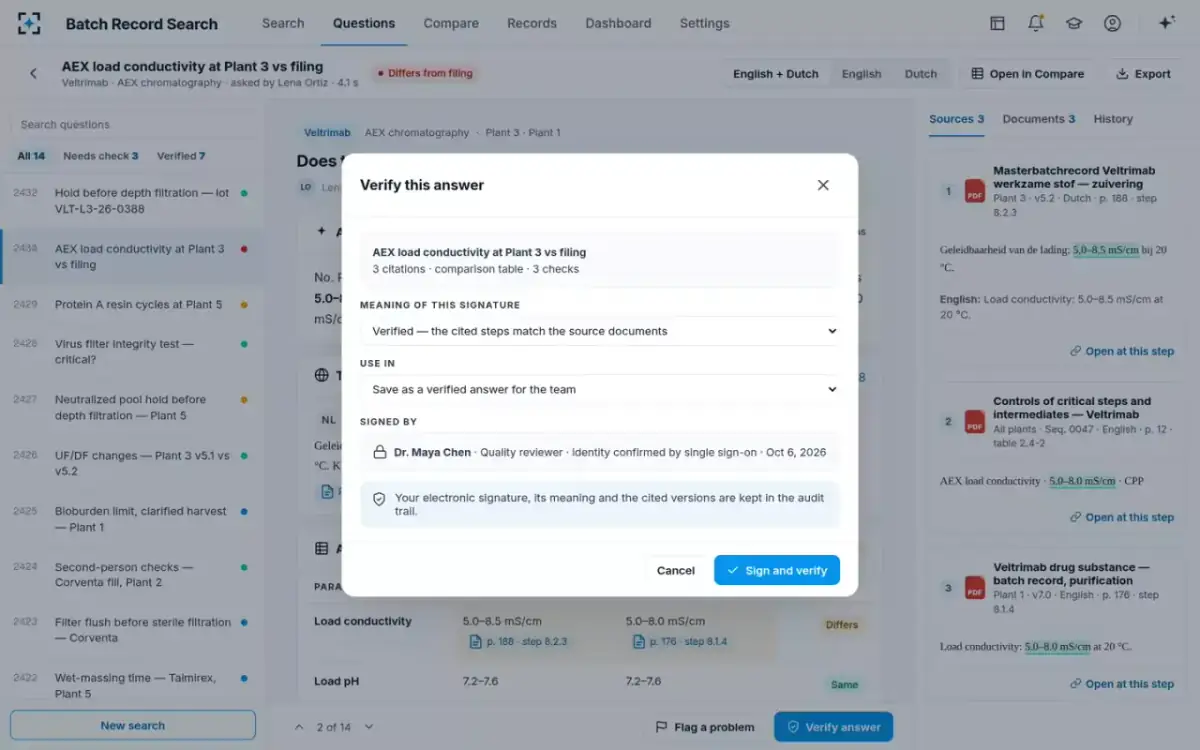
One part of the right-hand column is not optional, and it is the part a tool must not take over. Under US drug GMP, "all drug product production and control records, including those for packaging and labeling, shall be reviewed and approved by the quality control unit to determine compliance with all established, approved written procedures before a batch is released or distributed". Retrieval can be automated. Review and approval cannot, and in the solution the signature that carries them is a named person's, with its meaning recorded and the cited versions kept beside it.
Signing an answer in Batch Record Search: what it means, and where it may be used
A readiness test you can run on your own records this month
The exercise below needs one morning, two people and no new software. Pick ten requests of the shapes investigators actually make, run them cold on real documents, and record the clock and the version. The time to beat is not a published figure; it is whatever the slowest of the ten took, which is the one an investigator will find.
Ten requests, timed cold, on your own documents
- The executed record for a named lot from two years ago
A routine request. Time it from the request to the page open, not to the file located.
- One process step inside that record, by name rather than by step number
Investigators ask for the hold before filtration, not for step 7.5.1. Someone has to make that translation.
- The version of the master record that was in force on the lot’s manufacturing date
Not the current one. This is where a site can produce the wrong document confidently.
- The criticality classification of the parameter in that step
And the version of the analysis it comes from, with its effective date.
- The registered range for the same parameter in the dossier
Owned by regulatory affairs, usually in a different system from the batch records.
- The study the validated limit rests on
Hold time, cleaning validation or process validation, as applicable to the step.
- The deviation record for a lot that had one, and the batch record page it refers to
The pairing is the point: 236 FY2025 drug citations sit under the investigation requirement.
- The same step at a second site that makes the same product
If the two differ, you want to know before the question is asked in the room.
- A record in a language the person answering does not read
Count the time to a translation that keeps the numbers, units and step numbers exactly as written.
- Proof that the second-person check was performed on the entry
Initials, times and the procedure that required them. An unsigned entry is a finding waiting to be made.
Run the ten, write the times down, and the readiness conversation changes shape: instead of arguing about how many rehearsals to hold, a site is looking at which of ten ordinary questions takes forty minutes and why. For many sites the answer is not the document system but the step between the request and the document — the knowing which one, at which version. Why a document system stores well and finds badly takes that apart, and what good documentation practice expects of an entry covers the handwriting the back room has to read. To see a request answered end to end on sample records, start from Batch Record Search.
The estate a back room has to reach into, version by version
Questions people ask
What is a Form 483?
A list of observations an FDA investigator leaves at the end of an inspection. In FDA's words, observations "are listed on an FDA Form 483 when, in an investigator's judgment, the observed conditions or practices indicate that an FDA-regulated product may be in violation of FDA's requirements". It is not a final agency determination; the site responds, and what follows depends on the response and the severity. FDA's system issued 713 of them to the drugs programme in FY2025.
How quickly must you produce a record in an inspection?
No regulation states a number of minutes. The requirement is that records be readily available for authorised inspection at the establishment where the activity happened, and 21 CFR 211.180(c) treats records that "can be immediately retrieved from another location by computer or other electronic means" as meeting it. In practice the standard is judged in the room, which is why timing ten ordinary requests tells a site more than another rehearsal.
Can FDA look at electronic records?
Yes, and at the systems holding them. FDA's data integrity guidance states that all records required under CGMP are subject to inspection, including those generated and maintained on computerised systems and electronic communications that support CGMP activities — it gives an email authorising batch release as an example. The same guidance points back at 211.180(c) for the obligation to allow inspection, review and copying of electronic data.
Which part 211 sections are cited most on drug inspections?
In FDA's FY2025 drugs data, the single most-cited citation is 21 CFR 211.22(d), quality unit procedures not in writing or not fully followed, at 243. Next come 211.192 on investigations of discrepancies and failures at 164, 211.100(a) on written production and process controls at 162, and 211.160(b) on laboratory controls at 121. Counted as whole sections rather than single rows, 211.192 reaches 236.
How many FDA drug inspections are there a year?
FDA's Office of Pharmaceutical Quality reported 972 FDA-conducted drug quality assurance inspections in FY2024, up 27% from 766 in FY2023 and 522 in FY2022, plus 198 inspections classified under mutual recognition agreements. More than 62% of the FY2024 inspections were at sites outside the United States, the highest share recorded.
What happens if you cannot find a document during an inspection?
If a required record genuinely cannot be produced, it is citable: FDA's FY2025 drugs data carries six citations under the row "records not made readily available to FDA". The more common outcome is slower and less visible — the record arrives late, or the wrong version arrives first. Neither is a citation on its own, and both change how the rest of the inspection goes.