A document management system in the pharmaceutical industry is built to do one job extremely well: prove that the right version of a controlled document exists, that it was reviewed and approved, that the superseded one has been withdrawn, and that the people who need it have it. That job is hard, it is audited, and a good system is worth what it costs. What it is not built for is the question a quality reviewer actually arrives with — what was the hold before filtration on this lot, and was it inside what we registered — because that answer lives on one page inside a three-hundred-page scanned record, in handwriting, in the plant's own language, and needs three other documents to be complete. Botminds' Batch Record Search sits beside the document system, reading those records where they already live and answering with the document, page and step cited.
The site figures below come from a fictional sample network inside the solution: three products at four plants, 2,598 batch records and 3,232 effective documents in English, Dutch and French. The wage figures are the US Department of Labor's, and the regulatory material is the European Commission's, ICH's and FDA's own, linked where each appears.
The four numbers the comparison turns on
$62,280
median annual wage for quality control analysts in the United States, 2025
$102,440
median annual wage for manufacturing engineers, the other people who answer these questions
42min
to find and prove one batch-record answer by hand — our estimate, not a measurement
~14min
to a checked answer: the solution’s design target, not a measured outcome
What a pharmaceutical document management system is for
Document control is a GMP requirement before it is a software category. EU GMP Chapter 4 requires that it be "clearly defined which record is related to each manufacturing activity and where this record is located", and that secure controls be in place to ensure the integrity of the record throughout the retention period, validated where appropriate. A document management system is how a site discharges that: a controlled repository with versions, effective dates, owners, review cycles, withdrawal of superseded copies, access rules and an audit trail.
Judged on that job, a good system does it well. It can tell you, in seconds, that master batch record MBR-VLT-DS-L3 is at v5.2, effective 14 August 2026, owned by the Plant 3 MSAT lead, that v5.1 was superseded on that date, and who has acknowledged the current version. US drug GMP adds the retention and review obligations the same system carries: records must be kept so that their data can support an evaluation, at least once a year, of each drug product's quality standards (21 CFR 211.180(e)).
None of that is retrieval of content. Every one of those facts is about the document as an object — its identity, its version, its status, its custody. The question a reviewer asks is about something written inside it.
Control is not retrieval: the job a DMS is not built to do
The gap is easiest to see on one request. Ask a document system for the master batch record for Veltrimab drug substance at Plant 3 and it answers instantly and correctly. Ask it what the hold before depth filtration is allowed to be at Plant 3, and whether lot 0388 stayed inside it, and the system's honest answer is a 412-page Dutch PDF and a 318-page Dutch scan. Both answers are the system working as designed.
Completing the question needs three more documents that are also not the record: the criticality analysis that says whether the parameter is critical, the registered range in the dossier, and the hold time study behind the validated limit. In the sample network that difference is visible in the counts — 2,598 batch records, 3,232 effective documents — and the extra six hundred or so are where much of a process answer lives.
So the unit of work differs. A document system is priced and judged per controlled document: how many, how well governed, how quickly approved. The reviewer's work is priced per answered question. A site that compares the two purchases on the first unit is likely to conclude it already owns what it needs, and will keep paying for the second in minutes that never appear on a budget line.
Does a document management system search inside documents?
Usually yes, in the sense of full-text search across documents that carry a text layer, and that capability is real but shallow for this job. It will find the string "houdtijd" across a corpus. It will not tell you that the hold at step 7.5.1 ran from 09:45 to 15:02, that 09:45 and 15:02 are handwritten in two different hands, that the step is classified critical in the effective version of a separate analysis, and that the registered range in a third document is the same eight hours.
Three things defeat an index on exactly this corpus. The first is that the query is semantic, not lexical: "before filtration" is the reader's phrase for the neutralized pool hold, and no amount of keyword matching bridges that. The second is that the answer is a relationship between values on a page — a start time, an end time, a temperature and a limit — rather than a passage. The third is language: the same step is written in Dutch at one plant and French at another, and a search in English finds neither.
Scanned pages and handwriting: where index search runs out
An executed batch record is the hardest document in the estate to search, and it is also the one most questions are about. It is a scan of a printed form filled in by hand, entry by entry, across hundreds of pages, with initials beside each entry and a second person's initials beside the checks. Optical character recognition will read the printed instruction well and the handwriting variably, and nothing in a conventional index knows which column a value belongs to.
The draft revision of EU GMP Chapter 4 names the standard that matters here, in its definition of legibility: "Where the 'dynamic' nature of electronic data (the ability to search, query, trend, etc.) is important to the content and meaning of the record, the ability to interact with the data using a suitable application is important to the 'availability' of the record." It is a consultation text and not in force, but it draws the right line — a record you can display but not interrogate is only partly available, and a scanned archive is the clearest example of that.
Every question across the plants, and what each one cost to answer
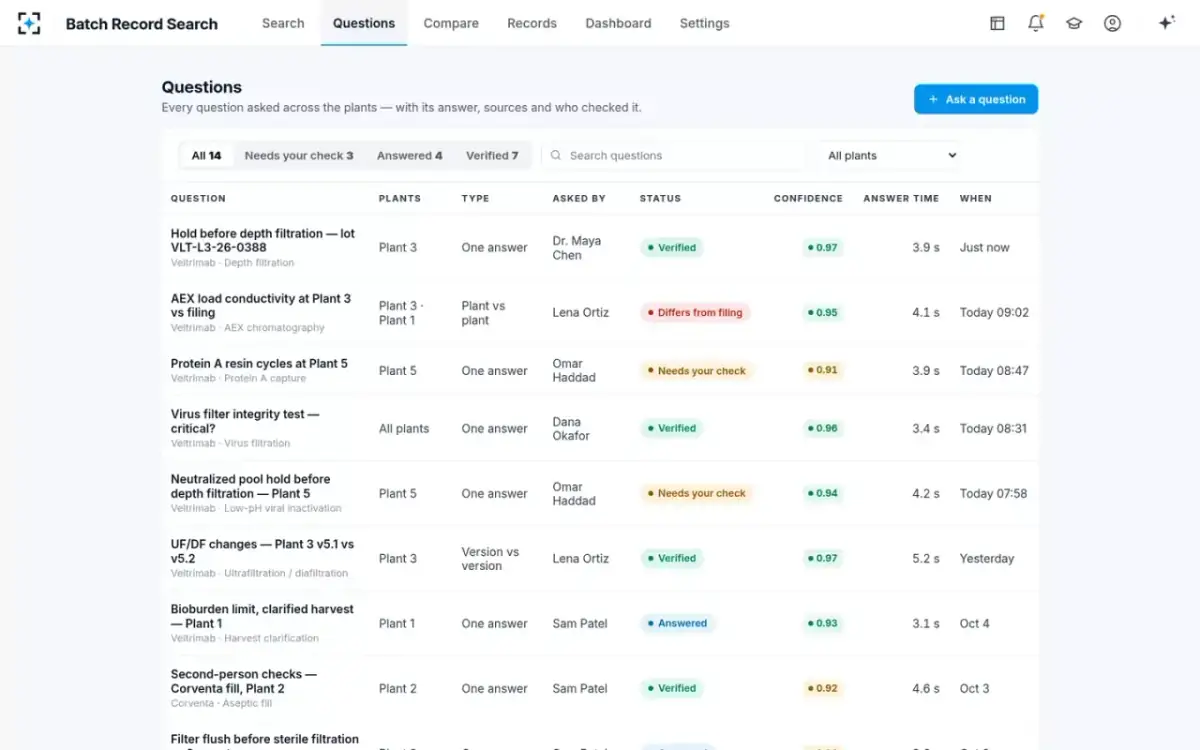
The unit that matters: cost per answered question
Price the work in the unit the work actually arrives in. One answered question, proved to the point where a reviewer will sign for it, is a well-defined piece of work with a measurable duration, a wage attached and a volume that a site already knows from its deviation, change control and annual review load.
Cost per answered question, from published wages
Minutes to a checked answer
42 min by hand · about 14 min with the solution
The first is our estimate of the manual work, the second the design target. Measure your own before using either.
Measured by the desk that does the work
The rate you price it at
$49.25 an hour
O*NET’s 2025 median hourly wage for the occupation manufacturing engineers report from. Substitute your own loaded rate, which will be higher.
Finance
One answer
minutes ÷ 60 × rate
$34.48 by hand against $11.49 to a checked answer — a difference of $22.98 an answer.
Our arithmetic on the figures above
A year of answers
questions per lot × lots per year
Your number, from your deviations, change controls and reviews. Per 1,000 answered questions the gap is $22,983.
Quality and MSAT
Two honest caveats belong with that arithmetic. The first is that the minutes are an estimate and a target, not a measurement, which is why the first term says to measure your own: a fortnight's log on a real desk costs nothing and replaces both numbers with something defensible. The second is that the wage is a wage, not a loaded cost — a site that applies its own fully loaded rate will get a larger number, and that is the one finance will want.
Working the number: minutes, loaded rate, questions per lot
The 42 minutes is not one slow task; it is six, and only one of them is the part a reader would call the work. The solution's own estimated split puts six minutes on finding the right plant, record, version and lot; twelve on paging to the step inside a three- to four-hundred-page scanned record; six on reading the handwriting and translating it; six on looking the parameter up in the criticality analysis; six on checking the filed limit and the validated hold; and six on writing it up with citations for the reviewer's check.
Where the 42 minutes go on one answer, by hand
Grouped, the shape is starker. Finding and paging is 18 of the 42 minutes, 43% of the total, and it is pure mechanical retrieval. Reading and translating is another 14%. Looking up the criticality and the filing — reading two other documents to complete the answer — is 29%. Writing it up for a reviewer is the last 14%, and that is the part that should not get faster, because it is what the reviewer checks.
The same answer by hand and to a checked answer, as shares
By hand · 42 minutes, estimated
- Finding and paging · 43%
- Reading and translating · 14%
- Criticality and filing · 29%
- Writing it up · 14%
To a checked answer · about 14 minutes, design target
- Finding and paging · 7%
- Reading and translating · 21%
- Criticality and filing · 36%
- Reviewer checks and signs · 36%
That second bar is the honest picture of what an answer layer does and does not buy. It does not make judgement faster. It removes the retrieval, which is why the reviewer's share rises even as the total falls — the work that remains is the work worth paying an expert for.
What knowledge management asks for, beyond a filing system
ICH Q10 asks for something a document system does not provide, and names it. It calls it knowledge management: a deliberate, systematic way of acquiring, analysing, storing and disseminating what is known about products, manufacturing processes and components (ICH Q10, section 1.6.1), drawing on prior knowledge, development studies, technology transfer, validation studies, manufacturing experience, innovation, continual improvement and change management.
Four verbs, and a document system covers one and a half of them. Storing, yes, and some of acquiring. Analysing and disseminating are where it stops, and they are the half the questions live in. A site that treats its document system as its knowledge management system has satisfied the storage clause and left the other three to whoever happens to know.
That is not an argument for replacing the document system. It is an argument for being clear about which clause each purchase satisfies, so that neither is asked to do the other's job. The desk that currently absorbs the difference is often MSAT, and it is where the unmeasured cost accumulates.
Keeping the system of record and adding Batch Record Search beside it
The arrangement that works is unglamorous: the document system stays the system of record, keeps control, versions, approvals, withdrawal and retention, and nothing migrates. An answer layer reads those documents where they live, read only, and answers questions from them with the page cited, leaving the signature to a named person.
A document system and an answer layer, eight rows
| A pharmaceutical document management system | An answer layer over the same documents | |
|---|---|---|
| What it is for | Proving the right version exists, is approved, is current and is in the right hands. | Answering a question about what is written inside those documents. |
| What it indexes | The document as an object: identity, version, owner, status, effective date, access. | Content: the step, the entry, the value, its units and the initials beside it. |
| A scanned handwritten page | Stored, versioned, retrievable as a file; its contents are an image with a partial text layer. | Read page by page and step by step, including the handwritten entries and both sets of initials. |
| What it returns | A document, usually several hundred pages of it. | A stated answer, with the document, page and step cited for every claim. |
| Who checks the result | Nobody needs to: the system states a fact about the document, not about the process. | A named reviewer, at the cited page, before the answer may be used in a deviation or a change control. |
| What it proves to an inspector | That documentation is controlled, current and retrievable. | That an answer rests on a specific page of a specific version, and who verified it. |
| Its unit of cost | Per controlled document, per user, per year. | Per answered question. |
| What it must not replace | Nothing — it is the system of record and should stay one. | The reviewer’s judgement, the release decision, and the document system underneath it. |
What Batch Record Search measures when the unit is an answered question
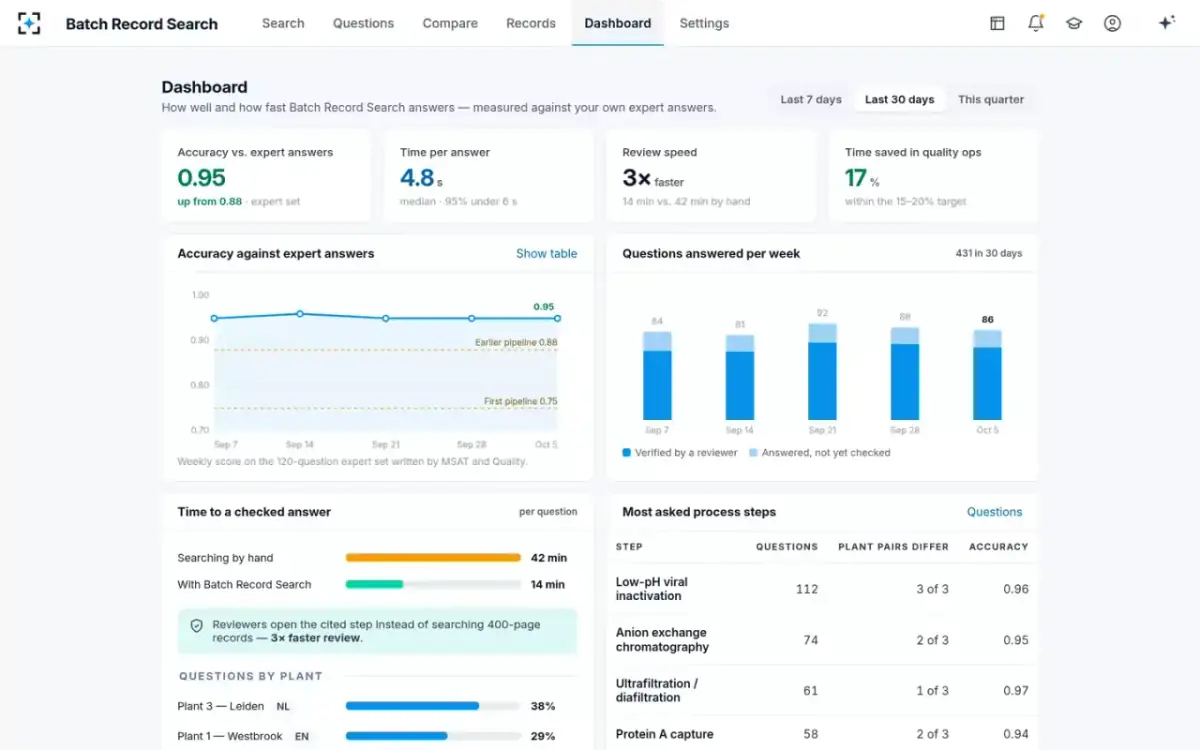
Eight questions to compare the two purchases honestly
Run these before either renewal. They are deliberately answerable from your own records in an afternoon, and most of them will tell you something whether or not you buy anything.
Eight questions, and what each one is really testing
- How long did it take to answer the last ten process questions?
Not an estimate. Ten real ones, timed from request to an answer someone would sign. This replaces every assumed figure, including ours.
- How many documents did each of those ten answers need?
If the average is above one, a system that returns documents is answering a fraction of the question.
- What proportion of those minutes was spent finding rather than deciding?
Split the log two ways. The retrieval share is the only part software can honestly claim.
- Can the system return a page and a step, or only a file?
Ask for a specific step in a specific lot and watch what comes back. The difference is the whole argument.
- What happens on a scanned page of handwriting in another language?
Test it on your worst record, not your best. That record is the one the inspection will reach for.
- How does either system keep a superseded version out of an answer?
Control of versions and citation of versions are different features; a site needs both.
- What is your fully loaded hourly cost for the people who answer?
Finance has this figure. Multiply it by the measured minutes before anyone quotes a return.
- Which ICH Q10 verb does each purchase satisfy — storing, analysing or disseminating?
Writing the answer down usually ends the debate about whether the two overlap.
What the arithmetic will not settle is the part that matters most in a regulated plant: an answer that is fast and wrong costs far more than an answer that is slow and right. That is why the comparison above keeps the reviewer in it, and why a tool worth buying here is one that makes checking easy rather than one that makes checking unnecessary. What an inspection does with a slow answer puts a number on the other side of the same trade, what the draft rules allow an AI to do sets out where the checking has to stay, and Batch Record Search shows the whole sequence on sample records.
Questions people ask
What is the difference between a DMS and a QMS?
A document management system controls documents: versions, approvals, effective dates, withdrawal, access and retention. A quality management system is the wider set of processes a site runs — deviations, CAPA, change control, complaints, training, audits — of which document control is one element. Many vendors sell them together, which is convenient and makes it easy to assume a question-answering capability was included in the bundle.
Can you search scanned documents in a DMS?
Usually to the extent that the scan carries a text layer, and that is the catch. Optical character recognition reads a printed instruction well and handwriting variably, and an index has no idea which column a value sits in or which step it belongs to. On an executed batch record — a printed form filled in by hand over hundreds of pages — keyword search finds pages, not answers.
What does document control mean in GMP?
Knowing which record relates to each manufacturing activity and where it is located, and keeping the integrity of that record throughout its retention period with secure, validated controls. EU GMP Chapter 4 states it in those terms; US drug GMP adds requirements for retention, for records to be readily available for inspection, and for data to support at least an annual review of each product's quality standards.
How much does it cost to answer a GMP question?
Work it from minutes and a loaded rate rather than taking anyone's figure. On the estimate used here — 42 minutes by hand — and O*NET's 2025 median hourly wage of $49.25 for the occupation manufacturing engineers report from, one proved answer costs about $34.48 in wages; at a design target of 14 minutes it is about $11.49. Both minute figures are an estimate and a target respectively, and a site's own measured pair is worth more than either.
How do you find a step in a 300-page batch record?
By hand: identify the plant, product, lot and version, find the section of the record the step belongs to, page to it, read the entry and the initials, then open the criticality analysis and the registered filing to complete the answer. With step-to-page mapping, by naming the step in the reader's own words — "the hold before filtration" — and opening the page it is written on, with the entry boxed.
What is knowledge management under ICH Q10?
A systematic approach to acquiring, analysing, storing and disseminating information about products, processes and components, drawing on prior knowledge, development studies, technology transfer, validation, manufacturing experience and change management. A document system covers the storing. The analysing and disseminating are the parts many sites discharge through individual people, which is why they are invisible on a budget and expensive in practice.