EU GMP Chapter 4 is the documentation chapter of EudraLex Volume 4, and it requires that a manufacturer define every type of document it uses, approve its instructions, record what actually happened contemporaneously and legibly, keep batch documentation for one year past expiry or five years past certification by the Qualified Person, and hold a batch processing record for every batch that is based on the currently approved formula and instructions. What it does not do — anywhere, in the version in force or in the 2025 consultation draft — is name a language. The word "English" appears in neither text, and the word "language" appears exactly once in each. Botminds' Batch Record Search is built for the consequence: a network whose plants write the same step three different ways, in three languages, and must still be able to answer one question about it.
The network on this page is a fictional sample inside the solution — one biologic drug substance made at four plants, with invented lots, people and document references. The clauses are quoted from the Commission's own published texts and linked where they appear.
What EU GMP Chapter 4 actually requires of a record
The chapter opens by splitting documentation into two kinds and setting one standard across both: "There are two primary types of documentation used to manage and record GMP compliance: instructions (directions, requirements) and records/reports… Suitable controls should be implemented to ensure the accuracy, integrity, availability and legibility of documents. Instruction documents should be free from errors and available in writing. The term 'written' means recorded, or documented on media from which data may be rendered in a human readable form" (EudraLex Volume 4, GMP Chapter 4, Principle).
"Human readable form" is the chapter's own standard for what counts as written, and "legibility" is one of the four properties controls must assure. Both are properties of a reader, not of a page. Neither is satisfied by a document that is technically perfect and incomprehensible to the person who has to rely on it — which is the whole of the multilingual problem, stated in the chapter's opening Principle.
The Chapter 4 clauses that bite on a network writing in more than one language
| Clause | What it says | What it means for a plant writing in Dutch or French |
|---|---|---|
| 4.1 — hybrid forms | Requirements apply equally to all document media; many documents are hybrids, with some elements electronic and others on paper, and relationships and control measures must be stated for both hybrid and homogenous systems. | A scanned Dutch page plus an electronic index of its steps is a hybrid record. The relationship between the two has to be defined and controlled, not assumed. |
| 4.4 — style and language | Instruction documents "should be laid out in an orderly fashion and be easy to check. The style and language of documents should fit with their intended use." | The only language clause in the chapter, and it points at the reader. The intended use of a floor instruction is the operator; the intended use of a batch record in a network review is somebody at another site. |
| 4.7 to 4.9 — the entries | Handwritten entries clear, legible and indelible; records made at the time; alterations signed, dated and leaving the original readable. | These are about the hand, not the tongue. A Dutch entry that satisfies them is a good entry; it is simply not yet readable by everyone who will need it. |
| 4.10 — which record, where | It should be clearly defined which record relates to each manufacturing activity and where it is located, with secure controls on integrity throughout the retention period. | In a four-plant network this is the clause that makes "which document answers this question" a documented fact rather than local knowledge. |
| 4.11 — retention | Batch documentation kept one year past expiry or five years past certification by the Qualified Person, whichever is longer. | Long enough that the people who wrote the entries, and sometimes the language skills to read them, will have moved on. |
| 4.20 — the batch processing record | Kept for each batch, based on the currently approved formula and instructions, carrying dates and times, operator and checker initials, in-process controls, yields and deviations. | Every item on the list has to survive a reader at another site. Numbers and initials travel unchanged; the words around them do not. |
What language must a batch record be in?
Chapter 4 does not say. It says this instead, and this is the whole of its language rule:
Documents containing instructions should be laid out in an orderly fashion and be easy to check. The style and language of documents should fit with their intended use.
EU GMP Chapter 4, clause 4.4
Read as a drafting instruction, that sentence is mild. Read as a test, it is demanding, because "intended use" is decided by who has to use the document and for what. For a processing instruction on the floor at Leiden, the intended use is a Dutch-speaking operator under time pressure, and Dutch is plainly the right answer — an English instruction that an operator half-understands fails clause 4.4 however correct its grammar. For the executed record of the same step, the intended use is wider: the site reviewer, the network's quality reviewer, the Qualified Person certifying the batch, a regulatory affairs reader checking the dossier, and an inspector who may arrive from anywhere. The same clause therefore pushes in two directions at once on the same document.
Where a language obligation exists, it comes from national law rather than from Chapter 4, and an inspectorate that cannot read a record may ask for a translation it can. The practical rule a network can operate is simpler than any of this: write for the operator, and be able to produce an accurate rendering for everybody else, with the original beside it.
The seam: the same step, written three ways in three plants
A multi-plant network does not have one record with three translations. It has three records, each authored locally, each versioned on its own change controls, each numbered to suit its own equipment. The language difference is the visible part of a deeper divergence, and the step numbering is often the first thing to go.
One product, four plants, four records — and three working languages
Plant 1English
The network’s reference text. Where a step is contested, this is the version most people have read — which is not the same as the version that governs.
Its own step numbering, set when the record was first issued.
Plant 2English
Same working language as Plant 1, different equipment and therefore a different record, with its own version history.
Numbering diverged from Plant 1 at the first local change.
Plant 3 — LeidenDutch
Executed records are written and signed in Dutch. A reader outside the site meets the step for the first time in translation.
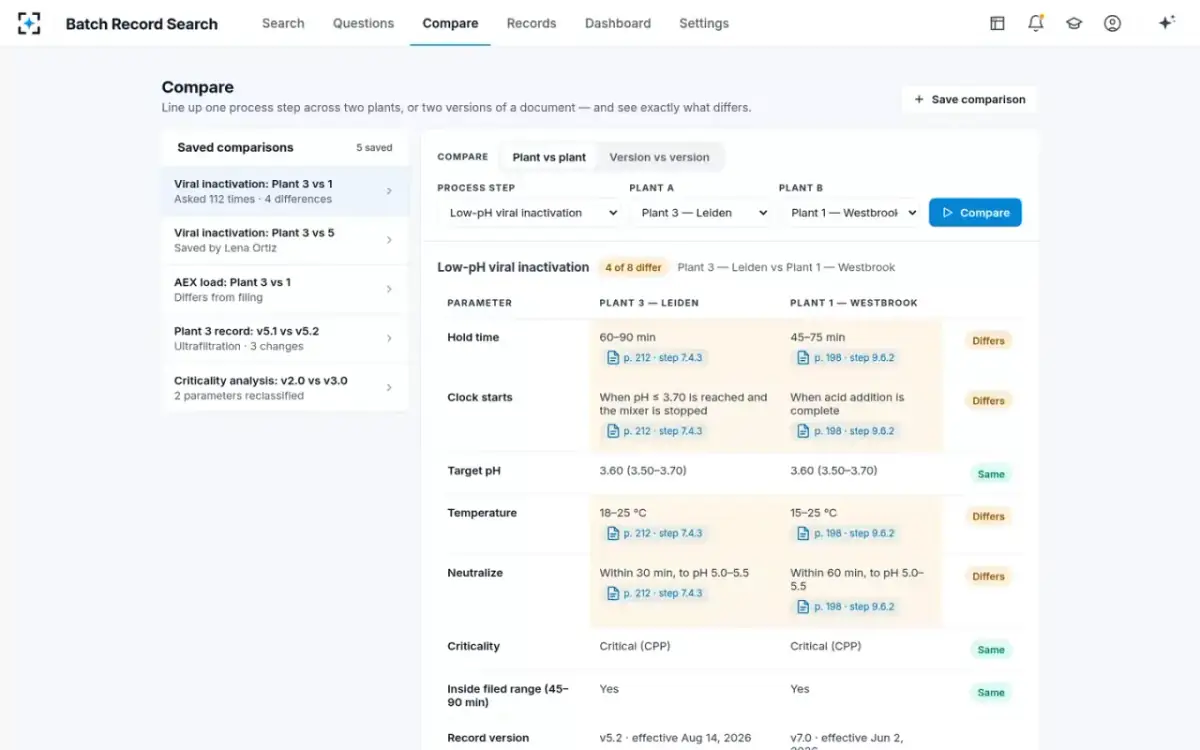
Low-pH viral inactivation is step 7.4.3 here.
Plant 5 — LyonFrench
Executed records in French, verified locally by site quality before anything crosses the network.
The same inactivation step is 7.3.4 here — matched by meaning, never by number.
Three consequences follow, and each one costs time long before it costs anything worse. A question asked in English has to be resolved against a record written in Dutch, which means the question's vocabulary and the record's vocabulary must be connected before any page can be found. A comparison between two plants cannot run on step numbers — in the sample network the same low-pH viral inactivation is step 7.4.3 at one plant and 7.3.4 at another — so it has to run on meaning, with every cell carrying its own citation. And a network-level reviewer has to be confident that what they read in English is what the page says, because their signature is on the conclusion.
Where translation is allowed, and the conditions attached to it
The inspectorates address translation in an unexpected place: the footnote on scribes in the PIC/S data-management guidance, which permits a second person to record on an operator's behalf in limited cases, including language limitations, and then says what good practice looks like around it — "In these cases, bilingual or controlled translations of documents into local languages and dialect are advised" (PIC/S PI 041-1, footnote 8).
Two words in that sentence carry the whole position. "Bilingual" means both texts present, not one replaced by the other. "Controlled" means the translation is a managed document with a version and an owner, not a convenience produced on the day by whoever was available. A translation that satisfies both is evidence; one that satisfies neither is a rumour about a document.
The same logic applies to a rendering produced on demand rather than in advance. If a reviewer is shown English and the Dutch is not on the screen, they are relying on the rendering. If both are shown and the numbers are visibly unchanged, they are relying on the record and using the rendering to navigate it — which is a different, and far more defensible, thing to put a signature under.
Numbers, units, ranges and step numbers: the parts a translation may not touch
Most of a batch-record step is language. A small part of it is not, and that part must come through untouched. The limit, the unit, the range, the step number, the equipment tag, the lot number and the date are the content a decision rests on; everything else is the sentence they sit in.
One Dutch step, and the same step rendered in English beside it
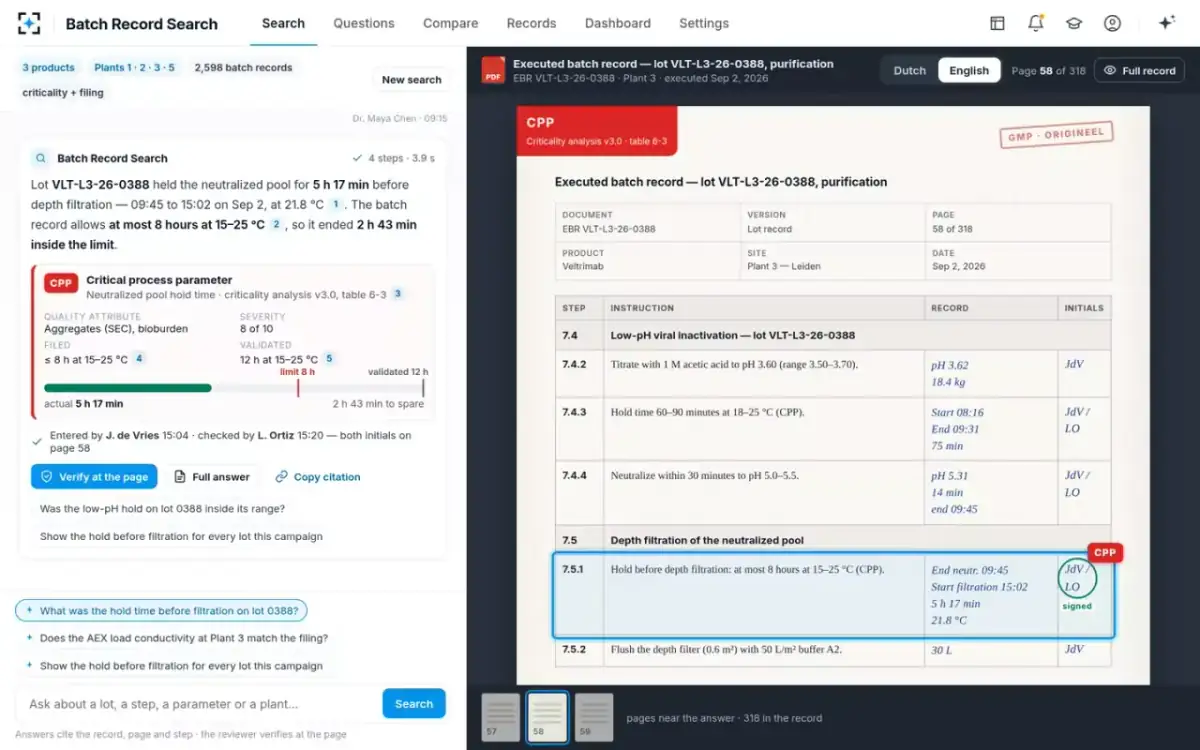
As written at Plant 3: "Houdtijd vóór dieptefiltratie: maximaal 8 uur bij 15–25 °C (CPP)"
As rendered for the reader: "Hold before depth filtration: at most 8 hours at 15–25 °C (CPP)"
As written at Plant 3: 8 uur
As rendered for the reader: 8 hours — the figure unchanged, only the word translated.
As written at Plant 3: 15–25 °C
As rendered for the reader: 15–25 °C — never collapsed to a midpoint, never re-expressed in another scale.
As written at Plant 3: 21,8 °C
As rendered for the reader: 21.8 °C — the convention shown in the reader’s form, the digits identical.
As written at Plant 3: 7.5.1
As rendered for the reader: 7.5.1 — the number belongs to the record, not to the language.
As written at Plant 3: As written on the page, in the operator’s hand.
As rendered for the reader: Reported as read, with the page shown. Not re-typed into the answer as though they were the record.
The decimal mark is worth dwelling on because it is the one place where leaving the original alone and rendering it for the reader genuinely conflict. "21,8" read by someone who expects a thousands separator is 218. Showing "21.8" to that reader is safer than showing "21,8" — and showing both, with the original visible, is safer still. That is the general shape of the right answer throughout: do not choose between the original and the rendering, show both.
The Dutch page in English, entries and step numbers unchanged, in Batch Record Search
What the 2025 draft Chapter 4 adds, and what it leaves alone
The Commission opened a stakeholders' consultation on 7 July 2025 covering a revised Chapter 4, a revised Annex 11 on computerised systems and a new Annex 22 on artificial intelligence; it closed on 7 October 2025 (European Commission, stakeholders' consultation). Everything in this section is about a consultation draft that is not in force, and nothing in it changes what a plant must do today.
What the draft adds is structure around data rather than new rules about paper. It opens new sections on data governance and risk management, works from the extended ALCOA++ attribute set, and states legibility as an explicit principle: "All records should be legible – the information should be readable and unambiguous in order to be understandable and of use. This applies to all information that would be required to be considered complete, including all original records or entries" (draft revised GMP Chapter 4, consultation text). "Understandable and of use" is a plainer restatement of the reading test the current clause 4.4 implies.
What the draft leaves alone is language. Its equivalent of clause 4.4 keeps the same sentence — style and language should fit the intended use — and adds requirements about predefined formats, data entry fields and instructions being accessible where the work is done. The word "English" does not appear in the draft any more than in the chapter in force. A network hoping the revision would settle the question will have to go on settling it for itself.
Hybrid records: half paper, half system, one review
Chapter 4 anticipated the hybrid record in its first clause of substance. Clause 4.1 accepts that many instructions and records will be partly electronic and partly on paper, and requires the relationships and control measures between master documents, official copies, data handling and records to be stated, whether the system is hybrid or homogeneous (EU GMP Chapter 4, clause 4.1). Many plants are hybrid, and multilingual plants especially so: paper executed records in the local language, an electronic document system holding the scans, and a layer of indexing and metadata in English on top.
The clause's demand is that the relationships be stated. Which artefact is the record. Which is an official copy. Where the authoritative version lives. What the index is allowed to be relied on for. In a bilingual setting there is a further relationship to state: whether the English layer is a controlled translation, a navigation aid, or something nobody has decided about. The draft revision is more explicit still, asking that documents meet the same requirements for legibility, accuracy, integrity and completeness "whether documents are created, stored, and managed electronically, paper based, by other means or through a hybrid system" — and adding that this also applies when documentation is outsourced.
The defensible configuration is the modest one. The scanned page in its original language is the record. Anything in English beside it is a rendering, labelled as such, never shown alone, and never the thing a signature is applied to. What a reader can establish from the page itself is the test that configuration has to pass.
Who carries the risk when a record crosses a language border
In the European system the answer is unusually clear, because one named person certifies the batch. Annex 16 puts it beyond argument: "Regardless of how many sites are involved, the QP performing certification of the finished product must ensure that all necessary steps have been completed under accepted pharmaceutical quality systems to assure compliance of the batch with GMP, the MA and any other legal obligations in the Member State where certification is taking place" (EudraLex Volume 4, Annex 16, clause 1.3).
"Regardless of how many sites are involved" covers language as surely as it covers geography. A Qualified Person certifying a batch whose purification was executed in Dutch cannot delegate the reading of that record to the translation they were handed; they remain responsible for the assurance. In practice this is managed through the quality system — site quality verifies locally, in the local language, and the certifying person relies on that verification under a defined arrangement — but reliance has to be designed, documented and auditable, not assumed because the English summary read well.
That is why the solution records who verified what, in which language, at which page. A site reviewer who reads French verifies the French pages; the network reviewer verifies the answer at the cited page with the original beside the rendering; and the signature records what it means and where the answer is used.
The same step at two plants, lined up by meaning rather than by number
Reading the original beside the translation, step by step
A question that crosses the language seam passes through more hands than one, and the division of labour is the point: the mechanical work is done by agents, the judgement stays with named people.
Batch Record Search: one question asked in English, answered from a Dutch page
Agent
Resolve the question against the records that existTakes a question in plain English and finds the plant, product, lot and effective version it is really about — across records written in English, Dutch and French.
Never: answers from the English-language record of a sister plant when the question is about this lot
Agent
Find the page and the stepLocates the step in the executed record and boxes it on the scanned page, so the reader is looking at the source.
Never: matches a step by number across two plants — steps are matched by what they do
Agent
Read the handwritten entries and both initialsReports the values, units, times and the two initials as written, with the page and step cited.
Never: rounds, converts or merges a process range
Agent
Render the step in English beside the originalPuts the Dutch or French step into English next to the original text, with decimal commas shown as points for the reader.
Never: changes a number, a unit or a step number — and the original is always shown
Agent
Check the limit against the registered rangeCompares the printed range with the range registered in the dossier and states any difference, with the section cited.
Never: clears a difference from the filing — it goes to a person, and regulatory affairs is notified
A person decides
The reviewer verifies at the page and signsReads the boxed step on the scan with the original beside the rendering, chooses what the signature means and where the answer is used, and signs.
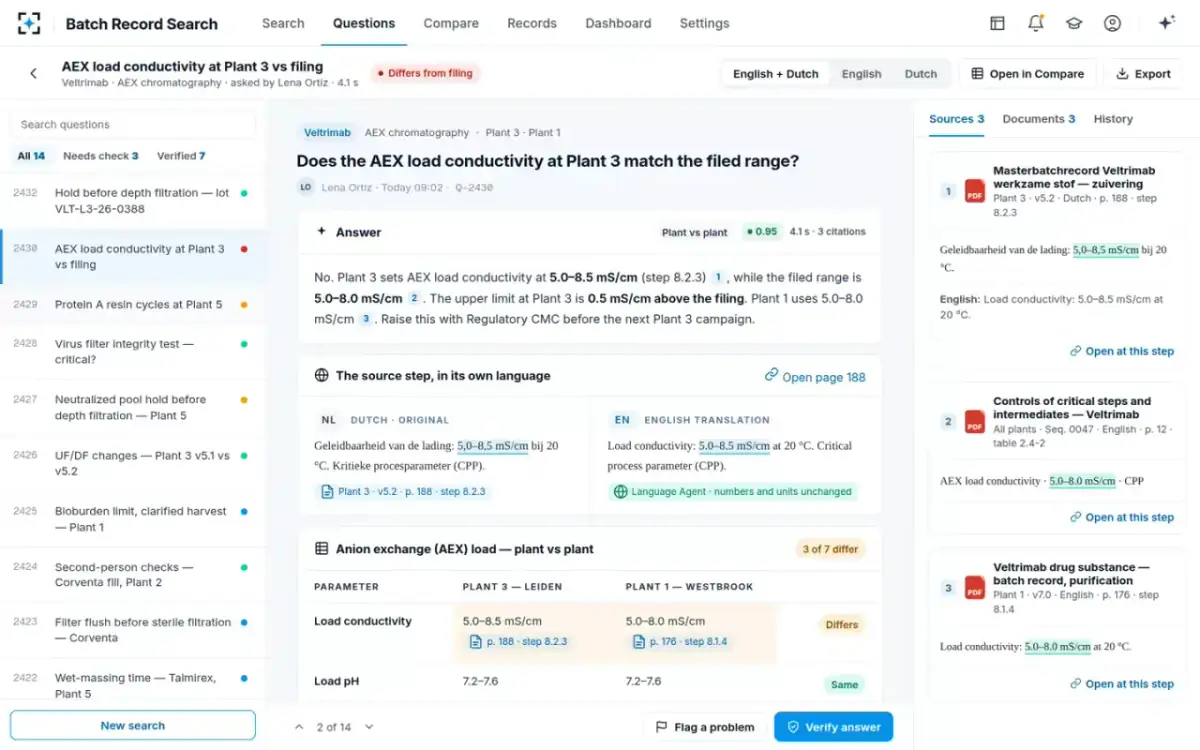
Where the two sides genuinely disagree, the disagreement has to survive translation rather than be smoothed by it. In the sample network one plant prints an anion-exchange load conductivity range of 5.0–8.5 mS/cm where the dossier registers 5.0–8.0 and a sister plant runs the registered range. The Dutch step and its English rendering sit side by side, the plant-against-plant table sits below, and regulatory affairs is notified — because no agent clears a difference from the filing.
A difference from the filing, shown in both languages with the plants beside it
Chapter 4's silence on language is not an oversight; it is a chapter written about readers rather than about words. A network that takes it that way ends up with the same discipline the clause implies: know which record and which version you are reading, show the original, and let a named person sign. To see one step read in two languages at once, start from Batch Record Search.
Questions people ask
What does EU GMP Chapter 4 require?
That the manufacturer define every type of document it uses in its quality system; that instruction documents be approved, signed, dated, uniquely identifiable and given an effective date; that entries be clear, legible, indelible and contemporaneous, with alterations signed, dated and leaving the original readable; that it be clearly defined which record relates to each activity and where it sits; that batch documentation be kept one year past expiry or five years past certification by the Qualified Person, whichever is longer; and that a batch processing record be kept for every batch, based on the currently approved formula and instructions.
Is EU GMP Chapter 4 being revised?
A revision was put out for stakeholder consultation by the European Commission on 7 July 2025, together with a revised Annex 11 on computerised systems and a new Annex 22 on artificial intelligence. The consultation closed on 7 October 2025. The draft adds sections on data governance and risk management and works from the extended ALCOA++ attributes, but it is a consultation text: the chapter in force remains the January 2011 revision, operative since 30 June 2011.
Can a batch record be translated?
Yes, and the inspectorates positively advise it where language limitations exist — PIC/S PI 041-1 says bilingual or controlled translations into local languages and dialect are advised. The two conditions in that phrase are the whole of the practice: bilingual, meaning both texts are present rather than one replacing the other, and controlled, meaning the translation is a managed document with a version and an owner. A translation that stands alone in place of the original is not a batch record.
What is a hybrid record under EU GMP?
One where some elements are electronic and some are paper. Chapter 4 clause 4.1 names them directly and requires that the relationships and control measures for master documents, official copies, data handling and records be stated for hybrid and homogenous systems alike. A scanned paper executed record held in an electronic document system with an electronic index is a hybrid record, and the clause's demand is that the plant has written down which part is the record and what the rest may be relied on for.
Do all sites have to use the same batch record?
No, and in practice they cannot. A processing instruction must state the processing location and the principal equipment to be used, and those differ between sites, as do local procedures and working languages. Networks that want harmonised processes often keep a global process description and a site record per plant. The consequence is that the same physical step can carry different numbers at two sites, so any comparison between them has to be made on what the step does.
How does a Qualified Person rely on a record in another language?
Through the quality system, and with the responsibility still theirs. Annex 16 clause 1.3 says that regardless of how many sites are involved, the Qualified Person certifying the finished product must ensure all necessary steps have been completed under accepted pharmaceutical quality systems. Reliance on a site's local verification is normal and workable, but it has to be a defined, documented arrangement — and where the certifying person reads a rendering rather than the original, the original has to remain available and identified as the record.