A master batch record is the approved, versioned instruction for making one product at one plant at one batch size: what goes in, in what order, to what limits, with blanks where the results will go. An executed batch record is what one lot leaves behind when that instruction has been followed — the same pages, now filled in by hand or by system, with values, times, initials and the notes on everything that did not go to plan. The master record is written once and reused; the executed record is written once per lot and never reused. Botminds' Batch Record Search reads both, finds the step a question is really about, and puts the answer beside the scanned page with the step boxed.
The pages below are the rules first and the product second. The worked examples come from a fictional sample network inside the solution — a biologic drug substance called Veltrimab, made at Plants 1, 2, 3 and 5, with invented people, lots and document numbers. The regulations are quoted from the regulators' own current texts and linked where they appear.
The pair, in four numbers
318pages
one lot’s executed purification record, scanned, handwritten, in Dutch
Sample data
386–412pages
the master records for the same drug substance, per plant, in three languages
Sample data
13
items 21 CFR 211.188(b) requires the executed record to document for each batch
5years
the EU floor for keeping batch documentation after the Qualified Person certifies the batch — or one year past expiry, whichever is longer
What a master batch record is, in one paragraph
The master record exists so that batch 400 is made the way batch 1 was. US law states the purpose in its first clause: uniformity from batch to batch. To get it, master production and control records must exist for each drug product and for each of its batch sizes, prepared, dated and signed in full handwritten signature by one person, then independently checked, dated and signed by a second (21 CFR 211.186(a)). Three things are already settled by that clause. The master record is per product and per batch size, so doubling the scale means another master record rather than a note in the margin. It is signed by name, in handwriting, by its preparer. And it is checked independently by a second person, who signs too.
In the European guide the same object arrives under a different name. EU GMP Chapter 4 splits it into the Manufacturing Formula and the Processing Instructions, and treats them as instruction documents: approved, signed and dated, uniquely identifiable, with the effective date defined. Clause 4.18(d) says the processing instructions must include "Detailed stepwise processing instructions [e.g. checks on materials, pre-treatments, sequence for adding materials, critical process parameters (time, temp etc)]" (EudraLex Volume 4, Chapter 4). That is where the printed limit on a page comes from, and it is the reason a limit is visible before anyone writes in the blank beside it.
What an executed batch record is, and why it is not a copy
The executed record begins life as a reproduction of the master, which is why it is so often mistaken for one. The US rule's first required item is "An accurate reproduction of the appropriate master production or control record, checked for accuracy, dated, and signed" (21 CFR 211.188(a)). ICH Q7 adds a check before the paper is even handed out: "The batch production record should be checked before issuance to assure that it is the correct version and a legible accurate reproduction of the appropriate master production instruction" (ICH Q7 clause 6.50). So the first page of an executed record is, genuinely, a copy — of one version, verified as that version, at a known moment.
Everything after that is not a copy at all. It is a dated, attributed account of one lot: the weights actually dispensed, the temperatures actually held, the yield actually obtained, the equipment actually used, the people who did each step and the people who checked them, and every deviation with its authorisation. A review article in the Journal of Young Pharmacists puts the point without any regulatory hedging: "Good records enable one to track all activities performed during batch manufacture, from the receipt of raw materials to the final product release; they provide a history of the batch and its distribution" (Patel and Chotai, 2011). A master record has no history. An executed record is nothing else.
Instruction and evidence: the two records, row by row
Master batch record: An approved instruction for making the product.
Executed batch record: The evidence that one lot was made that way.
Master batch record: One per product, per plant, per batch size, per version.
Executed batch record: One per lot, for ever.
Master batch record: A preparer, in full handwritten signature, and an independent checker.
Executed batch record: The operator who performed each significant step, and the person who checked it.
Master batch record: Printed instructions, limits, ranges and blanks.
Executed batch record: The same printed text, plus handwritten values, times, initials and margin notes.
Master batch record: A change control and a new version. The old one is retired.
Executed batch record: Nothing. A correction is struck through once, initialled and dated, and the original stays readable.
Master batch record: That the firm decided, in advance, how the product is made.
Executed batch record: That one particular lot was made that way, by named people, on named dates.
Master batch record: Is this the effective version, and does it match the filing?
Executed batch record: Is every blank filled, every entry attributable, every departure explained?
Master batch record: Development, validation and the registered dossier, written into the instruction.
Executed batch record: It does not. The limit is printed from the master; the record holds the result.
Master batch record: As long as the product and its batches need it.
Executed batch record: One year past the batch’s expiry or five years past certification in the EU, whichever is longer; at least one year past expiry under 21 CFR 211.180(a).
What must a master batch record contain?
Under US law, nine things. Clause 211.186(b) lists the name and strength of the product with its dosage form; the name and weight or measure of each active ingredient per unit; a complete list of components in names or codes specific enough to show any special quality characteristic; an accurate statement of the weight or measure of each component in one weight system; a statement of any calculated excess; theoretical weight or measure at appropriate phases; theoretical yield with the maximum and minimum percentages beyond which an investigation is required; a description of containers, closures and packaging with a specimen of each label signed and dated; and complete manufacturing and control instructions with sampling, testing, specifications, special notations and precautions.
The seventh of those is the one people forget, and it is the one that makes a master record useful rather than decorative. The yield range is not a target; it is a trigger. A batch outside it must be investigated under 211.192, whatever anyone thinks of the product. The European guide reaches the same place by a different route, through the Manufacturing Formula and Processing Instructions, and adds the statement of expected final yield with its acceptable limits. The two texts are not word-for-word, and a network that operates on both sides of the Atlantic has to satisfy the stricter reading of each line rather than the average of them.
The four rulebooks on one page, and where their wording parts
| What is required | US: 21 CFR part 211 | EU: GMP Chapter 4 | APIs: ICH Q7 |
|---|---|---|---|
| The approved instruction | 211.186(a): prepared, dated and signed in full handwritten signature by one person; independently checked, dated and signed by a second. | 4.3: approved, signed and dated by authorised persons; unambiguous, uniquely identifiable, with a defined effective date. | 6.40–6.41: master production instructions prepared, dated and signed by one person, independently checked, dated and signed by a person in the quality unit. |
| Per batch size | 211.186(a): a master record for each drug product "including each batch size thereof". | Stated in the lead-in to 4.17: an approved Manufacturing Formula and Processing Instructions "should exist for each product and batch size to be manufactured". | 6.41: where a quantity is not fixed, the calculation for each batch size or rate of production is included in the instruction. |
| Critical parameters in the instruction | 211.186(b)(9): complete manufacturing and control instructions, specifications and special notations. | 4.18(d): stepwise instructions including "critical process parameters (time, temp etc)". | 6.41: detailed production instructions including the ranges of process parameters to be used and time limits for individual processing steps. |
| The executed record is a verified reproduction | 211.188(a): an accurate reproduction of the master, checked for accuracy, dated and signed. | 4.20: based on the relevant parts of the currently approved Formula and Instructions. | 6.50: checked before issuance to assure it is the correct version and a legible accurate reproduction. |
| Who did it, and who checked it | 211.188(b)(11): identification of the persons performing and directly supervising or checking each significant step. | 4.20(c): identification (initials) of the operator(s) and, where appropriate, the name of any person who checked. | 6.52: signatures of the persons performing and directly supervising or checking each critical step. |
| Dates and times | 211.188(b)(1): dates. | 4.20(b): dates and times of commencement, of significant intermediate stages and of completion. | 6.52: dates and, when appropriate, times. |
| Who reviews before release | 211.192: all production and control records reviewed and approved by the quality control unit before release. | Chapter 4 requires the record; Annex 16 puts certification on the Qualified Person. | 6.71: critical steps reviewed and approved by the quality unit; non-critical steps may be reviewed by qualified production personnel. |
| How long it is kept | 211.180(a): at least one year after the expiry date of the batch. | 4.11: one year after expiry, or five years after the Qualified Person certifies the batch, whichever is longer. | 6.13: at least one year after the expiry date of the batch, or three years after distribution for APIs with retest dates. |
The row to read slowly is the last but one. ICH Q7 reviews critical steps in the quality unit and lets qualified production personnel review the non-critical ones; 21 CFR 211.192 sends everything to the quality control unit. Q7 is the guideline for active pharmaceutical ingredients, not finished drug product, so the lighter route belongs to API manufacture and does not travel across to a finished dosage form. It also means the word "critical" has to be defendable before anybody relies on it to route a review — which is a judgement recorded somewhere other than the batch record.
What the executed record has to prove, line by line
Read 211.188(b) as a reviewer rather than as a drafter and it stops being a list and becomes a set of questions about one page. Dates: when. Identity of individual major equipment and lines: on what. Specific identification of each batch of component or in-process material: from what. Weights and measures of components used: how much. In-process and laboratory control results: what came out. Actual yield and percentage of theoretical yield: how much came out, against what was expected. Identification of the persons performing and directly supervising or checking each significant step: by whom, and checked by whom. Any investigation made under 211.192: and what went wrong.
Batch production and control records shall be prepared for each batch of drug product produced and shall include complete information relating to the production and control of each batch.
21 CFR 211.188, Batch production and control records
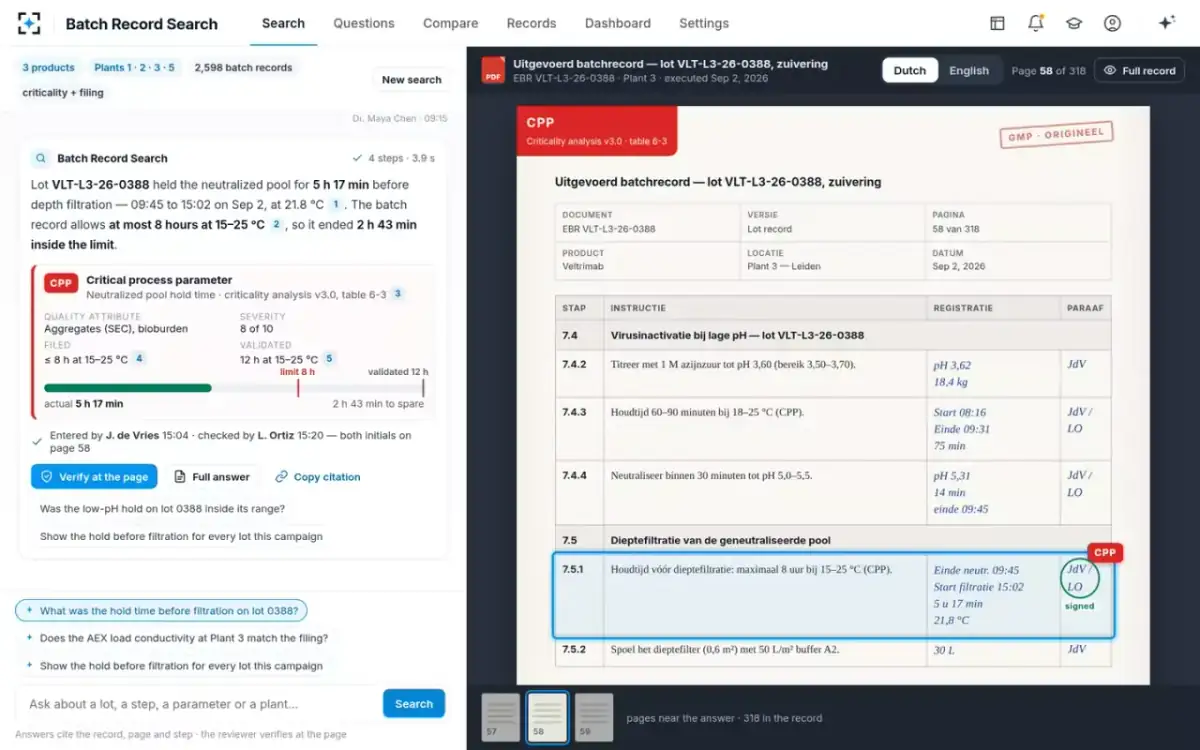
"Complete information relating to the production and control of each batch" is the sentence that decides most arguments about scope. It is why an executed record for one purification campaign runs to several hundred pages rather than a dozen, and why the interesting content is rarely in the first twenty. In the sample network, the hold before depth filtration that the worked example below asks about is step 7.5.1, on page 58 of a 318-page Dutch record — nowhere near the front, and findable only by someone who knows the step numbering.
One executed step, element by element, and the clause that puts each one there
On the pageThe step number and its printed instruction
Who puts it thereReproduced from the master record
The rule21 CFR 211.188(a) · EU GMP 4.20
Why a reviewer needs itThe operator is reading an accurate reproduction of an approved instruction, not a local copy of it.
On the pageThe printed limit beside the blank
Who puts it thereMaster record, processing instructions
The ruleEU GMP 4.18(d) and 4.18(e)
Why a reviewer needs itThe limit is set before the work, so the entry is judged against a number nobody chose afterwards.
On the pageThe handwritten value and its unit
Who puts it thereThe operator, at the time
The ruleEU GMP 4.7 and 4.8
Why a reviewer needs itClear, legible, indelible, and written when the action was taken — not copied up later from a note.
On the pageThe date and the clock time
Who puts it thereThe operator, at the time
The ruleEU GMP 4.20(b)
Why a reviewer needs itCommencement, significant intermediate stages and completion all carry dates and times; a hold cannot be computed without them.
On the pageA corrected digit, struck through once
Who puts it thereWhoever made the correction
The ruleEU GMP 4.9
Why a reviewer needs itThe original must still be readable, and the change signed and dated, with the reason where it matters.
On the pageThe operator initial
Who puts it thereThe person who did the step
The rule21 CFR 211.188(b)(11) · EU GMP 4.20(c)
Why a reviewer needs itAttribution: the record says who performed each significant step, not merely that it happened.
On the pageThe second-person initial
Who puts it thereAn independent checker
The rule21 CFR 211.188(b)(11) · EU GMP 4.20(c)
Why a reviewer needs itThe person who checked the step is named too, where a check is required.
On the pageThe deviation note in the margin
Who puts it thereProduction, with authorisation
The ruleEU GMP 4.20(h) · ICH Q7 6.52
Why a reviewer needs itSpecial problems are written on the page with signed authorisation for any departure from the instruction.
Two signatures, two meanings: preparer, checker, operator, second person
There are four signing roles across the pair, and they are routinely collapsed into one word. On the master record, the preparer writes the instruction and signs it in full handwritten signature; an independent second person checks it and signs. Those two signatures are about the document. On the executed record, the operator initials the step they performed and, where a check is required, a second person initials the check. Those two are about the work.
The difference matters when something is wrong. A defective instruction is the preparer's and the checker's problem, and the fix is a change control and a new version of the master record — every lot made under the old version is then in scope for assessment. A defective entry is the operator's and the second person's problem, and the fix is a deviation on one lot. Reading a master-record signature as if it approved a lot, or an operator initial as if it approved an instruction, sends an investigation down the wrong road on day one.
The second-person check is also narrower than most training suggests. EU GMP 4.20(c) asks for the operator's initials on each significant step and the name of any person who checked "where appropriate"; 211.188(b)(11) asks for the persons performing and directly supervising or checking each significant step. Neither says every line gets two initials. Which lines do is the firm's decision, written in its own procedure, and it usually tracks criticality — which is why reading two initials off a scanned page years later is a question about the procedure in force then, not the one in force now.
Version, plant and batch size: why one product has many master records
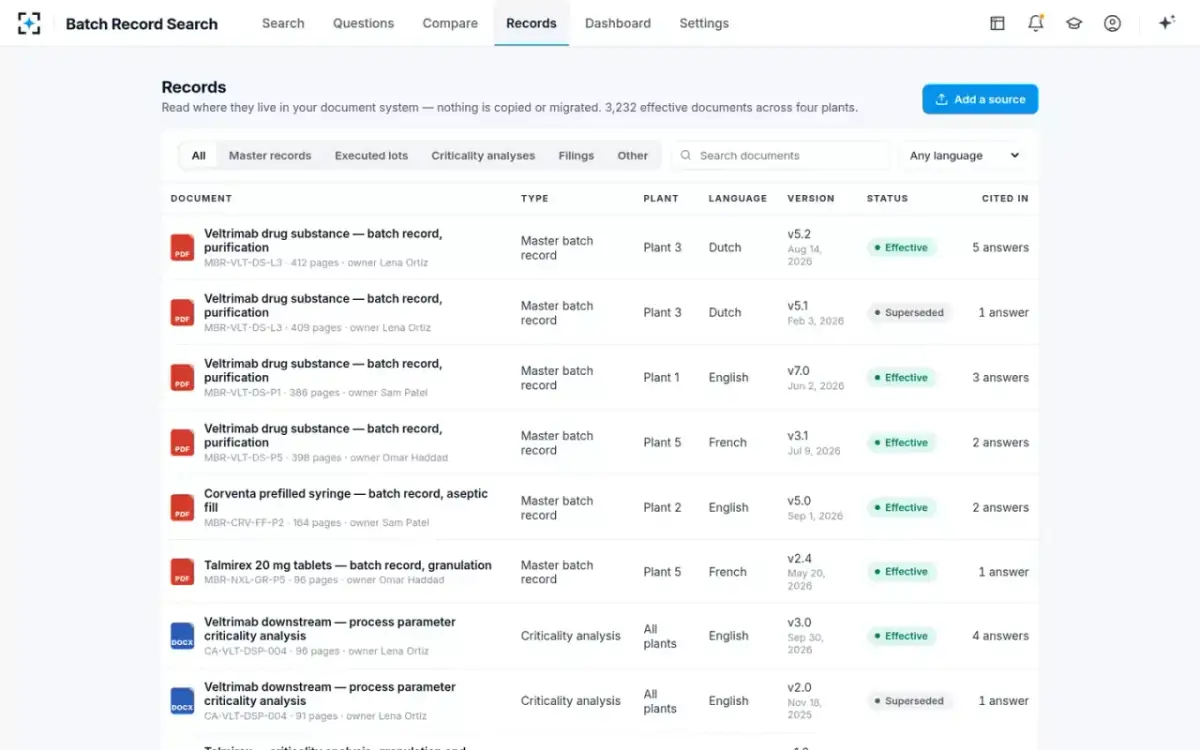
Ask how many master batch records a product has and the honest answer is a multiplication, not a number. One per plant that makes it, because the equipment, the room and the local procedures differ. One per batch size, because US law says so in as many words. One per version, with only one effective at a time but every superseded version still retrievable, because lots made under it still exist. And in a multinational network, written in the language the floor works in, which is why the same product can carry master records in three languages at once.
The sample network shows the result: master records of 386 to 412 pages per plant, in English, Dutch and French, in more than one version, and across 3 products and four plants 2,598 batch records in all, before the criticality analyses and filings that a single question usually needs with them. The practical consequence is that "look it up in the batch record" is ambiguous before you have fixed four things: which plant, which product, which version, and which lot. Get the version wrong and you will read a limit that was never printed on the page the operator held.
Every record the network holds, by type, plant, language and version — in Batch Record Search
How long must you keep a batch record, and in what form?
Two floors apply, and the longer one wins wherever both regimes reach. In the United States, "Any production, control, or distribution record that is required to be maintained in compliance with this part and is specifically associated with a batch of a drug product shall be retained for at least 1 year after the expiration date of the batch" (21 CFR 211.180(a)). In the European Union, batch documentation "must be kept for one year after expiry of the batch to which it relates or at least five years after certification of the batch by the Qualified Person, whichever is the longer", and for investigational medicinal products at least five years after the last clinical trial the batch was used in ends (EU GMP 4.11).
The form question has a clearer answer than many people expect. US law lets a record be kept as the original or as a true copy — a photocopy, microfilm, microfiche or another accurate reproduction (21 CFR 211.180(d)) — and requires records to be readily available for inspection at the establishment where the work was done, while accepting records that can be pulled up straight away by computer from another location (211.180(c)). A scanned executed record is therefore a legitimate retained record — provided the copy was made and verified as a true copy, which is a controlled act with its own procedure, not an afternoon with a sheet feeder.
The five questions people actually bring to the pair
In a working quality organisation almost every batch-record question is one of five. What does the instruction say? — a master-record question, answerable only once the version effective on the manufacturing date is known. What did this lot actually do? — an executed-record question, answerable from one page. Did this lot follow the instruction? — both records, side by side, on the same step. Why do two plants do this differently? — two master records, matched by meaning rather than by step number, because the numbering rarely agrees. Is the limit on the page the limit we registered? — a master record against the dossier, and the one question where finding the answer quickly matters most, because a mismatch has to reach regulatory affairs before the next campaign rather than after it.
Only the second of those is answered by a single document. That is the structural reason batch-record work is slow: the documents are filed by type, and the questions cut across types. A hold time question touches the executed record for the actual time, the master record for the printed limit, the criticality analysis for whether the parameter is critical, and the dossier for the registered range — and the validated hold from the study is a fourth number again.
Where Batch Record Search fits: finding the step in either record
Batch Record Search is an agentic search over the records a plant already keeps, read in place in the quality document system and never copied out of it. A question in plain words — "what was the hold time before filtration on lot 0388?" — is resolved to a plant, a product, a lot, an effective version, a page and a step, and the answer comes back beside the scanned page with the step boxed and the handwritten entries and initials read off it. Every claim cites the record, the page and the step, and that cannot be switched off.
Three limits are worth stating because they are what make the output usable in a regulated review. The reading agent never rounds, converts or merges a process range, so a printed "15–25 °C" stays "15–25 °C". It says "not found" rather than guessing. And it cites effective versions only, unless the question names a superseded one. A second agent looks the parameter up in the effective criticality analysis and against the registered range in the dossier, and when a batch-record range sits outside the filing it flags the difference and sends it to a person; it never clears one. On a Dutch or French page a third agent puts the step into English beside the original, leaving every number, unit and step number exactly as written — which is the whole of what Chapter 4 asks of a multilingual network.
One lot's hold, read off page 58, with the limit, the filing and the validated hold beside it
The pair is the foundation everything else in this subject sits on. To see the two records lined up against one lot, start from Batch Record Search.
Questions people ask
What is the difference between MBR and BPR?
MBR is the master batch record, the approved instruction; BPR is the batch production record, also called the executed or batch manufacturing record, which is what one lot leaves behind. The executed record starts as "an accurate reproduction of the appropriate master production or control record, checked for accuracy, dated, and signed" under 21 CFR 211.188(a), and then diverges from it the moment someone writes in a blank. One is reused for every batch; the other belongs to exactly one.
Who signs a master batch record?
Two people, by name. 21 CFR 211.186(a) requires the master record to be prepared, dated and signed with a full handwritten signature by one person, and independently checked, dated and signed by a second. ICH Q7 puts the independent check in the quality unit for active pharmaceutical ingredients. Those signatures approve the instruction; they say nothing about any particular lot, which is signed for separately on its own executed record.
How many pages is a batch record?
There is no published figure, because it depends entirely on the process. A simple compressed tablet may run to tens of pages; a biologic drug substance purification train runs to hundreds. In the fictional sample network on this page, one lot's executed purification record is 318 pages and the master records for the same drug substance run 386 to 412 pages per plant. What the regulation fixes is not the length but the content: "complete information relating to the production and control of each batch".
How long must you keep a batch record?
In the United States, at least one year after the batch's expiry date, under 21 CFR 211.180(a). In the European Union, one year after expiry or five years after the Qualified Person certifies the batch, whichever is longer, under EU GMP Chapter 4 clause 4.11 — and at least five years after the last clinical trial for investigational products. Longer periods apply to some product types, and a firm's own procedure may of course exceed both floors.
Can a scanned copy of an executed batch record be the record you keep?
Yes, if it was made and verified as a true copy. 21 CFR 211.180(d) allows a record to be kept as the original or as a true copy, such as a photocopy, microfilm or another accurate reproduction, and 211.180(c) accepts records that can be immediately retrieved electronically from another location. The weight sits on the word "true": the copy has to be verified as complete and accurate against the original, under a controlled procedure, and signed as such.
Can one master batch record cover two plants?
In practice, rarely, and never by accident. The instruction has to name the processing location and the principal equipment to be used — EU GMP clause 4.18(a) — and those differ between sites, as do the local procedures the instruction refers to. Networks that want harmonised processes often hold a global process description plus a site master record per plant, which is why the same step can carry different step numbers at two sites and must be matched by meaning rather than by number.