The farm operating loan renewal process is the annual re-underwriting of a farm's revolving line of credit before it matures: last year's results are set against last year's plan, any balance left on the line is sorted into unsold grain and true carryover, this year's crop plan and cash flow are tested at the bank's prices, insurance and liens are checked again, and a renewal memo is written, recommended and approved. It is hard because every operating line in a farm book tends to mature in the same few weeks before planting, and each one waits on documents from people outside the bank. Agricultural Loan Renewal Management, Botminds' agentic solution for farm operating line renewals, runs the process as eight named stages and starts each file months before anyone at the bank would otherwise open it.
The worked example is fictional sample data from the solution: Brandt Family Farms, 2,840 acres of corn and soybeans, a $1,450,000 operating line maturing on 1 March 2027 and a request for $1,650,000, at a bank with 58 operating lines due before planting. The rules come from the bank regulator's handbook, the Farm Service Agency's guaranteed-loan regulations and the Uniform Commercial Code, linked where they appear.
The renewal season the process has to carry, in the Federal Reserve's own surveys
136
index of farm loan renewals and extensions in the Seventh District, first quarter 2026 — its highest since 2020
17%
of farm borrowers carried more carryover debt into 2026 than into 2025, on lenders’ average estimate
≈half
of Ninth District ag lenders said renewals or extensions of existing loans increased in the first quarter of 2026
What is the farm operating loan renewal process?
It is a fresh credit decision dressed as an administrative one. A farm operating line funds one production cycle — seed, fertiliser, chemicals, fuel, cash rent and living costs from planting to the sale of the crop — and it is normally written for a year. The regulator's handbook ties the size of the line to the cycle itself: "the production (or growing) cycle should govern the maximum amount of revolving Ag credit available at any one time" (OCC, Agricultural Lending). When the cycle ends, so does the basis for the line. Renewing it means deciding again whether next year's cycle will repay it.
The phrase that matters on the solution's own page is that each line has to be re-underwritten, not rolled. A rolled renewal extends the maturity date on last year's analysis. A re-underwritten one asks the questions again with this year's numbers, and the difference is invisible until a bad year shows which kind the bank has been doing.
Why do farm operating lines renew every year?
Because the facts behind them expire every year. The crop is sold, the inputs are used up, rented ground changes hands, prices move, and the borrower's balance sheet is a different document after harvest than before planting. A one-year line forces the bank to look at a farm at the one point in the year when the cycle has closed and the next one has not yet started.
The regulator puts a date on what counts as current. "Current credit information generally is considered to be no more than 12 months old," the handbook says, and "the bank's loan policy should detail specific requirements for credit information and analysis." It adds a point about timing that explains why renewal seasons exist at all: "Ideally, inspections and cash flow projection analyses should occur at the same approximate time each year, because the value of the assets under production changes throughout the growing cycle" (OCC, Agricultural Lending). Comparing this February's balance sheet with last August's would compare a farm full of grain with a farm full of growing crop.
Eight stages, from a reopened file to a signed memo
Every bank names them differently. The work underneath is the same eight stages, each waiting on a document and each owned by someone. Laid out in order, the process also shows where a season goes wrong: not in the stages that need judgement, but in the waits before them.
The eight stages of a farm operating line renewal, and who owns each
Agent
1. Reopen the file from last yearCarry forward last year’s memo, plan, conditions, leases, filings and insurance; list what must be refreshed.
Never: Treat a carried-forward document as current
Agent
2. Bring in last year’s resultsYear-end balance sheet, income statement, Schedule F or accountant’s statements, spread into the bank’s measures.
Never: Estimate a figure that is missing — list it as missing
Agent
3. Count the grain, then name the carryoverValue unsold grain and crop receivables on a dated count; only the balance left over is carryover.
Never: Call a balance carryover before the inventory is counted
Agent
4. Build this year’s plan and cash flowCrop plan, leases and input budget at the bank’s price deck and insured yields, with line use by month and a stress case.
Never: Price above the bank’s deck
Agent
5. Check insurance and collateralSchedule of insurance against planted acres, the assignment of indemnity, lien filings and lapse dates, inspections.
Never: Count unassigned insurance as security
A person decides
6. Ask the borrower for what is missingOne request per farm listing only what the file still lacks; the officer sends it.
Never: Go to a borrower without the officer
A person decides
7. Recommend: memo, terms, conditionsWhat changed since last year, the carryover and its treatment, this year’s plan, any exception with mitigants; the officer signs.
Never: Set a rate outside the pricing grid
A person decides
8. Approve, book and secureApproval above the officer’s authority or with an exception; loan administration books, files continuations and records the assignment.
Never: Book with a lapsing filing or an unsigned assignment left open
Stages one to five are assembly. They decide nothing, and they take most of the time, because each depends on someone outside the bank: the accountant for the statements, the borrower for the bin count and the crop plan, the insurance agent for the schedule of insurance, the Secretary of State's records for the lien search. Stages six to eight are where the bank's judgement and authority sit, and in a season done by hand they are squeezed into whatever time the assembly leaves.
Stage three deserves its own warning. A balance on the line on 31 December is not, by itself, carryover; the farm may simply be holding grain to sell later. The handbook says so — "while a balance may be left on the operating line at renewal, this would not be an indication of carryover debt" where it reflects marketing or tax choices — and the order of operations that keeps the two apart is set out in how to calculate carryover debt on a farm operating loan.
What documents are needed to renew a farm operating loan?
The list is longer than most borrowers expect, and every item has a source outside the loan file. A bank's own credit policy sets the exact list; the table below is the common core, with the stage each document feeds and who usually has to produce it.
The documents a farm operating line renewal waits on, and who holds each
| Document | Feeds stage | Comes from | Why it matters |
|---|---|---|---|
| Year-end balance sheet and income statement | 2 | Borrower or accountant | The basis for every ratio, at a date comparable with last year’s |
| Tax return with Schedule F, or accountant’s statements | 2 | Accountant | Confirms income; reconciles cash to accrual |
| Grain and livestock inventory, with a count date | 3 | Borrower, sometimes verified by inspection | Separates unsold production from carryover |
| This year’s crop plan, leases and input budget | 4 | Borrower | Acres, rents and costs the cash flow is built on |
| Schedule of insurance and the assignment of indemnity | 5 | Insurance agent and insurer | What is insured, and whether the bank is named on any payment |
| Lien search and financing statement dates | 5 | Secretary of State records | Whether the bank’s security is still perfected, and when it lapses |
| Collateral inspection | 5 | A qualified person other than the lending officer | That the collateral exists and is valued sensibly |
Two of these do not arrive on the bank's timetable at all. The schedule of insurance follows the farm's acreage report by weeks, so a file assembled early in the year is often still holding last year's. And a financing statement has its own clock: under the Uniform Commercial Code, as most states enact it, "a filed financing statement is effective for a period of five years after the date of filing", and a continuation statement "may be filed only within six months before the expiration of the five-year period" (UCC § 9-515). Miss that window and the security interest "becomes unperfected". The insurance side of the same stage is worked through in whether a crop insurance assignment of indemnity counts as collateral.
How long does a farm loan renewal take, and when should it start?
The officer's working time and the elapsed time are different numbers, and the second is the one that misses deadlines. On the sample bank's estimates, preparing a renewal by hand takes about six hours of an officer's time. The elapsed time is set by the slowest document: statements that cannot exist until the year closes, a grain count that waits for a cold week in January, a crop plan that waits for the last lease to be signed.
Where an officer's renewal season goes, stage by stage, by hand and with the agents
| Work | By hand, working days | With the agents, working days |
|---|---|---|
| Gathering and chasing documents | 10 | 0.5 |
| Spreading statements | 9 | 0.5 |
| Last year against plan, and carryover | 7 | 1 |
| This year’s cash flow at the price deck | 7 | 1 |
| Insurance, filings and inspections | 4 | 0.75 |
| Memo, terms and approval | 6.5 | 2 |
| Season total for 58 renewals | 43.5 (348 hours) | 5.75 (46 hours) |
When to start follows from that. A renewal should start when its first document can exist, which for most farms is harvest, not when the maturity date appears on a report in January. The sample file was reopened on 14 October, twenty weeks before maturity, with eleven documents carried forward from the previous year's file. The bank's own setting asks for every file to be ready 21 days before maturity; after that the season calendar turns amber.
One renewal file from reopened to approved, in weeks
- Reopened, waiting for harvest14 Oct–2 Nov
- Harvest results in; waiting for the year to close and the grain count2 Nov–18 Jan
- Count, spreads, lien search, crop plan18 Jan–8 Feb
- Prepared and approved on 8 Feb; then ahead of maturity8 Feb–1 Mar
What the annual-analysis rules expect, guaranteed or not
For loans carrying a Farm Service Agency guarantee, the annual review is a regulation rather than a habit. Lenders must perform "an annual analysis of the borrower's financial condition to determine the borrower's progress", and lenders outside the preferred programme must do it on "all term loans when the sum of all balances on term loans is greater than $500,000, all line of credit loans, and all loans in monetary or non-monetary default" (7 CFR § 762.140). For a standard guaranteed lender, every operating line is reviewed every year whatever its size; preferred lenders document the analysis under their own approved credit management system.
The same section says what the analysis contains, and it reads like a renewal process in miniature. For loans secured by personal property, "lenders will also compare the borrower's actual to planned income and expenses for the past year", and every analysis includes "an account of the whereabouts or disposition of all collateral." Last year against its plan, and where the collateral went: stages two, three and five.
What an annual renewal analysis should be able to show, whoever the lender
- Credit information no more than 12 months old
The handbook’s general expectation for current credit information, with the bank’s own policy setting the details.
- Last year’s actual results against last year’s plan
Required for guaranteed loans secured by personal property; the natural first page of any renewal memo.
- An account of the collateral
Where the grain, livestock and equipment are, or what happened to them — required in every guaranteed-loan annual analysis.
- A cash flow projection at the same point in the cycle as last year
So that this year’s figures are comparable with last year’s.
- Inspections by someone other than the lending officer
Or, where a bank cannot separate the duties, periodic independent confirmation.
- Liens still perfected, and continuations filed in their window
A financing statement lapses five years after filing unless continued in the six months before.
Why renewals pile up in the weeks before planting
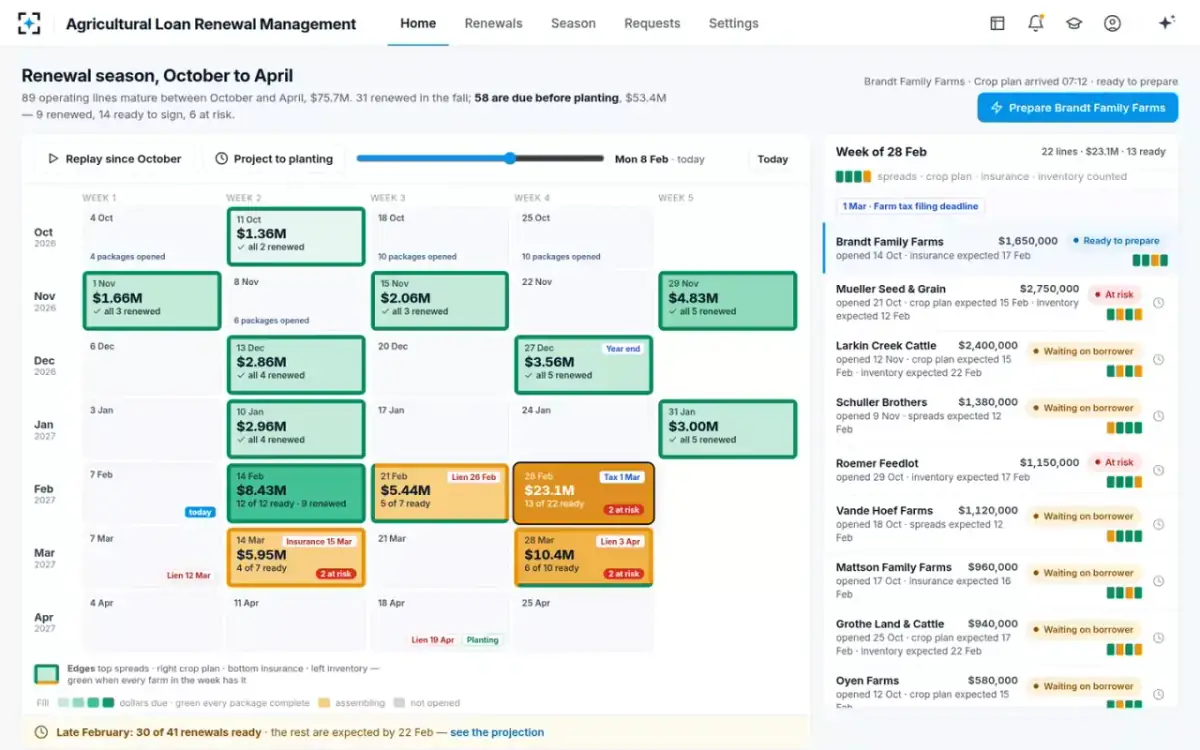
Because the calendar of farming puts them there. A line written to fund one cycle matures when that cycle has been sold and the next has not been planted, and for many row-crop farms that is late winter. A bank that wrote its lines over several years ends up with dozens maturing in the same six to eight weeks. In the sample bank, 58 of 89 operating lines — $53.4 million of $75.7 million — are due between mid-February and planting; the other 31 renewed in the fall.
Recent years have made the pile taller. The Chicago Fed's survey of district lenders put its index of renewals and extensions at 136 in the first quarter of 2026, "its highest value since the second quarter of 2020", with 38 percent of lenders reporting more renewals and extensions than a year earlier and 2 percent fewer (Federal Reserve Bank of Chicago, AgLetter). The index eased to 124 in the second quarter (AgLetter, August 2026), still well above the level at which increases and decreases balance. In the Minneapolis Fed's survey for the same quarter, lenders also expected renewals and extensions to increase further, and 24 percent said they had already raised the collateral they require on farm loans (Minneapolis Fed Ag Credit Survey).
The season in one view: maturities by week, shaded by dollars and outlined by readiness
What happens if a farm loan is not renewed before maturity?
On the note's own terms, the balance is due. In practice a bank rarely demands it from a sound borrower whose file is simply late; it grants a short extension and finishes the work. That is why the surveys count "renewals and extensions" together. But an extension is not a renewal: it buys time without answering any of the questions, and a book full of them is a book whose credit information is ageing past the twelve months the handbook treats as current.
The regulator's handbook draws the line that matters. Renewing a sound borrower is not, in itself, a problem — "loans to sound borrowers that are refinanced or renewed in accordance with prudent underwriting standards should not be classified unless well-defined weaknesses exist that jeopardize repayment" (OCC, Agricultural Lending). The protection is conditional on the prudent underwriting. A renewal rolled on last year's analysis has not earned it, and examiners rate "Ag refinancing and renewal practices" as part of judging a bank's agricultural credit risk.
The quieter risks of a late renewal are in stage five. A financing statement that lapses while the renewal is still being assembled leaves the bank unperfected from that day. A crop insurance gap found after the sales closing date can no longer be fixed for the year. Neither waits for the memo.
One file, start to signed: the Brandt renewal week by week
The sample file shows the stages running in the order the documents allow. Reopened on 14 October with eleven documents carried forward. Harvest results in on 2 November. Grain counted on 18 January: 98,000 bushels of corn in four bins. Spreads on 2 February, the lien search on 5 February, and the 2027 crop plan at 07:12 on 8 February. Three of four readiness checks were in; the schedule of insurance was expected on 17 February.
How the package assembled itself, document by document, from October
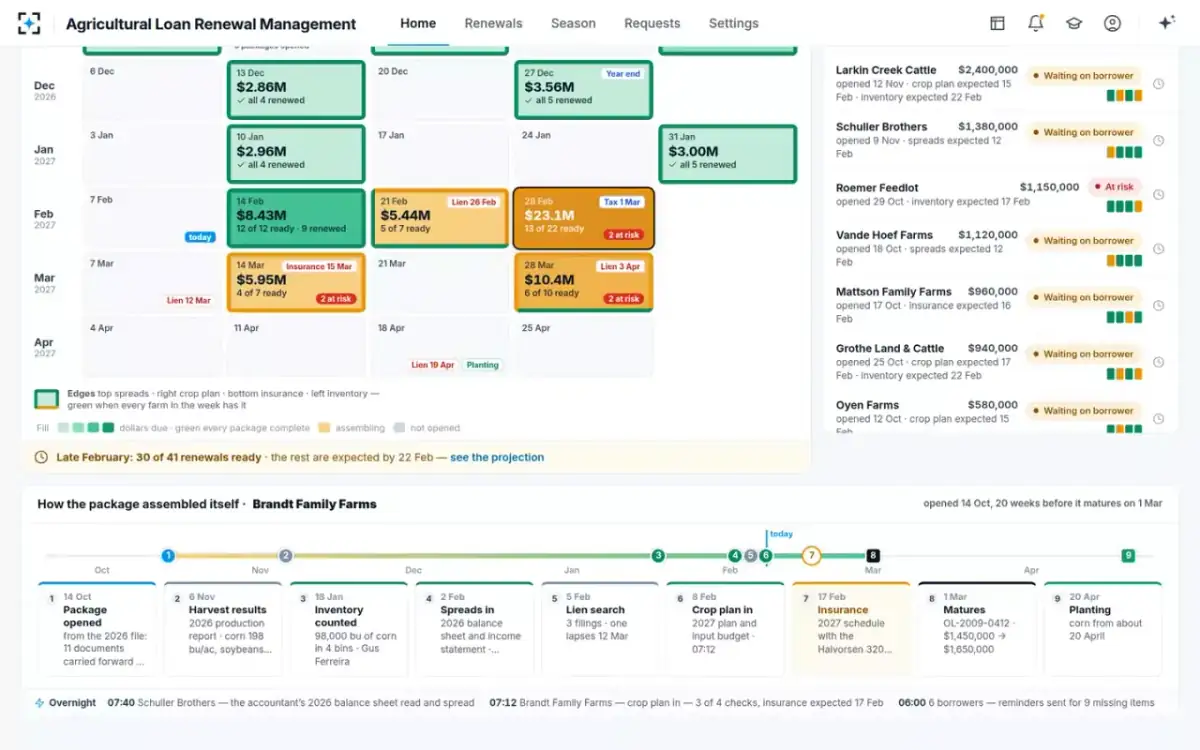
That morning the officer pressed one button. Six agents read 23 documents and came back with four things that needed his judgement: carryover on the line, coverage of 1.18x against a 1.25x minimum, a lien filing lapsing on 12 March, and 320 rented acres missing from the crop insurance. He added one condition — sell or contract 40,000 bushels of stored corn by 31 March — recommended the renewal and signed it. Because it was above his $1.5 million authority and needed a coverage exception, it went to the Ag Lending Manager, who approved it the same day: 21 days before maturity and about ten weeks before planting. Loan administration took the continuation to file and the assignment to record.
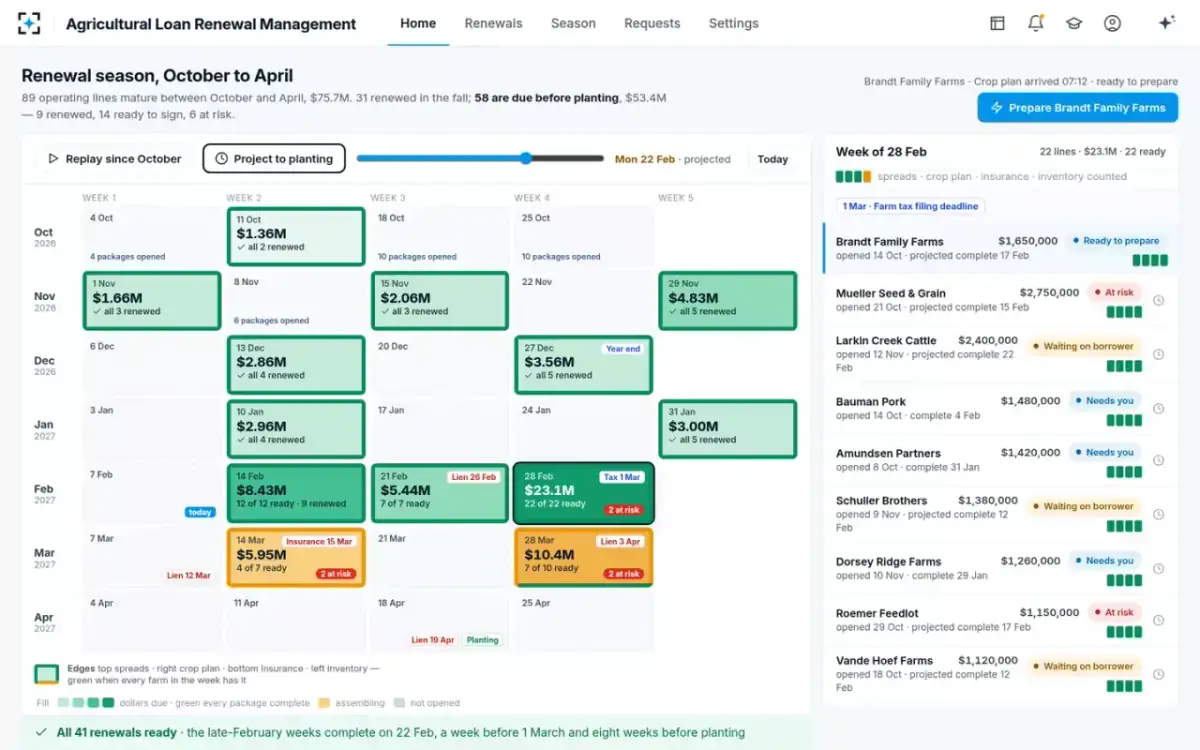
Back on the season calendar, the officer projected every remaining file forward on the expected dates of its missing documents. The late-February weeks turned from amber to green: all 41 renewals in those weeks projected ready by 22 February, a week before 1 March. Each stage of that file, and the eight weeks around it, is the process above; what it costs a bank to run it by hand is worked through in the real cost of a farm loan renewal.
The rest of the season projected forward on each file's expected documents
Questions people ask
How long does a farm loan renewal take?
Two answers. Officer time by hand is a matter of hours per file — about six on the sample bank's estimates. Elapsed time is set by the slowest document, often harvest-to-February, which is why a renewal that starts when its first document can exist finishes far earlier than one started from a maturity report in January.
When do farm operating lines come up for renewal?
Most row-crop operating lines mature in late winter, between the sale of one crop and the planting of the next, so a farm book's maturities cluster in the weeks before planting. Some lines are set to mature in the fall instead, which spreads the work; the sample bank renews 31 of its 89 lines then.
What is an annual farm loan review?
A fresh analysis of the borrower's financial condition, usually done with the renewal. For FSA-guaranteed lines it is required: lenders must document an annual analysis of every line of credit loan, comparing actual to planned income and expenses for loans secured by personal property and accounting for all collateral.
How far in advance should a farm loan renewal start?
As soon as its first document can exist, which for most farms is harvest. The sample file in this guide was reopened twenty weeks before maturity and was approved 21 days early; the bank's own setting is that every file should be ready three weeks before maturity.
What is the difference between renewing and extending a farm loan?
A renewal is a new credit decision on current information, often with new terms. An extension moves the maturity date, usually briefly, without that decision. Surveys count them together, but only a renewal underwritten on current figures earns the handbook's protection for sound borrowers whose loans are renewed under prudent standards.
Why does a renewal need a new lien search every year?
Because a financing statement lapses five years after filing unless a continuation is filed in the six months before, and because other creditors file too. The search shows whether the bank is still perfected, whether anyone has filed ahead of it, and which continuations fall due this season.