The agricultural lending process at a bank starts with the ag loan officer, whose work is this: find and keep farm borrowers, understand each operation well enough to judge its credit, structure operating lines, equipment loans and real estate loans that fit the production cycle, recommend them for approval, and service them until they are repaid. The federal description of the wider occupation says loan officers "evaluate, authorize, or recommend approval of loan applications" (BLS Occupational Outlook Handbook). What it does not say is when the work lands. Most farm operating lines mature in the weeks between New Year and planting, and each one has to be re-underwritten, so an ag loan officer's year has a season in it that a commercial lender's does not. Agricultural Loan Renewal Management, Botminds' agentic solution for farm operating line renewals, is built for that season: it assembles each renewal so the officer spends those weeks on judgement rather than on paperwork.
No officer carries a renewal alone. Four seats touch every file, each with a different job and a different thing it must never do, and the friction sits in the handoffs between them rather than in any one seat. The people, the bank and the farms below are fictional sample data from the solution — an officer with 58 operating lines due before planting at a bank with a written credit policy.
One officer's renewal season does not fit the calendar
58
operating lines due before planting for the sample officer
6 hrs
of preparation each when the work is done by hand
348 hrs
of preparation in total: 43.5 eight-hour days
~32
working days between 15 February and 1 April
What does an ag loan officer do across one renewal season?
Across a year, the job is relationship banking with a balance sheet attached: visiting farms, reading tax returns and Schedule F, watching markets, structuring credit and fielding requests at planting, at harvest and every time a combine breaks. Across a renewal season, it narrows to one repeated task. For every operating line that matures before planting, the officer has to set last year's results against last year's plan, find out whether the balance on the line is unsold grain or carryover, build this year's cash flow at the bank's prices, confirm that insurance and liens still protect the bank, and then write and sign a recommendation.
The sample officer in the solution, Owen Lindqvist, has 58 operating lines renewing between 15 February and 1 April, and about six hours of preparation each when the work is done by hand. That is 348 hours, or 43.5 eight-hour days, in a window with about 32 working days in it. The arithmetic is the whole story of the season: either the officer works far beyond a normal week, or files get rolled forward on last year's numbers. The BLS notes that "most loan officers work full time, and some work more than 40 hours per week"; for an ag officer in February, the second half of that sentence is the job.
Two things set the ag version of the job apart from a commercial loan officer's. The first is the production cycle. The regulator's handbook puts the principle plainly: "the production (or growing) cycle should govern the maximum amount of revolving Ag credit available at any one time" (OCC, Agricultural Lending). The second is that a farm's collateral moves. Grain is sold, cattle are shipped, and rented ground changes hands every spring, so the officer's view of the security has to be refreshed every year rather than set at closing.
The four seats on a farm operating line renewal
At a community bank with an agricultural book, a renewal typically passes through four seats. The titles vary; the separation of duties does not, because the regulator looks for it. Among the factors examiners weigh in agricultural lending is the "quality of credit administration, e.g., segregation of duties, financial analysis, monitoring, and documentation standards" (OCC, Agricultural Lending). Segregation of duties is what makes four seats out of one job.
Four seats on one renewal, and what each keeps whatever the tools
Today
Eight weeks as a file clerk: chasing statements, keying spreads, counting bins by phone, then a memo written at night.
With agents
Opens each file prepared and spends the time on the few things that need judgement on that farm.
Still theirs: The relationship, the recommendation and the signature
Today
Half the season re-keying balance sheets for several officers at once.
With agents
Reviews spreads and cash flows already built at the price deck, with the stress case beside each plan.
Still theirs: The challenge: whether the numbers mean what they appear to
Today
Asks every officer the same question: what changed since last year?
With agents
Gets a memo that sets last year against its plan and shows any exception with its mitigants.
Still theirs: Approval above the officer’s authority, and every exception
Today
Finds a lapsed filing or an unsigned insurance assignment after booking.
With agents
Sees every lapse date, insurance gap and inspection due on one calendar, with continuations drafted.
Still theirs: Filing, booking and the bank’s security of record
The ag loan officer: owns the farm, recommends the terms, signs
The officer's seat is the only one that knows the farm. That knowledge is what an approver is buying when they read a recommendation: that a family held its grain on purpose last year, that the next generation is taking over the livestock, that a landlord is about to sell a rented quarter. None of it is in the statements, and it is why the officer's recommendation carries weight that the arithmetic alone does not.
The officer's tasks on a renewal are specific. Request the year-end statements and this year's crop plan. Decide whether the balance on the line at year end is carryover or unsold grain — the arithmetic is set out in how to calculate carryover debt, and getting it wrong in either direction misleads the approver. Propose a structure: a renewed line, perhaps a term loan for true carryover, conditions on grain sales. Write the memo. Then recommend and sign, with the signature meaning something definite — in the sample bank, "I have reviewed the file and recommend these terms".
What the officer must not do is as important. The officer does not approve beyond their own authority; the sample officer approves to $1.5 million, and anything larger or carrying a policy exception goes up. And the officer should not be the only person who inspects the collateral on their own loans. The handbook is direct about it: "an inspection and reevaluation should be performed by a qualified person other than the lending officer responsible for the credit decision" (OCC, Agricultural Lending). Where that separation is impossible, it describes rotating inspection duties among staff other than the primary lending officer, using outside directors, or hiring an independent third party.
The credit analyst: spreads, cash flows and the stress case
The analyst's seat turns documents into numbers an approver can trust. Spreading a farm balance sheet is not clerical: market and cost values sit side by side, accrual adjustments change the income figure, and a single misread line — prepaid inputs counted as a current asset twice, a machinery note placed in the wrong column — moves the ratios that decide the renewal. A good analyst catches what the officer's optimism missed. In the sample bank one analyst, Priya Raman, supports four officers, which is why her February is a queue.
The analyst also owns the challenge to the plan. A cash flow at the borrower's prices and yields is a forecast written by the person who needs the loan, and the regulator expects the bank to underwrite against its own view: "an Ag loan approval should be based on a reasonable expectation that operating cash flow will provide sufficient repayment, not on the Ag land value." The analyst's tools for that are the bank's price deck, the farm's insured yields and a stress case. The measures that come out of the spread, and the minimums they are judged against, are set out in the farm financial ratios a renewal is judged on.
The Ag Lending Manager: approval above authority, and every exception
The manager's seat decides. It approves what the officer cannot: loans above the officer's limit, and in a well-run bank every file that departs from credit policy, whatever its size. In the sample bank Marta Hensley approves to $5 million and every exception; above $5 million the file goes to the Chief Credit Officer. Examiners look at exactly this structure, including the "appropriateness of the approval process, including officers' approval limits" (OCC, Agricultural Lending).
The manager's complaint in renewal season is almost always the same: show me what changed since last year, not the whole file again. An approver reading thirty renewals in a fortnight does not need a fresh narrative for each farm. They need last year's plan beside last year's result, the carryover and what is proposed for it, this year's coverage against policy, and any exception with the mitigants the officer is relying on. A memo built that way can be approved on the file. A memo that repeats last year's text with new numbers pasted in has to be re-read from the start.
Loan administration: filings, insurance, inspections
The fourth seat holds the bank's security in fact rather than on paper. Loan administration books the renewal, files the continuation statement before a financing statement lapses, records the crop insurance assignment with the insurer, and keeps the inspection calendar. In the sample bank that is Gus Ferreira, whose view of the season is a list of dates: "A lapsed filing is a lien we no longer have."
This seat is where renewal-season failures become permanent. An officer who misses a carryover can correct the structure next month. A financing statement that lapses on 12 March leaves the bank unperfected from that day, and a crop insurance assignment that was never signed means the indemnity is paid to the farmer. Both are explained in whether an assignment of indemnity counts as collateral. Neither shows up in a ratio, which is why they tend to be found by the person booking the loan rather than the person recommending it.
Who does what on a renewal, and who may not
| Seat | Does | Decides | Must not |
|---|---|---|---|
| Ag loan officer | Gathers the file, reads the farm, structures the request, writes the memo | What to recommend, and on what conditions | Approve above authority, or be the only inspector of collateral on their own loans |
| Credit analyst | Spreads statements, builds the cash flow at the price deck, runs the stress case | Whether the numbers support the request | Accept the borrower’s prices or yields without challenge |
| Ag Lending Manager | Reads the memo, weighs exceptions and mitigants | Approval above the officer’s limit, and every policy exception | Approve without the evidence for an exception in the file |
| Loan administration | Books, files continuations, records insurance assignments, schedules inspections | Whether the security is actually in place | Let a filing date or an assignment slip past booking |
Where a renewal season actually breaks: the handoffs
Each seat, done well, is manageable. What breaks a season is the waiting between them. The analyst cannot spread a balance sheet the officer has not yet chased from the accountant. The manager cannot approve a memo that is waiting on the analyst's cash flow. Loan administration cannot file a continuation for a renewal nobody has told them is coming. Every handoff is a queue, and in February every queue is full at once.
One renewal across four seats, and where it waits
A person decides
Ag loan officer — gathers the fileRequests year-end statements, the crop plan and leases, the grain count and the schedule of insurance from the borrower, the accountant and the agent.
Never: Starts analysis on last year’s statements because this year’s have not arrived
A person decides
Credit analyst — spreads and buildsSpreads the statements, compares last year with its plan, builds this year’s cash flow at the price deck with the stress case.
Never: Prices above the bank’s deck
A person decides
Ag loan officer — recommendsDecides the structure, writes the memo with what changed since last year, recommends and signs.
Never: Approves above authority
A person decides
Ag Lending Manager — approvesApproves above the officer’s limit and every policy exception, on the evidence in the file.
Never: Approves an exception without its mitigants
A person decides
Loan administration — securesBooks the renewal, files continuations, records the insurance assignment, schedules inspections.
Never: Leaves a lapse date or an unsigned assignment for later
The handoffs are also where information is lost. An analyst who finds that the rented acres on the crop plan do not match the schedule of insurance has to tell the officer, who has to tell the borrower, who has to call the agent, who has to tell loan administration. In a quiet month that chain works. In the eight weeks before planting it is how a gap like the sample file's 320 uninsured acres reaches a booked loan.
How the eight weeks change when the assembly is done for you
The seats do not change. What changes is what fills them. In Agricultural Loan Renewal Management six agents open each renewal in October from last year's file and fill it as documents arrive: statements are read and spread, last year is compared with its plan, carryover is named only after the grain is counted, this year's cash flow is built at the price deck, insurance acres and lien dates are checked, a borrower request listing only what is missing is drafted, and the memo is drafted with every figure tied to its document. No agent recommends, approves, files or sends anything to a borrower; those stay with the four people.
Where the officer's renewal season goes, by hand and with the agents
By hand — 348 hours
- Chasing documents · 23%
- Spreading · 21%
- Last year and carryover · 16%
- This year’s cash flow · 16%
- Insurance, filings · 9%
- Memo and approval · 15%
With the agents — 46 hours
- Chasing documents · 9%
- Spreading · 9%
- Last year and carryover · 17%
- This year’s cash flow · 17%
- Insurance, filings · 13%
- Memo and approval · 35%
Read the second bar for what it says about the job. By hand, more than four hours in ten go on chasing and keying; with the agents, more than a third of the officer's remaining time is the memo, terms and approval. The officer's estimated season falls from 348 hours to 46 on the sample bank's 58 renewals — figures from the solution's sample season, not a measured result at any bank. The four judgement calls that come back on a file are the work the job description was written for.
What the officer opens: a prepared renewal and the four things that need judgement
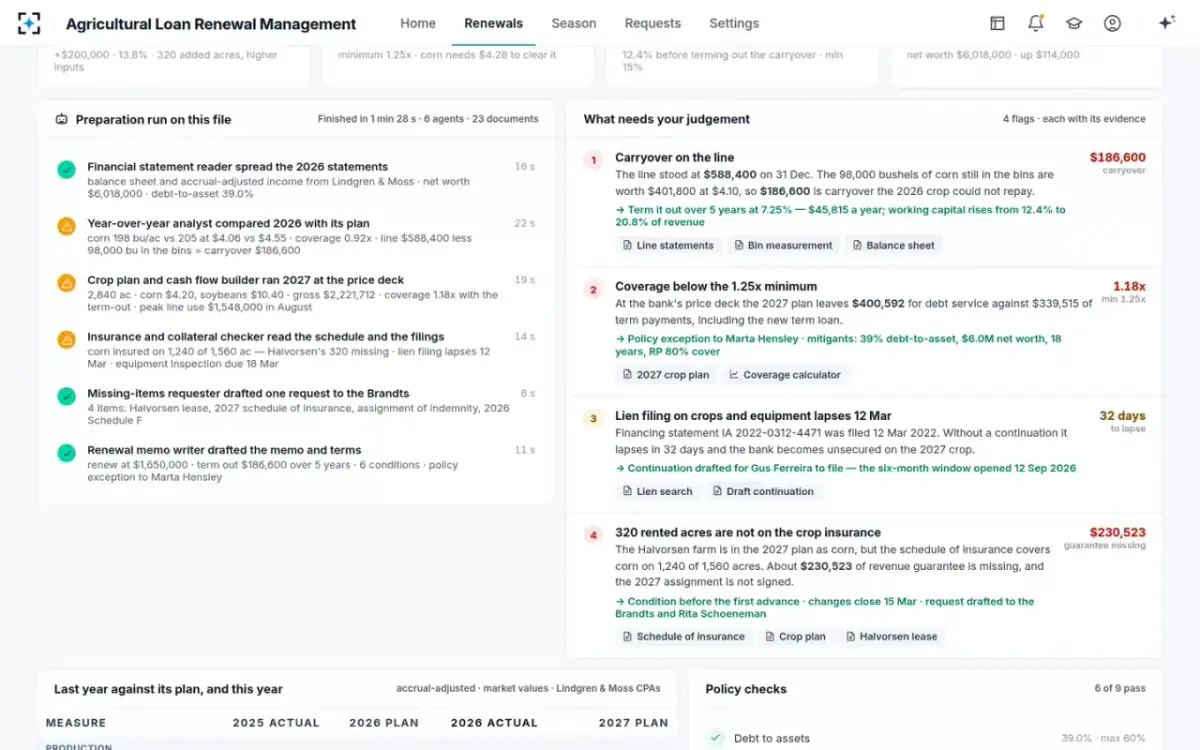
The analyst's seat changes in the same direction. Reviewing a spread that cites each figure's page is faster than building it, and the time goes into the challenge rather than the keying. The manager's memo arrives in the shape they asked for. And loan administration sees the season's lapse dates and insurance gaps as one calendar rather than discovering them at booking.
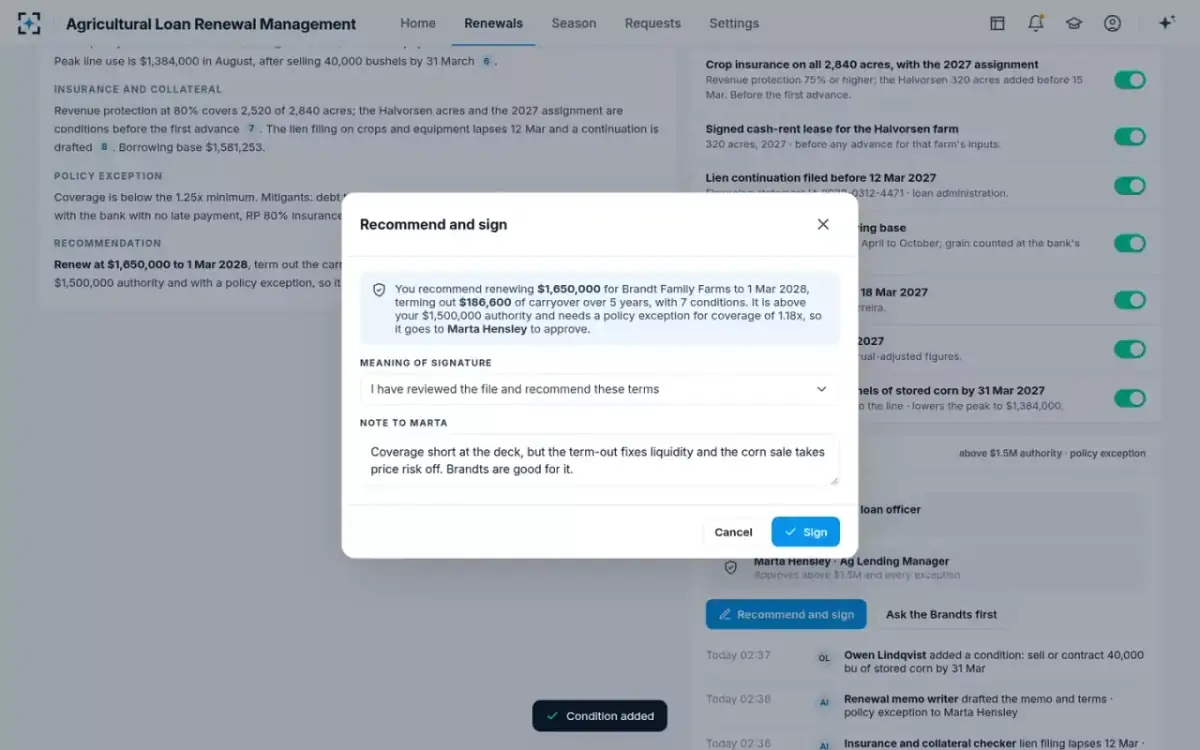
The officer's signature, with its meaning recorded, routed to the manager above authority
Why banks struggle to staff the ag desk in renewal season
Because the people are scarce where the farms are. The OCC's handbook observes that "given the general decline in farm and rural populations, some Ag-focused community banks have had difficulty developing and retaining qualified staff for key positions" (OCC, Agricultural Lending). A bank in a farm county is often short of exactly this person.
The renewal season is hard by arithmetic rather than temperament: dozens of maturities in a few weeks, each with a family business behind it, in years when prices have not covered costs. The part that wears people down is rarely the judgement. It is doing the assembly at night so that the judgement can happen during the day. That is the part software can take. What it costs a bank to leave it with the officer is worked through in the real cost of a farm loan renewal.
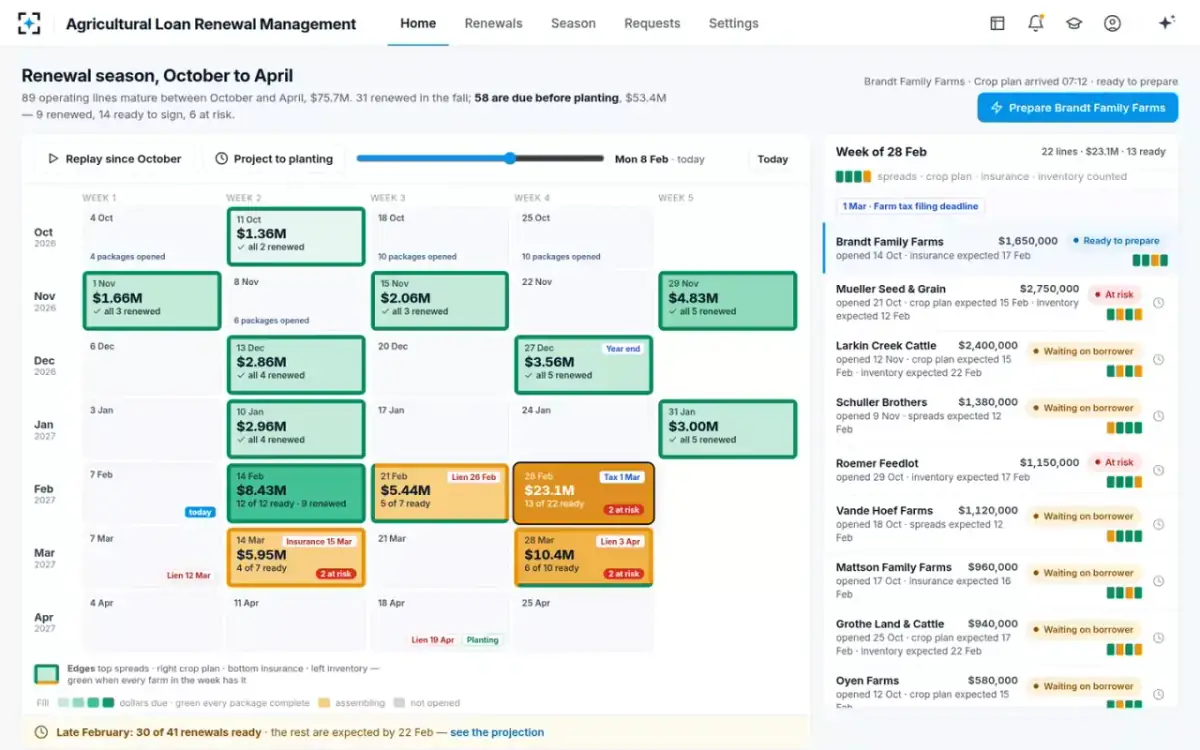
The season the job is organised around, on one calendar
Questions people ask
What does an ag loan officer own in the agricultural lending process?
An ag loan officer develops and keeps farm and ranch borrowers, analyses their operations and statements, structures operating lines, equipment loans and real estate loans around the production cycle, recommends them for approval, and services them until repaid. In renewal season the work narrows to re-underwriting every operating line that matures before planting.
What does a credit analyst do at a bank's ag desk?
The analyst spreads borrowers' financial statements into the bank's format, compares last year's results with last year's plan, builds this year's cash flow at the bank's prices, and runs a stress case. The analyst's other job is to challenge: whether the numbers actually support the officer's recommendation.
Who approves agricultural loans?
An officer approves within their personal authority; above it, a manager, a senior credit officer or a loan committee approves, depending on the bank's policy. Policy exceptions usually go above the officer whatever the size. Examiners review the approval process, including officers' approval limits, as part of judging agricultural credit risk.
How many farm loans does one loan officer handle?
There is no standard number; it depends on loan size, complexity and support staff. What matters in renewal season is how many mature in the same window. The sample officer in this guide has 58 operating lines due before planting, at about six hours each by hand — 348 hours in roughly 32 working days.
Can an ag loan officer inspect the collateral on their own loans?
The regulator's expectation is that inspections are done by a qualified person other than the lending officer responsible for the credit decision. Where a small bank cannot separate the duties, the handbook describes alternatives: rotating inspections among other staff, using outside directors, contracting an independent third party, or a dual inspection with someone independent of loan production.