Can AI underwrite a farm loan? It can do most of the underwriting work — read the statements, spread them, compare last year with its plan, count the grain before naming carryover, build this year's cash flow at the bank's prices, check insurance acres and lien dates, and draft the memo — and it should decide none of it. The recommendation, the approval, the price, the filing and every word sent to the borrower belong to named people at the bank, because that is where accountability sits under the rules banks already follow. Agricultural Loan Renewal Management, Botminds' agentic solution for farm operating line renewals, is built on that division: six agents prepare each renewal, and the ag loan officer recommends and the manager approves.
The question matters now because the work has outgrown the people. One ag loan officer re-underwrites dozens of operating lines in the weeks before planting, and most of the hours go on assembly rather than judgement. This guide sets out where an agent can safely take the assembly, where it must stop, and what the regulators have — and have not — said about it. The farm and the bank in the examples are fictional sample data from the solution.
Can AI underwrite a farm loan? The short answer, and the long one
The short answer is no, if underwriting means deciding, and largely yes, if it means preparing. Most of what an underwriter does on a farm renewal is gather, read, reconcile and compute. Those are tasks a well-limited agent can do faster and more consistently than a person working through a February backlog, and every output can be checked against the document it came from.
The long answer is about the remainder. A farm credit decision weighs things no document states: whether this family's late grain sales were strategy or distress, whether the operation can absorb a bad year, what the bank is willing to lend against. The regulator's handbook frames agricultural underwriting around exactly that kind of judgement: "Ag banks should not place undue reliance on collateral and cyclical factors as part of underwriting decisions," and "an Ag loan approval should be based on a reasonable expectation that operating cash flow will provide sufficient repayment, not on the Ag land value" (OCC, Agricultural Lending). A reasonable expectation is a person's, held on the evidence. The agent's job is to put that evidence in front of the person, complete and cited.
What underwriting a renewal involves, task by task
Split a renewal into its tasks and the line between preparing and deciding becomes concrete. The table below is the division Agricultural Loan Renewal Management applies; a bank designing its own process would draw it in roughly the same place, because the right-hand column is where its policies already assign authority.
A farm renewal, task by task: what an agent prepares and who decides
| Task | An agent can | A person decides |
|---|---|---|
| Gather documents | List what the file lacks and draft one request per borrower | Whether and when to send it — the officer |
| Spread statements | Read balance sheets, income statements and Schedule F into the bank’s measures, citing the page for each figure | Whether the spread is right — the analyst |
| Last year against plan | Explain the variance by yield and price | What the variance says about the operator — the officer |
| Carryover | Count and value grain on hand, then report the remaining balance | How to treat it: term out, sell grain, or decline — officer and approver |
| This year’s cash flow | Build it at the bank’s price deck and insured yields, with the stress case beside it | Whether the plan is credible — analyst and officer |
| Insurance and liens | Match planted acres to the schedule of insurance, check the assignment, list lapse dates, draft continuations | Filing the continuation — loan administration |
| Memo and terms | Draft the memo, conditions and terms from the pricing grid, with every figure cited | Recommend and sign — the officer; approve — the manager |
Two features of that table carry the argument. Every task on the left produces something a person can check — a figure with its page, a variance with its arithmetic, a draft with its sources. And nothing on the left changes the bank's position with the borrower or the public record until a person acts.
Six agents, one job each, and the line each may never cross
A single general-purpose assistant asked to "prepare the renewal" is hard to limit, because its job has no edges. Splitting the work into six narrow jobs makes each limit specific enough to write down and test. Each agent in the solution has a stated job and a stated thing it may never do.
Six agents on one renewal, each with the thing it may never do
Agent
Financial statement readerReads year-end balance sheets, income statements, Schedule F and accountants’ statements, and spreads them into the farm financial measures, citing the page for every figure.
Never: Estimates a missing figure — it lists it as missing
Agent
Year-over-year analystCompares last year’s results with last year’s plan, explains the variance by yield and price, and finds carryover after counting grain on hand.
Never: Names carryover before the inventory is counted
Agent
Crop plan and cash flow builderBuilds this year’s cash flow from the crop plan, input budget and leases at the bank’s price deck and the farm’s insured yields, with line use by month.
Never: Prices above the deck, or shows a plan without its stress test
Agent
Insurance and collateral checkerReads the schedule of insurance and the assignment, the lien filings and lapse dates, inspections and the borrowing base.
Never: Counts unassigned insurance, or files a continuation itself
Agent
Missing-items requesterLists what each file still needs and drafts one plain request per borrower.
Never: Sends without the officer, or asks for a document already in the file
Agent
Renewal memo writerDrafts the memo with what changed since last year, proposed terms, conditions and any policy exception with its mitigants, and routes it for approval.
Never: Approves, or sets a rate outside the pricing grid
A person decides
The ag loan officer, then the approverThe officer recommends and signs with the meaning of the signature recorded; above authority or with an exception, the manager approves.
Never: Delegates the decision to an agent
The limits are not decorative. "Never estimates a missing figure" is the difference between a spread that is incomplete and one that is quietly wrong. "Never counts unassigned insurance" keeps a borrowing base from claiming security the bank does not hold — the reason is set out in whether an assignment of indemnity counts as collateral. "Drafts continuations; never files them" leaves the public record in the hands of loan administration. Each is a place where an agent that tried to be helpful would do harm.
Is agentic AI covered by federal model-risk guidance?
Not yet, and the agencies say so themselves. The revised model risk management guidance issued in April 2026 by the Federal Reserve, the OCC and the FDIC replaced the guidance banks had followed since 2011, and it puts generative and agentic AI outside its own scope in a footnote.
"Generative AI and agentic AI models are novel and rapidly evolving. As such, they are not within the scope of this guidance. Nonetheless, a banking organization's risk management and governance practices should guide the determination of appropriate governance and controls for any tools, processes, or systems not covered in this document."
SR Letter 26-2, Revised Guidance on Model Risk Management, footnote 3 (Federal Reserve, OCC and FDIC, 17 April 2026)
Two more features of that letter matter to an ag lender. It "is expected to be most relevant to banking organizations with over $30 billion in total assets", and it says that models at banks of $30 billion or less "typically are subject to internal risk management and governance practices appropriate for the size and risk profile of these banking organizations" (SR 26-2). Most banks with a large agricultural book are far below that line. So the honest position for a community bank evaluating agents is that no federal rulebook tells it exactly what to do. Its own governance has to.
That is an argument for limits that are written into the system rather than borrowed from a regulator. If the bank's controls are going to be its own, they need to be explicit enough to test: which agent may do what, what it may never do, and what a person has to sign. Testing those limits on renewals the bank has already closed is set out in how to measure the accuracy of AI on a farm loan renewal.
Who is accountable when an agent drafts the renewal memo?
The bank, and within the bank the person who signs. Buying software does not move that responsibility to the vendor. The agencies' interagency guidance on third-party relationships says "the use of third parties does not diminish or remove banking organizations' responsibilities to ensure that activities are performed in a safe and sound manner and in compliance with applicable laws and regulations, including but not limited to those designed to protect consumers (such as fair lending laws …)" (Interagency Guidance on Third-Party Relationships, 88 Fed. Reg., 9 June 2023).
Inside the bank, accountability follows the signature, which is why the signature should mean something specific. In the solution the officer recommends and signs with its meaning recorded — "I have reviewed the file and recommend these terms" — and the approver approves on the file. Every agent step, every condition the officer adds and every signature is on the file's activity trail with who and when. If an approver later asks why a figure was relied on, the answer is a document, a page and a name, not "the system said so".
The same renewal memo, drafted by hand and drafted by an agent
Drafted by the officer: The officer who signs
Drafted by an agent, signed by the officer: The officer who signs — unchanged
Drafted by the officer: Usually the analyst’s spread; rarely cited
Drafted by an agent, signed by the officer: Numbered back to its statement, crop plan, schedule of insurance or filing
Drafted by the officer: The narrative, and whatever figures look odd
Drafted by an agent, signed by the officer: Any figure, against its source, in one step
Drafted by the officer: Pasted figures from last year’s memo; a missed lapse date
Drafted by an agent, signed by the officer: Over-trust: a signature on a draft nobody read — which is why the officer adds conditions and signs a stated meaning
Why the agents never price above the bank's own deck
Because a cash flow is only as conservative as its prices, and the price is a credit decision. A farm plan built at the borrower's hoped-for corn price can show comfortable coverage that disappears at the bank's own view of the market. The bank's view is set once, by the person accountable for it: in the sample bank, the Chief Credit Officer's 2027 deck is $4.20 corn and $10.40 soybeans, with a stress case of corn down 10 percent and yield down 10 percent shown beside every plan.
An agent that could price above that deck would be making a credit decision dressed as arithmetic. So the cash flow builder cannot, and the memo writer cannot set a rate outside the pricing grid. On the sample file, the plan at the deck produced coverage of 1.18x against a 1.25x minimum; the calculator showed that corn would have to reach $4.28 to clear the minimum, and at $3.90 coverage would fall to 0.90x. Those are the facts an approver needs. Whether to grant an exception on them is the approver's call, and in the sample bank it went to the Ag Lending Manager with its mitigants.
One renewal prepared by six agents, and what came back for a person
23
documents read on the sample file — statements, crop plan, leases, grain count, insurance, filings
4
flags returned for the officer’s judgement, each with its evidence
1.18x
coverage at the bank’s price deck, against a 1.25x policy minimum
0
decisions made by an agent — recommendation, approval, filing and borrower contact stayed with people
Does a declined renewal need reasons a person can give?
Yes, and that alone settles where the decision has to sit. A farm operating line is business credit, and the Equal Credit Opportunity Act's Regulation B applies to it. Its definition of adverse action includes "a refusal to grant credit in substantially the amount or on substantially the terms requested in an application" unless the applicant accepts a counteroffer, and "a refusal to increase the amount of credit available to an applicant who has made an application for an increase" (12 CFR § 1002.2). A renewal request for a larger line — the sample farm asked to go from $1,450,000 to $1,650,000 — is exactly that kind of application.
When adverse action is taken, the reasons have to be real. Regulation B requires that a statement of reasons "must be specific and indicate the principal reason(s) for the adverse action", and states that reasons based on "the creditor's internal standards or policies" or a failure "to achieve a qualifying score on the creditor's credit scoring system are insufficient" (12 CFR § 1002.9). For businesses with gross revenues above $1 million the bank may give the written statement only on request, if the applicant asks in writing within 60 days; the obligation to have specific reasons does not go away.
That is a practical case for keeping the decision with a person and the evidence with the agents. A person who decided on a cited file can state the principal reasons in plain words: coverage of 1.18x at the bank's prices, carryover of $186,600, 320 acres uninsured. A decision that came out of a system nobody at the bank can explain cannot meet that standard.
What still needs a person, every time: four flags on one file
On the sample renewal the agents came back with four findings and no conclusions. Each needed a different kind of judgement. Carryover on the line: is $186,600 a bad year or a pattern, and is a five-year term-out the right treatment? Coverage of 1.18x below policy: is an exception justified, and on what mitigants? A lien filing lapsing on 12 March: has loan administration got the continuation? And 320 rented acres missing from the crop insurance: can the borrower fix it before the sales closing date, 35 days away?
The prepared renewal: what six agents did, and the four things left for the officer
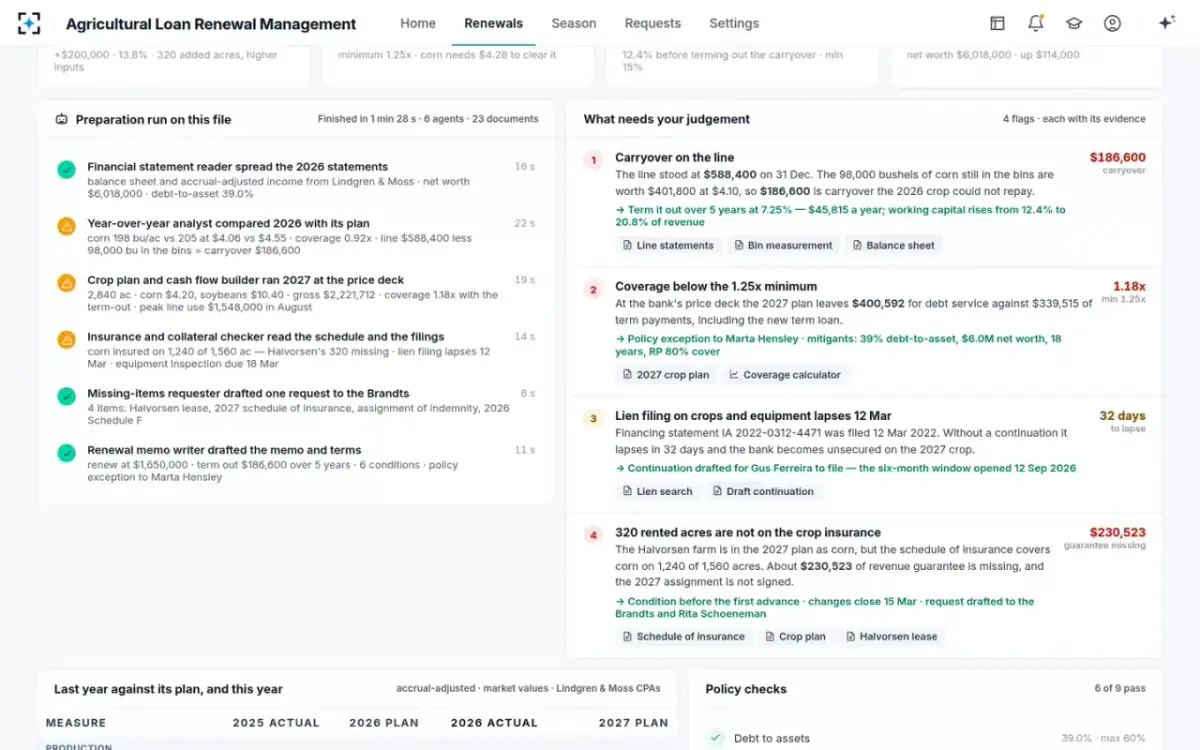
The officer's response shows the division working. He accepted the term-out of the carryover as drafted, added one condition the cash flow builder had suggested — sell or contract 40,000 bushels of stored corn by 31 March, about $164,000 to the line — and recommended the renewal. Because it was above his authority and needed a coverage exception, it went to the manager, who approved it. Nothing in that sequence was decided by an agent, and nothing in it had to be assembled by hand.
How a flag is raised, and what evidence it carries
A flag is useful only if a person can confirm it without redoing the work. Each one in the solution carries its arithmetic and its documents. The insurance flag on the sample file is the schedule of insurance set against the crop plan field by field: 1,240 of 1,560 corn acres covered, the Halvorsen farm's 320 acres missing, and the 2027 assignment of indemnity unsigned, with the sales closing date 35 days away. The officer can see in one screen what the agent saw and why it stopped short of a conclusion.
One flag's evidence: insurance against the crop plan, acre by acre
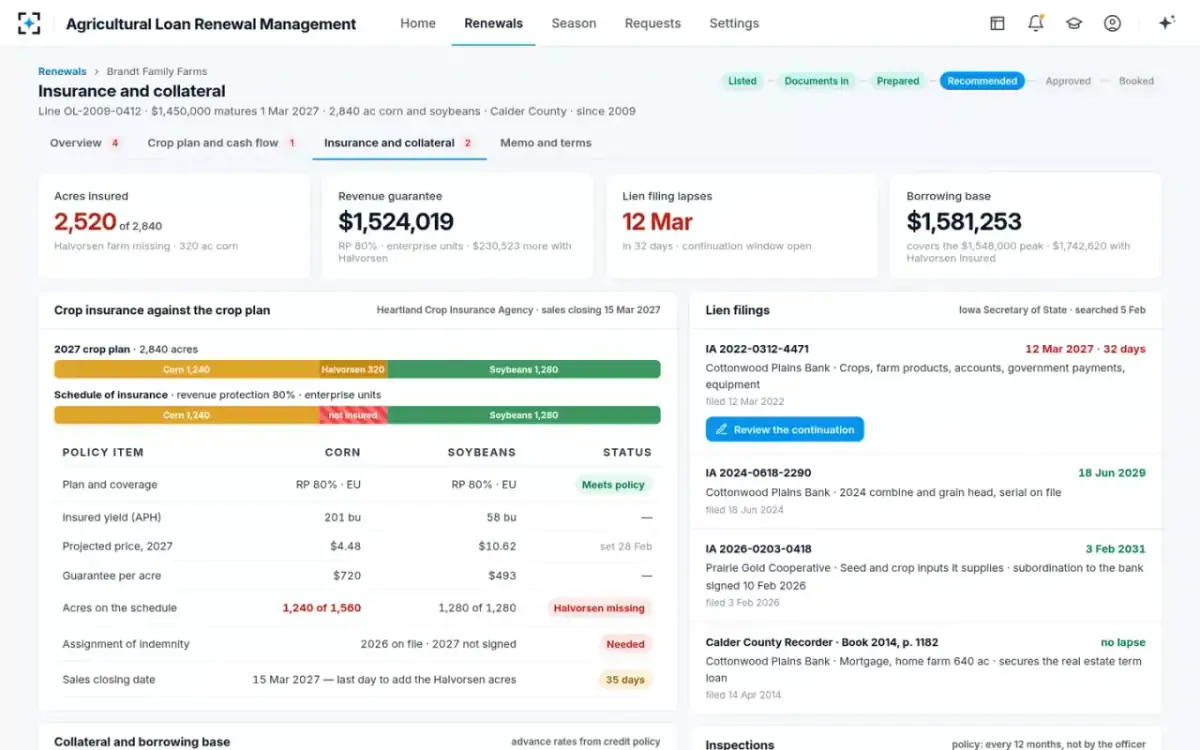
That is the design principle behind the whole answer. An agent that concludes hides its reasoning in its conclusion. An agent that reports what it found, with the documents, leaves the reasoning to the person accountable for it. Where the rest of a renewal season's hours go once the assembly is done this way is set out in the farm operating loan renewal process, step by step.
Questions people ask
Is AI used in agricultural lending today?
Mostly for preparation rather than decisions: reading and spreading statements, comparing years, checking documents and drafting. Survey evidence from the FDIC's community bank study found automated loan underwriting at about one community bank in nine in 2019, so most ag lending is still assembled by hand.
Can an AI agent approve a farm loan?
It should not, and in Agricultural Loan Renewal Management it cannot. Approval authority is assigned to named people by a bank's credit policy, and a declined or reduced request needs specific reasons under Regulation B. The agents prepare and draft; the officer recommends and signs, and the manager approves above the officer's authority.
Does an AI model need regulatory approval to be used in underwriting?
There is no federal approval process for a bank's underwriting tools. The April 2026 model risk guidance places generative and agentic AI outside its scope and says a bank's own risk management and governance should determine the controls. The bank remains responsible for anything a third party provides.
Can AI set the interest rate on a farm loan?
In this solution, no. The memo writer proposes terms only from the bank's pricing grid and never sets a rate outside it; any departure is a person's decision recorded as an exception. Pricing is a credit and business decision with fair lending consequences, so it stays inside a grid the bank controls.
Who is responsible if an agent's figure is wrong?
The bank, and the person who signed the file. That is why every figure in the drafted memo is numbered back to its document: the officer and approver can check it before signing. Interagency guidance is explicit that using a third party does not reduce a bank's responsibility for safe and sound, lawful operation.
What should an AI agent never do in ag lending?
Decide, price outside the grid, file anything on the public record, contact a borrower without the officer, estimate a missing figure, or count security the bank does not hold, such as unassigned crop insurance. Each of those either changes the bank's position or hides a gap a person needs to see.