The real cost of a farm loan renewal is officer and analyst hours multiplied by a loaded wage and by the number of operating lines that mature before planting — and on most ag desks nobody has ever worked it out, because the hours are never booked to a file. Botminds' Agricultural Loan Renewal Management prepares each renewal before the officer opens it: last year's results against last year's plan, the carryover left on the line, this year's cash flow at the bank's price deck, insurance and lien filings, and a drafted memo. The case for it is not a percentage. It is a count of hours that move from assembly to judgement, priced at what an hour of your own people costs, and it is a figure you can build yourself in six lines.
The season figures below come from the fictional sample bank in the solution — invented farms, an invented bank and invented people — and the wage and benefit inputs are from the US Bureau of Labor Statistics, linked where they appear. Every piece of arithmetic is shown, so you can substitute your own numbers at any line.
One ag loan officer's renewal season, counted
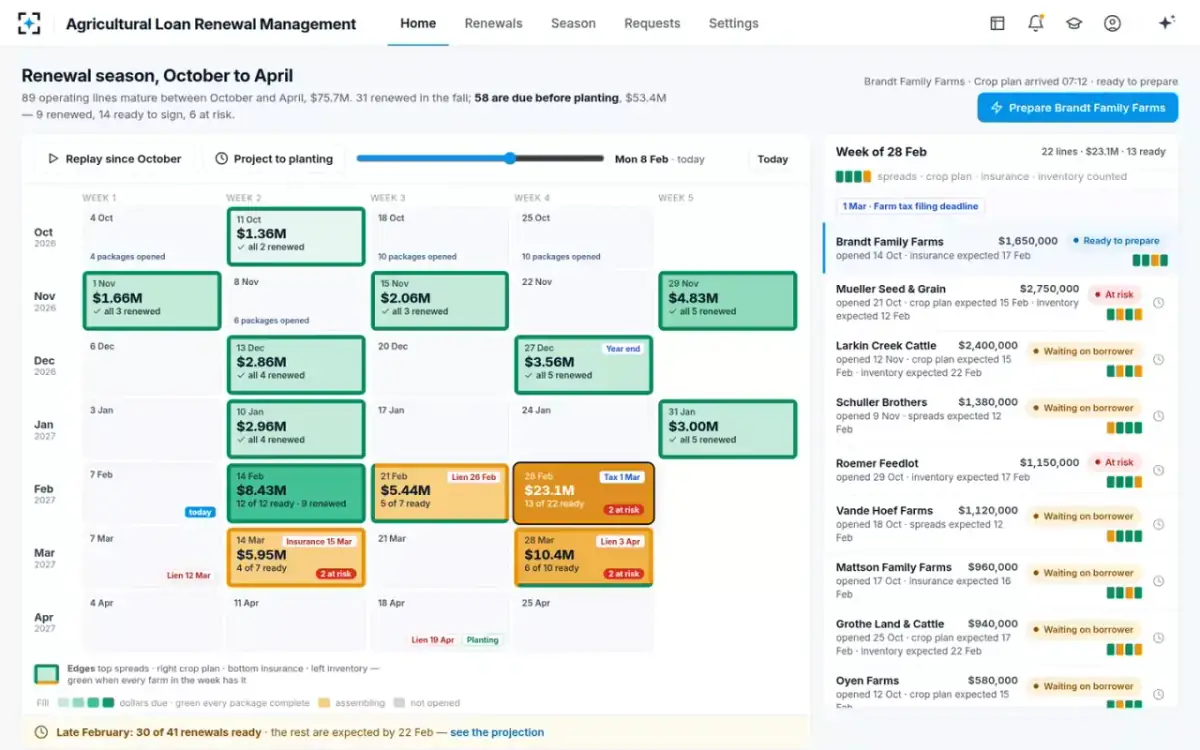
58renewals
operating lines maturing before planting, $53.4M of commitments
43.5days
of preparation by hand, at six hours a renewal
32days
of working days between 15 February and 1 April to do them in
5.75days
of officer time for the same 58 renewals with the agents
What does a farm loan renewal really cost a bank?
Start with the uncomfortable arithmetic in that figure. Forty-three and a half working days of preparation have to fit into thirty-two, in a window where the officer is also closing new money, handling collateral inspections and answering the phone. The gap is not a productivity problem; it is a volume problem with only three solutions, and two of them are bad. Hire, let renewals land after maturity, or roll files forward on last year's analysis. The third is what "rolled instead of re-underwritten" means in practice, and it is how carryover hides inside a renewed line and a financing statement lapses quietly.
So the cost of a renewal is not only the hours. It is the hours plus whatever the bank gives up when the hours run out. The hours are the part you can price, which is where to start, and the rest belongs in the business case as named risks rather than invented numbers.
Build the cost of one renewal in seven lines, from your own payroll
1. Officer hours on one renewal, by hand
Calculation348 hours ÷ 58 renewals
Result6.0 hours
2. A salary from your own payroll
CalculationBetween the 10th and 90th percentile BLS publishes for loan officers; $95,000 used here
Result$95,000
3. Add benefits at the published share
Calculation$95,000 ÷ 0.70 (benefits are 30.0% of employer cost)
Result$135,700
4. A loaded hour
Calculation$135,700 ÷ 2,080 hours
Result$65.24
5. One renewal, prepared by hand
Calculation6.0 hours × $65.24
Result$391
6. One renewal, prepared by the agents
Calculation0.79 hours × $65.24
Result$52
7. One officer, one season of 58 renewals
Calculation58 × ($391 − $52)
Result$19,700
Three hundred and ninety-one dollars to prepare one renewal, and just under twenty thousand dollars of officer time across one officer's season, is a smaller number than most business cases open with. It is also the honest one, and it is deliberately narrow: it counts one officer's hours and nothing else. The credit analyst who re-keys the balance sheets, the loan administrator who chases the filings and the manager who reads the memos are all extra, and so is every renewal that lands late.
How many hours does a farm loan renewal take?
About six hours of officer preparation each, in the sample season, before a single judgement is made about the credit. That figure is worth testing on your own desk rather than accepting, because it is the single input that moves the answer most — more than the wage, more than the price of any software. Two ways to get it: take an officer's calendar for one February and mark the half-days against files, or time five renewals end to end next season and take the median.
Where the six hours go matters more than the total, because the stages do not shrink alike. Chasing documents and re-keying statements nearly disappear when a package opens itself in October and fills as documents arrive. Writing a memo and setting terms do not, and should not.
Where a renewal season goes, by hand and with Agricultural Loan Renewal Management
By hand · 43.5 working days
- Gathering and chasing documents · 23%
- Spreading statements · 20.7%
- Last year against plan, and carryover · 16.1%
- This year's cash flow at the price deck · 16.1%
- Insurance, filings and inspections · 9.2%
- Memo, terms and approval · 14.9%
With the agents · 5.75 working days
- Gathering and chasing documents · 8.7%
- Spreading statements · 8.7%
- Last year against plan, and carryover · 17.4%
- This year's cash flow at the price deck · 17.4%
- Insurance, filings and inspections · 13%
- Memo, terms and approval · 34.8%
Read the two bars as shapes, not as lengths. By hand, gathering and spreading take nearly forty-four per cent of the season and the memo, terms and approval take fifteen. With the agents the same memo work takes thirty-five per cent of a season that is one-eighth as long. The officer's season does not merely get shorter; what is left in it is almost entirely the part that needs a person.
Days saved by stage across one season of 58 renewals
Why is ag lending so labor intensive?
Because a farm renewal is assembled from documents that live in other people's offices, arrive once a year, and have to be reconciled against each other before any of them means anything. On one renewal in the sample season the agents read twenty-three documents. A year-end balance sheet and income statement from the accountant, a Schedule F, the crop plan with acres by farm, the cash-rent leases, the input budget, the schedule of insurance from the insurance agent, a lien search at the Secretary of State, inspection reports, and a count of the grain still in the bins. Nine sources, three of them outside the bank, none of them on the bank's calendar.
Then each one has to be matched to the others. Acres in the crop plan against acres on the schedule of insurance, farm by farm. Bushels in the bins against the balance sheet's inventory line, at a price with a date on it. Term payments in the debt schedule against the payments the cash flow assumes. It is the reconciliation, not the reading, that eats the February.
The staffing side compounds it. The OCC's agricultural lending handbook is blunt that this is specialist work: "prudent Ag lending requires specialized expertise", and "Ag lenders should be experienced and sufficient in number to grant and administer credits in accordance with the bank's policy", with "sufficient resources … allocated to Ag staff development and continuing education" (Comptroller's Handbook: Agricultural Lending). "Sufficient in number" is a supervisory expectation with a price attached, and it is the expectation a season that needs 43.5 days inside 32 is failing.
Volume is not helping. USDA's Economic Research Service forecasts that farm non-real estate debt — the category operating lines sit in — "is expected to reach $206.1 billion in 2026, a 4.4-percent increase in nominal terms" (USDA ERS, Assets, Debt, and Wealth). More operating credit each year, re-underwritten in the same eight weeks, by a profession the Bureau of Labor Statistics expects to grow barely at all over the coming decade.
What a loaded hour costs, and how to work out your own
Nearly every ROI argument in lending software turns on an hourly cost that nobody shows their working for. There are two published inputs, and between them you can build yours in a minute.
The first is pay. BLS reports that for loan officers "the lowest 10 percent earned less than $39,430, and the highest 10 percent earned more than $153,180" (BLS Occupational Outlook Handbook, May 2025). That is a wide band on purpose: an experienced ag officer in a farm county and a consumer lending officer in a branch are the same occupation code and not the same job. Take the number from your own payroll, not from the range.
The second is the part most calculations forget. BLS's quarterly employer-cost series puts the whole of employment on one basis: "total employer compensation costs for private industry workers averaged $46.89 per hour worked in June 2026. Wages and salaries averaged $32.82 and accounted for 70.0 percent of employer costs, while benefit costs averaged $14.07 and accounted for the remaining 30.0 percent" (BLS, Employer Costs for Employee Compensation). So a salary divided by 0.70 is a defensible loaded cost, and it is a published share rather than a rule of thumb.
Divide the loaded figure by 2,080 hours and you have an hourly cost. Two honest caveats to state when you present it. BLS notes that "most loan officers work full time, and some work more than 40 hours per week", so dividing by 2,080 overstates the cost of an hour at a desk that works more than that — which makes the resulting business case conservative, not generous. And an hour released is only worth its loaded cost if it goes to work that earns or protects something. An hour saved in June is a benefit; an hour saved at 9pm on 27 February is a renewal that happens on time.
How do you measure the ROI of loan underwriting software?
Write it as a sum of named terms, each with an owner who will defend it, and mark the ones you cannot measure as unmeasured rather than estimating them. The version below is the shape we would put in front of a credit committee for a renewal season.
A renewal season's return, written as a sum of terms you can each defend
Officer hours released
(hours by hand − hours with the agents) × renewals × loaded hourly cost
Both hour counts measured on your own files, not quoted. This is the only term in the sum that is straightforwardly countable.
Ag Lending Manager
Renewals that stop landing late
renewals past maturity × days late × what a day past maturity costs you
Count the first two from last season. The third is a policy question for credit, not an arithmetic one.
Chief Credit Officer
Security that does not lapse
filings continued before lapse × exposure behind each one
An exposure protected, not a dollar earned. State it as exposure, never as a saving.
Loan administration
Carryover named, not rolled
lines where carryover was found and termed out × the amount termed out
The benefit is a correctly structured credit and a rating that holds, which is a risk measure rather than a cash one.
Credit risk
The software and its setup
licence + configuration + your credit policy and memo template loaded
Ask for all three as one number for three years, not year one alone.
Ag Lending Manager
Your own people, during the change
pilot hours + settings hours + one season run in parallel
The season you run both ways is the largest hidden cost and the one most often left out.
Credit risk
Note what that sum refuses to do. It does not convert a lapsed lien into an expected loss by multiplying exposure by a default rate somebody invented, and it does not price a renewal landing three weeks early. Those are real benefits, and a committee is better served by seeing them named with an owner than by seeing them priced with a number nobody can defend. The first term carries the business case; the rest tell the committee what else it is buying.
What a vendor's "X% faster" claim is not evidence of
A percentage is a ratio of two numbers, and in almost every published claim neither of them is yours. Before a figure like that can enter your sum, ask four questions. What was the baseline, and was it measured or asserted? Whose hours — the officer's alone, or the officer, analyst and loan administrator together? On what files — a demonstration set, or renewals with a missing crop plan and a photographed statement? And is the comparison against a desk that does the same work, or against one that was skipping a step your policy requires?
This matters more than it sounds, because the sensitivity runs the other way from the way buyers argue. Put a twenty per cent error into each input of the hours-released term and watch which one moves the answer.
A 20% error in each input, and what it does to one season's hours released
The figure the sales conversation is about, how quickly the agents prepare a file, is worth about six hundred dollars of argument. The figure nobody measures, how long a renewal takes your desk today, is worth more than seven times that. Spend the week measuring your own baseline and you will have bought the whole business case; spend it negotiating over a demonstration timing and you will have bought nothing.
The season Agricultural Loan Renewal Management is costed against
How many renewals can one ag loan officer handle?
There is no published figure, and any number quoted as an industry standard should be treated as somebody's internal target. The arithmetic, though, is yours to do, and it has only three inputs: the hours a renewal takes on your desk, the working days in your maturity window, and how much of an officer's day is really available for file work.
On the sample season, the ceiling at six hours a renewal and six available hours a day is a little over five renewals a week, or roughly forty-two in the thirty-two working days from 15 February to 1 April. The book has fifty-eight. That shortfall is the whole case, and it does not go away by working harder: it is sixteen renewals that will be late, rolled, or done by somebody else. At forty-eight minutes a renewal the same window holds the book several times over, which is why the season calendar in the solution can project every file ready a week before 1 March rather than reporting, in April, which ones were not.
Two things change that ceiling without buying anything, and both are worth doing anyway. Opening the renewal package in October rather than February spreads the document chase over twenty weeks instead of six. And deciding in advance which files genuinely need a full re-underwrite, rather than treating all fifty-eight alike, concentrates the hours where the credit risk is. The farm operating loan renewal process, step by step sets out the order the stages have to happen in.
One season's hours, by hand and with the agents
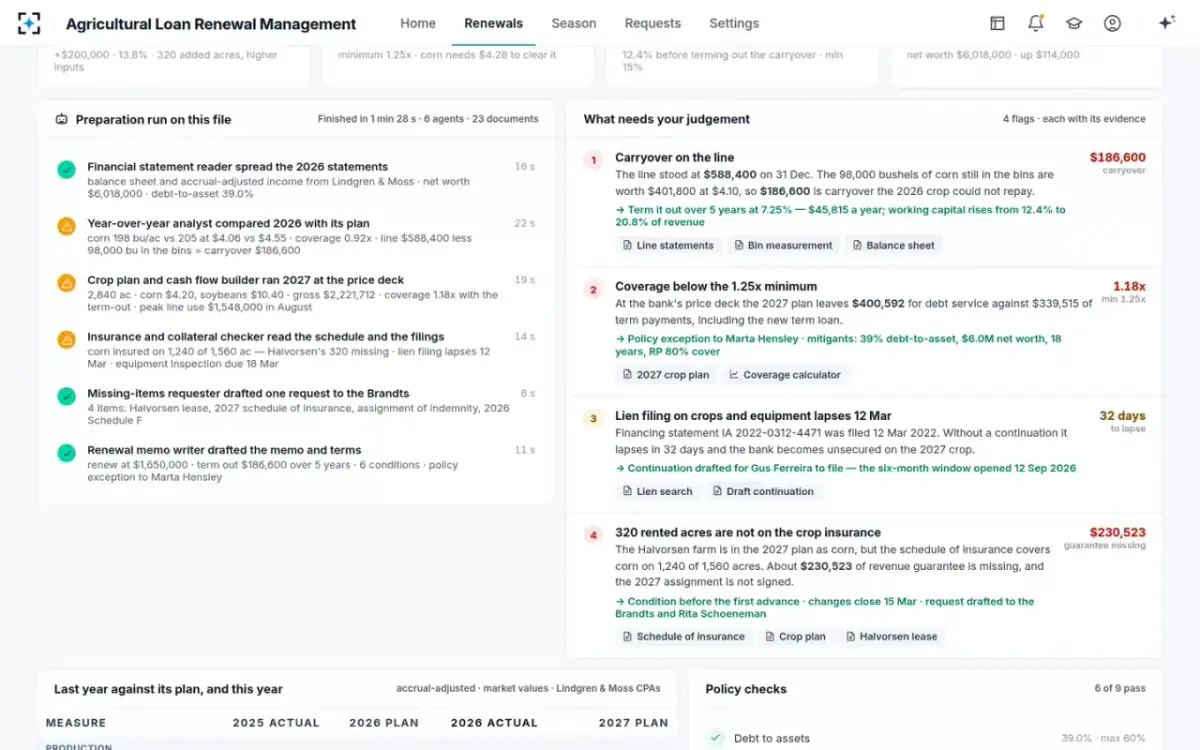
What the arithmetic looks like on a single file is more persuasive than any season total. In the sample season an officer presses Prepare renewal on one borrower's file and six agents read its twenty-three documents: the statements are spread, last year is compared with its plan, this year's cash flow is built at the price deck, insurance and filings are checked, a borrower request and the memo are drafted. Four things come back needing judgement, each with its evidence — carryover on the line, coverage below the policy minimum, a lien filing that lapses in March, and rented acres missing from the crop insurance.
Those four are what the six hours were supposed to produce. The difference is that they arrive at the start of the officer's work rather than at the end of it, and that the officer's remaining time goes on deciding what to do about them: whether to term out the carryover, what condition to attach, whether an exception is worth recommending. That is the move the business case is actually buying — and whether the agents find those four reliably on your files is a separate question with its own method, set out in the four measures of accuracy.
What $52 of prepared renewal looks like before the officer opens it
What to measure on your own desk before you ask anyone for a price
- Hours per renewal, measured not estimated
Time five files end to end, or mark one officer’s February calendar against files. This is the input that moves your answer most.
- Renewals maturing inside your window, and their dollars
By month, with the working days between. The gap between days needed and days available is the business case in one line.
- How many landed after maturity last season
And how many were renewed on last year’s analysis rather than re-underwritten. Both are counts you already have.
- A loaded hourly cost you can defend
Your own salary figures, divided by 0.70 for benefits on the published share, divided by 2,080 hours.
- The analyst and loan administration hours
They are outside the officer figure on this page and they are not small. Count them separately so the committee sees both.
- Filings that lapsed, and insurance gaps found late
Named exposures for the business case. Keep them as exposures; do not multiply them by a loss rate you invented.
- What a season run in parallel would cost you
The largest hidden cost of the change, and the one most often missing from a vendor’s model.
With those seven numbers you can price the problem before anyone prices a solution, which is the right order. When you are ready to test a system against them, how to pilot ag lending software on your own renewal files sets out the method, and the three approaches to running a renewal season compares what each one actually costs. To see the season calendar the figures on this page are drawn from, start from Agricultural Loan Renewal Management.
Questions people ask
How much does a farm loan renewal cost a bank?
On the fictional sample season in this solution, about $391 of officer time for one renewal prepared by hand: six hours at a loaded cost of $65.24 an hour. Your own figure moves with two things — how long a renewal takes on your desk and what your officers cost — and both are numbers you can get from your own records in a week. The officer figure also excludes analyst and loan administration time, which belong in the business case separately.
How many hours does a farm loan renewal take?
About six hours of officer preparation each in the sample season, before any judgement about the credit. Nearly half of that is gathering documents and re-keying statements into the spread. The rest is comparing last year with its plan, building this year's cash flow at the bank's price deck, checking insurance and filings, and writing the memo.
What is the ROI of loan underwriting software?
There is no industry figure, and the honest version is a sum with named terms rather than a single percentage. Only one term — officer hours released, priced at a loaded hourly cost — is reliably countable in year one. Renewals that stop landing late, filings that do not lapse and carryover found rather than rolled are real benefits better presented as named exposures with owners than converted into dollars with an assumed probability.
How many renewals can one ag loan officer handle in a season?
No published standard exists. Do the arithmetic instead: hours per renewal, working days in your maturity window, and the share of a day genuinely available for file work. At six hours a renewal and six usable hours a day, a six-and-a-half-week window holds roughly forty-two files. A book larger than that is not a productivity problem; it is a volume problem that gets solved by hiring, by lateness, or by rolling files forward.
How do I work out a loaded hourly cost for an ag loan officer?
Take the salary from your own payroll, divide by 0.70 to add benefits at the share BLS publishes for private industry workers, and divide by 2,080 hours. BLS also reports that many loan officers work more than forty hours a week, so dividing by 2,080 makes the resulting case conservative rather than generous.
Is agricultural lending software worth it for a small ag book?
It depends almost entirely on how many lines mature in the same few weeks, not on the size of the book in dollars. Forty renewals concentrated between mid-February and 1 April produce the same crunch as a hundred spread across a year. Count the renewals in your tightest maturity window, multiply by your measured hours, and compare the result with the working days you have; if the first number is larger, the problem is real whatever the book's size.