Carryover debt is the part of a farm operating line that the borrower could not repay out of the year's production revenue — the crop, livestock or milk sales the line was advanced against. It is a balance that has stopped being seasonal borrowing and started being capital, and the bank regulator's own handbook says so in as many words. The reason the term causes so much trouble at renewal is that it looks exactly like something else: a balance left on the line on 31 December because the farmer has not sold the grain yet. One is a credit weakness. The other is a marketing decision, and often a tax decision. So the way to calculate carryover debt is in a fixed order: take the line's balance at year end, subtract the value of unsold grain and crop receivables at a stated price on a stated date, and only what remains is carryover. Agricultural Loan Renewal Management, Botminds' agentic solution for farm operating line renewals, is built so the two are never confused: it counts and values the grain on hand before it is allowed to call anything carryover, and it reports the remainder with the documents behind every figure.
The farm, the bank and the people on this page are fictional sample data from the solution. Brandt Family Farms runs 2,840 acres of corn and soybeans, carries a $1,450,000 operating line maturing 1 March 2027, and has asked for $1,650,000. The research figures come from the regulator, from USDA and from a Federal Reserve bank survey, linked where they appear.
The season this question arrives in
≈half
of Ninth District ag lenders said renewals or extensions of existing loans increased in the first quarter of 2026
≈half
reported a decrease in loan repayment rates over the same quarter
41%
flagged a potential decline in agricultural loan quality in the mid-2026 survey
What is carryover debt? The examiner's own definition
The Comptroller's Handbook booklet on agricultural lending gives the definition examiners use, and it is worth reading slowly because every clause is doing work: "Carryover debt refers to the portion of an Ag operating line that the borrower cannot repay from operating production revenue (for example, from crop, livestock, or milk sales). It represents a substitute for investment capital and should be serviced through future cash flow, sale of unencumbered assets, or other sources" (OCC, Agricultural Lending).
Three things follow from that sentence. First, carryover is defined by a source of repayment, not by a date: the test is whether production revenue could retire it, not whether a balance happens to be outstanding on 31 December. Second, it is called a substitute for investment capital, which is the polite way of saying the bank has financed something that equity should have financed. Third, the handbook already names its treatments — future cash flow, sale of unencumbered assets, or other sources — and none of them is "roll it into next year's line".
The same booklet is blunt about what carryover signals: "By its nature, carryover debt suggests a well-defined credit weakness." A well-defined credit weakness is the language of the substandard classification, so the word on a memo is not a neutral description. It changes the risk rating conversation, and in a bad year it changes the allowance.
Why a balance on the line at renewal is not always carryover
Here the handbook pulls the other way, and this is the part most often missed. "Examiners should not automatically classify carryover debt and should consider all relevant information to evaluate repayment capacity and arrive at an accurate risk rating. Some factors may lead a farmer to not pay off operating lines and still not result in carryover debt. For example, a farmer who has a strong crop year may delay crop sales or prepay expenses to reduce income tax liability. While a balance may be left on the operating line at renewal, this would not be an indication of carryover debt."
That is not a technicality. It describes how a large share of American grain is actually held. On 1 December 2025, corn stored in all positions totalled 13.3 billion bushels, and 8.70 billion of those bushels — about two out of every three — were stored on farms, up 14 percent from a year earlier (USDA NASS, Grain Stocks, 12 January 2026). A lender who treats every post-harvest operating balance as a repayment failure is mis-rating most of the grain belt in most years.
The farmer's incentive is in the tax code as much as the market. Cash-basis reporting lets the timing of sales and input purchases move income between years; the handbook gives the example of fertilizer bought at year end, expensed to the preceding crop and used in the next tax year. A line that is still drawn on 31 December may be the trace of exactly that, and the bank's own file will show it: a grain inventory that matches the unpaid balance, and an income statement that does not need the sale to clear its obligations.
How to calculate carryover debt: count the grain first
To calculate carryover debt, start from the operating line balance at the borrower's year end, subtract the value of the unsold production and other current farm assets that the line financed, and call the remainder carryover. The order matters. A figure produced the other way round — naming the carryover first and then looking for assets to cover it — ends up as an argument about collateral rather than a measurement of repayment.
Three inputs decide the answer, and all three are facts a renewal file can hold. The quantity on hand, which needs a count, not an estimate: bins measured or scaled tickets added up, on a stated date. The price, which needs a stated basis — a local cash bid on the count date is the usual choice, and it is the one the sample bank has set. And the encumbrance: grain already contracted, already delivered, or pledged elsewhere is not available twice.
The carryover calculation on one operating line, step by step
| Step | What it is | Figure |
|---|---|---|
| 1. Operating line balance at year end | Drawn against the 2026 crop, at 31 December 2026 | $588,400 |
| 2. Unsold grain on hand, counted | 98,000 bushels of corn in four bins, counted 18 January | 98,000 bu |
| 3. Price applied to the count | Local cash bid on the count date, the bank's stated basis | $4.10 / bu |
| 4. Value of the grain backing the line | 98,000 × $4.10 | $401,800 |
| 5. Remainder: true carryover debt | $588,400 − $401,800 | $186,600 |
| 6. Carryover against the maturing line | $186,600 ÷ $1,450,000 | 12.9% |
Step 3 is where two different prices get mixed up, so it is worth saying plainly: the price used to value grain in the bins and the price used to project next year's revenue are not the same number and do not do the same job. The sample bank values the bins at the local cash bid on the count date, $4.10, because that is what the grain would fetch if it moved; it projects 2027 revenue at a price deck of $4.20 set by the chief credit officer, because that is the price the bank is willing to underwrite. Using the deck to value the bins would overstate the asset. Using the cash bid to project the year would understate the plan.
It also means the carryover figure is priced, not counted, and moves with the bid. On these bins, every ten cents is $9,800 of carryover.
The same bushels, three prices: what the carryover figure does
What carryover debt does to a risk rating
The handbook sets out the three factors an examiner weighs once the figure is real: "The size of the carryover debt in relation to the size of the borrower's operation"; "Whether the borrower can amortize the carryover debt within a realistic time frame while reasonably servicing all other debt obligations"; and "The borrower's historical cash flow, liquidity, and leverage, to assess the ability to absorb carryover debt and the potential for reasonable debt restructuring."
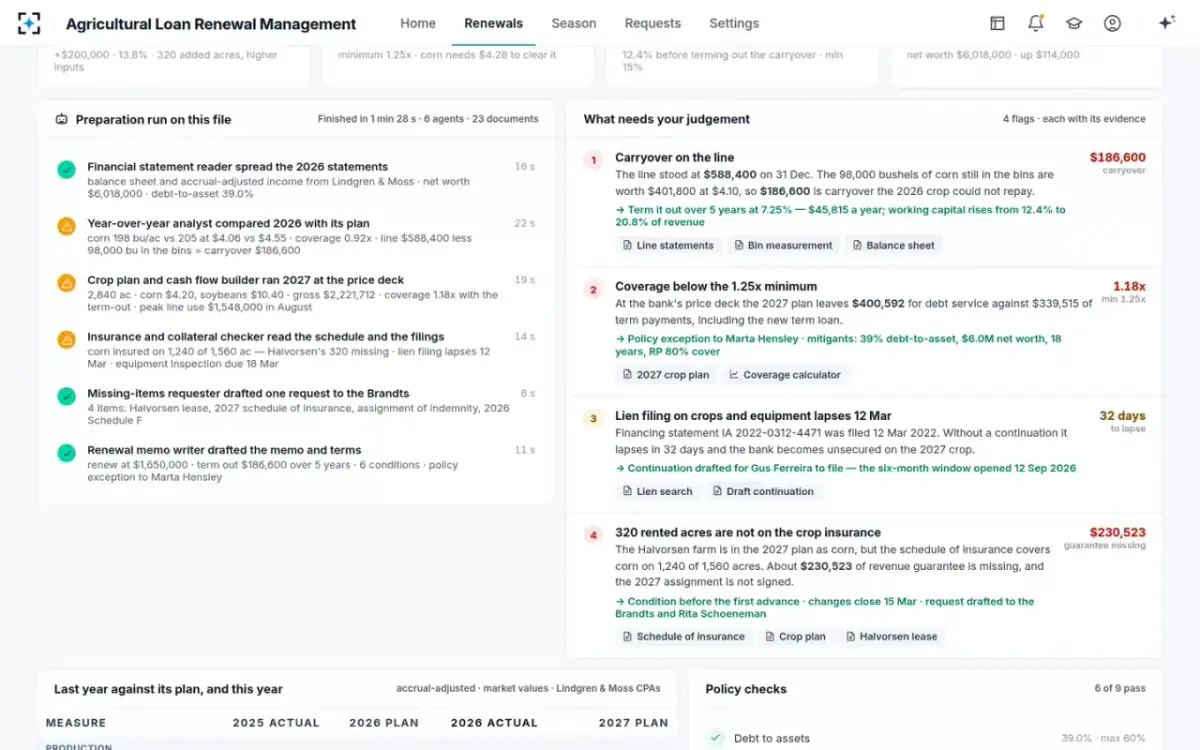
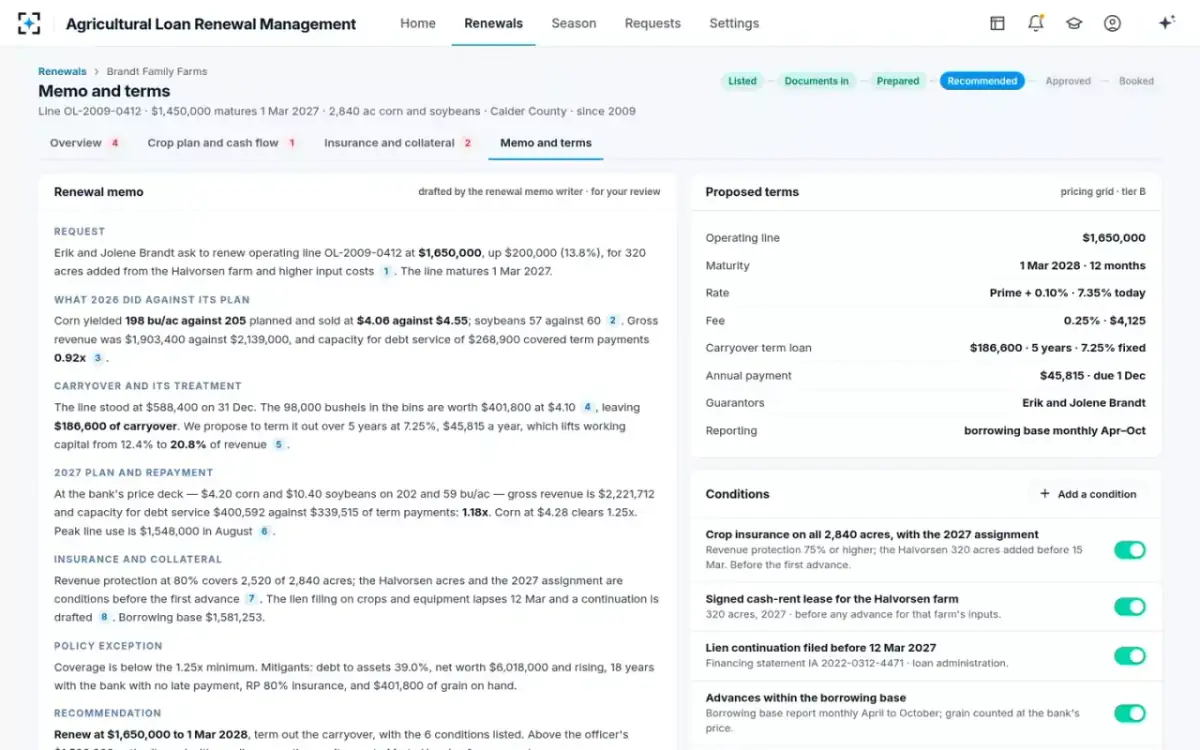
Every one of those is an arithmetic question with a documented answer, which is why a renewal file that answers them is worth more than one that argues them. Size: $186,600 against a $1,450,000 line is 12.9%, and against a 2,840-acre operation it is about $66 an acre. Amortisation: a five-year term-out at 7.25% is $45,815 a year, and the 2027 plan has to carry that on top of the term debt it already owes. Absorption: 2026 covered the farm's term payments 0.92 times, which is the real reason the balance exists.
And the handbook names the consequence when the answers are bad: "When collateral does not cover carryover debt and repayment capacity is not evidenced, the carryover balance should be classified and the examiner needs to determine whether a loss rating is appropriate." Collateral alone does not save the rating; repayment capacity has to be evidenced too.
A balance on the line, and carryover debt: the same dollars, different credits
A balance backed by production: Grain, livestock or receivables the line financed, not yet converted to cash.
Carryover debt: The part of the line the year's production revenue could not retire.
A balance backed by production: A marketing or tax decision: the farmer is holding the crop, or prepaid next year's inputs.
Carryover debt: Revenue fell short of the plan, or costs ran past it.
A balance backed by production: A dated count and a stated price, plus the unencumbered title to the grain.
Carryover debt: The same count, and a remainder that survives it.
A balance backed by production: Renew the line. The asset retires the balance when it sells.
Carryover debt: Term it out against a real repayment source, or take a capital injection.
A balance backed by production: Nothing on its own. It is seasonal borrowing doing its job.
Carryover debt: Suggests a well-defined credit weakness; classified where collateral and capacity are both absent.
Term it out, sell the grain, or roll it? Three treatments
Once the figure is agreed, the structure question has three honest answers and one dishonest one. The dishonest one is to add the carryover to next year's operating request and say nothing, which is the subject of a later section.
Term it out. Move the carryover to an amortising note against capital assets, leave the operating line to finance the current crop, and let the two repay from different sources. The handbook describes exactly this: "it may be appropriate to restructure carryover debt into amortizing medium-term loans while continuing to finance current operations with short-term loans." On the sample file that is $186,600 over five years at 7.25% fixed, $45,815 a year. The 2027 plan has to clear that payment along with everything else, which is the test the structure is for.
Sell the stored grain first. This is the option borrowers reach for, and it needs care, because selling the bins retires the part of the balance the grain was already backing — it does not touch the carryover unless the grain sells for more than the value already credited to it. On the sample file, selling 40,000 bushels at $4.10 brings about $164,000 to the line and drops peak line use in August from $1,548,000 to $1,384,000. That is a liquidity gain and a sensible condition. It is not a carryover repayment, and a memo that presents it as one is wrong by the amount of the grain.
Take it from outside the operation. Off-farm income, a land sale, a capital injection from the family, or the sale of an unencumbered asset — the handbook's "sale of unencumbered assets, or other sources". This is the fastest fix and the one most likely to be refused, which is itself information about how the borrower sees the year.
Four flags come back with the prepared renewal, and carryover is the first
How much carryover debt is too much?
There is no published threshold, and anyone who quotes one as a rule is quoting a policy, not a regulation. The handbook's test is relational: the size of the carryover against the size of the operation, and whether it can be amortised in a realistic time while the rest of the debt is serviced. That makes the ceiling a function of the plan, not a percentage.
The useful way to ask it is backwards. Add the carryover's annual payment to the term debt the farm already owes, rebuild the coming year's capacity for debt service at the bank's prices, and see whether the coverage ratio still clears the policy minimum. If it does, the carryover is absorbable at that term. If it does not, either the term has to lengthen, the carryover has to shrink, or the credit has to change shape. On the sample file the answer was uncomfortable: with the term-out included, 2027 coverage comes to 1.18x against a 1.25x minimum, which is why the renewal needed a policy exception and the manager's approval rather than the officer's.
Two sanity checks are worth running alongside. The first is the borrower's working capital, because a farm that is absorbing carryover out of a shrinking cash buffer is solving one year by borrowing from the next; at sector level, working capital fell 15.0 percent in 2025 before a forecast 3.5 percent recovery in 2026 (USDA ERS, Assets, Debt, and Wealth). The second is whether this is the first year or the third. One year of carryover is an event. Three in a row is a business model.
Why carryover debt hides inside a renewed line
The mechanism is mundane: a line is renewed for a larger amount, the old balance rolls in, and nobody writes down which part of the new commitment is financing the 2027 crop and which part is financing the 2026 shortfall. A year later the same question is harder, because the two crop years have been drawn and repaid through one account.
The handbook's remedy is a bookkeeping discipline, not an analytical one: "Management should have processes in place to determine whether a farm borrower has carryover debt for the current crop year. A best practice is to segregate operating notes by crop year and not comingle operating proceeds between the different growing seasons. If loan proceeds are comingled for more than one crop year, management should be able to document the operating proceeds for each year to support management's risk ratings and repayment analysis."
That is the structural reason the sample bank terms carryover out instead of rolling it. Two notes with two repayment sources can each be measured; one note with two crop years inside it cannot. It is also why the solution opens a renewal package in October against last year's file rather than starting from the renewal request: the carryover question is answered from the 2026 crop's own documents, before the 2027 numbers arrive to blur them.
Carryover is also one of the conditions that makes a plan atypical in federal lending rules. USDA's Farm Service Agency defines a feasible plan as one where "an applicant or borrower's cash flow budget or farm operating plan indicates that there is sufficient cash inflow to pay all cash outflow", and requires a plan drawn on a typical cycle where the projection is distorted by, among other things, "cash or inventory on hand, new enterprises, carryover debt, atypical planned purchases" (7 CFR 761.2). Inventory on hand and carryover debt sit in the same list for the same reason: both make one year's numbers unreadable without the other's.
What a carryover file has to show
A memo that uses the word should be able to produce all of this without a phone call. The list below is the one the sample bank's renewal files are prepared against.
The evidence behind a carryover figure
- The operating line balance at a stated date
Not the balance today. The balance at the borrower's year end, matched to the statement date the rest of the analysis uses.
- A dated count of grain and livestock on hand
Bins measured or tickets totalled, with the date on the face of it. An estimate from last year's yield is not a count.
- The price basis, named
Local cash bid on the count date, the price deck, or the bid less a margin — whichever the credit policy sets, applied the same way for every borrower.
- Encumbrances on that inventory
Forward contracts already priced, grain delivered and unpaid, warehouse receipts pledged elsewhere. Each removes bushels from the calculation.
- Last year's result against last year's plan
The variance split between yield and price, so the shortfall has a cause rather than a size.
- The proposed treatment and its payment
Term, rate, annual payment, and the coverage ratio recomputed with that payment in it.
- Which crop year each note finances
Written on the file from the day the carryover is created, not reconstructed a year later.
What the shortfall was actually made of
A carryover figure with no cause attached is half a finding. The sample file's 2026 corn made 198 bushels an acre against a plan of 205, and sold at $4.06 against a planned $4.55. Those two shortfalls are not the same size, and the split changes what the bank should do about it.
Hold price at plan and the yield miss costs 7 bushels at $4.55, about $31.85 an acre. Hold yield at actual and the price miss costs 198 bushels at 49 cents, about $97.02 an acre. Together that is $128.87 an acre, a 13.8 percent revenue shortfall, and roughly three-quarters of it is price. A yield problem argues for agronomy, insurance coverage and a look at the ground. A price problem argues for marketing discipline, and it is the one a condition on the renewal can actually address — which is how the officer arrived at selling or contracting 40,000 bushels of the stored corn by 31 March.
That decomposition is also the honest answer to a borrower who says the year was fine apart from the weather. On this farm it mostly was not the weather.
The memo states the carryover and its treatment, with every figure cited
Where Agricultural Loan Renewal Management does this work
The rule the solution enforces is the one this whole page turns on: a year-end balance is called carryover only after the unsold grain has been counted and valued. The year-over-year analyst takes the balance, subtracts the inventory at the price basis the credit policy sets, and reports the remainder with the count date, the bid and the documents behind each number. It will not name carryover without an inventory figure, which means a file missing the count comes back as incomplete rather than as a credit weakness.
From there the rest of the renewal is already assembled: last year against its plan, this year's cash flow at the bank's price deck with the term-out payment included, the insurance and lien checks, and a drafted memo with the carryover section written and cited — the stages set out in order in the farm operating loan renewal process. The ratios that decide whether the structure clears policy are set out in the five farm financial measures a renewal is judged on. To see the arithmetic on a season of your own renewals, start from Agricultural Loan Renewal Management.
Questions people ask
Is carryover debt the same as a delinquent loan?
No. Carryover debt can sit inside a line that has never missed a payment, because an operating line is usually interest-only until maturity. What carryover measures is whether the year's production could have retired the principal, not whether the borrower kept current. A line can be perfectly current and carry a well-defined credit weakness at the same time.
Does carryover debt mean the loan will be classified?
Not automatically. The Comptroller's Handbook tells examiners not to classify carryover debt on sight and to weigh its size against the operation, whether it can be amortised in a realistic time while other debt is serviced, and the borrower's cash flow, liquidity and leverage. Classification follows when collateral does not cover the carryover and repayment capacity is not evidenced.
Can carryover debt be termed out, and over how long?
Yes, and restructuring it into an amortising medium-term loan while the operating line continues to finance the current crop is the treatment the handbook describes. The term is a credit policy question; the sample bank's setting is up to five years. The real constraint is the coverage ratio once the new payment is added to the existing term debt, so a longer term is only an answer if the asset it is secured against lasts at least that long.
How does a lender count grain that is still in the bins?
By measuring or scaling it on a stated date and valuing it on a stated basis, then removing anything already sold or pledged. In the sample file 98,000 bushels of corn in four bins were counted on 18 January and valued at the local cash bid that day. An inspection and the cash flow work are best done at the same point each year, because the value of assets under production changes through the growing cycle and comparisons across different points in it mean little.
Why is a balance left on the line after a good year?
Usually tax and marketing. Cash-basis farmers can move income between years by delaying sales or prepaying inputs, so a strong crop year can end with grain in the bin, fertilizer in the shed and a drawn line. The giveaway is that the inventory and the prepaid expense together account for the balance, and the farm's obligations were covered without the sale.
Does selling the stored grain clear the carryover?
Only to the extent the grain sells for more than the value already credited against the line. The bushels were subtracted before the carryover figure was struck, so their sale retires the part of the balance they were already backing. Selling 40,000 of the sample farm's 98,000 bushels brings about $164,000 to the line and cuts peak borrowing in August, which is a liquidity improvement worth having — but the $186,600 remains until something outside this year's crop repays it.