A crop insurance assignment of indemnity is a producer's written transfer, on the insurer's own form, of the right to a crop year's insurance payout to a creditor the producer owes — and it is the only thing that turns a crop insurance policy into security a bank can actually be paid from. Does it count as collateral? Only in a narrow sense: once signed and with the insurer, for one crop year, as a right to be named on a payment. Coverage alone does not do it. A policy can insure every planted acre at a high coverage level and still pay the producer, and only the producer, if no assignment has been executed and provided to the insurer. Botminds' Agricultural Loan Renewal Management reads the schedule of insurance against the crop plan acre by acre, checks whether the current year's assignment exists, and never counts unassigned insurance as security on the borrowing base — which is a design rule rather than a preference, because the alternative is a bank that has miscounted what it holds.
The policy language on this page is from the Common Crop Insurance Policy Basic Provisions as they stand for the 2025 and succeeding crop years, published by USDA's Risk Management Agency, with a binding agency determination where the text needed interpreting. The worked example is the fictional sample season in the solution — invented farms, an invented bank, invented people.
"Unless you have provided us with a properly executed assignment of indemnity, we will not make any payment to a lienholder or other person to whom you have a financial debt or other pecuniary obligation even if you may have a lien or other assignment recorded elsewhere."
Common Crop Insurance Policy, Basic Provisions, section 29(c)
What is a crop insurance assignment of indemnity?
It is a short form with a large consequence. Section 29 of the Basic Provisions — the policy every federal multi-peril crop insurance contract is built on — sets out the whole mechanism in four paragraphs. The producer "may assign your right to an indemnity for the crop year only to creditors or other persons to whom you have a financial debt or other pecuniary obligation", and "may be required to provide proof of the debt or other pecuniary obligation before we will accept the assignment of indemnity" (Basic Provisions, section 29(a)).
Three features of that sentence matter to a lender. It is the producer's right being assigned, so only the producer can do it. It is for the crop year, so it is an annual act, not a standing arrangement that renews with the operating line. And it runs only to a creditor with a real debt, which is why a bank may be asked to evidence the obligation before the insurer accepts the form.
The form itself is not negotiable either: "all assignments must be on our form and must be provided to us", though "each assignment form may contain more than one creditor or other person to whom you have a financial debt or other pecuniary obligation" (section 29(b)). That last clause is the practical one on a farm with an operating lender, an equipment lender and a landlord — one properly executed form can name them all, and a lender left off it is simply not there.
The anatomy of an assignment of indemnity, and what each part means for the bank
Who signs it
The policyholder — the insured producer. Not the bank, and not the agent.
A lender cannot create its own claim on an indemnity by filing a lien or a notice somewhere else.
What it transfers
The right to an indemnity for one crop year, to a named creditor the producer owes.
One crop year at a time. Last year’s assignment does not carry this year’s loss.
What form it must be on
The insurer’s own form, provided to the insurer. One form may name more than one creditor.
A security agreement, a UCC filing or a letter to the agent is not an assignment.
What it does not do
It does not increase the indemnity, insure an uninsured acre, or make an unreported acre payable.
The acreage report fixes what is covered; the assignment only redirects what is paid.
What the policy says a lender may and may not rely on
Section 29(c) is the sentence to put in a credit policy, because it closes every informal route a lender might assume it has. Without a properly executed assignment provided to the insurer, no payment goes to a lienholder — "even if you may have a lien or other assignment recorded elsewhere". A perfected security interest in growing crops does not reach the indemnity. A notice to the agent does not. An assignment taken in the security agreement and filed in the bank's own records does not.
The same paragraph then states the insurer's liability limits twice over. Under no circumstances will the insurer be liable to a creditor "where you have failed to include such lienholder or person on a properly executed assignment of indemnity provided to us", nor "to pay to all lienholders or other persons … any amount greater than the total amount of indemnity owed under the policy" (section 29(c)(1)–(2)). The second clause matters where several creditors are named on one form: the assignment divides a payout, it does not multiply it.
What a lender does get, once the form is on file, is specific. "If we have received the properly executed assignment of indemnity form", then "only one payment will be issued jointly in the names of all assignees and you, unless all assignees and you agree in writing for the payment to be issued to a single payee" (section 29(d)(1)). A joint cheque by default, a single payee only by written agreement of everyone named — including the producer. A lender that expects to be paid directly should know that the policy's default is a joint instrument requiring the borrower's endorsement.
Why coverage and assignment are not the same thing
These are two separate documents, created at different times, by different people, for different purposes, and a renewal file routinely contains one without the other. Coverage is created by the producer's application and acreage report, and recorded on the schedule of insurance the insurer issues. Assignment is created by a form the producer signs afterwards, usually at the lender's request, and held by the insurer.
Treating them as one number is the error that costs a bank its security. The OCC's agricultural lending handbook sets the expectation in process terms: "banks should be able to obtain information from borrowers regarding the type of insurance selected (i.e., whether yield or revenue), crop pricing options, coverage percentage, and whether the borrower is in compliance with the terms of the contract" (Comptroller's Handbook: Agricultural Lending). And in its own examination procedures the agency asks examiners to "evaluate whether conditions and documentation are in place for payment of insurance or guarantees should a claim be necessary" — which is precisely the assignment question, asked from the other side of the desk.
Three acre counts on one renewal, and only one of them is security
| The count | Where it comes from | What it proves |
|---|---|---|
| Acres planted | This year's crop plan, farm by farm, with the leases behind the rented ground | What the borrower is actually farming, and therefore what the operating line is funding |
| Acres on the schedule of insurance | The insurer, after the acreage report is filed — about 8 to 10 weeks later | What is insured, at what coverage level and price election. Anything missing here is uninsured |
| Acres whose indemnity is assigned | A signed assignment of indemnity on the insurer’s form, held by the insurer | What the bank can actually be paid from if there is a loss. The only one of the three that is security |
A renewal that checks only the first two has found the uninsured acres and missed the unassigned ones. A renewal that checks only the policy's existence has found neither. In Agricultural Loan Renewal Management the insurance and collateral checker does both comparisons and reports each gap by farm, because a gap stated in total acres cannot be fixed by anybody.
Does an assignment of indemnity count as collateral?
It is better described as a payment direction on a contingent claim than as collateral in the way a lien on equipment is collateral, and the distinction has practical consequences. It gives the bank a right to be named on a payment the insurer may owe the producer, for one crop year, if an insured loss occurs. It does not create a property interest in the crop, it does not survive the crop year, and it has no value at all in a year without a loss.
That shape argues for three rules in a credit policy. Count unassigned coverage as zero in the borrowing base, which is the rule the solution applies. Treat assigned coverage as a floor under a repayment scenario rather than as collateral value — a revenue protection policy at a given coverage level tells you the revenue the producer is guaranteed per acre, which belongs in the cash flow's downside case. And re-check it every year, because the assignment expires with the crop year even where the operating line does not.
The lien side of the file follows the same discipline for the same reason. The OCC's handbook warns that "if liens are not properly perfected, banks may not be protected by collateral when liquidation, repossession, or foreclosure becomes necessary" (Comptroller's Handbook: Agricultural Lending). Security that exists on paper but not in the record is the recurring failure in both cases.
What the coverage level actually guarantees
A coverage percentage is not a percentage of the loan, of the input budget or of the crop's market value. It is a percentage of the farm's own approved yield, and the Basic Provisions define the per-acre production guarantee as the approved yield per acre multiplied by the coverage level percentage the producer elects. On a revenue policy that guarantee is then valued at the greater of the projected price and the harvest price — prices the policy sets, not the bank. Two farms with the same coverage level and the same acres can therefore be protected to very different dollar amounts, and a renewal file should carry the figure, not just the percentage.
What a revenue protection guarantee comes to, per acre
Approved yield
The farm's documented production history for that crop and unit
Specific to the farm; it is not the county average, and the bank cannot adjust it
Production guarantee per acre
Approved yield × coverage level elected
The coverage level is what the producer chose by the sales closing date
Revenue guarantee per acre
Production guarantee × the greater of the projected and harvest prices
Projected price only, if the harvest price exclusion is elected. On the sample file, revenue protection at 80 percent works out at $720 an acre of corn
What the bank can rely on
Revenue guarantee × insured acres whose indemnity is assigned
Uninsured acres and unassigned coverage both contribute nothing
Which kind of policy is in the file matters as much as the level. The OCC's handbook summarises the difference: revenue policies "compensate farmers for shortfalls in crop revenues relative to their baseline averages and may also allow for increased payments if harvest prices exceed planting season prices", while yield policies "pay farmers for a percentage of yield shortfalls relative to their average crop history or the average yields in their county" (Comptroller's Handbook: Agricultural Lending). A yield policy pays nothing on a price collapse with an average crop — the year that produces most carryover — which is why the sample bank's credit policy sets revenue protection at 75 percent or better as its minimum. That is a credit choice, not a regulatory one.
What happens if a crop insurance assignment is not signed before a loss?
The producer is paid, and the bank's position depends entirely on the borrower's cooperation and on whatever else it holds. The indemnity arrives as a payment to the producer, who may apply it to the operating line, or to the landlord, or to next year's inputs. A bank with a perfected security interest in the crop may have a claim on proceeds under state law, and that is a different argument in a different forum from the one the assignment would have avoided — and it takes place after the money has moved.
The practical fix is timing. There is no calendar deadline in the policy for executing an assignment; what the policy requires is that the properly executed form has been provided to the insurer before it pays. The risk is therefore not a date but a sequence: a loss can happen the week after planting, and an assignment signed after a claim is adjusted is a conversation rather than a document. The rule worth writing into a renewal checklist is that the current crop year's assignment is on file before the first advance against this year's crop, not before the claim.
One deadline nearby is worth knowing because it bounds what can still be fixed. RMA's own description of the insurance cycle is that "insurance applications must be completed and signed no later than the sales closing date specified in the Special Provisions" (USDA RMA, Insurance Cycle). After that date the coverage a producer has is largely the coverage they will have for the year — so a gap found before the sales closing date can be closed by buying coverage, and a gap found after it can only be managed.
A crop insurance loss, and where the assignee's rights sit
A person decides
The producer reports the lossNotice of loss goes to the agent within the time the policy requires, and the claim for indemnity is filed on the insurer’s form.
Never: The lender cannot start this while the producer is doing it
Agent
The insurer adjusts the claimProduction is appraised against the guarantee on the schedule of insurance for the insured acres and units.
Never: Uninsured or unreported acres are not adjusted
A person decides
The assignee may step in — but only if the producer does notWhere the producer fails to submit the notices and forms, the assignee may submit the claim, no later than 30 days after the filing period has expired.
Never: Not available where the producer has filed properly
A person decides
The dispute rights follow the filingAn assignee who files because the producer did not assumes the producer’s rights and responsibilities to dispute determinations about that claim.
Never: Except where the insurer determines it cannot accurately adjust the loss
Agent
The indemnity is paidOne payment, issued jointly to all assignees and the producer — unless everyone named agrees in writing to a single payee.
Never: Never to a lienholder who is not on a properly executed form
Can a lender file a crop insurance claim if the borrower does not?
Yes, in narrow circumstances, and the rule was tightened and clarified in the provisions now in force. An assignee "will have the right to submit all loss notices and forms as required by the policy if you fail to do so", and where the producer has suffered an insured loss and fails to submit a claim within the period the policy allows, "an assignee may submit the claim for indemnity not later than 30 days after the period for filing a claim has expired" (Basic Provisions, section 29(d)(2)). There is a hard limit attached: no indemnity will be paid if the insurer determines it cannot accurately adjust the loss, and neither the producer nor any assignee may dispute that determination.
The boundary of that right was settled before it reached the policy text. In a binding determination on the earlier version of section 29, RMA's Federal Crop Insurance Corporation agreed that where a producer fails to submit a claim, the assignee may "step in the shoes" of the policyholder with all the policyholder's rights and obligations, including the right to be part of an arbitration over the claim. It disagreed that the right extends further: where the policyholder "has properly filed all loss notices and forms, and submitted the claim for indemnity in accordance with the policy terms, the assignee does not have the right to commence an arbitration proceeding or to challenge any indemnity or claim determination" (USDA RMA, Final Agency Determination FAD-252, 17 December 2015). That determination "is binding on all participants in the Federal crop insurance program for the crop years the policy provisions are in effect".
That is the rule a lender should plan around: the assignee's step-in right is a backstop against a producer who does nothing, not a seat at the table on a claim the producer is handling. A bank that disagrees with how a loss is being adjusted on a file where the producer has filed properly has a commercial conversation with its borrower, not a route into the claim.
Two changes in the current provisions are worth flagging to anyone working from older notes. The joint-payment rule now allows a single payee where all assignees and the producer agree in writing. And the dispute-rights position established by the determination above is now written into the policy itself, at section 29(e): an assignee who submits a notice of loss or claim because the producer did not "assumes any rights and responsibilities you may have under section 20 to dispute determinations related to the notice of loss or claim for indemnity". Set the 2025 provisions beside the section 29 text quoted in that 2015 determination and both differences are plain on the page; the current wording applies to the 2025 and succeeding crop years.
How to check whether crop insurance covers rented acres
Rented ground is where the acre counts come apart, because a lease signed in February does not update a schedule of insurance issued the previous summer. The check is mechanical and has to be done farm by farm: take this year's crop plan, list acres by crop and by farm, take the schedule of insurance, list the insured acres by crop and unit, and reconcile the two lists rather than the two totals. A match on total corn acres can conceal a rented quarter section that is not insured and a parcel the producer no longer farms that is.
The reason this cannot be fixed later is the acreage report. RMA tells producers plainly that "if you report too little acreage, you may recover less when you file a claim", and that "you may not revise this report after the acreage reporting date" (USDA RMA, Getting Acreage Reporting Right). A lender who finds a missing farm after that date has found something the producer cannot correct for the year.
Coverage can also be partial by choice, which is the second thing the acre reconciliation catches. The OCC's handbook notes that "farmers generally have the option to obtain coverage on all or part of their acreage in production", on an enterprise-wide basis or by specific parcel. A borrower who insured the home farm and left the rented ground out has done nothing wrong and has changed what the bank's security is worth.
What the schedule of insurance is, and when it arrives
The document a lender should be asking for by name is the schedule of insurance, also called the summary of protection, and its timing explains a great deal about why renewal files are so often incomplete. RMA describes it like this: "about 8 to 10 weeks after you submit your acreage report, you will receive a Summary of Protection or Schedule of Insurance. This document summarizes your previous acreage report as it appears in the official records" (USDA RMA, Getting Acreage Reporting Right).
So the authoritative record of what is insured arrives two months or more after the acreage report, from the insurer, through the agent — which is why a renewal file assembled in February is often working from last year's schedule or from the agent's verbal confirmation. It is also why the solution tracks the schedule of insurance as an expected document with a date rather than as a tick-box: a readiness check that cannot be completed yet is different from one that has been failed, and the season calendar shows which is which.
Insurance and collateral, checked acre by acre in Agricultural Loan Renewal Management
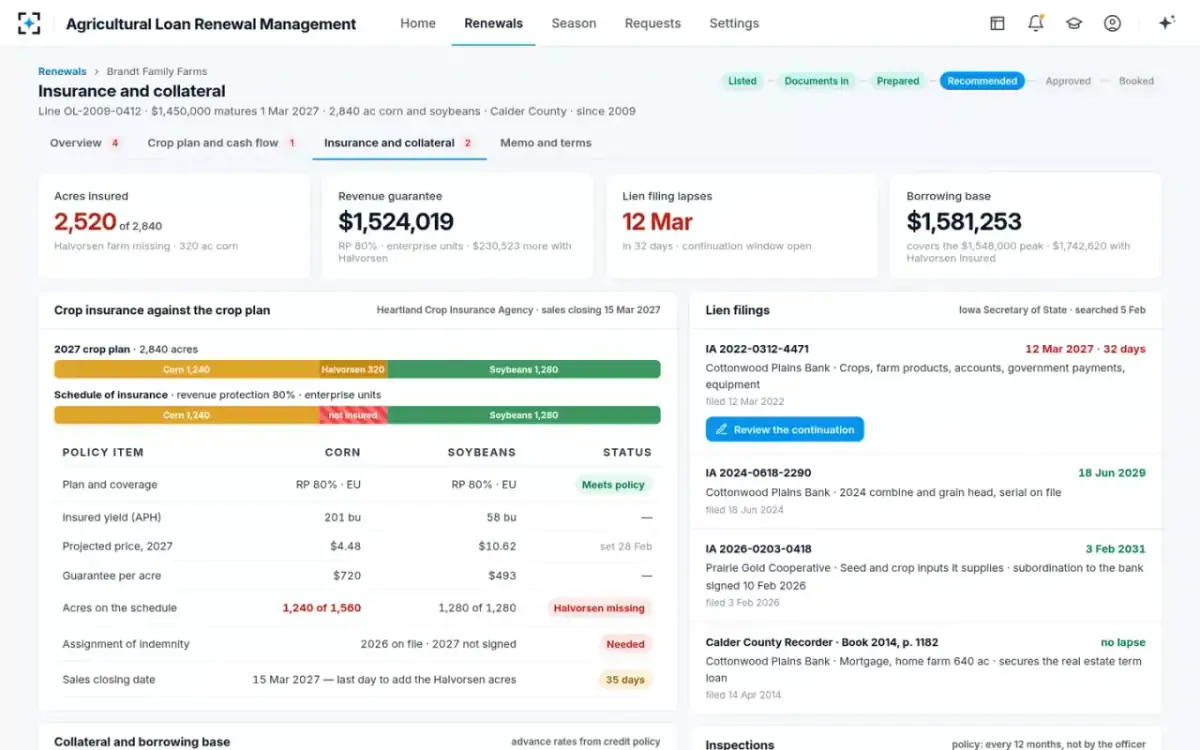
One file, one gap: acres insured but not assigned
On the sample renewal the two checks returned different answers, which is the normal case and the reason both are needed. The schedule of insurance covered 1,240 of 1,560 acres of corn: one rented farm's 320 acres were not on it at all. And the current crop year's assignment of indemnity had not been signed, with the sales closing date 35 days away.
Two insurance findings on one sample renewal
1,240of 1,560
acres of corn on the schedule of insurance — the rest uninsured
320acres
on one rented farm, missing from the schedule entirely
0
acres whose indemnity is assigned to the bank — the form is unsigned
35days
to the sales closing date, after which coverage elections are fixed
Read in order, the three findings have different urgencies and different owners. The uninsured 320 acres are a coverage question with a hard date attached, and belong to the borrower and the insurance agent. The unassigned indemnity is a security question with no date, which is what makes it dangerous: nothing forces it, so it slips to the bottom of a list until a hailstorm promotes it. And the borrowing base figure is the bank's own, because an advance made against insurance nobody assigned is an advance against nothing.
That is why the checker in the solution never counts unassigned insurance as security, in the same way that it drafts lien continuations but never files them. Where the file still needs something, the missing-items requester lists it in one plain request per borrower for the officer to send — nothing goes to a borrower on its own. The whole of that step, including the filings that lapse in the same season, sits inside the farm operating loan renewal process.
What to check before relying on crop insurance as security on a farm loan
- Reconcile acres farm by farm, not in total
This year’s crop plan against the schedule of insurance, by crop and by unit. A matching total can hide an uninsured rented farm and an insured parcel no longer farmed.
- Ask for the schedule of insurance by name
Not a certificate, not the agent’s email. It arrives 8 to 10 weeks after the acreage report, so know which crop year the one in your file belongs to.
- Check the assignment is for this crop year
The right assigned is for the crop year. Last year’s form on file is a record, not security.
- Confirm the insurer has it, on the insurer’s form
Executed and provided to the insurer. A copy in the bank’s file, a clause in the security agreement, or a lien recorded elsewhere do not reach the indemnity.
- Check every creditor who should be named is named
One form may carry several creditors, and the insurer will not pay one who is not on it. The equipment lender and the landlord are the usual omissions.
- Know what a joint payment means for your process
The default is one payment issued jointly to all assignees and the producer; a single payee needs everyone’s written agreement. Decide before a loss which you want.
- Record coverage type, level and price election
Yield or revenue, the coverage percentage and the pricing option. They decide what the floor under the cash flow actually is.
- Count unassigned coverage as zero
In the borrowing base and in the memo. It is the only treatment that cannot mislead an approver.
Where the insurance finding reaches the officer in Agricultural Loan Renewal Management
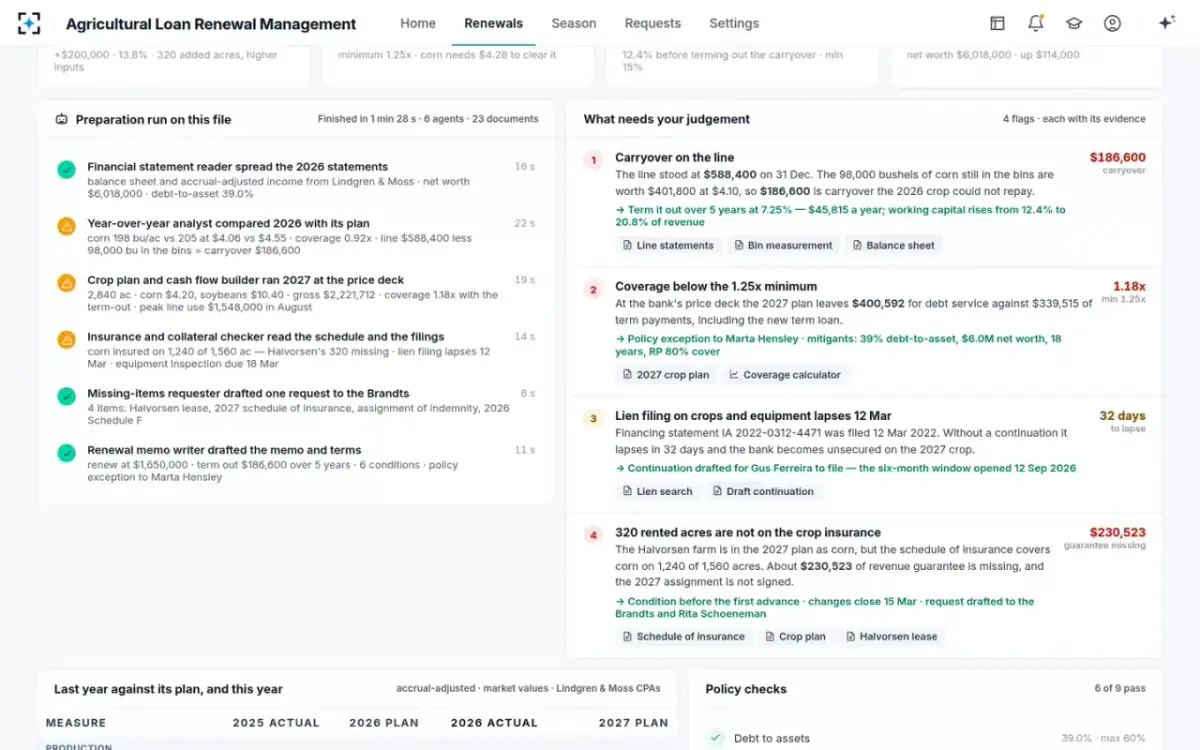
Insurance is one of the two places where a renewal quietly loses security; filings are the other, and both are checked in the same pass. For how the rest of a prepared renewal is put together and what each agent may not do, see what AI may prepare on a farm renewal, and who decides, or start from Agricultural Loan Renewal Management.
Questions people ask
What is a crop insurance assignment of indemnity?
A producer's written transfer, on the insurer's own form, of the right to a crop year's insurance indemnity to a creditor the producer owes. The Basic Provisions allow it only to creditors or others to whom the producer has a financial debt or pecuniary obligation, and the insurer may ask for proof of that debt before accepting it. One form may name more than one creditor.
Where do I get a crop insurance assignment of indemnity form?
From the insurance provider, through the producer's crop insurance agent. The policy requires that "all assignments must be on our form and must be provided to us", so the insurer's own form is the only one that works, and it has to reach the insurer rather than sit in the bank's file. Insurers' forms differ in layout; what matters is that the executed form is on file with the company that issued the policy.
Does an assignment of indemnity count as collateral?
Not in the way a lien on equipment does. It is a payment direction on a contingent claim for one crop year: it gives the bank a right to be named on an indemnity the insurer may owe, if a loss occurs. It creates no interest in the crop, expires with the crop year, and is worth nothing in a year without a loss. The safe treatments are to count unassigned coverage as zero and to treat assigned coverage as a floor in the cash flow's downside case.
What happens if a crop insurance assignment is not signed?
The indemnity is paid to the producer. The policy is explicit that without a properly executed assignment provided to the insurer, no payment will be made to a lienholder "even if you may have a lien or other assignment recorded elsewhere". A bank may still have a claim on proceeds under state law, but that argument happens after the money has moved, which is a far weaker position than being named on the payment.
Can a lender file a crop insurance claim?
Only where the producer does not. An assignee may submit the loss notices and forms if the producer fails to do so, and may submit a claim no later than 30 days after the producer's filing period has expired. An assignee who files on that basis takes on the producer's rights and responsibilities to dispute determinations about that claim. Where the producer has filed properly, the assignee has no right to commence an arbitration or challenge the claim determination.
How do I check that crop insurance covers rented acres?
Reconcile this year's crop plan to the schedule of insurance farm by farm and crop by crop, never total to total. Rented ground added after the acreage report is the usual gap, and it cannot be corrected afterwards: RMA tells producers they may not revise the acreage report after the acreage reporting date, and that reporting too little acreage means recovering less on a claim.