Agricultural loan renewal software is any system that carries a farm operating line from last year's approval through fresh analysis to a renewed decision, and today three quite different things answer to the name: a set of spreadsheets with email around them, a commercial loan origination system with an agricultural product configured on it, or software built around the facts a farm renewal actually turns on — carryover on an operating line, acres on a schedule of insurance, bushels still in a bin, a financing statement with a lapse date. Botminds' Agricultural Loan Renewal Management is the third kind, and it differs from the other two in one structural way worth deciding about before any feature list: it opens every renewal package in October from last year's file and fills it as documents arrive, rather than waiting for a person to start it in February.
This page compares the three on the work rather than on features, and says plainly where each is the right answer. The season figures are from the fictional sample bank in the solution; the research is from US banking regulators and federal statistics, linked where it appears.
What is agricultural lending software, and how is it different from commercial loan software?
Commercial loan software models a borrower as a business with financial statements, a debt schedule and collateral. That model is not wrong for a farm; it is incomplete in ways that are invisible until a renewal season. Four facts about a farm have no natural home in it.
The first is inventory that is also repayment. Grain in a bin on 31 December is an asset, a hedge position and next quarter's loan payment at once, and it is the difference between a borrower with a repayment problem and one who simply has not sold yet. A system with a balance field and no bin count cannot tell those apart. The second is insurance as security, which depends on acres and on a signed assignment rather than on a policy existing. The third is a price deck: a farm cash flow is a projection built on prices somebody chose, and which prices were used is a credit policy question, not a modelling detail. The fourth is seasonality — most operating lines mature in the same eight weeks, so the queue is the problem, not any single file.
Agricultural lending software earns the adjective when those four are first-class, not when it has a crop dropdown. The test is simple enough to apply in a demonstration: ask what happens when a borrower has unsold grain, when the crop plan has more acres than the schedule of insurance, and when the price deck changes in January.
Three ways to run a renewal season, row by row
| The work | Spreadsheets and email | A generic loan system, configured for ag | Agents built for ag renewals |
|---|---|---|---|
| Who opens the file, and when | A person, when the maturity list is run — usually weeks before the date | A person, by starting an application when the renewal is keyed in | The file opens itself months ahead, carrying forward what last year already proved |
| Where last year’s figures come from | Last year’s workbook, copied and renamed | Whatever was keyed into the system at origination | The documents themselves, each figure cited back to its page |
| Carryover on the operating line | Spotted if somebody thinks to subtract unsold grain from the year-end balance | A balance field; the system has no concept of grain in a bin | Named only after inventory is counted and valued, with the count date on the page |
| Crop insurance | A PDF in a folder, read if the officer opens it | Usually a yes/no flag and an expiry date | The schedule of insurance matched to the crop plan acre by acre, and the assignment checked |
| Lien filings | A diary reminder, if somebody set one | A maturity or review date field, often not the filing’s lapse date | Lapse dates read from the filing, continuations drafted ahead of the warning period |
| Prices in the cash flow | Whatever the last person typed, deck or borrower | Rarely modelled at all; the projection lives outside the system | The bank’s deck, set once, with the stress test shown beside every plan |
| What the approver sees | A memo somebody wrote from the workbook | A system-generated summary plus an attached memo | What changed since last year, with every figure numbered to its document |
| What it costs to change a rule | Edit each workbook, and hope | A change request, a release, and a wait | A setting, versioned, applying to files prepared from then on |
| Who it fits | A book small enough that one person holds it all in their head | A bank whose ag book looks like its commercial book | A book whose renewals concentrate in one window and turn on ag-specific facts |
Three approaches: spreadsheets, generic loan software, ag-specific agents
Spreadsheets are not a failure of discipline; they are what you get when the work has more shapes than any system offers fields for. An experienced ag officer's workbook holds a decade of local knowledge about yields, landlords and input costs, and it adapts the day a borrower adds a hog barn. What it cannot do is hold the queue. A workbook has no view of fifty-eight maturities and no way to tell you which four financing statements lapse this spring, so the season runs on memory and a diary.
A commercial loan origination system fixes the queue and loses the shape. It knows every maturity, produces the pipeline report the credit committee asks for, and files documents where an examiner can find them. Then a borrower's renewal needs a cash flow at the bank's deck with a stress case beside it, and the officer builds it in a spreadsheet anyway and attaches the PDF. The system records that a renewal happened; the analysis that justified it lives outside the system, which is exactly the part a file is judged on.
The third approach starts from the documents. Statements are read and spread, last year is compared with last year's plan, the cash flow is built at the deck, the schedule of insurance is matched to the crop plan, and filings are read for their lapse dates — and each figure is numbered back to the page it came from. What a person is left with is the judgement: whether to term out carryover, what condition to attach, whether an exception is worth recommending. What the six agents may and may not do is set out separately, and the limits matter as much as the capabilities.
What a file that opens itself means in Agricultural Loan Renewal Management
Farm loan software vs spreadsheets: where each one breaks
Compare them on failure rather than on features, because that is what a buyer is actually choosing between. A spreadsheet season breaks in three predictable places. A workbook is copied and the formula that valued stored grain points at last year's price. Two versions of one file exist and the memo quotes the older. And a filing lapses because the reminder was in a diary belonging to somebody who has left.
That third failure is the expensive one, and the OCC's agricultural lending handbook names it as a process expectation rather than an accident: "lien searches should be completed for each loan to assure the lender of its position relative to other lenders and to identify other creditors", and "management should also have processes in place to monitor UCC filings so that they remain current as most UCC filings expire within five years and have specific renewal requirements thereafter" (Comptroller's Handbook: Agricultural Lending). A process, in that sentence, is not a reminder in one person's calendar.
A generic system breaks differently and more quietly. It records the renewal, so the pipeline looks healthy, while the analysis sits in an attachment nobody re-reads. The symptom to look for in your own book is a renewal memo that repeats last year's language with the figures changed — which is what happens when the only thing carried forward is a document rather than an analysis.
And the ag-specific approach has its own failure mode, which a buyer should ask about directly: documents it has not seen. An accountant's statement in an unusual layout, a filing office whose records read differently, a crop plan built on a co-op's template. The honest answer to "how does it cope" is a measured one, which is why the four measures of accuracy and a pilot on your own files matter more than any demonstration.
What each approach costs, and where the cost actually lands
| Cost | Spreadsheets and email | A generic loan system | Agents built for ag renewals |
|---|---|---|---|
| Licence or subscription | Spreadsheets and emailNone | A generic loan systemPer seat or per loan, usually bundled with the commercial module | Agents built for ag renewalsPer seat or per renewal |
| Setup | Spreadsheets and emailNone, and that is the attraction | A generic loan systemConfiguration of an ag product on a commercial template | Agents built for ag renewalsYour credit policy, price deck, memo template and a sample of past files |
| Where the real cost lands | Spreadsheets and emailOfficer and analyst hours, every season, forever | A generic loan systemHours that move from the spreadsheet into keying, plus the workbook you still keep | Agents built for ag renewalsOne season run in parallel, then hours released |
| Cost of a changed rule | Spreadsheets and emailHours, times the number of workbooks | A generic loan systemA release cycle | Agents built for ag renewalsMinutes, versioned |
| What breaks it | Spreadsheets and emailA person leaving, or two versions of one workbook | A generic loan systemAnything the commercial template has no field for | Agents built for ag renewalsDocuments your own book sends that nobody tested it on |
Put a number on the third row before you ask anyone for a price. The real cost of a farm loan renewal builds it in seven lines from your own payroll, and the result is usually the only part of a business case that survives a credit committee intact.
Why community banks are slow to adopt new ag lending technology
Not because they are behind. Because the technologies that mattered to a deposit customer arrived years before anything useful arrived for a loan file, and because of where ag banks sit. The FDIC's Community Banking Study, drawing on a national survey of 519 community banks by the Conference of State Bank Supervisors, measured which technologies community banks had actually adopted. The gap between deposit-side and lending-side adoption is the whole story.
What community banks had adopted, by product: deposits first, lending last
Nine community banks in ten had mobile banking. One in nine had anything that automated loan underwriting. Those are not banks that reject technology; they are banks that bought what their depositors asked for and were never offered anything that understood a farm.
Geography compounds it. The same study found that in the survey data "the probability of being a low-technology adopter increased from 28 percent to 39 percent if the bank was located in a rural area" (FDIC Community Banking Study). Ag banks are disproportionately rural banks, so the adoption gap and the ag gap are substantially the same gap.
The reasons the bankers themselves gave are worth quoting, because they are the objections any ag lending purchase has to answer. One low-adopting community-bank president told the survey: "small bank with a small number of customers makes it difficult to justify the cost of new products." A medium-adopting president put the other barrier more bluntly: "vendors move to[o] slow and for smaller banks we are pushed to back of line." Forty-six banks in the survey named their core systems or core service providers when describing the hardest part of new technology.
Both objections apply with force to ag lending and both are answerable. The first is answered by counting renewals in your tightest maturity window rather than the book in dollars, because concentration, not size, is what creates the crunch. The second is answered by asking where a system has to touch the core at all — a renewal is prepared from documents and a maturity list, and the parts that write back are narrower than a buyer expects.
The competitive and credit background to an ag lending purchase
24%
of district banks increased the collateral they require on farm loans, first quarter 2026
13.54%
forecast farm sector debt-to-asset ratio for 2026, up from 13.34% in 2025
$206.1B
forecast farm non-real estate debt in 2026, up 4.4% in nominal terms
39%vs 28%
chance a surveyed community bank was a low technology adopter if rural
Two of those figures are about the file rather than the bank. When lenders tighten, they tighten on the things a renewal has to prove: more collateral required, more scrutiny of security. One Ninth District lender told the Minneapolis Fed survey that "the uncertainty is hard to manage. As a lender we will be more conservative", and more than a third of respondents expected to raise collateral requirements further in the following quarter (Minneapolis Fed Ag Credit Survey). Tightening is exactly the season in which an unsigned assignment or a lapsing filing costs the bank something real.
The competitive side is in the OCC's handbook, which notes that "banks are competitive in the Ag credit market, but nonbank lenders are increasingly competitive for certain types of Ag loans" (Comptroller's Handbook: Agricultural Lending). A renewal that lands three weeks before maturity instead of three days after is a relationship argument as well as a credit one.
How to choose agricultural loan renewal software: what to ask a vendor
Ask about the work, not the modules. Every question below has a wrong answer that sounds reasonable in a demonstration, which is why each is phrased so that a vague reply is visible as one.
Questions to put to any ag lending software before you buy it
- Show me a renewal with unsold grain on the balance sheet.
What does the system call the year-end line balance, and what does it do with the bin count? A tool that cannot separate stored grain from carryover will mislabel a good borrower.
- Whose prices does the cash flow use?
Ask to see where the price deck is set, who can change it, and whether a stress case is shown beside every plan or only on request.
- Match the crop plan to the schedule of insurance, in front of me.
Acre by acre, farm by farm. Ask what it does about rented ground added after the acreage report.
- Where does the lapse date come from?
Read off the financing statement, or inferred from a five-year rule? Ask how far ahead it warns, and who files the continuation.
- Open the source for any figure in the memo.
One click to the page it came from, or a reference number nobody can follow. This is the question an examiner will ask you later.
- Change a policy minimum while I watch.
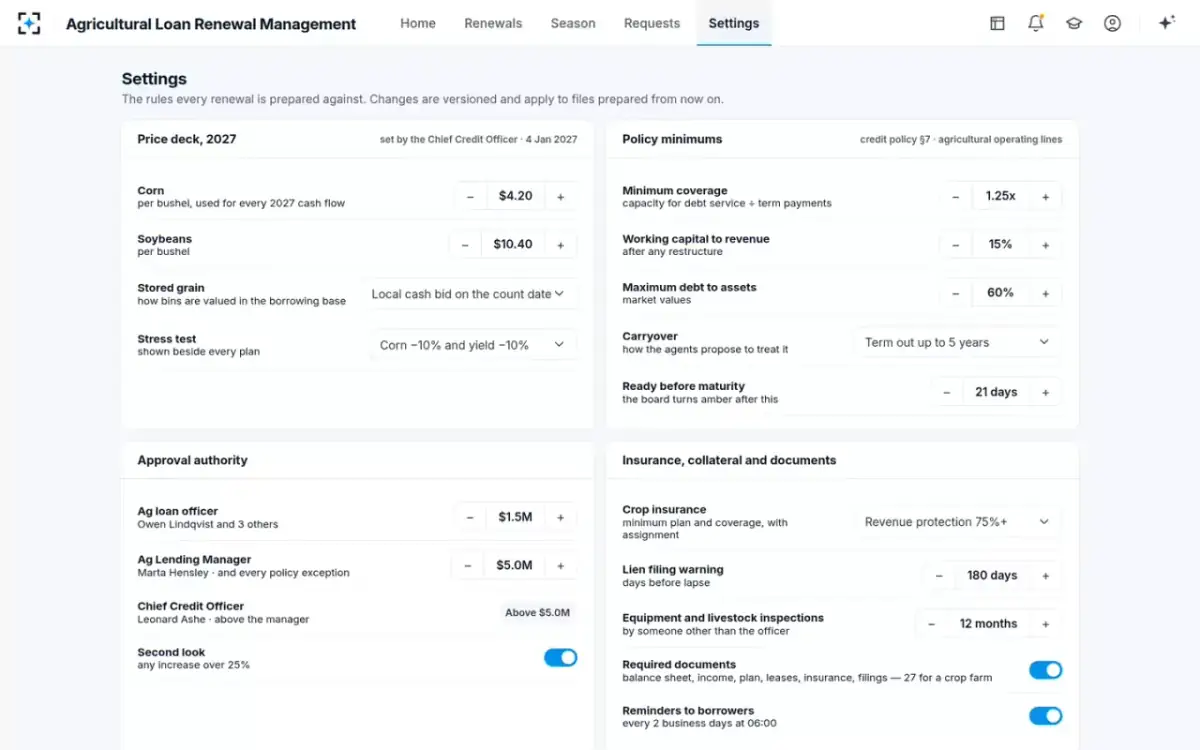
Is it a setting, a change request or a release? And does it apply to files prepared from then on, or silently to files already prepared?
- What does it do when a document is missing?
Estimate a figure, or list it as missing and draft a request for the officer to send? There is only one acceptable answer.
- What does it never do without a person?
Ask for the list in writing: send to a borrower, file a continuation, approve a renewal, price outside the grid.
- Which connections are live, and which are simulated today?
Loan servicing, lien search and insurance feeds differ. Ask which ones a pilot would have to stand up.
Does ag lending software handle crop insurance and liens?
Some does, most does not, and the difference is specific enough to test in ten minutes. A generic system usually holds crop insurance as a yes/no flag with an expiry date, which answers the wrong question. The question a renewal needs answered is whether every planted acre in this year's crop plan appears on the schedule of insurance, and whether the indemnity is assigned to the bank — because coverage that is not assigned is not the bank's security at all. That distinction has its own page: what a crop insurance assignment of indemnity actually covers.
Liens are the same shape of problem. A review date in a loan system is not a financing statement's lapse date, and the gap between them is where security quietly disappears. The OCC's own examination questions put both plainly: "does the bank have processes to verify that liens on Ag properties are properly filed and perfected?" and "does the bank have processes to monitor the adequacy of insurance coverage?" (Comptroller's Handbook: Agricultural Lending). If the software you are evaluating cannot be the answer to those two questions, something else in your bank still has to be.
Insurance, filings and the rules behind them are settings in Agricultural Loan Renewal Management
What stays a spreadsheet even after you buy software
Honesty about this is a better buying signal than any feature list, and the answer is: more than a vendor will volunteer. Three things reasonably stay outside.
The first is the one-off analysis. A borrower buying a neighbour's quarter section mid-season, a succession plan across three entities, a dairy expansion modelled over five years — these are arguments, not forms, and an officer should build them where arguments are easiest to build. The second is the relationship's history: who the landlords are, which son is coming back to the operation, why a borrower switched elevators. That belongs in a credit file as narrative. The third is anything your credit committee has asked for in a particular shape for twenty years, until somebody decides it is worth changing.
What should not stay a spreadsheet is anything a file is judged on: the spread, the cash flow and the price deck behind it, the insured acres, the filing dates. Those need to be produced from documents, attached to their sources, and reproducible by somebody who was not there. A workbook can produce all of them and cannot prove any of them.
How one renewal package assembled itself, start to finish
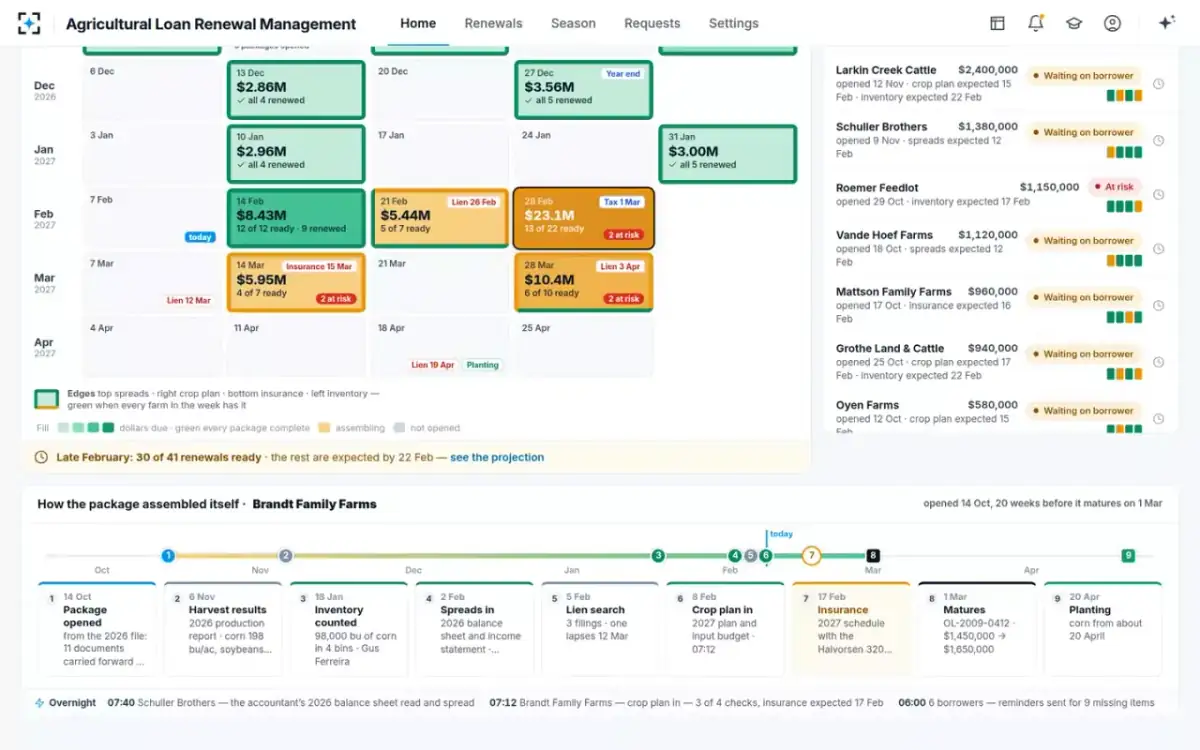
The clearest way to see the difference between the three approaches is to watch one file. In the sample season, a borrower's renewal package was opened on 14 October, twenty weeks before a 1 March maturity, carrying eleven documents forward from the previous year's file. Harvest results landed on 2 November. The grain was counted on 18 January — ninety-eight thousand bushels of corn in four bins. Spreads arrived on 2 February, the lien search on 5 February, and the new crop plan at 07:12 on the morning the officer opened it. Three of four readiness checks were in, with insurance expected on 17 February.
Nothing in that sequence required a person until the end of it, and that is the point. In a spreadsheet season all of it happens in February, by telephone. In a generic system the renewal is created in February and the documents are attached as they arrive. Here the file was built over twenty weeks and the officer's first act was to press Prepare renewal and read four things that needed judgement.
What the approach does not do is make the credit decision, and buyers should be suspicious of any claim that it might. The agents prepare; the ag loan officer recommends and signs; above the officer's authority or with any policy exception, the Ag Lending Manager approves. The farm operating loan renewal process, step by step sets out where each of those decisions sits, and how to pilot ag lending software on your own renewal files sets out how to test any of the three approaches on files you have already closed. To see the season calendar, the prepared renewal and the settings behind them, start from Agricultural Loan Renewal Management.
Questions people ask
What is ag lending software?
Software that carries an agricultural credit from application or renewal through analysis to a decision. In practice the name covers three quite different things: spreadsheets with email around them, a commercial loan origination system with an agricultural product configured on it, and software built around farm-specific facts such as carryover, insured acres, stored grain and financing statement lapse dates. Only the third reliably handles the facts a renewal turns on.
How is ag lending software different from commercial loan software?
Four facts have no natural home in a commercial model: inventory that is also repayment, insurance that is only security once it is assigned, a cash flow built on a price deck the bank sets, and a season in which most operating lines mature in the same eight weeks. A commercial system records that a renewal happened; whether it can produce the analysis that justified it is the question to test.
Is ag lending software worth it instead of spreadsheets?
It depends on concentration, not on the size of the book. A workbook holds a decade of local knowledge and adapts the day a borrower adds a hog barn; what it cannot hold is the queue — fifty-eight maturities, four filings lapsing this spring, which files are missing a crop plan. If your renewals concentrate in one window, the queue is the problem and a spreadsheet is the wrong tool for it.
Does ag lending software handle crop insurance?
Generic systems usually hold a yes/no flag and an expiry date, which answers the wrong question. A renewal needs every planted acre in the crop plan matched to the schedule of insurance, and the assignment of indemnity checked, because unassigned coverage is not the bank's security. Ask a vendor to do the acre-by-acre match in front of you rather than describe it.
Why have community banks been slow to adopt lending technology?
The FDIC's Community Banking Study, using a 2019 national survey of 519 community banks, found 90.9 per cent had mobile banking and 11.6 per cent had anything automating loan underwriting. The same study found the probability of being a low adopter rose from 28 to 39 per cent for a bank in a rural area. Bankers themselves named cost against a small customer base, and being "pushed to back of line" by vendors.
How to choose agricultural loan renewal software?
Test it against the work, not the module list: a renewal with unsold grain on the balance sheet, an acre-by-acre match of the crop plan to the schedule of insurance, a lapse date read from the actual filing, and one click from any figure in the memo to the page it came from. Then ask which rules are settings, what the system does when a document is missing, and what it will never do without a named person.