What happens when farm equipment collateral loses value is that a loan can fall out of compliance without the borrower doing anything at all. There is no missed payment, no request and no warning: the machines are worth less than they were, the loan is the size it always was, and a ratio written into the credit file crosses a line. Whether anyone notices depends entirely on when the pledged units were last valued. In the file on this page the answer was the same morning, because the lender re-values every pledged unit each quarter against that quarter's dealer and auction results. Botminds' Agricultural Collateral Monitoring is the software doing that work — matching each pledged machine by make, model, year, hours and serial number, recomputing coverage for the whole relationship, and drafting the inspection for a named person to approve.
The file is a fictional sample from the solution's own book: Nygaard Custom Harvest, account EQ-3355 in Hamilton County, a borrower of the fictional Ridgefold Agricultural Credit. The business, the people, the machines and every figure describing them are sample data, not a customer's measured result. The regulatory rules and the market commentary are real and linked where they appear.
One relationship, before and after the quarter's evidence
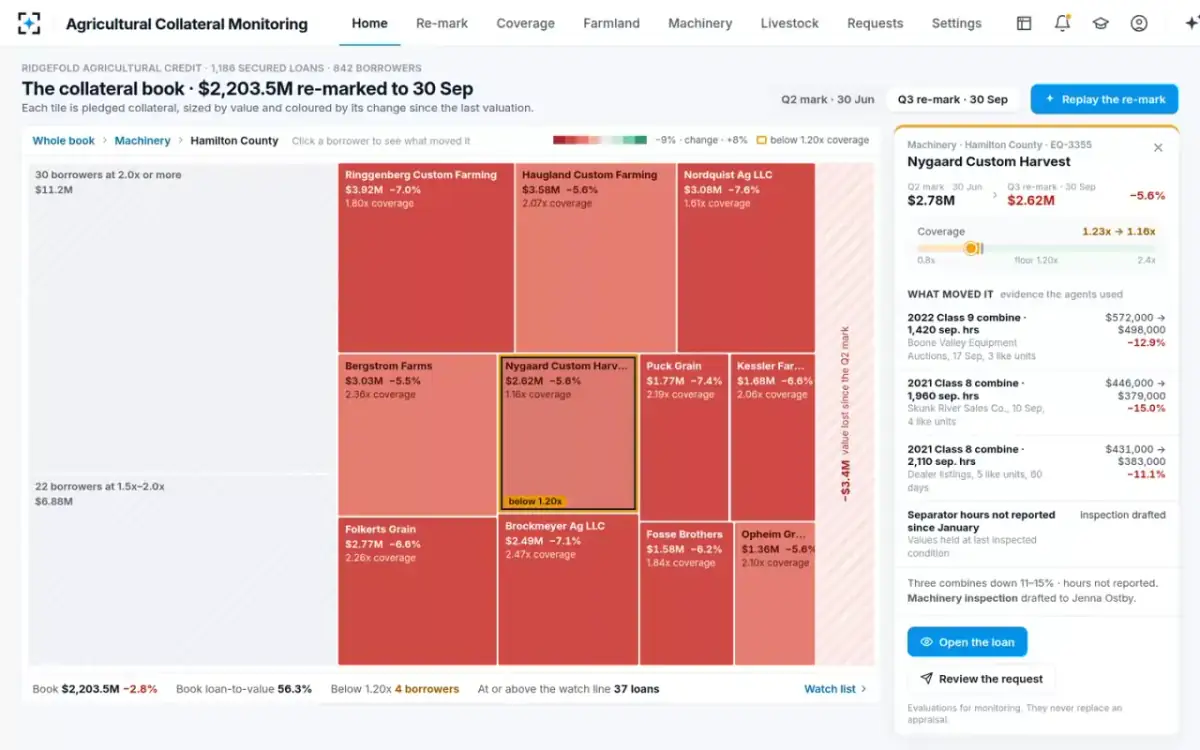
$572K→ $498K
the 2022 Class 9 combine, re-marked on the quarter’s auction and dealer results
−15.0%and −11.1%
the two 2021 Class 8 combines, now $379,000 and $383,000
1.23x→ 1.16x
collateral coverage against $2.26M of exposure, through the 1.20x floor
0missed
payments, requests or covenant notices from the borrower in the quarter
A loan in good standing, until the market moved
Nygaard Custom Harvest runs machines for other people's acres. Its balance sheet is mostly iron: three combines carry the bulk of the pledged collateral, alongside headers, carts and the rest of a custom operation's kit. At the second-quarter mark the relationship held $2.78M of collateral against $2.26M of exposure — coverage of 1.23x, comfortably clear of the lender's 1.20x floor, and a relationship loan-to-value of 81.3%.
Nothing about the borrower changed in the third quarter. The crew worked, the payments arrived on the dates they were due, and nobody at the bank had a reason to open the file. What changed was the market for used Class 8 and Class 9 combines, and the lender's exposure to that market was concentrated in exactly three machines.
The wider context pointed the same way. In the Chicago Fed's second-quarter District survey, lenders expected "farm machinery, grain storage construction, and farm real estate loan volumes" to "shrink below the levels seen in the third quarter of 2025" (AgLetter, August 2026) — the demand side of the same softening that shows up in auction prices. A lender reading only the survey would have known the direction. It would not have known which of its borrowers was standing in front of it.
What is a coverage floor on a farm loan?
A coverage floor is the minimum ratio of collateral value to exposure that a lender will accept on a relationship before it does something about it: here, 1.20x, meaning $1.20 of collateral for every dollar lent. It is the mirror of a loan-to-value watch line — the sample lender runs an 80% watch line on machinery and livestock and 75% on farmland — and it is set in policy rather than by regulation.
Three things make it useful and one makes it dangerous. It is useful because it is a single number across mixed collateral, because it is testable the moment any value changes, and because it names relationships rather than loans, which is how borrowers actually fail. It is dangerous because it is only as current as the values underneath it: a floor tested against a year-old machinery valuation tells you what was true last autumn. On a book where values are struck once a year, the floor is a backward-looking statistic wearing a forward-looking name.
What drives swings in used machinery values?
Two things, and the regulator asks a lender's inspection to address both. Analysis of equipment condition "should include a supported estimate of depreciation in value resulting from the amount and type of use", while a marketability analysis "should consider the local supply and demand for similar equipment" (Comptroller's Handbook, Agricultural Lending). Depreciation is about this machine; marketability is about everyone else's.
The two halves of a used machine's value, and what moved each one here
Depreciation
“A supported estimate of depreciation in value resulting from the amount and type of use”
What it is read fromYear, model, separator or engine hours, and the condition at the last inspection
In this fileSeparator hours had not been reported since January, so all three machines were held at their last inspected condition rather than marked down further for wear
Marketability
“A marketability analysis should consider the local supply and demand for similar equipment”
What it is read fromWhat comparable units actually sold for nearby, and how many buyers exist for this kind of machine
In this fileLarge Class 9 and Class 8 combines are specialised machines whose buyer pool can be narrow, and the quarter’s auction results moved the category down 9.8% across the book
In a quarter like this one the marketability half does the damage. A combine does not wear out in three months; the pool of buyers for a five-year-old Class 8 can thin in three months, and when it does, every comparable sale that clears does so lower. Across the sample book the combine category came down 9.8% in the quarter against 5.6% for machinery as a whole, which is why a borrower whose collateral is three combines moved more than a borrower with a mixed line of tractors, carts and tillage.
The morning the quarter's evidence came in
The run is scheduled: the eighth business day after quarter end, once the quarter's evidence has landed. On the morning in question that meant 214 recorded farmland sales, 9,860 dealer and auction results, thirteen weeks of USDA prices and 402 head counts, read before anything was valued.
From the quarter's evidence to an approved inspection, in one morning
- Evidence read: sales, auction results, prices, countsevidence
- Farmland, machinery and livestock re-valued class by classre-mark
- Loan-to-value recomputed for 1,186 loans; watch lines testedcoverage
- Requests drafted for the manager: orders, inspections, counts, alertsdrafts
- Three combines matched to dealer and auction results by serialmatched
- Collateral $2.78M to $2.62M; coverage crosses the 1.20x floorbreach
- Machinery inspection drafted, with the unreported hours as its reasoninspection drafted
Two details in that sequence matter more than the speed. The first is that the machinery values were produced by matching each pledged unit to real sale results rather than by applying a depreciation curve: 4,166 of the book's 4,212 pledged units found a match by make, model, year, hours and serial number. The second is that nothing was sent. Everything the run produced for this relationship was a draft waiting for the Rural Appraisal Manager.
What happens when pledged farm equipment loses value?
Four things happen in sequence, and only the first is automatic. The collateral value falls. Any ratio computed from it moves, which can put a loan or a relationship outside a policy limit without any change in the debt. The lender acquires an obligation to understand its position — the sample lender's own trigger is a value down 10% or more, and here the three combines were down about 13% between them. And then a person decides what to do, which is the only step that changes anything in the outside world.
What does not happen is just as important. No risk rating changed that morning. No terms changed. No letter went to the borrower. The agents in the run recompute and propose; they never alter a loan, and the one that drafts requests never sends without approval. That boundary is what makes the speed safe: a measurement that arrives in a morning is only an improvement if the actions it triggers still pass through someone who can be asked why.
From 1.23x to 1.16x: the math on one relationship
The arithmetic is worth laying out, because the interesting part is that the combines fell by more than the relationship did.
Nygaard Custom Harvest, second-quarter mark against the third-quarter re-mark
| Line | Q2 mark | Q3 re-mark | Change |
|---|---|---|---|
| 2022 Class 9 combine | $572,000 | $498,000 | −$74,000 (−12.9%) |
| 2021 Class 8 combine | about $445,900 | $379,000 | −15.0% |
| 2021 Class 8 combine | about $430,800 | $383,000 | −11.1% |
| The three combines together | about $1,448,700 | $1,260,000 | about −$188,700 |
| All pledged collateral | $2,780,000 | $2,620,000 | −$160,000 (−5.8%) |
| Exposure | $2,260,000 | $2,260,000 | unchanged |
| Coverage | 1.23x | 1.16x | below the 1.20x floor |
| Relationship loan-to-value | 81.3% | 86.3% | above the 80% machinery watch line |
Read the fourth and fifth rows together. The three combines gave up about $188,700 while the relationship's whole collateral position fell $160,000, which means the rest of what Nygaard pledged moved up by roughly $29,000 over the same quarter. A borrower can therefore cross a floor on the strength of one asset class while another class of its collateral is appreciating — and a report that shows only the relationship total will say the position weakened 5.8% without ever naming the three machines that did it. Why the classes move on different clocks is the general form of that problem.
The second thing the table shows is how small the breach is. Coverage went to 1.16x against a 1.20x floor: the relationship is short about $92,000 of collateral value, on $2.26M of exposure. That is a conversation, not a crisis — which is precisely the argument for finding it now. At renewal the same gap would be discussed against another two or three quarters of market movement.
What moved it, on one screen
How is machinery valued for a farm loan?
By comparison with what similar machines are actually selling for, documented well enough that someone else can follow it. The Farm Credit Administration's rule for personal property is specific about the file: an evaluation "shall include a source of comparisons of value (i.e., equipment dealer listings, Blue Book, market sales reports, etc.) and a description of the property being evaluated, including location of the property and, where applicable, quantity, species/variety, measure/weight, value per unit and in total, type of identification (such as brand, bill of lading, or warehouse receipt), quality, condition, and date" (12 CFR 614.4266(b)). Personal property is to be valued on the basis of market value under the institution's own evaluation standards.
The OCC names the sources a lender is likely to use: "a common valuation source for used equipment is the Farm Equipment Official Guide", and "local auctioneers and equipment dealers are often reliable sources of information". It also sets the cadence: non-real estate collateral supporting term debt should be inspected and valued periodically, with condition and marketability in the inspection documentation.
The sample lender's own rule adds one limit that matters here: a unit is never valued above its last inspected condition. Nygaard's separator hours had not been reported since January, so the quarterly run could price the machines against the market but could not assume they had been cared for in the meantime. The values were held at the last condition anyone had verified — and the gap in the hours became the reason for the inspection rather than a footnote to it.
What triggers a re-appraisal on a farm loan?
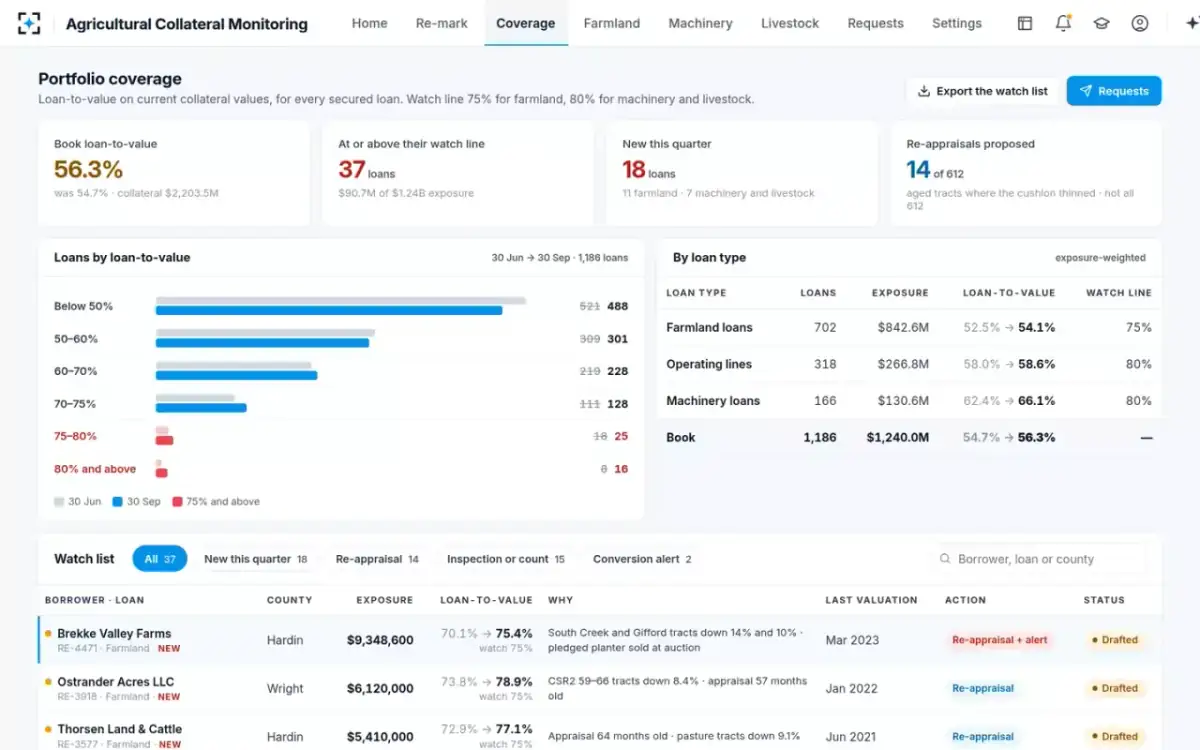
In the sample lender, two settings do, and both have to be about a loan that matters. A re-appraisal is proposed when the appraisal behind a tract is older than 36 months and the loan sits at or above its watch line, or when a value has fallen 10% or more. The pairing is deliberate: age alone would have proposed 612 orders in the quarter, and measured movement alone would have proposed orders on strong loans that did not need them. Together they proposed 14.
Machinery takes a different route, because the answer to a machinery question is an inspection rather than an appraisal. Where a value falls and the condition behind it is unverified, what the lender needs is somebody to go and look at the machine. Where a value falls and the condition is known, the number is simply the number. Nine machinery inspections were drafted across the book that quarter, against fourteen re-appraisal orders and six livestock counts.
From a fallen value to an approved inspection, and who does which part
Agent
Sales and price readerReads the quarter’s dealer and auction results alongside recorded sales, price reports and borrower inventory reports.
Never: Never uses a sale it cannot tie to its source
Agent
Machinery valuerMatches each pledged unit by make, model, year, hours and serial number and re-marks it from the results found.
Never: Never values a unit above its last inspected condition
Agent
Coverage checkerRecomputes loan-to-value for every loan and relationship on the new values and tests them against the watch lines and the coverage floor.
Never: Never changes a risk rating or a loan’s terms
Agent
Request drafterDrafts the machinery inspection, naming the units, the fall in value and the unreported hours as its reason.
Never: Never sends anything without the manager’s approval
A person decides
Rural Appraisal ManagerReads the evidence behind the new values, approves the quarter’s marks under her own name, then approves and sends the inspection request.
A person decides
Ag loan officer and inspectorCarries out the inspection: hours, condition and marketability on each machine, documented, and a conversation with the borrower about the coverage gap.
What happens after a machinery inspection is ordered?
It goes out with the rest of the quarter's approved requests, under the manager's name. In the sample quarter that was 31 requests in one batch: 14 re-appraisal orders to five panel appraisers at $46,100 in fees, 9 machinery inspections, 6 livestock counts and 2 alerts about pledged units found sold. The inspection on this relationship carried its own reason — three machines down about 13%, hours unreported since January — so the person doing it knows what the bank is worried about before they arrive.
What comes back changes the file in one of three ways. If the machines are in the condition last recorded, the quarterly marks stand and the conversation is about the $92,000 gap: additional collateral, a paydown, or an accepted exception with a date on it. If they are in worse condition, the values fall again and the gap widens. If they are better — fewer hours than feared, a rebuilt rotor — the value rises off its held figure, because the limit that held it down was the absence of information, not a judgement about the machine.
The regulation anticipates that loop. Where an evaluation of personal property is done by a fee appraiser, an institution's standards "shall include provisions for periodic collateral inspections and verification by the institution's account officer or appropriate designee" — the market value and the physical check are meant to confirm each other rather than substitute for each other.
One row on a watch list of thirty-seven
What the case does, and does not, prove
It does not prove a saving. Nothing here says the lender would have lost money had it found the gap at renewal instead; Nygaard may well harvest a good season, sell nothing and renew at a comfortable ratio. A case study on sample data cannot measure an avoided loss, and claiming one would be the same kind of statement this page is arguing against.
What it does show is a sequence, and the sequence is the point. A market moved; three specific machines moved with it; a ratio crossed a line; the reason was on the screen beside the ratio; a named person approved an inspection the same morning; and the borrower's own loan officer had something concrete to ask about. Every step is checkable, and the only step that took judgement was taken by someone who could be asked to explain it.
It also shows what the cost of the alternative actually is, in the only currency that can be measured here: time. The difference between finding this on the eighth business day after quarter end and finding it at renewal is up to eleven months of market movement on a collateral class that fell 9.8% in a single quarter. The three ways a lender can track collateral between appraisals sets out what each of them costs to reach the same answer, and what an undetected drop in collateral costs follows the consequences further. To see a quarter run on your own book, start from Agricultural Collateral Monitoring.
Questions people ask
Can a loan fall out of compliance without a missed payment?
Yes, and on a collateral-secured ag loan it is common. A coverage floor or a loan-to-value watch line is tested against the current value of the collateral, so a fall in the market can move a relationship outside policy while every payment arrives on time. In this file the borrower missed nothing and asked for nothing; coverage went from 1.23x to 1.16x because three pledged combines were re-marked against the quarter's auction results.
Who gets notified when collateral coverage drops?
In the sample lender, nobody outside the bank until a person says so. The run recomputes coverage, flags the relationship on the quarter's watch list and drafts a request; the Rural Appraisal Manager approves the marks and the requests under her own name; the loan officer then receives the inspection and has the conversation with the borrower. Nothing goes out before that approval, and a fee above the lender's $4,000 cap needs the Chief Credit Officer as well.
How much does a used combine fall in a bad quarter?
It depends on the class and the local buyer pool rather than on an average. In this sample quarter one 2022 Class 9 fell 12.9% and two 2021 Class 8s fell 15.0% and 11.1%, against 9.8% for combines generally and 5.6% for all machinery in the book. The spread between those numbers is the reason a percentage applied to a machinery line misses the borrowers who are actually exposed.
What does a lender do when coverage falls below the floor?
Establish the facts before acting on the ratio. The useful order is: confirm what moved and on what evidence; verify the condition behind the values, which is what an inspection is for; then discuss the gap with the borrower — additional collateral, a paydown, or an exception approved and dated. A $92,000 shortfall on $2.26M of exposure is a manageable conversation; the same gap discovered three quarters later rarely is.
Why would a machinery value be held rather than changed?
Because a market price assumes a condition, and if nobody has confirmed the condition the price is an assumption too. The rule in this file is that a unit is never valued above its last inspected condition, so unreported separator hours meant the three combines could be marked down to the market but not marked up past what was last verified. The missing information becomes a reason to go and look, rather than a gap quietly filled with an optimistic number.
Does a quarterly re-mark replace a machinery inspection?
No, and in this file it produced one. A re-mark reads the market; an inspection reads the machine. The regulator expects both — condition and marketability in the inspection documentation, and for fee-appraised personal property, standards that provide for periodic inspections and verification by the institution's own officer. What the quarterly pass changes is which machines get visited, and how quickly the reason to visit them appears.