How to implement agricultural collateral monitoring software is mostly a question about your own collateral policy rather than about the software. Every quarterly re-mark follows a short list of settings — the watch lines, the re-appraisal triggers, the comparable-sale rule, the coverage floor, the re-mark date, the fee cap and who approves and signs — and a bank already makes all of those decisions, one file at a time, by habit and memory. Going live on Botminds' Agricultural Collateral Monitoring means writing each of them down once, connecting the evidence the decisions rest on, proving the result against your own book before relying on it, and then signing the first coverage report under your own name.
The sequence below is the one the fictional sample lender, Ridgefold Agricultural Credit, follows on a book of 1,186 secured loans, 1,630 tracts, 4,212 machinery units and 70,900 head. Week counts are design targets, not measured averages; what is measured is noted as such.
From a written collateral policy to a signed coverage report
- Policywk 1
- Evidencewks 2–3
- Your bookwk 4
- Dry runwks 5–6
- Sign-offswk 7
- First runwk 8
What goes live, in what order
The order matters more than the duration, because each phase produces the input the next one needs. Settings before evidence, because the evidence rules are settings. Evidence before your book, because loading collateral you cannot value tells you nothing. Your book before the dry run, because the dry run's whole purpose is a comparison against values you already have. And the dry run before any sign-off, because a person is being asked to put their name on these numbers and should have seen them wrong at least once first.
The sequence also has a natural stopping point that is worth planning for. After the dry run, a bank frequently discovers that its written collateral policy and its actual practice differ — the policy says thirty-six months, the practice has been "when the officer thinks so" — and that difference has to be resolved by a person with the authority to resolve it, not absorbed into a setting.
What do we need to start agricultural collateral monitoring?
Five things, and four of them you already have. The collateral records themselves, the last valuation for each, the evidence feeds, the loan balances, and a written collateral policy — which is the one most banks have to produce rather than retrieve.
What to have in hand before week one
- Your pledged collateral, item by item
Tracts with acreage and soil ratings, machinery with make, model, year and serial number, livestock by class — as they appear on the security agreement schedules, not as a summary.
- The last valuation for each, with its date
The date matters as much as the figure: it is what the age trigger fires on, and it is how the first comparison is read.
- Loan balances, commitments and the schedules that tie collateral to loans
From the loan system. Without the tie, a re-marked tract cannot move any loan’s coverage.
- Operating account deposits for livestock borrowers
Only for the borrowers whose herd is pledged — this is what lets a fall in head count be matched to a reported sale.
- A written collateral policy, or a decision to write one
Watch lines, re-appraisal triggers, who approves, who signs, and the fee above which approval moves up. If these live in people’s heads, week one is where they come out.
The regulators' expectation here predates any of this, and it is a useful thing to put in front of a committee that thinks the policy can be written later. "Bank guidelines for collateral should include procedures for determining collateral values," the Comptroller's Handbook says, and "the current values of all collateral should be established during the underwriting process" (OCC, Agricultural Lending, version 1.4). A monitoring program is the second half of a sentence whose first half is already required.
Week one: your collateral policy, as settings
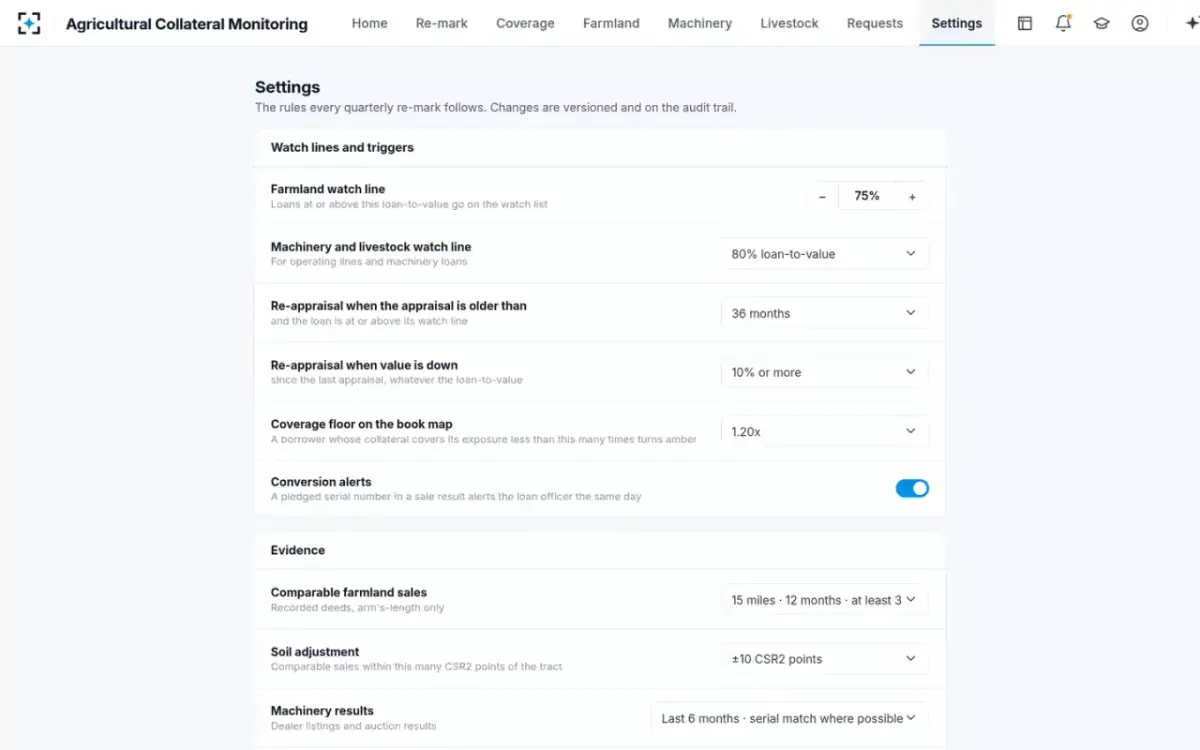
Week one is a workshop, not an installation. Eight decisions are taken, written down, and from then on applied identically to every tract, unit and head in the book. The defaults below are the sample lender's; the alternatives are the ranges the settings offer.
Your collateral policy as eight settings, with the default and the range
| Setting | Sample lender’s value | The alternatives | What the choice actually decides |
|---|---|---|---|
| Farmland watch line | 75% loan-to-value | Set up or down in steps | How many farmland loans appear on the watch list — and therefore how much of the quarter is spent on them |
| Machinery and livestock watch line | 80% loan-to-value | 75% · 80% · 85% | Whether depreciating collateral is held to a tighter standard than ground, which most policies intend but few state |
| Re-appraisal when the appraisal is older than | 36 months, and the loan is at or above its watch line | 24 · 36 · 48 months | The pairing is the setting: age alone would have ordered 612 appraisals on the sample book, age plus a thinned cushion ordered 14 |
| Re-appraisal when value is down | 10% or more | 7.5% · 10% · 15% or more | How sharp a fall counts as a market event rather than noise |
| Coverage floor on the book map | 1.20x | 1.15x · 1.20x · 1.25x | Which borrowers are ringed on the map before anyone reads a number |
| Comparable farmland sales | 15 miles · 12 months · at least 3 | 10 miles · 12 months · at least 3, or 20 miles · 18 months · at least 4 | Comparability against coverage: tighter means better comps and more tracts going to a review appraiser |
| Re-mark schedule | Quarterly, 8th business day | Monthly, 5th business day, or quarterly, 15th business day | Whether the run lands before or after the credit committee that will read it |
| Re-appraisal fee cap | $4,000 | $3,500 · $4,000 · $5,000 | The point at which the decision to spend leaves the valuation function for the Chief Credit Officer |
Two of these take an hour and six take a week. The watch lines and the coverage floor are usually already decided somewhere in credit policy. The comparable-sale rule, the pairing of age with a watch-line breach, and the fee cap are often being decided for the first time, and they are worth the argument.
The eight decisions, after week one
Setting the watch lines and the coverage floor
A watch line is a loan-to-value above which a loan appears on the quarterly watch list with a reason and an action. A coverage floor is a relationship-level multiple below which a borrower is flagged on the book map. They answer different questions and both are needed: a borrower can hold every individual loan inside its watch line and still have total collateral worth less than 1.20 times total exposure.
Set the watch line by working backwards from capacity rather than forwards from prudence. At 75% on farmland and 80% on machinery and livestock, the sample book produced 37 loans on the watch list out of 1,186 — about three per cent, and a list the Rural Appraisal Manager can actually work in a quarter. Lower the farmland line and the list grows faster than the quarter's capacity to work it; raise it and the loans that most need the conversation arrive on it later.
The useful discipline is to run the first dry run at two settings and read both lists. A watch line is defensible when the loans on the list are the ones a credit officer would have named from memory, plus a handful nobody would have.
Connecting the evidence: county recorder, auctions, market prices, the loan core
Weeks two and three connect the five evidence sources the three collateral classes need, and the work is mostly about coverage and identity rather than about the connections themselves.
The five feeds, what each one is for, and what makes it hard
| Feed | What it answers | What to check in week two |
|---|---|---|
| County recorded deeds and sales | What comparable ground has actually sold for, and whether the sale was arm’s-length | Which of your counties publish promptly, and how soil ratings are carried by parcel — the two together decide how much of your farmland book can be re-marked from sales |
| Land value surveys | The direction of the county and the soil band, as context around the comparable sales | Which surveys cover your footprint, and at what geography — a state average is not evidence for a tract |
| Dealer and auction results | What pledged machinery is worth, and whether a pledged serial number has been sold | Whether results carry serial numbers; a result without one can price a model but cannot find a disposition |
| Weekly market price reports | What each class and weight of livestock is worth this week | That the classes reported match the classes your borrowers actually run |
| Your loan system | Balances, commitments, security agreement schedules and operating account deposits | That the schedules tie items to loans. A collateral list with no tie produces values that cannot move any loan’s coverage |
Two of the five are worth a specific decision. Machinery matching is only as good as the serial number: with serials, a pledged unit can be matched to the sale of that exact machine, which is what turns a valuation into a disposition alert. Without them, matching is by make, model, year and hours, which values the machine correctly and finds nothing. And livestock deposits are the only feed that touches the borrower's bank account; connect it for the pledged-herd borrowers and no further, because a fall in head count that matches a deposit is the test, not a general look at the account.
The first dry run on your own book
Weeks five and six run the whole book against the quarter's evidence and compare the result with the values already in your files. This is the phase that makes or breaks the implementation, and it produces three outputs: a book value, a list of differences, and an argument.
Expect the differences to cluster. On the sample book the quarter moved land down 2.9%, machinery down 5.6% and livestock up 6.3% — three classes, three directions, which is itself the finding most lenders take from a first run. Inside the farmland number the spread was wider than the average: ground on the poorer soils fell 7.2% while the best ground was up 0.4%, which a county average applied to everything would have hidden entirely.
What a first run typically surfaces, on the sample book
−2.9%
farmland, against −5.6% machinery and +6.3% livestock in the same quarter
612of 1,630
pledged tracts whose last appraisal was more than three years old
18loans
newly at or above a watch line — found on the day the run was made, not at renewal
28of 214
recorded farmland sales set aside as not arm’s-length, each listed with its reason
The argument is the valuable part. Every difference between a new value and the one in the file is either the market having moved, the old value having been wrong, or the new method being wrong — and working through a sample of them with the review appraiser is how a bank decides whether it believes the output. Nothing should be signed until somebody has lost one of those arguments.
How do we test it before relying on it?
With a comparison, a sample and a deliberate failure, in that order.
The comparison is the dry run above: the whole book re-marked against the file, with the differences ranked by size and by effect on coverage. The sample is twenty to thirty values pulled by the review appraiser and worked by hand, chosen to include the hardest cases rather than a random draw — tracts with the fewest comparable sales, machines with the oldest reported hours, herds with the oldest inventory reports. The question is not whether the figures match but whether the evidence behind each one would stand up in a file.
The deliberate failure is the test most implementations skip. Take a tract with three supporting sales and remove one, and confirm it routes to the review appraiser rather than publishing a value from two. Take a machine whose hours are stale and confirm the value is held at last inspected condition rather than marked up. Take a head count with no matching deposit and confirm it raises an exception. A rule nobody has watched fire is not a rule you know you have.
Three tests, and what each one is actually asking
What you run: Every pledged item re-marked against the quarter’s evidence, differences ranked by size and by effect on coverage.
What a 'pass' means: The differences have explanations you accept — market movement, a stale file value, or a method you have now examined.
What you run: 20 to 30 values chosen for difficulty and worked independently by the review appraiser.
What a 'pass' means: The evidence behind each one would survive being questioned, whether or not the figures agree exactly.
What you run: Cases constructed to breach each rule: too few sales, stale hours, an unexplained drop in head count, a fee above the cap.
What a 'pass' means: Each one routes to a person instead of publishing a value — and you watched it happen.
Who signs, and in what order
Week seven fixes the approvals, and there are three decisions in it. Who approves the quarter's values, who approves each order and alert that follows from them, and who signs the coverage report.
At the sample lender all three sit with the Rural Appraisal Manager except the second signature on the report, which is the Chief Credit Officer's, and the approval of any re-appraisal fee above the $4,000 cap, which is also the Chief Credit Officer's. The structural requirement behind that arrangement is independence, and it is a reporting-line question rather than a job-title one.
An institution should establish reporting lines independent of loan production for staff who administer the institution's collateral valuation program, including the ordering, reviewing, and acceptance of appraisals and evaluations.
Interagency Appraisal and Evaluation Guidelines, December 2010
Ordering, reviewing and accepting: all three are named, and all three are things this program does every quarter. A bank where the person approving the quarter's values reports to the head of lending has an implementation problem that no setting can fix, and it is far cheaper to discover that in week seven than in an examination. Who holds each of these seats, and what an examiner asks of them, is set out in who watches a farm loan book's collateral.
The Farm Credit rules add a requirement that is easy to miss in a program built around data: where a real or personal property evaluation is completed by a fee appraiser, a System institution's standards "shall include provisions for periodic collateral inspections performed by the institution's account officer or appropriate designee" (12 CFR 614.4265(g), and the parallel requirement for personal property at 614.4266(d)). Somebody still has to go and look, on a schedule, and the implementation should produce that schedule rather than assume it.
What happens in the first quarterly run?
On the re-mark date, the quarter's evidence is read, the book is re-valued class by class, loan-to-value is recomputed for every loan and relationship, and the exceptions are drafted. On the sample book the run read 214 recorded farmland sales, 9,860 dealer and auction results, thirteen weeks of market prices and 402 head counts, re-marked 1,630 tracts, 4,212 units and 70,900 head, and recomputed 1,186 loans. The book moved from $2,267.3 million to $2,203.5 million and loan-to-value from 54.7% to 56.3%.
Then the work starts. Thirty-one items were drafted: fourteen re-appraisal orders to five panel appraisers carrying $46,100 in fees, nine machinery inspections, six livestock counts and two conversion alerts where a pledged serial number had turned up in auction results. The Rural Appraisal Manager approved the values, then the requests; nothing went out before she did.
The first run is also where the settings get their first real test, and a bank should expect to change one or two of them afterwards. A watch list of three loans means the lines are too loose; a watch list of two hundred means the quarter cannot be worked and the lines are too tight. Both are findings about the policy, not about the run.
The checks it must pass before it goes live
Five checks, each of which can fail, and each of which someone has to sign off as having passed. A check nobody could fail is not a check.
What has to be true before the first live run
- Coverage: every pledged item is valued, or explicitly held
A book with silent omissions is worse than a book with known ones. Items held at a prior value should be listed as held, with the reason.
- Identity: the collateral ties to the loans
Every item reconciles to a security agreement schedule and a loan. The population on the report has to match the loan system’s.
- Evidence: every value opens to what moved it
The sales used, the sales set aside with reasons, the auction results matched, the price reports and counts relied on.
- Routing: each rule has been watched to fire
Fewer than three sales routes to the review appraiser; stale hours hold the value; an unexplained head-count drop raises an exception; a fee above the cap moves up a level.
- Approval: nothing leaves without a named person
Orders, inspections, counts and alerts all wait, and the quarterly report carries two signatures with the meaning of the first one written beside it.
The fifth is the one that decides whether the first report can be relied on. The agencies also expect a bank to decide when an existing value stops being usable — "an institution should establish criteria for assessing whether an existing appraisal or evaluation continues to reflect the market value of the property (that is, remains valid)" — and a monitoring program is the operational form of exactly those criteria. Whether what it produces is an evaluation or something else is worth settling before week one, and is worked through in evaluation or appraisal, and what makes a farm collateral file defensible.
How long does it take to go live with collateral monitoring software?
About eight weeks is a reasonable target for a single book at a lender whose collateral policy is already written and whose security agreement schedules tie items to loans. The two things that move that number are both yours rather than the software's.
The first is the policy. A bank deciding its watch lines, its re-appraisal triggers and its comparable-sale rule for the first time should expect week one to become weeks one to four, because those are credit-policy decisions that need the people who own credit policy. The second is the collateral data. A book whose schedules carry serial numbers and acreage is ready; a book where machinery is described as "farm equipment per schedule" needs that resolved before anything can be matched, and that work is not quick.
What does not usually move the number is the evidence connections. Recorded sales, auction results and market price reports are published sources, and connecting them is a known quantity.
What week eight produces
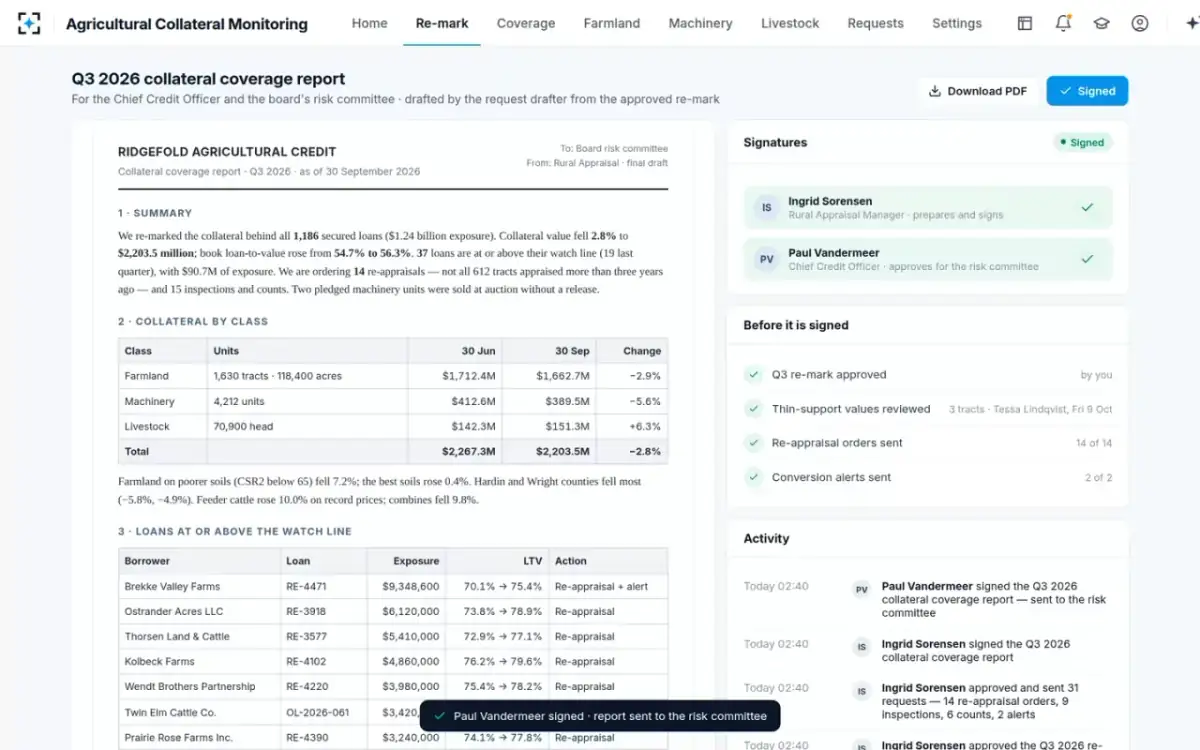
To see the settings, a quarter's run and the signed report in one place, start from Agricultural Collateral Monitoring, or read what the six agents do, and what none of them may do.
Questions people ask
What data does the system need from our loan core?
Balances and commitments by loan, the security agreement schedules that tie each pledged item to the loans it secures, and operating account deposits for borrowers whose livestock is pledged. The schedules are the critical part: without the tie between an item and a loan, a re-marked tract or machine cannot move any loan's coverage, and the output is a collateral valuation exercise rather than a monitoring program.
How do we set our watch lines and re-appraisal triggers?
Work backwards from the quarter you can actually staff. A farmland watch line at 75% and a machinery and livestock line at 80% produced a 37-loan watch list on a 1,186-loan sample book — about three per cent, which one manager can work. The re-appraisal trigger is best written as a pair rather than a single condition: an appraisal older than thirty-six months only orders a new one where the loan is also at or above its watch line, which is the difference between 612 candidates and 14 orders.
What settings does a quarterly re-mark need?
Eight: the farmland watch line, the machinery and livestock watch line, the appraisal-age trigger, the fall-in-value trigger, the coverage floor on the book map, the comparable-sale rule of distance, window and minimum count, the re-mark schedule, and the re-appraisal fee cap above which approval moves to the Chief Credit Officer. Each should be versioned, so that a value can later be read against the rules that were in force when it was produced.
Who has to approve before the system goes live?
At minimum the person who will own the values — typically a rural appraisal manager or collateral valuation officer, reporting outside loan production — and the credit officer who will sign the quarterly report second. The interagency guidelines require reporting lines independent of loan production for the staff who order, review and accept appraisals and evaluations, so the approval structure is a condition of the implementation rather than a step inside it.
How do we test it before relying on it?
Three tests. Re-mark the whole book against the values already in your files and work through the differences until each has an explanation you accept. Have the review appraiser work twenty to thirty of the hardest values by hand — the fewest comparable sales, the oldest reported hours, the oldest inventory reports. Then construct cases that should fail, and watch each rule route to a person: too few sales to a review appraiser, stale hours to a held value and an inspection, a fee above the cap to the Chief Credit Officer.
What happens in the first quarterly run?
The quarter's evidence is read, every pledged item is re-valued class by class, loan-to-value is recomputed for every loan and relationship, and the exceptions are drafted for approval. On the sample book that was 1,630 tracts, 4,212 machinery units and 70,900 head re-marked, 1,186 loans recomputed, 37 loans at or above a watch line with 18 of them new, and 31 orders, inspections, counts and alerts drafted — none of which was sent before the Rural Appraisal Manager approved it.