Under the farm products rule in 7 U.S.C. §1631, an honest buyer of pledged livestock will usually keep the cattle even though the bank's security interest was perfected, even if the buyer knew about it, and even though the farmer sold without the lender's consent. That is not a gap in anyone's paperwork; it is the deliberate effect of a federal statute, the Food Security Act of 1985, which reversed the ordinary rule for crops and livestock in order to stop buyers paying twice. The lender's claim survives only where it put something in place before the sale — direct written notice to that buyer within the preceding year, or a filing in a state that runs a certified central list. A pledged combine sold at the same auction is a completely different question, because a combine is not a farm product. Botminds' Agricultural Collateral Monitoring is the monitoring side of this: it matches every pledged serial number to dealer and auction results and every head count to the borrower's reported sales, so a lender learns that a pledged asset has moved in the quarter it moved, not at renewal.
This page explains the rules as the statutes and the uniform code state them; it is not legal advice, and the question of who keeps a particular asset is one for the lender's counsel. The worked example is a fictional sample lender running through the solution — Ridgefold Agricultural Credit in central Iowa — and the borrowers, auctions and amounts in it are invented sample data.
The sale that nobody reported
2units
pledged machinery found sold at auction in one quarter, with no release asked for
$189,500
in sale proceeds that never reached the line they secured
4,166of 4,212
pledged units matched to a dealer or auction result by serial number in the same run
1 year
how long a direct notice to a buyer of farm products stays good, under federal law
Two sales, two different rules
Start with the fact that trips most people up: the same borrower, selling two pledged things on the same day, is governed by two different bodies of law. One hundred and ten head of feeder cattle sold at a sale barn are farm products, and a federal statute decides who keeps them. A 24-row planter sold at a farm auction is equipment, and the uniform commercial code decides that one. The answers point in opposite directions.
The code draws the line by definition rather than by instinct. "Farm products" are goods, other than standing timber, held by a debtor engaged in a farming operation that are crops, livestock "born or unborn", supplies used or produced in farming, or products of crops or livestock in their unmanufactured states. "Equipment", meanwhile, is defined by exclusion: "goods other than inventory, farm products, or consumer goods" (UCC §9-102(a)(33), (a)(34)). A combine is not a crop, is not livestock and is not a supply consumed in farming, so it falls through into equipment — and out of every rule written for farm products.
Can a farmer sell pledged livestock without telling the lender?
Legally, the sale will usually pass good title to the buyer whether the lender was told or not. The security agreement almost certainly forbids it, so the borrower is in default and owes the proceeds. But the buyer's position does not depend on the borrower's promises to the bank, and that is the whole point of the federal rule.
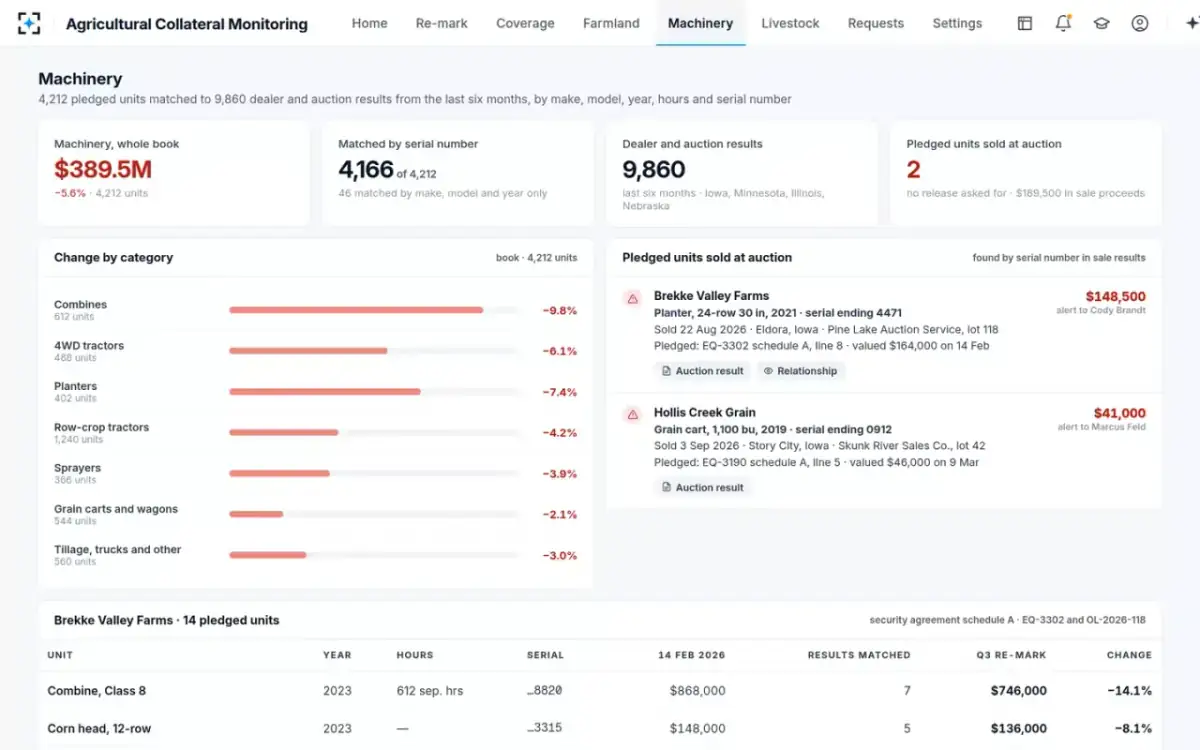
Commercially, the consequence lands on the lender in a particular shape: the collateral is gone, the loan is unchanged, and nothing in the loan system knows. In the sample quarter two pledged machinery units had been sold at auction with no release asked for, $189,500 of proceeds had not reached the lines they secured, and both would have remained invisible until the next renewal had nothing matched the serial numbers against the sale results.
The general UCC rule: farm products are the exception, not the norm
Under the uniform code, a buyer in the ordinary course of business normally takes free of a security interest created by its seller. There is one carve-out written on the face of the section, and it is agriculture: a buyer in ordinary course "other than a person buying farm products from a person engaged in farming operations, takes free of a security interest created by the buyer's seller, even if the security interest is perfected and the buyer knows of its existence" (UCC §9-320(a)).
Read the exception twice. Within the uniform code itself, the farm-products buyer is the one person who does not get the ordinary-course protection: the bank's lien follows the cattle into the buyer's hands. That was the state of the law that Congress found intolerable, and the federal statute that follows exists to reverse it.
The federal override: the Food Security Act's buyer protection
Congress's findings say exactly what the problem was. Some state laws let a lender enforce a lien against a purchaser who "does not know that the sale of the products violates the lender's security interest in the products, lacks any practical method for discovering the existence of the security interest, and has no reasonable means to ensure that the seller uses the sales proceeds to repay the lender" — which subjects that purchaser "to double payment for the products, once at the time of purchase, and again when the seller fails to repay the lender" (7 U.S.C. §1631(a)). Double payment, Congress concluded, inhibited competition and burdened interstate commerce. The remedy is blunt.
Except as provided in subsection (e) and notwithstanding any other provision of Federal, State, or local law, a buyer who in the ordinary course of business buys a farm product from a seller engaged in farming operations shall take free of a security interest created by the seller, even though the security interest is perfected; and the buyer knows of the existence of such interest.
7 U.S.C. §1631(d), Food Security Act of 1985
Three phrases in that sentence do the work. "Notwithstanding any other provision" means it overrides the state code, including §9-320's carve-out. "Even though the security interest is perfected" means the filing that normally wins does not. And "the buyer knows of the existence of such interest" means that even actual knowledge of the bank's lien does not put the buyer back on the hook. A lender that is relying on its filing alone, against a buyer of crops or livestock, is relying on the one thing the statute was written to disable.
Does a buyer of farm products take them free of a bank's lien?
Yes, unless the lender had already done one of two specific things before the sale. The statute sets out both in subsection (e), and each has a second limb that is easy to miss.
The first route is direct notice. The buyer takes subject to the security interest if, "within 1 year before the sale of the farm products, the buyer has received from the secured party or the seller written notice of the security interest organized according to farm products" — a notice that must name the secured party and the debtor, carry the debtor's taxpayer or other approved identifier, describe the products with the crop year and the counties where they are produced or located, be amended within three months to reflect material changes, and set out "any payment obligations imposed on the buyer by the secured party as conditions for waiver or release of the security interest". The second limb is the one lenders forget: the buyer takes subject only if it then "failed to perform the payment obligations". A buyer who received the notice and paid by joint cheque as the notice required takes free.
The second route exists only in states that run a central filing system. There, a buyer takes subject if it "failed to register with the Secretary of State of such State prior to the purchase" and the secured party "has filed an effective financing statement or notice that covers the farm products being sold" — or if the buyer did register and was sent the list naming that seller and that product.
The two ways a lender keeps its claim: direct notice or a registry
Those two routes are not alternatives a lender can choose between. Which one is available is decided by the state the farm products are produced or located in, and a lender that operates across a state line operates under both systems at once.
Crops and livestock, against the machine parked beside them
Livestock and crops — 7 U.S.C. §1631: The buyer takes free of a perfected security interest, even knowing of it.
Machinery — UCC Article 9: A security interest "continues in collateral notwithstanding sale … unless the secured party authorized the disposition free of" it.
Livestock and crops — 7 U.S.C. §1631: On its own, nothing. The statute overrides perfection expressly.
Machinery — UCC Article 9: Perfection is what makes the continuing interest good against later claimants.
Livestock and crops — 7 U.S.C. §1631: Direct written notice within the year with its payment conditions met, or an effective financing statement in a central-filing state.
Machinery — UCC Article 9: Nothing extra: the interest follows the machine, and attaches to any identifiable proceeds of the sale.
Livestock and crops — 7 U.S.C. §1631: No. Knowledge is expressly irrelevant to the protection.
Machinery — UCC Article 9: It can. An ordinary-course buyer must be acting in good faith and without knowledge that the sale violates another’s rights.
Livestock and crops — 7 U.S.C. §1631: Only if buying from someone "in the business of selling farm products".
Machinery — UCC Article 9: A buyer in ordinary course buys "in the ordinary course from a person … in the business of selling goods of that kind" — a farmer is not in the business of selling combines.
Livestock and crops — 7 U.S.C. §1631: Find out which regime each state uses, and keep the notices current.
Machinery — UCC Article 9: Find the machine and the money: the interest and the proceeds claim both survive.
One sold asset, five questions, and who keeps it
1Is the thing sold a farm product?
Crops, livestock, supplies used in farming and unmanufactured products of either, while in the hands of someone engaged in a farming operation.
If yesThe federal farm products rule applies. Go to the next question.
If noIt is equipment, and the ordinary rules of Article 9 decide it. Skip to the last row.
2Did the buyer buy in the ordinary course from a farmer?
A person who, in the ordinary course of business, buys farm products from someone engaged in farming who is in the business of selling them.
If yesThe buyer takes free of the lien unless one of the two exceptions below is met.
If noThe federal protection does not reach the sale; the security interest continues in the asset.
3Did the secured party give direct written notice within the year?
A notice organised by farm product, naming the parties, the debtor identifier, the product, crop year and counties, and the payment conditions for release.
If yesThe buyer takes subject to the lien only if it then failed to meet the payment conditions in that notice.
If noNo claim on this route. The next question is the only one left.
4Does the state run a certified central filing system?
A statewide list of effective financing statements kept by the Secretary of State and certified by the Secretary of Agriculture.
If yesAn unregistered buyer takes subject where a statement was filed; a registered buyer who was sent the list takes subject too.
If noDirect notice was the only route, and it was not used.
5And if it was equipment all along?
A combine, a planter or a grain bin: goods that are not inventory, farm products or consumer goods.
If yesThe security interest continues in the machine unless the lender authorised the sale free of it — and it attaches to the identifiable proceeds.
If no—
Does Iowa have a central filing system for farm products?
No. Iowa is a direct-notice state, which is the single most important operational fact for a lender in that market. The Center for Agricultural Law and Taxation at Iowa State University states it plainly: the farm products rule "allows buyers in the ordinary course to purchase grain free and clear of an existing security interest unless the buyer (in Iowa) receives direct notice of a perfected security interest in the grain" (Center for Agricultural Law and Taxation, Iowa State University).
Two riders go with that. The first is that the rule reaches only security interests. As the same source notes, it "applies only to security interests, not agricultural liens", so a landlord with a perfected landlord's lien is not required to notify ordinary-course buyers of a tenant's crops — though a landlord who also takes a consensual security interest in the same collateral is back inside the rule. The second is geography: where farm products subject to an agricultural lien are moved to another state, the lien is governed by the law of the place the products are, not the place the debtor is, so a herd trucked across a state line can need a separate filing there.
For a lender, the practical question is therefore not "are we perfected?" but "in which of the states we lend into is perfection enough, and where does it take a notice as well?" That is a question about a list of states, kept current, and about whether the notices to the buyers on that list are inside their year.
Why a sold combine is a different case entirely
Nothing in the federal statute touches equipment, so the machine falls back on the uniform code — and there the lender's position is strong. A security interest "continues in collateral notwithstanding sale, lease, license, exchange, or other disposition thereof unless the secured party authorized the disposition free of the security interest", and it "attaches to any identifiable proceeds of collateral" (UCC §9-315(a)). The interest in the combine survives the auction, and a claim on the money arises at the same moment.
The ordinary-course escape hatch rarely helps the buyer here either, because of who the seller is. A buyer in ordinary course of business is someone who buys "in the ordinary course from a person, other than a pawnbroker, in the business of selling goods of that kind" (UCC §1-201(b)(9)). A farmer dispersing equipment at a farm auction is not in the business of selling combines; a dealer selling from its own lot is. Which of the two sold the machine can therefore decide the outcome, and it is a fact the lender can establish from the sale result itself.
In the sample book that fact pattern is concrete. A 24-row planter on line 8 of one borrower's security agreement, serial ending 4471, valued at $164,000 in February, appears in a county auction service's published results: lot 118, sold on 22 August 2026 for $148,500. No release was asked for and no payment reached the line. What the solution does with that is narrow and deliberate — it drafts an alert to the loan officer naming the sale, the lot, the amount and the schedule line, with what to ask the borrower for: the proceeds, or a replacement unit pledged in their place. It does not decide who owns the planter. That is the lender's and its counsel's call, on facts the alert has put in front of them within days rather than months.
The match that starts the conversation: a pledged serial in a published sale result
What is a central filing system for farm products?
It is a statewide list, defined by the federal statute itself rather than by state practice, and it only counts if the Secretary of Agriculture has certified it. Under §1631(c)(2) the system must take effective financing statements filed with the Secretary of State, record the date and hour of each filing, and compile them into a master list organised by farm product and then arranged alphabetically by debtor, numerically by the debtor's taxpayer or other approved identifier, geographically by county or parish, and by crop year.
A statement in such a system is effective for five years, can be continued, must be amended in writing within three months to reflect material changes, and lapses when either its period runs out or the secured party files notice that it has lapsed. On the buyer's side, registration with the Secretary of State is what buys protection: a registered buyer receives the relevant portion of the list and takes free of anything not on it, while an unregistered buyer takes subject to any filed statement covering what it bought.
The design is a direct answer to the congressional finding. In a central-filing state the buyer finally has the "practical method for discovering the existence of the security interest" whose absence the findings complained of; in a direct-notice state, the lender supplies that knowledge one buyer at a time.
What a lender needs in place before a pledged crop or herd is sold
- A current list of which regime each state you lend into uses
Central filing or direct notice is a per-state fact, and it decides whether a filing is worth anything against a buyer. The rule applies where the farm products are produced or located, not where the borrower banks.
- Notices that are inside their year, to the buyers that matter
The protection in §1631(e)(1) runs from a notice received within one year before the sale. A list of sale barns, elevators and packers a borrower actually uses, reviewed annually, is the practical form of that.
- The payment conditions written into the notice
The notice must state the payment obligations imposed on the buyer as conditions for waiver or release — a joint cheque, usually. Without them, there is nothing for the buyer to fail to perform, and the second limb of the exception cannot be met.
- Amendments within three months of a material change
New counties, a new crop year, a changed product description: the statute requires the notice or statement to be amended in writing to reflect material changes, and the clock on that is short.
- In a central-filing state, an effective financing statement that has not lapsed
Five years, continuable in the six months before expiry. A lapsed statement is indistinguishable from no statement to a buyer searching the list.
- A way of learning that a sale happened at all
Every protection above operates before the sale. After it, the only question is speed: matching pledged serial numbers to published sale results, and head counts to deposits, is how the lender finds out in days rather than at renewal.
What this means for a quarterly re-mark
The legal position above is fixed before the sale. Everything a lender can still influence afterwards is a matter of how quickly it finds out, and that is a monitoring problem rather than a legal one.
Speed matters for three separate reasons. A claim on identifiable proceeds is easiest while the money is still identifiable, and a deposit that has been spent on inputs is harder to trace than one that is still in the operating account. A conversation about pledging a replacement unit is a different conversation at week three than at month nine. And a borrower who sold one pledged asset without a release may have sold others, so the question the first finding raises is always a portfolio question.
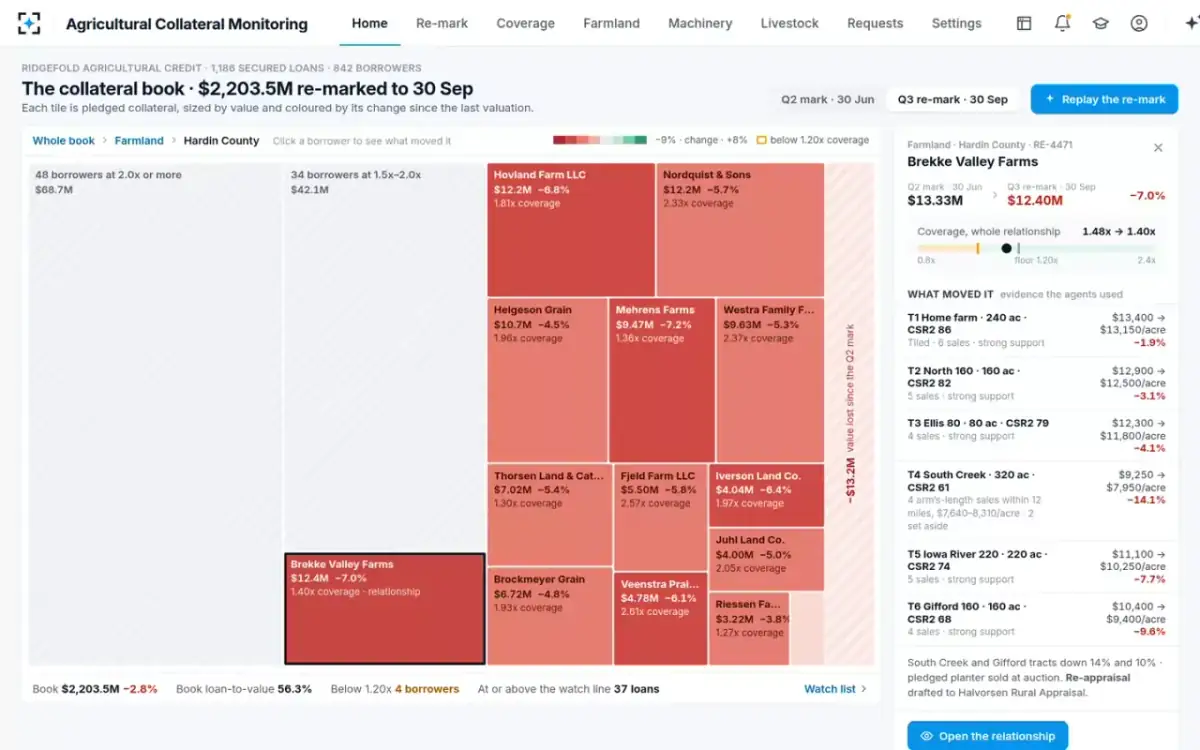
That is why the sample lender's run checks both classes in the same pass: every pledged serial number against dealer and auction results, and every borrower's head count against what is pledged, with a drop passing only when a sale matches a deposit. In the quarter shown, 110 head sold on 18 September tied to a $271,800 deposit and passed; two machinery serials did not, and both became alerts. Why the three classes move on different clocks explains why the same pass has to look at both at once, and one quarter followed through a single relationship shows what a lender does with a finding on the morning it arrives.
Where a finding lands: the borrower's own collateral, with the sale against the line it secured
To see the serial matching, the count checks and the alerts they draft, start from Agricultural Collateral Monitoring.
Questions people ask
What is the farm products rule?
It is the popular name for 7 U.S.C. §1631, part of the Food Security Act of 1985. It provides that a buyer who in the ordinary course of business buys a farm product from a seller engaged in farming operations takes free of a security interest created by that seller, even where the interest is perfected and the buyer knows about it. It reverses, for crops and livestock, the ordinary commercial rule that a perfected lien survives a sale.
Does the farm products buyer rule apply to pledged equipment too?
No. The statute protects buyers of farm products, and the uniform code defines equipment as goods that are not inventory, farm products or consumer goods — so a combine, a planter or a grain bin sits outside it. For equipment the ordinary rule applies: the security interest continues in the machine unless the lender authorised the sale free of it, and it attaches to any identifiable proceeds.
How does a lender protect a security interest in livestock or crops?
By doing something before the sale that the statute recognises. In a direct-notice state that means sending each likely buyer a written notice, organised by farm product and carrying the required details and the payment conditions for release, and keeping it inside its one-year life and amended within three months of any material change. In a central-filing state it means an effective financing statement on file with the Secretary of State that has not lapsed. Perfection alone does not do it.
What happens if a pledged machine is sold at auction?
The lender normally keeps a claim on both the machine and the money. The security interest continues in the machine unless the lender authorised the disposition free of it, and it attaches to identifiable proceeds of the sale. Whether the buyer can defeat it usually turns on whether the seller was in the business of selling goods of that kind: a dealer's lot and a farmer's dispersal sale are not the same transaction in law, even when the gavel sounds the same.
What should a lender do when pledged cattle are sold without a release?
Not consistently with the security agreement, which will almost always require the proceeds to be applied to the loan, so a sale without a release is usually an event of default whatever the buyer's position. What the buyer's protection changes is where the lender has to look: at the borrower and the money rather than at the cattle. That is why a lender's first question on finding an unreported sale is whether a matching deposit reached the operating account.
How quickly can a lender find out that pledged collateral was sold?
As quickly as it is willing to match pledged assets against published evidence. Dealer and auction results carry serial numbers, and a borrower's reported head counts can be compared with deposits. In the sample book that pass runs each quarter and found two sold units out of 4,212 pledged, with $189,500 of proceeds unaccounted for. The alternative — learning at renewal — can be the better part of a year later.