AI for agricultural lending collateral monitoring is useful in exactly one shape: narrow agents that gather evidence and compute values, under a person who approves them. In Agricultural Collateral Monitoring, six agents re-price a $2.2 billion farm loan book each quarter — one reads sales and prices, three value the three collateral classes, one recomputes coverage, one drafts what should happen next — and not one of them can approve a value, change a risk rating, replace an appraisal or send a letter. The division of labour between them is also the control: a narrow agent with a written limit is auditable in a way that one general-purpose assistant with access to the loan system is not.
The book on this page belongs to a fictional lender, Ridgefold Agricultural Credit: 1,186 secured loans, 1,630 pledged tracts, 4,212 machinery units and 70,900 head across central Iowa, as the solution runs on its own sample data. The regulators' sentences are real.
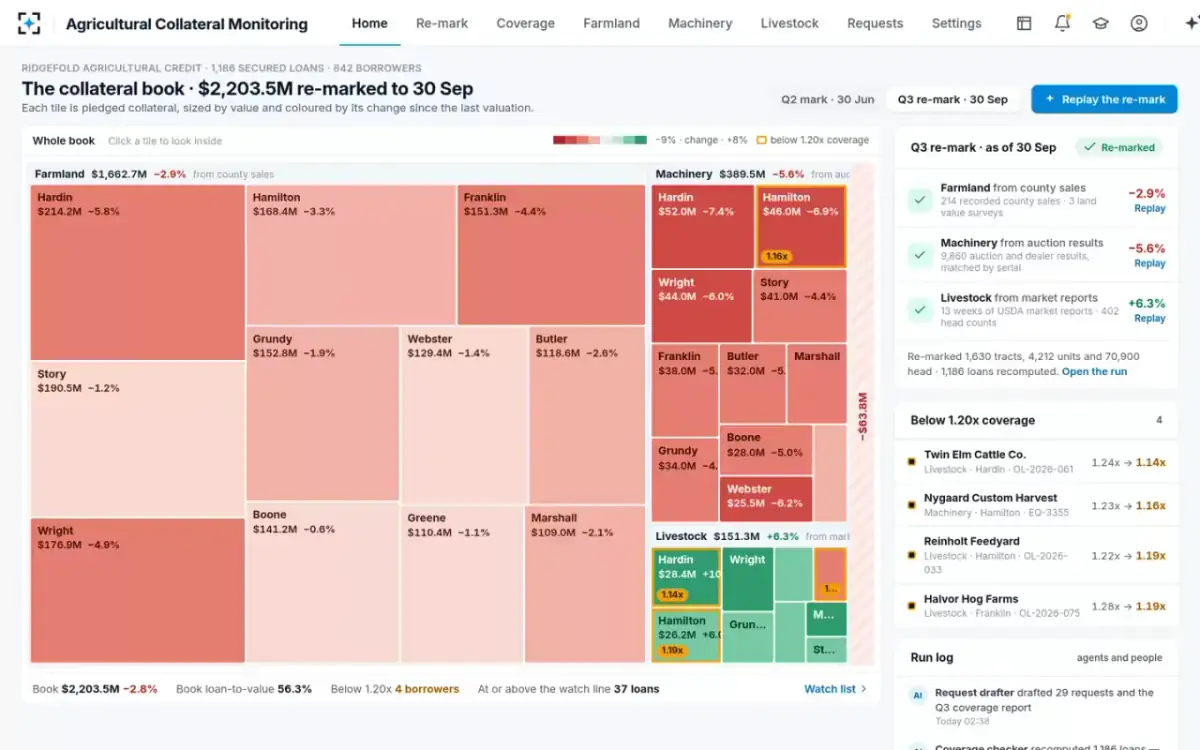
One quarter's run, in what went in and what came out
9,860
dealer and auction results read and matched against pledged serial numbers
214sales
recorded farmland sales read, of which 28 were set aside as not arm’s-length
1,186loans
loan-to-value recomputed against the new values, with 37 at or above a watch line
0
risk ratings changed, loan terms altered or requests sent without a person’s approval
The book the six agents re-price, after the run
Six agents, and who approves what they find
What the agents find is approved by one person: the Rural Appraisal Manager, who owns the valuation function and signs the quarter's values under her own name. Everything the six produce arrives at her desk as a proposal — a value with its evidence, a loan that crossed a watch line, an order written but not sent — and nothing moves until she acts on it.
That is the opposite of the usual arrangement, where a system decides and a person reviews exceptions. Here the system proposes everything and decides nothing, which is more work for the person on paper and much less in practice, because the proposals arrive with the evidence attached and ranked by what actually changed. On the sample book the quarter's thirty-one requests arrived at her desk already written, each with its reason and its evidence.
The six are not six copies of one thing. They are six different jobs, and they are separate because the evidence, the method and the failure modes are different in each. A farmland value is wrong when a sale was not arm's-length. A machinery value is wrong when a machine's hours are stale. A livestock value is wrong when the head count is a number the borrower last reported in spring. One agent asked to do all three would have one set of rules for three unrelated problems.
The six, in the order they run
Agent
Sales and price readerReads recorded farmland sales, land value surveys, dealer and auction results, weekly market reports and borrower inventory reports, and flags the sales that are not arm’s-length.
Never: Never uses a sale it cannot tie to a recorded deed; never treats a family transfer as arm’s-length
Agent
Farmland valuerRe-marks every pledged tract by sales comparison, adjusted for soil, size, drainage and date, and shows the sales behind each value and the ones set aside.
Never: Never replaces an appraisal; fewer than three sales and the value goes to a review appraiser
Agent
Machinery valuerMatches every pledged unit to dealer and auction results by make, model, year, hours and serial number, and looks for pledged serials that have been sold.
Never: Never values a unit above its last inspected condition
Agent
Livestock valuerPrices each borrower’s head count by class and weight at the week’s market prices, and ties reported sales to deposits in the operating account.
Never: Never counts livestock it has no report or count for
Agent
Coverage checkerRecomputes loan-to-value for every loan and every relationship on the new values, tests the watch lines and ranks the watch list.
Never: Never changes a risk rating or a loan’s terms
Agent
Request drafterWrites the re-appraisal orders, inspection and count requests, conversion alerts and the quarterly coverage report.
Never: Never sends anything without the manager’s approval; a fee above the cap goes to the Chief Credit Officer
A person decides
Rural Appraisal ManagerApproves the quarter’s values, then each order, inspection, count and alert, under her own name.
Can AI value farmland for a loan?
It can produce an evaluation — a supported estimate of market value used to monitor a loan the bank already holds — and it cannot produce an appraisal, which is a different document with a different author and a different legal standing. That distinction is not a hedge; it is written into the rules that govern what a lender may rely on, and which of the two your file actually needs is the question most worth getting right before any of this is automated.
Within the evaluation lane, the federal banking agencies have been explicit that a method rather than a profession is what has to be demonstrated. An institution "should be able to demonstrate that an evaluation, whether prepared by an individual or supported by an analytical method or a technological tool, provides a reliable estimate of the collateral's market value as of a stated effective date prior to the decision to enter into a transaction" (Interagency Appraisal and Evaluation Guidelines, 2010). Prepared by an individual or by a tool: the sentence puts them on the same footing and applies the same test to both.
The same guidelines then rule out the shortcut. "A valuation method that does not provide a property's market value or sufficient information and analysis to support the value conclusion is not acceptable as an evaluation." A price pulled from a general index, or a number with no comparable sales behind it, is not an evaluation however it was produced. This is why the farmland valuer's output is a list of sales with adjustments rather than a figure.
The Farm Credit Administration's rule for System institutions adds the method itself: market value must be determined by "a reasonable valuation method" that considers the income capitalization, sales comparison and cost approaches as appropriate, and "explains and documents the elimination of any approach not used" (12 CFR 614.4265(b)). On cropland with active sales, sales comparison is the approach and the other two are eliminated — but the elimination has to be stated, not assumed.
The sales and price reader: arm's-length only
The first agent never values anything. It decides what counts as evidence, which is the decision every later value inherits.
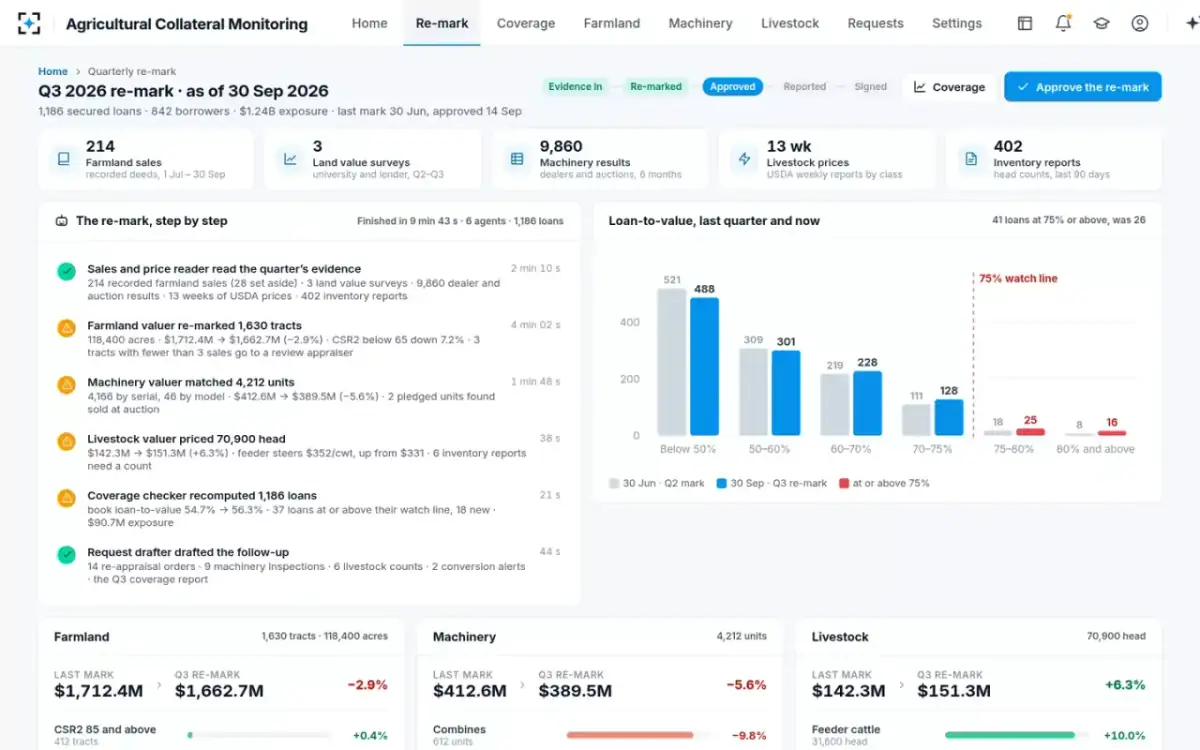
Its work is mostly subtraction. Of 214 recorded farmland sales in the quarter, 28 were set aside: transfers within a family, sales of farms carrying a building site and grain bins, parcels sold with a crop already in the ground, auction results that could not be tied to a recorded deed. The two exclusions that mattered most on one Hardin County tract were a family transfer at $10,900 an acre and a farm with a building site at $11,400, against four arm's-length sales at $7,640 to $8,310.
The limit written into this agent is that it will not use a sale it cannot tie to a recorded deed. That is deliberately strict and it costs coverage: a genuine arm's-length sale that has not been recorded yet is excluded along with the noise. Strictness is the right trade here, because a value's defensibility depends on every comparable being checkable by someone else months later.
On machinery and livestock the same agent reads dealer and auction results and weekly market prices, and the filter is different in kind: a result is admissible when it identifies the machine well enough to match, or the class and weight well enough to price. A lot described as "JD combine, runs good" is not evidence of anything.
The farmland valuer: sales comparison, never an appraisal
The farmland valuer re-marks each pledged tract from the admitted sales, adjusted toward the subject for date, soil rating, size and drainage, and then shows its work. On the sample book's hardest tract — 320 acres of CSR2 61 creek-bottom ground, part of it untiled — four sales within twelve miles indicated $7,950 an acre against a 2023 appraisal's $9,250, a fall of 14.1%. The tract's prior appraisal had rested on 2022 sales, so the value in the file was describing a market two turns old.
Two limits sit on this agent. It never calls its output an appraisal, and where a tract's value rests on fewer than three comparable sales it does not publish a number at all: the tract goes to a review appraiser. Three tracts of 1,630 crossed that line in the quarter, which is a workload rather than a queue.
The second limit is the one that keeps the first honest. An agent that quietly lowered its evidence standard when sales were scarce would produce a full book of values every quarter and a thin file behind its hardest tracts — exactly the loans where the value matters most.
Events or economic changes may cause farm and ranch real estate values to fluctuate subsequent to the bank's valuations. When this occurs, prudent risk management may require updated collateral valuations.
OCC, Comptroller's Handbook — Agricultural Lending, version 1.4
The machinery valuer: matched by serial, never above condition
Machinery is the class where matching does most of the work. A 2022 Class 9 combine and a 2021 Class 8 are different markets, and within a model the hours decide the number. The machinery valuer matches each pledged unit to dealer and auction results by make, model, year, hours and serial number, and 4,166 of 4,212 pledged units matched in the quarter.
Its hard limit is that it never values a unit above its last inspected condition. When a borrower's separator hours have not been reported since January, the agent holds the value at the condition last observed rather than marking the machine up on a general trend. That is a deliberately conservative asymmetry: good news needs an inspection, bad news does not. The Comptroller's Handbook sets the same expectation for the human version of the task — "Non-real estate collateral supporting term debt should be inspected and valued periodically. Collateral condition and marketability should be included in the inspection documentation."
The 46 units that did not match are as interesting as the 4,166 that did. Some are specialised machines with no comparable sale in six months. One, on the sample book, matched a sale result rather than a listing: a 24-row planter whose serial appeared in an auction house's results for $148,500, on a security agreement schedule, with no release asked for. That finding is not a valuation at all — it is a different kind of problem, taken up in what an undetected drop in farm loan collateral costs a lender.
The quarterly run, pass by pass
The livestock valuer: counts tied to deposits
Livestock is priced the most easily and counted the least reliably. Weekly market reports give a defensible price per hundredweight by class and weight. What they cannot give is how many head are actually in the lot, and that number comes from the borrower.
So this agent's limits are about the count rather than the price. It never values livestock it has no report or count for — an inventory report older than ninety days produces a count request to the loan officer, not an assumed herd. And a fall in head count passes only when a sale matches a deposit: 110 head sold on 18 September tied to a $271,800 deposit in the operating account, so the smaller herd is explained. A drop with no matching deposit is an exception, not an update.
That rule catches the single most common way a livestock-secured line goes wrong, which is not fraud but drift: cattle sold through the season, proceeds spent on inputs, and a borrowing base that nobody re-cut. The agent cannot stop any of it. It can make sure the quarter's numbers say so out loud.
The coverage checker: recomputes, never re-rates
The fifth agent does the arithmetic nobody argues about and stops precisely where arguments begin. It recomputes loan-to-value for every loan and every relationship on the new values, tests each against its watch line — 75% on farmland, 80% on machinery and livestock at the sample lender — and ranks the result. In the quarter, 37 loans sat at or above a watch line against $90.7 million of a $1.24 billion book, 18 of them new.
Its limit is the shortest of the six and the most important: it never changes a risk rating or a loan's terms. A thinner cushion is an input to a rating decision, not the decision. Ratings are approved by credit officers against a rating definition that weighs repayment capacity, management and the operation's own trend, and a collateral number that re-rated loans by itself would be making a credit decision from one variable.
There is also a practical reason. A book where ratings move automatically each quarter on collateral prices produces rating migration that reflects the land market rather than credit quality, and an examiner reading that migration would learn nothing from it.
The request drafter: drafts, never sends
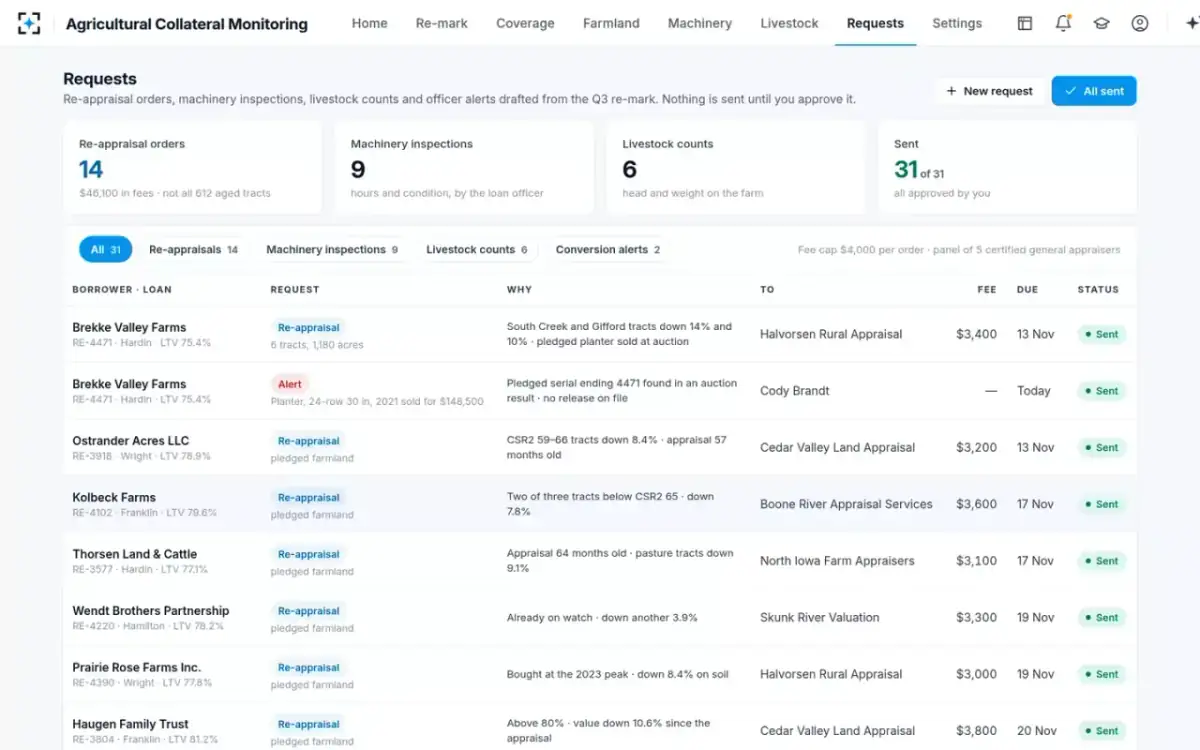
The sixth agent writes: re-appraisal orders to panel appraisers, machinery inspections and head-count requests for loan officers, conversion alerts where a pledged serial number has turned up in sale results, and the quarterly coverage report itself. In the quarter it drafted 31 items — 14 orders carrying $46,100 of fees, 9 inspections, 6 counts and 2 alerts.
It sends none of them. Every draft waits for the Rural Appraisal Manager, and the ones that carry a fee above the bank's $4,000 cap wait for the Chief Credit Officer instead. The order, the recipient, the scope and the fee are all written; the decision to incur them is not.
Drafting is where an agent earns its keep without taking a decision, because most of the cost of a re-appraisal order is not the fee. It is assembling the tract list, the acreage, the last appraisal date, the soil ratings and the reason this tract and not the next one: mechanical work, repeated for every order, and none of it judgement.
What the sixth agent wrote, after a person approved it
What may none of the six agents ever do?
None of the six may approve a value, change a risk rating or a loan's terms, send anything to an appraiser, a borrower or a loan officer, describe its output as an appraisal, incur a fee above the bank's cap, use a sale it cannot tie to a recorded deed, value a machine above its last inspected condition, or count livestock it has no report for. The list is short enough to put on one page and specific enough to test.
The six agents, and the limit written into each
| Agent | What it does | What it may never do | What happens instead |
|---|---|---|---|
| Sales and price reader | Reads recorded sales, land value surveys, dealer and auction results, market reports and inventory reports | Use a sale it cannot tie to a recorded deed; treat a family transfer as arm’s-length | The sale is set aside and listed as set aside, with the reason |
| Farmland valuer | Re-marks each tract by sales comparison, adjusted for soil, size, drainage and date | Replace an appraisal; publish a value resting on fewer than three comparable sales | The tract goes to a review appraiser — three of 1,630 in the quarter |
| Machinery valuer | Matches each pledged unit to dealer and auction results by make, model, year, hours and serial | Value a unit above its last inspected condition | The value is held at last inspected condition and an inspection is drafted |
| Livestock valuer | Prices each head count by class and weight at weekly market prices | Count livestock it has no report or count for; pass a drop with no matching deposit | A count request is drafted, or the drop is raised as an exception |
| Coverage checker | Recomputes loan-to-value for every loan and relationship and ranks the watch list | Change a risk rating or a loan’s terms | The loan is listed with its reason; the rating decision stays with credit |
| Request drafter | Writes orders, inspections, counts, alerts and the quarterly report | Send anything without approval; incur a fee above the cap | The draft waits for the manager, or for the Chief Credit Officer above the cap |
Is AI allowed to value agricultural real estate collateral?
For monitoring purposes, yes, within the evaluation lane and under the conditions the agencies set: the method must produce a market value with sufficient information and analysis behind it, the evaluation must be performed by someone independent of loan production, and the file must show the analysis rather than the conclusion. Where the transaction requires an appraisal, no tool substitutes for a State certified or licensed appraiser.
Who may perform an evaluation is the part most often skipped. For Farm Credit System institutions, valuations of personal property and of real property that falls inside the rule's exemptions "shall be performed by qualified individuals who meet the established standards of this subpart and the Farm Credit System institution obtaining the collateral valuation" (12 CFR 614.4260(a)). An agent is not a qualified individual; the qualified individual is the person who sets the standards it runs under and approves the output. That is a real distinction, and it is the reason the approval step is a named person rather than a status field.
Commercial banks sit under the interagency guidelines and their own appraisal regulation rather than this rule, but the structure is identical: a documented method, an independent valuation function, and a person who owns the result.
What an agent proposes, and what the manager decides
The agent produces: An indicated value per acre with the sales used, their adjustments, and the sales set aside with reasons.
The person decides: Whether the evidence carries it, or the tract goes to a review appraiser.
The agent produces: A matched value by serial, held at last inspected condition where hours are stale.
The person decides: Whether to order an inspection now or carry the held value another quarter.
The agent produces: The recomputed loan-to-value, the reason, the last valuation date and the action drafted.
The person decides: Whether the loan needs a re-appraisal, a conversation, or nothing this quarter.
The agent produces: The appraiser, the tracts, the acreage, the scope note and the quoted fee.
The person decides: Whether to spend it — and above the cap, that decision moves up a level.
The agent produces: Nothing. The agents do not propose ratings.
The person decides: Credit management, on the bank’s rating definitions.
Why does an examiner want the limits written down?
Because a limit that lives in someone's understanding of the system cannot be tested, and an examiner's whole method is testing. A written limit can be read, sampled against the quarter's output and falsified: if the rule says no value rests on fewer than three sales, pull twenty values and count the sales. If the rule says nothing is sent before approval, pull the sent items and match them to approvals. If the rule says ratings do not move on collateral alone, pull the quarter's rating changes and look for one with no credit memorandum behind it.
The second reason is drift. A valuation program is a set of settings — watch lines, the comparable-sale radius and window, the minimum number of sales, the fee cap — and settings change. When they are written and versioned, a value can be read against the rules in force on the day it was produced. When they are not, this quarter's rules are applied retrospectively to last year's file, which is how a defensible decision becomes an indefensible one without anybody doing anything wrong.
The external conditions give the point some urgency. The Federal Reserve Bank of Chicago's August 2026 survey of District agricultural bankers reported that "the amount of collateral required by lenders across the District was higher than a year ago" (AgLetter, August 2026). When lenders ask for more collateral, the quality of the valuation behind each pledge becomes the thing that actually carries the credit.
What a fee cap routes to a human
The fee cap is the smallest rule in the system and the clearest illustration of how the limits are meant to work. A re-appraisal order at or below $4,000 is approved by the Rural Appraisal Manager. Above it, the order is routed to the Chief Credit Officer. Nothing is blocked; the decision simply moves to the person whose budget it is.
That is the pattern worth copying. Each of the six limits has a route attached: a sale that fails the arm's-length test is set aside and listed, a tract with thin support goes to a review appraiser, a machine with stale hours is held and an inspection is drafted, a herd with no recent report produces a count request. None of them ends in a refusal, and none of them ends in the system deciding anyway.
Five questions to ask of any agent that touches collateral value
- What is the one job?
An agent that reads evidence, values three asset classes and writes letters has no testable limit, because every failure looks like a different failure.
- What may it never do, in writing?
The limit has to be specific enough to sample against the quarter’s output, not a statement of intent.
- Where does a blocked case go?
A limit with no route produces a gap in the book. A limit that routes produces a short queue for a person.
- Who approves, by name?
Approval by a role is approval by nobody. The sample lender’s values are approved under the manager’s own name, and the audit trail carries it.
- Is the setting versioned?
A value has to be readable against the rules that were in force when it was produced, not the rules in force when it is questioned.
Six narrow agents and one approver is a slower design than one capable assistant with access to the loan system, and it is slower on purpose. To watch the six run against a quarter's evidence, and to see where the approval sits, start from Agricultural Collateral Monitoring. Who holds each of those approvals, and what the examiner asks of them, is set out in who watches a farm loan book's collateral.
Questions people ask
Can an AI agent change a loan's risk rating?
Not in this design, and it is the limit worth insisting on. The coverage checker recomputes loan-to-value, tests the watch lines and ranks the result; the rating decision stays with credit management on the bank's own rating definitions. A collateral value is one input to a rating that also weighs repayment capacity, management and the operation's trend, and a book whose ratings moved automatically with the land market would produce migration that tells an examiner nothing.
How does AI match machinery to auction results?
By identity first and price second: make, model, year, engine or separator hours, and serial number where the sale result carries one. On the sample book 4,166 of 4,212 pledged units matched dealer and auction results in a quarter. The unmatched remainder is informative — specialised machines with no comparable sale in six months stay at their last value, and a pledged serial that appears in a sale result rather than a listing raises an alert instead of a value.
How does AI price livestock collateral?
By class and weight against the week's published market prices, applied to the borrower's own latest inventory report. The price is the easy half. The count is the hard half, so the rule is that no head is valued without a report or count behind it, a report older than ninety days produces a count request, and a fall in head count passes only when a reported sale matches a deposit in the operating account.
What happens when a value can't be confirmed from a sale?
It is routed rather than guessed. A farmland value resting on fewer than three comparable arm's-length sales goes to a review appraiser. A machine whose hours have not been reported is held at its last inspected condition and an inspection is drafted. A herd with no recent inventory report produces a count request. In each case the quarter's output says what was held and why, which is more useful to a credit committee than a complete book of equally confident numbers.
What stops an agent from replacing an appraisal?
The rules, first: where a transaction requires an appraisal, only a State certified or licensed appraiser can perform it, and no analytical method changes that. The design, second: the farmland valuer's output is labelled an evaluation for monitoring, the signature on the quarterly report repeats the qualification, and when a value falls far enough or an appraisal ages past the bank's trigger the system drafts an order to a panel appraiser rather than standing in for one.
Who approves what the agents find?
The Rural Appraisal Manager, under her own name, for the quarter's values and for every order, inspection, count and alert that follows from them — except orders carrying a fee above the bank's cap, which go to the Chief Credit Officer. The quarterly coverage report is then signed by both. Nothing in the quarter's thirty-one requests left the building before a person approved it.