Four people monitor a farm loan book's collateral, and the line between them is the control an examiner tests first: an ag loan officer who knows the borrower and inspects what is pledged, a Rural Appraisal Manager who owns the value that goes into the file, a review appraiser who takes the tracts whose evidence is thin, and a Chief Credit Officer who signs the quarterly report before the board's risk committee reads it. The work is hard because three kinds of collateral move on different clocks and far outnumber the people who could re-mark them by hand. Botminds' Agricultural Collateral Monitoring re-values every pledged tract, machinery unit and head of livestock each quarter and drafts what should follow — but it decides nothing: each of the four seats keeps exactly the judgement it owned before.
The lender on this page is fictional: Ridgefold Agricultural Credit, 1,186 secured loans to 842 borrowers across central Iowa, as it appears in the solution's sample data. The people are characters. The rules, wages and regulators' sentences are real and linked where they appear.
One quarter's collateral review, and how many hands it passes through
1,186loans
loan-to-value recomputed in one run, on 1,630 tracts, 4,212 machinery units and 70,900 head
4seats
people with a decision in the quarter: officer, manager, review appraiser, credit officer
31
orders, inspections, counts and alerts drafted — none sent before a person approved them
2signatures
on the coverage report that goes to the board’s risk committee
Four people, one quarterly re-mark
A farm loan book is secured by land that is appraised at origination and often not again for years, by machinery valued when the operating line renews, and by livestock counted when the borrower reports. Keeping those values current is not one job. It is four decisions taken in sequence, and each one belongs to a different person for a reason that predates any software.
The ag loan officer decides what is actually there: the head count, the condition of the planter, whether the borrower still farms the rented quarter. The Rural Appraisal Manager decides what it is worth and what evidence is good enough to say so. The review appraiser decides whether a value built on two sales can stand. The Chief Credit Officer decides whether the book's position, taken together, is one the bank will report and act on. Collapse any two of those into one seat and the file gets easier to produce and harder to defend.
The same quarter, from each of the four seats
Today
Learns a pledged planter was sold when the borrower happens to mention it, usually at renewal.
With agents
Gets the sale, the lot, the amount and the schedule line, and knows what to ask for: the proceeds, or a replacement unit pledged in its place.
Still theirs: Owns the borrower relationship and every conversation about it
Today
Half the values in her files are older than the land market’s last turn, and she cannot re-mark the book by hand.
With agents
Re-marks every tract, unit and head each quarter and orders re-appraisals where the cushion actually thinned, not everywhere it aged.
Still theirs: Owns the value in the file and approves every order that leaves the desk
Today
Receives a number with no comparable sales behind it and no way to test it.
With agents
Receives the sales used and the sales set aside, with their adjustments, and reviews only the tracts whose support is thin.
Still theirs: Owns the judgement on evidence that will not carry a value
Today
Hears that land dipped three percent, not which loans lost their cushion.
With agents
Signs a report that names every loan at or above its watch line, with what has been ordered for it.
Still theirs: Owns the second signature, and any fee above the cap
The Rural Appraisal Manager: owns the number
The Rural Appraisal Manager is the seat the whole quarter turns on. She owns the value that goes into the credit file for every pledged tract, every machinery unit and every head, and she owns the consequence of that value being wrong in either direction. Too high and the bank is lending against a cushion that is not there. Too low and a sound borrower is pushed onto a watch list, re-appraised at the bank's cost and told their operation has weakened when it has not.
What she does not own is the credit decision. That separation is the point of the seat, and the Farm Credit Administration writes it into its own rule for System institutions in plain terms: evaluations of real property that serve as the primary security for a loan must be performed by a qualified real estate appraiser who has "no direct or indirect interest, financial or otherwise, in the loan or subject property and is not engaged in the marketing, lending, collection, or credit decision processes" of the institution making the loan (12 CFR 614.4255(c)). A commercial bank is not under that rule, but it is under the same idea, expressed by the five federal banking agencies together.
The collateral valuation program is an integral component of the credit underwriting process and, therefore, should be isolated from influence by the institution's loan production staff.
Interagency Appraisal and Evaluation Guidelines, December 2010
Read that sentence as a job description and the Rural Appraisal Manager's reporting line matters as much as her qualifications. If she reports to the head of lending, her independence is a matter of character rather than structure, and an examiner will say so. If she reports through credit risk, the structure does the work and nobody has to be brave.
Who approves a farm loan's collateral value?
At a bank with a properly separated valuation function, a farm loan's collateral value is approved by the person who owns the valuation program — here, the Rural Appraisal Manager — and never by the loan officer who made the credit or the relationship manager who will renew it. The approval is a named act by a named person, not a system output, and it is what makes the number usable in a credit file, a watch list or a regulatory report.
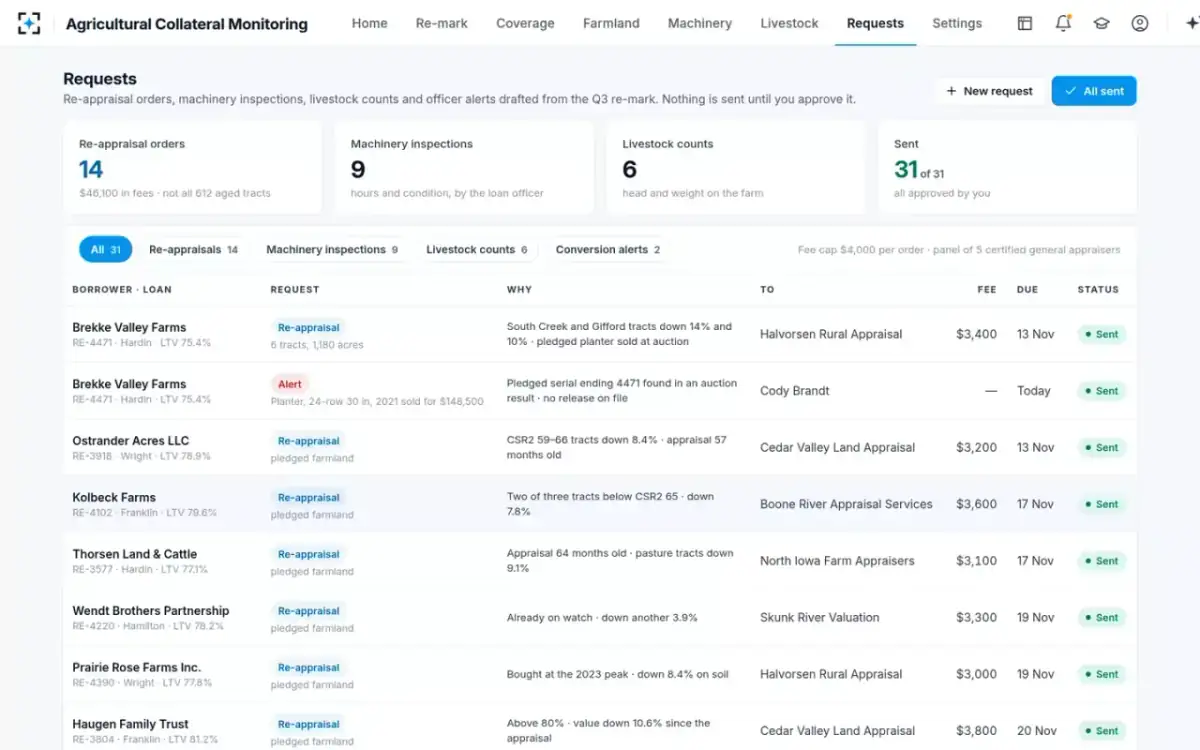
In practice that approval has three parts. First, she accepts or rejects the evidence behind each class of collateral: the recorded, arm's-length sales behind a farmland value, the dealer and auction results behind a machine, the weekly market prices and the borrower's own count behind a herd. Second, she decides which values need more than the evidence can carry and sends those to a review appraiser. Third, she approves what follows from the new numbers — the re-appraisal orders, the inspection and count requests, the alerts to loan officers — before any of them leaves the building.
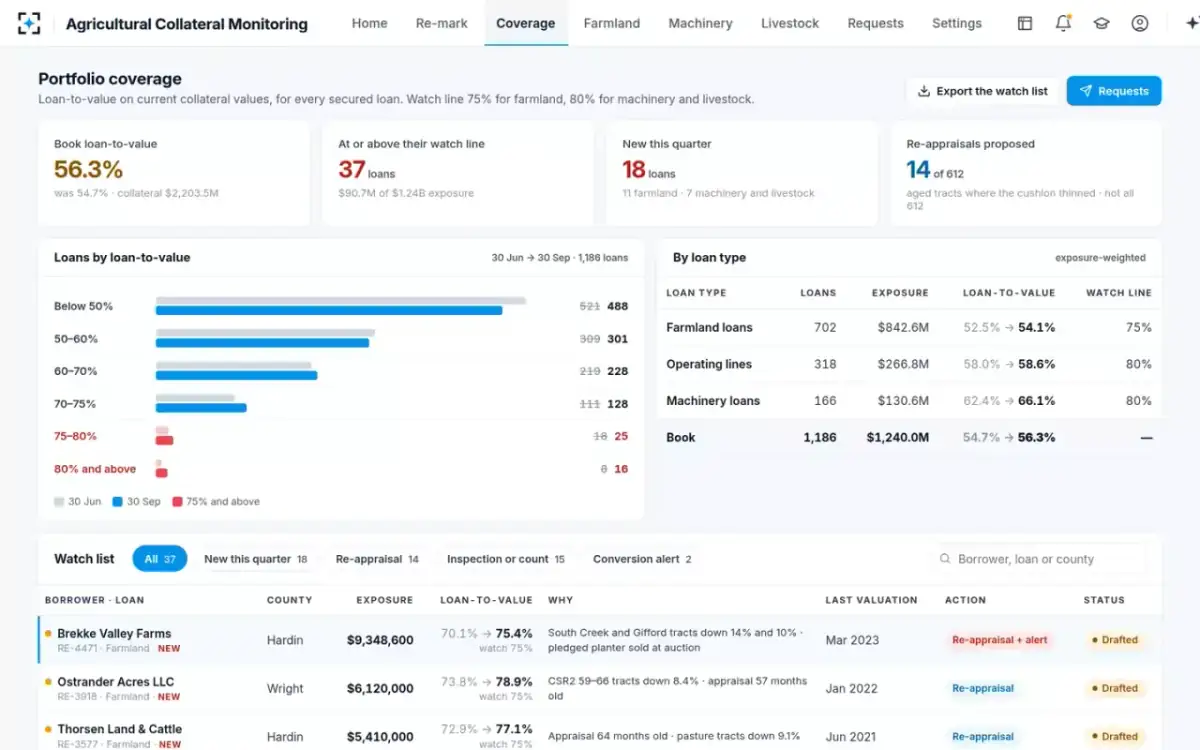
The reason the third part is an approval and not a formality is cost and relationship. A re-appraisal order is a bill the bank pays and a message the borrower receives. At the sample lender, fourteen orders to five panel appraisers came to $46,100 in fees in one quarter, against 612 tracts whose last appraisal was more than three years old. Ordering all 612 would have been defensible and ruinous; ordering none would have been cheap and indefensible. Choosing the fourteen is the job.
What she approves from: the book's coverage, loan by loan
The review appraiser: the second eyes on thin evidence
A review appraiser is a certified general appraiser whose job inside a lender is not to produce values but to test them. In collateral monitoring the trigger is evidence, not size: a tract whose re-mark rests on fewer than three comparable arm's-length sales goes to the review appraiser whatever it is worth, because a value supported by two sales is an opinion wearing a number's clothes.
That threshold is a policy setting rather than a legal line, and it is worth understanding why three is a common choice. Sales comparison works by adjustment: each comparable sale is moved toward the subject for date, soil, size, drainage and improvements. With three or more sales, the adjusted indications can be reconciled and an outlier shows itself. With two, there is nothing to reconcile, and with one the "comparison" is a sale price with arithmetic applied to it. At the sample lender, three tracts of 1,630 crossed that line in a quarter — a workload a single review appraiser can carry, which is the other half of a usable rule.
The review appraiser's second function is to judge what was thrown away. On one Hardin County tract, four arm's-length sales within twelve miles supported $7,950 an acre, while two higher sales were set aside: a transfer within a family at $10,900 and a farm carrying a building site and grain bins at $11,400. Both exclusions are defensible and both are judgements. A reviewer who sees only the four sales used cannot check the judgement that produced them, which is why the sales set aside and the reason for each belong in the file. The same discipline separates a monitoring value from an appraisal, a distinction worked through in evaluation or appraisal, and what makes a farm collateral file defensible.
The ag loan officer: the one who calls the borrower
The ag loan officer is the only seat with a telephone number. Everything the quarterly re-mark produces that needs a human conversation — a machinery inspection, a head count, a question about a unit that appears to have been sold — reaches the borrower through this person, and nothing else should.
That is a deliberate narrowing of the role, not a demotion of it. The officer still carries the inspection and verification work that no price source can do: confirming that the cattle are in the lot, that the separator hours on a combine are what the borrower reports, that stored grain is where the warehouse receipt says it is. The Comptroller's Handbook is specific that this work is observed rather than inferred, and that it is better done without notice. "As with any confirmation process, greater credibility is placed on the results of inspections that are conducted unannounced," the agricultural lending booklet says (OCC, Agricultural Lending, version 1.4).
What the officer does not do is set the value that results from their own inspection. The handoff is the control: the officer reports condition, hours and counts; the manager prices them. When a pledged serial number turns up in auction results with no release asked for, the alert goes to the officer with the lot, the date and the amount already attached, and the officer's job is the call, not the conclusion. What that call is about, legally, is set out in when a buyer takes pledged farm collateral free of your lien.
The Chief Credit Officer: the second signature
The Chief Credit Officer signs the quarterly coverage report after the Rural Appraisal Manager has signed it, and the order matters. The first signature says the values were prepared and reviewed and that they are evaluations for monitoring rather than appraisals. The second says the bank accepts the resulting picture of its own book and the actions attached to it.
The Chief Credit Officer also owns one exception that keeps the approval rail honest. The bank sets a cap on what a re-appraisal may cost — $4,000 at the sample lender — and any order above it is routed to the Chief Credit Officer rather than approved by the manager. That is not a trust mechanism. It stops the valuation function from quietly buying its way out of a hard tract, and it puts the one decision with a real budget consequence in front of the person who owns the budget.
Who inspects, who values, who approves and who signs, by collateral class
| Collateral class | Evidence comes from | Who inspects or verifies | Who sets the value | Who approves | Who signs |
|---|---|---|---|---|---|
| Farmland | Recorded arm’s-length sales, soil ratings, land value surveys | Review appraiser on thin support; panel appraiser on a re-appraisal order | Rural Appraisal Manager | Rural Appraisal Manager | Manager, then Chief Credit Officer |
| Machinery and equipment | Dealer and auction results matched by make, model, year, hours and serial | Ag loan officer, by inspection | Rural Appraisal Manager | Rural Appraisal Manager | Manager, then Chief Credit Officer |
| Livestock | Weekly market prices by class and weight, borrower inventory reports | Ag loan officer, by count | Rural Appraisal Manager | Rural Appraisal Manager | Manager, then Chief Credit Officer |
| A re-appraisal order within the fee cap | The watch line and the age of the last appraisal | — | — | Rural Appraisal Manager | — |
| A re-appraisal order above the fee cap | The same, plus the quoted fee | — | — | Chief Credit Officer | — |
| The quarterly coverage report | Every approved value in the quarter | — | — | Rural Appraisal Manager | Manager, then Chief Credit Officer |
Why the examiner wants separation of duties
Bank examiners do not treat collateral valuation as a measurement problem. They treat it as an incentive problem, because the person most motivated to see a high value is the person whose loan depends on it. Every rule in this area is a version of that one observation.
The Comptroller's Handbook states the ag-specific form of it directly: "An inspection and reevaluation should be performed by a qualified person other than the lending officer responsible for the credit decision" (OCC, Agricultural Lending). The interagency guidelines generalise it to the whole valuation program and add the structural half: the people who administer that program should sit on a reporting line of their own, outside the lending side of the house.
The reason this matters more in agricultural lending than in most other secured lending is the evidence itself. Farmland trades thinly: a county may record only a handful of qualifying arm's-length sales in a quarter, and the adjustments applied to them are matters of judgement about soil, drainage and tiling. Machinery values turn on hours and condition that someone has to observe. Livestock is counted. In each case the number depends on a human choice about what to admit as evidence, and a choice made by an interested party is not evidence at all.
Can the same person inspect collateral and approve the loan?
As a rule, no — and where it cannot be avoided, the bank is expected to compensate for it rather than ignore it. The handbook's own answer is the honest one for a small lender: "When such a separation of duties is impossible or impractical, every effort should be made to periodically reaffirm inspection results by independent means."
It then names the means banks actually use: "periodically rotating inspection duties among bank personnel other than the primary lending officer, using outside directors as inspectors/reappraisers, and contracting the services of an independent third party." A dual inspection — the servicing officer and an independent inspector at the same time — is offered as an effective control where it is feasible.
Two things follow for a lender too small to staff four distinct seats. First, the compensating control has to be written down and performed on a schedule, because an examiner will ask when it last ran, not whether it exists in principle. Second, the one separation that is hardest to compensate for is the valuation approval itself. Rotating who walks the lot is straightforward; rotating who decides what a tract is worth, on a book where the same officer originated most of it, is not.
What does a rural appraisal manager do all quarter?
A rural appraisal manager runs a valuation program rather than producing appraisals: she sets the evidence rules, approves the values that go into credit files, orders re-appraisals where monitoring is no longer enough, manages the panel of appraisers who perform them, and reports the book's collateral position to credit management each quarter. On a book of a thousand-plus secured loans, that is a continuous cycle rather than a quarterly event.
The quarter has a shape. Evidence accumulates: recorded sales, dealer and auction results, weekly price reports, borrower inventory reports. On the re-mark date every pledged item is re-valued against it and loan-to-value is recomputed for every loan and every relationship. Then the exceptions arrive — the tracts with thin support, the loans that crossed a watch line, the serial numbers that appeared in sale results, the inventory reports older than ninety days — and the manager works them. Last comes the report, and with it the two signatures.
One quarter, from evidence to two signatures
Agent
Evidence readRecorded sales, dealer and auction results, weekly market prices and borrower inventory reports are gathered and the non-arm’s-length sales flagged.
Never: Never uses a sale it cannot tie to a recorded deed
Agent
The book re-valuedEvery pledged tract, machinery unit and head is re-priced against the quarter’s evidence, class by class.
Never: Never replaces an appraisal
Agent
Coverage recomputedLoan-to-value is recomputed for every loan and relationship and tested against the watch lines.
Never: Never changes a risk rating or a loan’s terms
A person decides
Review appraiserTakes the tracts whose support is thin — fewer than three comparable sales — and decides whether the value stands.
Agent
Requests draftedRe-appraisal orders, machinery inspections, livestock counts, conversion alerts and the quarterly report are written.
Never: Never sends anything before the manager approves it
A person decides
Rural Appraisal ManagerApproves the quarter’s values under her own name, then approves each order, inspection, count and alert — and routes any fee above the cap upward.
A person decides
Ag loan officerMakes the calls: the inspections, the counts, and the conversation about a unit that has been sold.
A person decides
Chief Credit OfficerSigns the coverage report second, and it goes to the board’s risk committee.
Who signs the coverage report, and why two signatures?
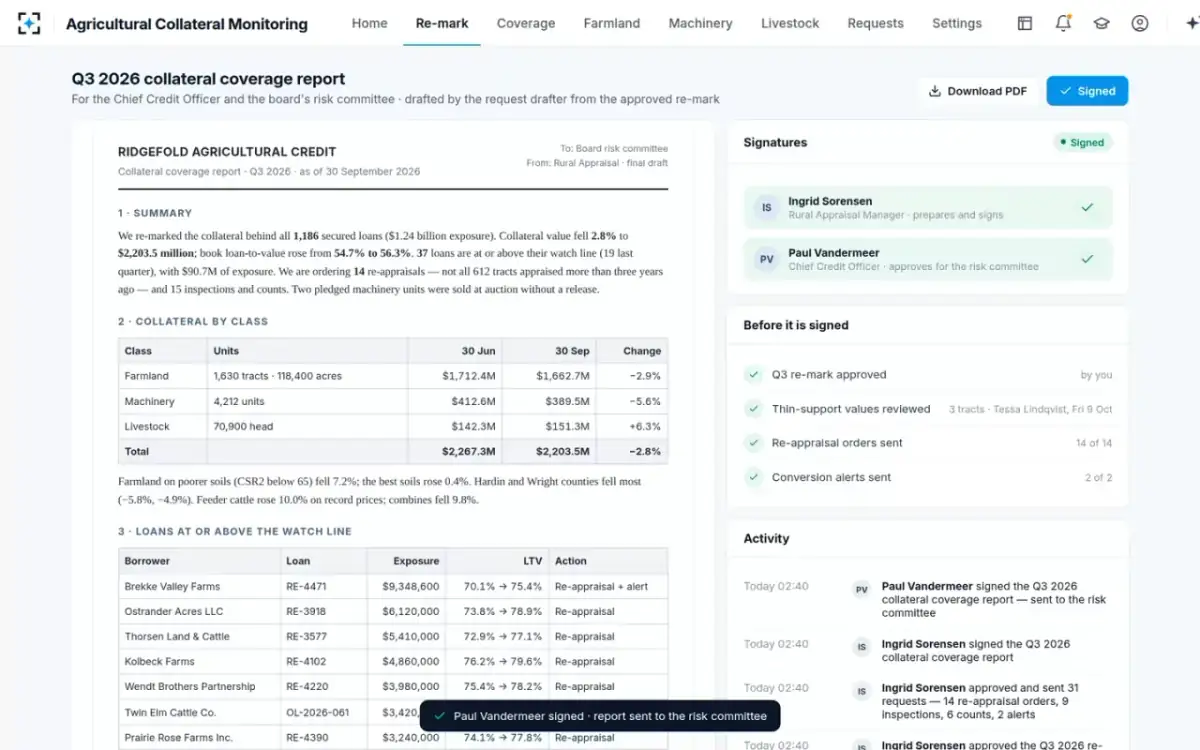
The quarterly coverage report is signed twice: by the Rural Appraisal Manager, who prepared and reviewed the values, and by the Chief Credit Officer, who accepts them on behalf of credit management before the board's risk committee sees them. Two signatures are not ceremony. They record two different assertions, and separating them is what lets either be relied on.
The first signature carries a meaning the bank writes down: prepared and reviewed, and these values are evaluations for monitoring, not appraisals. That qualification is the single most important sentence on the report, because it tells every later reader — a credit committee, an examiner, a successor — exactly how much weight the numbers can take. The second signature says the picture has been accepted and the actions attached to it are management's.
What makes the pair meaningful is that the second signer can decline. A Chief Credit Officer who signs whatever arrives has added a line, not a control. The useful version is a short list of checks performed before signing: that every value at or above a watch line has an action against it, that the exceptions routed above the fee cap were actually decided, and that the report's own population matches the loan system's.
The quarter's requests, after approval
Two signatures, and what each one means
Where the four seats hand off to each other
Most of what goes wrong in collateral monitoring happens at a handoff rather than inside a seat. There are four of them, and each has a characteristic failure.
Officer to manager: condition and counts arrive late, or not at all. The sample lender's own quarter shows the shape of it — separator hours on a borrower's combines not reported since January, so the machines were held at their last inspected condition rather than marked up. Holding is the right answer; the cost is a value that is deliberately stale and has to be flagged as such.
Manager to review appraiser: the trigger is set so wide that the reviewer becomes a rubber stamp, or so narrow that nothing reaches them. Three tracts a quarter is a workload; three hundred is a queue nobody reads.
Manager to officer: an alert that arrives without the facts the officer needs to make the call. A conversion alert that says "possible sale" produces a confused phone call; one that gives the auction house, the lot number, the date, the amount and the schedule line produces a specific question with two acceptable answers.
Manager to Chief Credit Officer: a report that shows an average instead of a list. A book that fell 2.8% tells the risk committee nothing it can act on. Thirty-seven named loans at or above their watch lines, eighteen of them new this quarter, each with an action, is a document the committee can question. The difference that makes to the numbers themselves is the subject of why farmland, machinery and cattle do not lose their cushion together.
What the market pays the seat that makes the call
$76,690
median annual wage for loan officers, May 2025
283,000jobs
loan officers employed in the United States, 2025
1%
projected change in loan officer employment, 2025 to 2035 — slower than the average occupation
Those numbers are worth a moment because they explain the shape of the problem this page describes. The occupation is not growing. A book of 1,186 secured loans, 1,630 tracts, 4,212 machinery units and 70,900 head cannot be re-marked each quarter by adding seats, because the seats are not being added anywhere. What can change is how much of the quarter each seat spends on arithmetic and evidence-gathering rather than on the decision only that seat can make.
A short test of your own separation of duties
- Does the person who approves collateral values report outside loan production?
- Can the officer who originated a credit change the value in its file?
- Is the trigger that sends a value to a review appraiser written down, and did it fire this quarter?
- Where separation is impractical, what is the compensating control, and when did it last run?
- Who may approve a re-appraisal fee, and what is the cap above which it goes higher?
- Does the quarterly report name the loans at or above a watch line, or only the book average?
To see the four seats, the handoffs and the two signatures on one quarter's run, start from Agricultural Collateral Monitoring.
Questions people ask
What does an agricultural loan officer do?
An ag loan officer originates and services farm and ranch credit: analysing the operation, structuring the operating line and term debt, inspecting and verifying pledged collateral, and keeping the borrower relationship through the season. In a lender with a properly separated valuation function, the officer reports what is there — condition, hours, head counts — but does not set the value that results from their own inspection. The Bureau of Labor Statistics puts loan officers' median annual wage at $76,690 in May 2025, across all sectors.
Who approves a farm loan's collateral value?
The person who owns the bank's collateral valuation program, typically a rural appraisal manager or collateral valuation officer, and never the loan officer who made the credit. The 2010 interagency guidelines say the valuation program "should be isolated from influence by the institution's loan production staff", and the Farm Credit Administration's rule for System institutions goes further for real property, requiring an appraiser with no interest in the loan who is not engaged in lending, collection or credit decisions.
What does a review appraiser do for a bank?
A review appraiser tests values rather than producing them: whether the comparable sales used were arm's-length and genuinely comparable, whether the adjustments are supported, and whether the sales set aside were rightly excluded. In collateral monitoring the usual trigger is thin evidence — a value resting on fewer than three comparable sales — because with two sales there is nothing to reconcile and no way for an outlier to reveal itself.
Can the same person inspect collateral and approve the loan?
Not as a rule. The OCC's agricultural lending booklet says the inspection and reevaluation "should be performed by a qualified person other than the lending officer responsible for the credit decision", and where that is impossible or impractical it expects the bank to reaffirm inspection results by independent means — rotating inspection duties, using outside directors, contracting a third party, or running a dual inspection. The compensating control has to be scheduled and documented, not merely intended.
Who decides if a farm loan needs a new appraisal?
The valuation function decides, on written triggers rather than case by case. A common pair is age plus exposure — an appraisal older than thirty-six months on a loan at or above its watch line — together with a fall in value of ten percent or more. The point of writing the triggers down is that they fire on the loans that need them rather than on the loans somebody remembered, and that the fourteen orders placed can be explained alongside the six hundred not placed.
What does a chief credit officer check before signing?
That every loan at or above a watch line has an action against it; that exceptions routed above the fee cap were actually decided rather than left pending; that the report's loan population reconciles to the loan system; and that the values are described for what they are, evaluations for monitoring rather than appraisals. A second signature is only a control if the second signer can decline to give it.