The cost of farm loan collateral deterioration is not one number, which is why it is so often left out of the business case. It arrives as a cascade. A loan crosses its watch line and nobody looks for a quarter. A pledged machine is sold at auction, no release is asked for and the proceeds go to the operating account rather than the line. A borrower files, and the bank's secured position is whatever the file can prove on the day. Each stage costs more than the one before it, and the only variable a lender actually controls is how early the first one is caught. Botminds' Agricultural Collateral Monitoring exists to move that moment from the renewal to the quarter.
The worked figures below come from a fictional lender's sample book — Ridgefold Agricultural Credit, $1.24 billion of exposure across 1,186 secured loans in central Iowa — and are labelled where they do. The external figures are from the federal courts and two Federal Reserve Banks, linked where they appear.
One quarter's findings on a $1.24 billion ag book
37loans
$90.7M of exposure at or above a watch line after the quarter’s re-mark — 18 of them for the first time
$189,500
in sale proceeds from two pledged machines sold at auction with no release asked for
612tracts
whose last appraisal was more than three years old, of which 14 were re-ordered
1quarter
between a cushion thinning and the lender seeing it, instead of waiting for the renewal
A cascade, not a single number
Credit losses on farm loans are rarely caused by a surprise. They are caused by a known weakness that stayed invisible for one cycle too many, and the mechanism is almost always the same: the value in the file stopped describing the collateral, and nothing in the calendar forced anyone to notice.
Three kinds of ag collateral make this easy. Farmland is appraised at origination and often not again for years. Machinery is valued when the operating line renews. Livestock is counted when the borrower reports. The file is therefore accurate on the day each document is written and decays from that day forward, at different rates, in different directions, for each of the three.
What makes the decay expensive is that it compounds with the borrower's own position. A thinned cushion on a sound operation is an observation. The same cushion on an operation whose repayment capacity is weakening is the difference between a workout that recovers and one that does not — and the second condition is exactly when a borrower is least likely to volunteer that the planter has been sold.
The cascade, stage by stage, and what each one costs
| Stage | What has happened | What it costs | What would have caught it |
|---|---|---|---|
| One · a missed quarter | A loan crossed its watch line and nobody looked. The cushion is thinner than the file says. | The cost of the re-appraisal that should have been ordered, plus one quarter of optionality — the structural conversation not had while the borrower still had room. | A quarterly re-mark with a watch line and a written trigger. |
| Two · an unreleased sale | Pledged machinery or livestock has been sold. No release was asked for and the proceeds did not reach the line. | The proceeds themselves, where they cannot be recovered, plus the loss of the collateral and whatever the conversation costs the relationship. | Matching every pledged serial number against auction and dealer results; matching every drop in head count against a deposit. |
| Three · a filing | The borrower is in Chapter 12 and the bank’s secured position is what the file can prove on the day. | The secured shortfall, the legal and workout cost, and the time of the people who have to reconstruct the position from documents. | Both of the above, early enough to have mattered — which is the only thing that separates the stages. |
How much do farm loan losses cost a bank?
There is no national figure for the cost of undetected collateral deterioration, and anyone who quotes one is extrapolating. What is published is the distribution of trouble across farm loan books, and it is the better number to reason from because it tells you how much of your own book is already in the first stage.
The Federal Reserve Bank of Kansas City's quarterly survey of agricultural banks puts it plainly: "On average across the region, less than 10% of farm loan balances had major or severe repayment problems while about 15% had minor troubles" (Agricultural Credit Survey, second quarter 2026). Roughly a quarter of farm loan balances in the District, then, carry some degree of repayment trouble — and the survey adds that "agricultural credit conditions continued to deteriorate gradually in the second quarter of 2026, but the level of financial stress was modest".
Where the trouble sits in a District farm loan book
What the survey reports: Less than 10% of farm loan balances, on average across the District.
What it implies for a collateral program: These loans are already being managed. The collateral question is whether the file’s value survives a workout — and it is usually tested far too late.
What the survey reports: About 15% of farm loan balances.
What it implies for a collateral program: The decisive band. A thinning cushion here is still a conversation; a quarter later it may be a restructure.
What the survey reports: The large majority, with no reported repayment trouble.
What it implies for a collateral program: A county average is adequate for these, which is why so many lenders use one everywhere — and why the quarter of the book that needs more does not get it.
What the survey reports: Credit conditions "continued to deteriorate gradually", with financial stress at a modest level.
What it implies for a collateral program: Gradual is the hard case. Nothing in a gradual decline forces a calendar event, so the calendar has to be set deliberately.
Stage one: a watch-line loan missed one quarter
The cheapest stage is the one that looks like nothing happened. A borrower's ground re-marks down, loan-to-value crosses 75%, and because the next scheduled look at that file is the renewal in eight months, nobody acts.
The direct cost of that quarter is small and easy to compute: it is the fee for the re-appraisal that should have been ordered, deferred by a quarter. On the sample book, fourteen orders to five panel appraisers came to $46,100, an average of about $3,300 each. Deferring one of those for three months costs nothing in cash at all.
The real cost is optionality. A borrower at 76% loan-to-value with a sound operation can be asked for additional collateral, a paydown from the crop proceeds, or a restructure of the term debt, and will often agree, because the request arrives while there is room to agree. The same borrower at 88% eight months later, after a weak harvest, has fewer options and less reason to use them on you. The quarter you did not spend is not a fee; it is a negotiating position.
The sample book's own numbers show the scale of what one cycle hides: of the 37 loans at or above a watch line after the quarterly run, 18 were there for the first time. Half the watch list had been produced since the previous quarter's look.
Stage two: a pledged unit sold with no release
The second stage has a cash number attached, which is why it is the one that gets a business case approved.
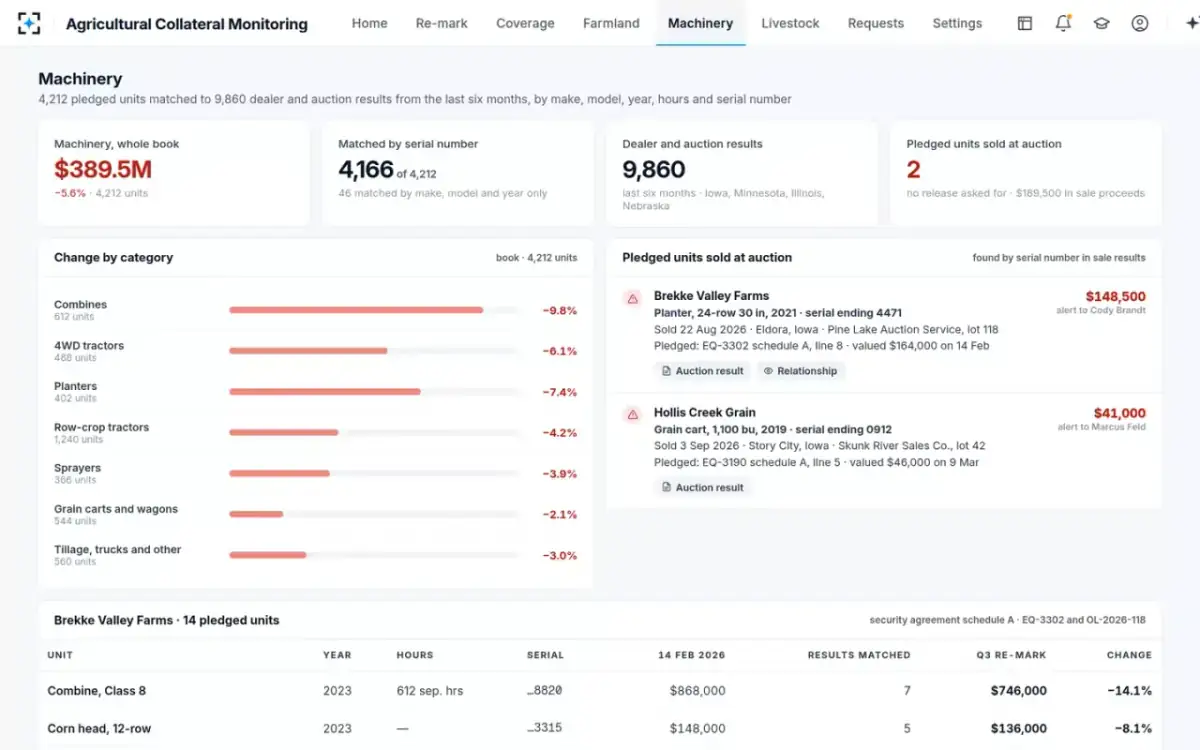
On the sample book, two pledged machines were found in auction results with no release asked for, together representing $189,500 of sale proceeds. The larger was a 24-row planter, serial ending 4471, on line 8 of a borrower's security agreement schedule and carried in the file at $164,000 in February. It sold on 22 August 2026 at an auction house in Eldora, lot 118, for $148,500. The proceeds did not reach the line.
Nothing about that is exotic. A machine is sold because a newer one was bought or because cash was needed; the paperwork is the thing that does not happen. The Comptroller's Handbook names the underlying property of ag collateral that makes this structural rather than occasional.
While the liquid nature of this collateral gives banks and Ag borrowers the flexibility to quickly raise cash when needed, it can also cause rapid shifts in the bank's collateral position and the borrower's balance sheet structure.
OCC, Comptroller's Handbook — Agricultural Lending, version 1.4
Flexibility that works in both directions is the whole problem. The same liquidity that lets a borrower raise cash in a bad week lets a secured position change between two scheduled looks, without anybody intending anything.
A pledged serial number, found in the quarter's auction results
What happens if a farmer sells pledged equipment?
Commercially, three things can happen, and which one you get depends almost entirely on when you find out. The borrower remits the proceeds to the line and the security agreement is amended; the borrower pledges a replacement unit of equivalent value; or the proceeds have already been spent, and the bank is unsecured to the extent of the machine with a conversation to have about how the gap is filled.
Legally, the position is more interesting than most lenders assume, and it differs between farm products and equipment. A buyer in the ordinary course of business can take goods free of a security interest created by the seller, and farm products sit under a separate federal rule with its own notice requirements. The detail is worked through in when a buyer takes pledged farm collateral free of your lien, and it is worth reading before relying on a lien to solve this.
The practical control is detection, not law. A pledged serial number that appears in an auction house's published results is a fact available to anyone who looks, on the day it is published. A bank that matches its pledged schedule against those results every quarter finds the sale inside ninety days. A bank that waits for the renewal finds it when the borrower mentions it, or does not.
The detection has to reach the right person with the right facts. An alert that says "possible disposition" produces a cautious phone call. One that carries the auction house, the lot number, the date, the amount and the schedule line produces a specific question with two acceptable answers, which is what the sample lender's loan officer receives.
Stage three: Chapter 12
Chapter 12 is the family-farmer reorganisation chapter, and a filing is where every assumption in the collateral file is tested at once. What the bank is secured for, on what, at what value, with what perfection, becomes a question with a legal answer rather than a credit one.
Filings are not rare and they are not falling. In the twelve months ending 30 September 2026 there were 361 Chapter 12 filings, against 293 in the year before — a rise of 23%, within a broader bankruptcy picture that the Administrative Office of the U.S. Courts headlined as an 11.4% increase, from 557,376 cases to 621,111 (Administrative Office of the U.S. Courts, October 2026).
Chapter 12 filings, twelve months ending 30 September
Against a book of a thousand-odd farm borrowers, 361 filings nationally is a small annual probability per borrower and a near-certainty that some year you will have one. The cost of a filing is not primarily the legal bill. It is that the position you can prove is fixed on the filing date, and everything you did not know until then is now something you cannot do anything about.
What tightening credit conditions do to the margin for error
Two District surveys describe the same quarter from different angles, and both point at the same thing: lenders are asking for more collateral while the collateral is doing less work.
The Federal Reserve Bank of Chicago's August 2026 AgLetter reports that "repayment rates for non-real-estate farm loans were lower in the second quarter of 2026 compared with a year ago, and renewals and extensions of such loans were higher", with the District's index of loan repayment rates at 73 for the quarter (AgLetter, August 2026). Slower repayment and more renewals mean operating debt sitting on books longer, secured by machinery and livestock whose value is being asked to carry it.
That is the condition in which a stale collateral value does the most damage. When loans turn over quickly, a wrong value is corrected at the next origination. When they are renewed and extended, the same value is relied on for another cycle, and the error compounds instead of clearing.
Pricing one quarter's delay on a $90.7M watch list
A business case for monitoring does not need a loss-rate assumption. It needs the arithmetic of what finding something a quarter earlier is worth, with the lender's own numbers in the gaps.
What earlier detection is worth, as a sum a lender can fill in
Proceeds recovered
sale proceeds found × share recoverable when found inside 90 days
On the sample book, $189,500 of sale proceeds from two pledged machines in one quarter. What share is actually recovered depends on the borrower and the conversation.
Ag loan officer
Exposure re-secured
watch-line exposure found early × the change you can negotiate while there is room
$90.7M sat at or above a watch line in the quarter, 18 loans of it newly. The value is in what a borrower will agree to at 76% that they will not at 88%.
Credit
Appraisal spend avoided
(tracts aged past the trigger − tracts actually ordered) × fee
612 tracts were past the age trigger; 14 were ordered, because only those had also lost cushion. At roughly $3,300 an order, ordering on age alone would have cost multiples of the program.
Rural Appraisal Manager
People’s quarter
days of a quarterly review × fully loaded cost
Botminds estimates a by-hand quarterly review of the sample book at 32 days of work across gathering, re-valuing, recomputing, deciding and reporting; replace it with your own count.
Rural Appraisal Manager
Cost of running it
the program, plus the orders it actually causes
The quarter’s 14 re-appraisal orders cost $46,100 in fees. That is a real cost of knowing, and it belongs on this side of the sum.
Chief Credit Officer
Two of those terms are worth arguing about and two are not. Appraisal spend avoided and the people's quarter are measurable in advance and hard to dispute. Proceeds recovered and exposure re-secured depend on judgement about what a borrower will do, and a careful case states them as a range rather than a point.
What should not be in the sum at all is an assumed reduction in loss rates. Nobody can show that a quarterly re-mark changes a book's losses, and a business case that rests on it will not survive its first review.
How often should farm collateral be re-valued?
Often enough that the value in the file still describes the collateral, which the regulators express as a function of volatility rather than as a fixed interval. Grain in the bin and cattle in the lot are expected to be looked at on a repeating cycle, and more often when prices are moving; ground and machines are expected to be looked at whenever something in the market suggests the figure in the file has fallen well behind.
In practice that turns into two decisions. The cadence — quarterly is a common choice, because it matches the reporting cycle and the crop year without producing noise — and the triggers that fire between cadences. The sample lender runs quarterly on the eighth business day, with re-appraisal triggered by an appraisal older than thirty-six months on a loan at or above its watch line, or a fall in value of ten per cent or more. Why the three classes cannot share one cadence is the subject of why farmland, machinery and cattle do not lose their cushion together.
The interagency guidelines add the portfolio half of the answer, which is the half most monitoring programs skip: "an institution should monitor collateral risk on a portfolio and on an individual credit basis" (Interagency Appraisal and Evaluation Guidelines). A watch list is the individual half. The band-by-band movement of the whole book is the portfolio half, and it is what tells a risk committee whether the watch list is growing.
Are farm bankruptcies rising in 2026?
Yes. Chapter 12 filings in the year ending 30 September 2026 were 361, up from 293 a year earlier — a 23% increase, on a base small enough that single-year movements should be read with care. Total bankruptcy filings across all chapters rose 11.4% over the same period.
The District surveys point the same way without the volatility of a small count. Credit conditions have deteriorated gradually; repayment rates are lower than a year ago; renewals and extensions are higher; and lenders are requiring more collateral than they did. None of those is a crisis indicator. Together they describe a book where collateral is being asked to do more than it was two years ago, which is a reason to know what it is worth.
What a lender actually controls
Not land prices, machinery markets, cattle cycles or a borrower's harvest. What a lender controls is the lag: the time between a cushion thinning and somebody knowing it. Everything in the cascade gets more expensive with that lag and nothing gets cheaper.
That is a narrow claim, and it is the only one a monitoring program should make. It will not reduce the number of borrowers who get into difficulty. It will not improve a recovery once a filing has happened. What it does is move the moment of discovery from the renewal to the quarter, and on the sample book that was the difference between finding eighteen newly-stretched loans in a day and finding them over the following eight months, one renewal at a time.
The watch list, the day the quarter ran
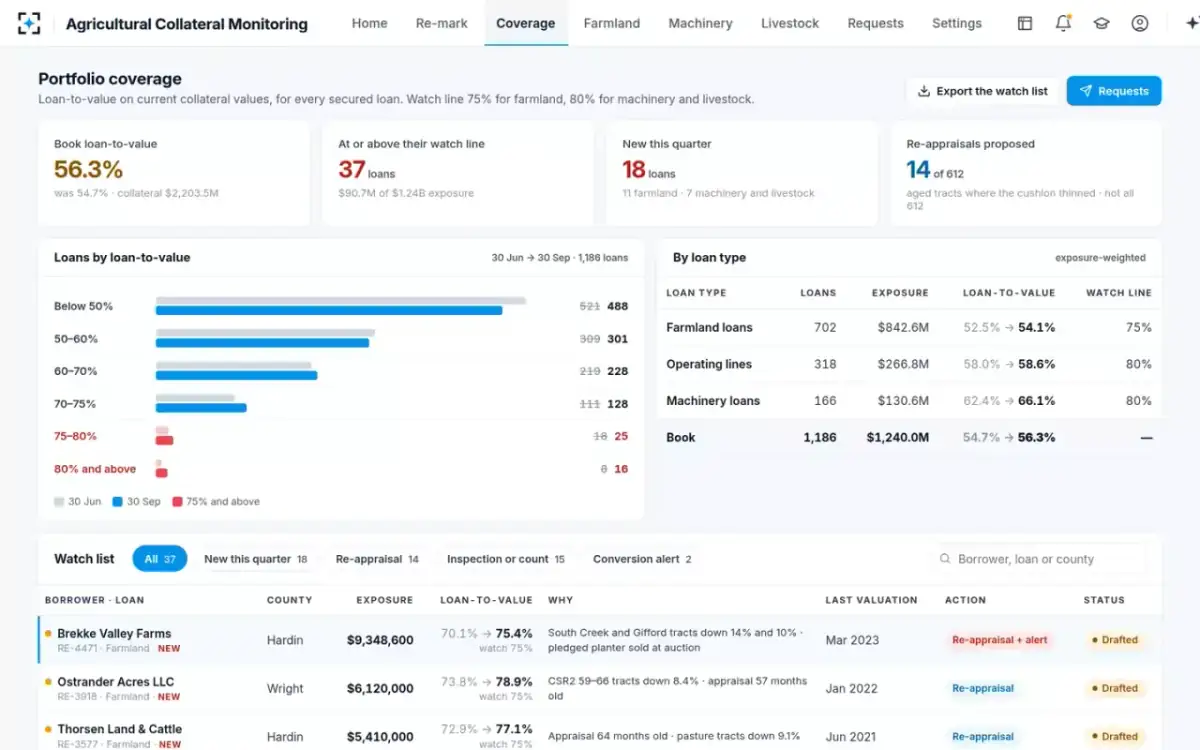
To see a quarter's re-mark, the watch list it produces and the orders and alerts that follow, start from Agricultural Collateral Monitoring.
Questions people ask
What percent of farm loans have repayment problems?
In the Kansas City Fed's Tenth District, on average, less than 10% of farm loan balances had major or severe repayment problems in the second quarter of 2026 and about 15% had minor troubles — roughly a quarter of balances carrying some degree of trouble. The survey described credit conditions as continuing to deteriorate gradually, with financial stress at a modest level. Figures are reported by District rather than nationally, so a lender's own comparison should be with its own Reserve Bank's survey.
What does a late re-appraisal cost a lender?
In cash, almost nothing — the fee is the same whenever it is paid, and on the sample book re-appraisal orders averaged around $3,300. The cost is in what the delay removes. A borrower asked for additional collateral or a paydown while their cushion is still intact has room to agree; the same borrower asked eight months later, after a weak harvest, has fewer options and less reason to use them on one lender.
How do lenders measure ag loan portfolio risk?
On two levels at once, which is what the interagency guidelines ask for: individual credits, through loan-to-value against a watch line with a stated reason and action for each exception; and the portfolio, through the movement of balances between loan-to-value bands quarter on quarter. The second is what tells a risk committee whether the watch list is growing or merely being read more carefully, and it is the half most often missing from a collateral report.
What happens when farm loan collateral loses value and nobody notices?
The loan keeps performing until something forces a look — a renewal, a missed payment, a filing — and by then the options that existed when the cushion first thinned have closed. The characteristic sequence is a watch-line crossing nobody saw, followed by a disposition nobody was told about, followed by a workout in which the bank's position is whatever the file can prove. Each stage costs substantially more than the one before, and the only variable the lender controls is the lag.
Are farm bankruptcies rising in 2026?
Chapter 12 filings rose to 361 in the year ending 30 September 2026 from 293 the year before, an increase of about 23%, within a total bankruptcy count up 11.4% to 621,111 cases. The base is small enough that one year's movement should not be over-read, but the direction matches the District credit surveys, which report lower repayment rates, more renewals and extensions, and lenders requiring more collateral than a year ago.
How often should farm collateral be re-valued?
Frequently enough that the file still describes the collateral, with the cycle tightening when prices move. Supervisory guidance sets a repeating cycle for stored crops and livestock, and an event-driven look at ground, machinery and equipment whenever the market suggests the assigned figure has fallen well behind. A quarterly cadence with written triggers between quarters — appraisal age combined with a watch-line breach, or a fall in value past a set percentage — is one practical way to turn that into something that actually happens.